

In competitive exams like SSC, Banking, and Railways, Algebraic Identities play a crucial role in the Quantitative Aptitude section. These identities are powerful tools that help in simplifying complex algebraic expressions quickly, avoiding lengthy calculations. Whether it’s a simplification-based question or one hidden inside a tricky expression, knowing these identities gives you a significant speed advantage.
In this blog, we will provide all the details about the Algebraic Identities for exams in 2026 including definitions, short notes, formulas, tricks, solved questions, common mistakes, and more.
Attempt Live Quiz on Algebraic Identities Questions
Attempt them live and check your score according to the real exam marking scheme.
What are Algebraic Identities in Quantitative Aptitude?
Algebraic Identities are equations that hold true for all values of variables involved. These identities simplify complex algebraic expressions and help solve problems without full expansion or lengthy calculation.
This topic frequently appears in competitive exams because it tests the candidate’s ability to apply basic algebraic principles to solve expressions quickly and accurately.
Skills Required:
- Formula memorization
- Speed-based mental calculations
- Pattern recognition
- Simplification logic
Why is Algebraic Identities Important in Competitive Exams?
Algebraic identities form the foundation of many Quantitative Aptitude questions, especially in topics like simplification, factorization, quadratic equations, and number systems.
| Exam | No. of Questions | Difficulty |
| SSC CGL / SSC CHSL | 1-2 | Easy |
| IBPS PO / SBI PO | 1-2 | Moderate |
| RRB NTPC / RRB Group D | 1 | Easy |
| State PSC / Police | 1–2 | Moderate |
Algebraic Identities Quantitative Aptitude Short Notes
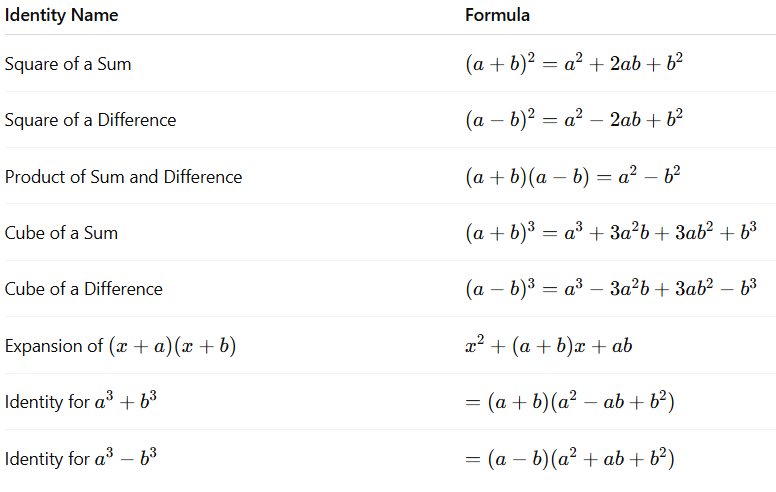
Some of the commonly used identities while solving algebra problems are as follows:
Concepts used in Algebraic Identities Questions
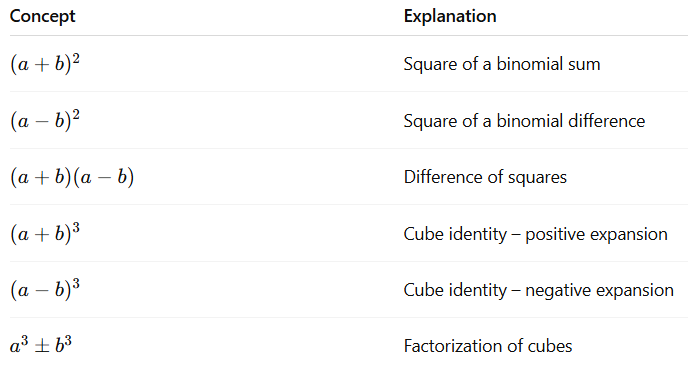
Some of the commonly used concepts in algebraic identities are as follows:
What are the Types of Algebraic Identities Questions in Quantitative Aptitude?
Different question types based on algebraic identities include:
- Direct: Simplify using direct application of identity
- Puzzle-based: Hidden values or variables needing indirect use of identity
- Coded: Identities applied in numerical coding problems
- Mixed-concept: Combined with surds, equations, or simplifications
Algebraic Identities Formulas for Quantitative Aptitude
Memorizing and practicing these formulas can help you save time:
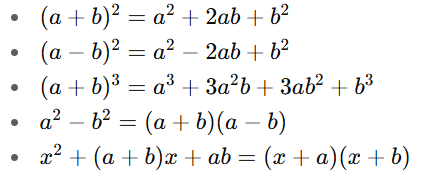
Use pattern-matching to directly apply them instead of full expansion.
Algebraic Identities Tricks for SSC CGL and Other Exams
Some of the quick strategies to solve identity-based problems faster:
- Identify the structure: Match question with standard form
- Avoid expansion: Use identities, don’t manually multiply
- Use substitution: Assign values like a=2, b=1if options are value-based
- Compare options: Eliminate wrong expressions via reverse checking
- Recognize cube and square forms immediately in expressions
- Break large expressions into smaller identity chunks
FAQs
Identities always hold true, while expressions need evaluation and may not be equal.
They simplify complex expressions and save time during problem-solving.
Simplification, factorization, and expression comparison are common types.
You should remember the most common ones the rest can be derived with practice.
Trying to expand or solve without recognizing that an identity can simplify it.
- SBI Clerk Prelims Exam Analysis 2026, 26th September, All Shifts
- SSC CGL Last Minute Tips 2026, Tier 1 Final Revision Strategy
- How Many Hours to study for SSC CGL? Check Full Details
- SSC CHSL Study Plan for Tier 1 Exam, Crack Exam in 60 Days
- SSC CHSL Study Plan for 45 Days 2026, Check For Tier 1
- RRB NTPC Answer Key 2026, Check Graduate & Undergraduate Answer Key

Hi, I’m Aditi. I work as a Content Writer at Oliveboard, where I have been simplifying exam-related content for the past 4 years. I create clear and easy-to-understand guides for JAIIB, CAIIB, and UGC exams. My work includes breaking down notifications, admit cards, and exam updates, as well as preparing study plans and subject-wise strategies.
My goal is to support working professionals in managing their exam preparation alongside a full-time job and to help them achieve career growth.