
The IIBF CAIIB exam is one of the most important career growth exam for banking professionals who want to enhance their knowledge and skills in banking operations. One of the key papers in CAIIB is BFM (Bank Financial Management). With limited time before the exam, it is essential to focus on the most important topics and units to maximize marks and secure success.
In this blog, we have provided details about the important topics of CAIIB BFM, along with the module-wise important topics for the BFM paper.
What are the CAIIB BFM module-wise important topics?
The CAIIB BFM (Bank Financial Management) paper is one of the most crucial papers for banking professionals. To score well, it is important to focus on high-weightage topics across all modules (A, B, C, and D). The details of the important topics are as follows:
What are the important topics in CAIIB BFM module A?
Module A covers foreign exchange, trade finance, and export-import procedures. It has high weightage and includes both concepts and practical rules related to forex transactions, remittances, and regulatory guidelines.
| Topic | Key Points |
| Exchange Rate & Forex Business | Spot rate, cash rate, forward rate; Participants in forex market; RBI and Federal Reserve guidelines; Arithmetic and regulatory aspects of forex transactions |
| Liberalised Remittance Scheme (LRS) | Limits on money transfer abroad; Guidelines for outward and inward remittances |
| Capital Account Transactions | Rules and schedules (Schedule I, II, III); Banking services for forex – with or without accounts |
| Letter of Credit (LC) | Types, definitions, and involved parties; Framework and regulatory guidelines |
| Uniform Customs & Practices (UCP) | Current trends, key articles, and practical applications |
| Export Data Processing & Monetary System | Guidelines for exporters and importers; Trade credit definitions and operational guidelines |
Also Check: CAIIB Exam Date 2026
What are the important topics in CAIIB BFM module B?
Module B focuses on risk management, Basel norms, and treasury operations. It helps in understanding how banks manage risks, maintain capital, and handle treasury activities in real banking scenarios.
| Topic | Key Points |
| Risk Management | Types of risks: credit, operational, market; Risk management frameworks and Basel norms; Measurement & management of credit risk via loan review; Liquidity risk management & overseas guidelines |
| Basel III Norms | LCR (Liquidity Coverage Ratio) and NSFR (Net Stable Funding Ratio); Pillars I, II, III – capital guidelines and framework |
| Treasury Management & Products | Money market and forex market operations; International equity and debt products, GDR rules; Treasury risk management (VaR, derivatives); ALM concepts and guidelines |
What are the important topics in CAIIB BFM module C and D?
Modules C and D cover balance sheet management, ALM, and banking risks. These topics focus on fund management, NPA concepts, and practical case studies based on risk and financial decisions.
| Topic | Key Points |
| Balance Sheet Management & ALM | Source of funds vs. application of funds; NPA classification, insolvency, IBC code basics; Interest rate risk management techniques; Case studies on operational & financial risk management |
| Treasury & Risk in Banking | Repeat concepts of derivatives, VaR, and liquidity management; Practical application in case studies |
Also Check: CAIIB Syllabus
What is the module wise weightage of the CAIIB BFM paper?
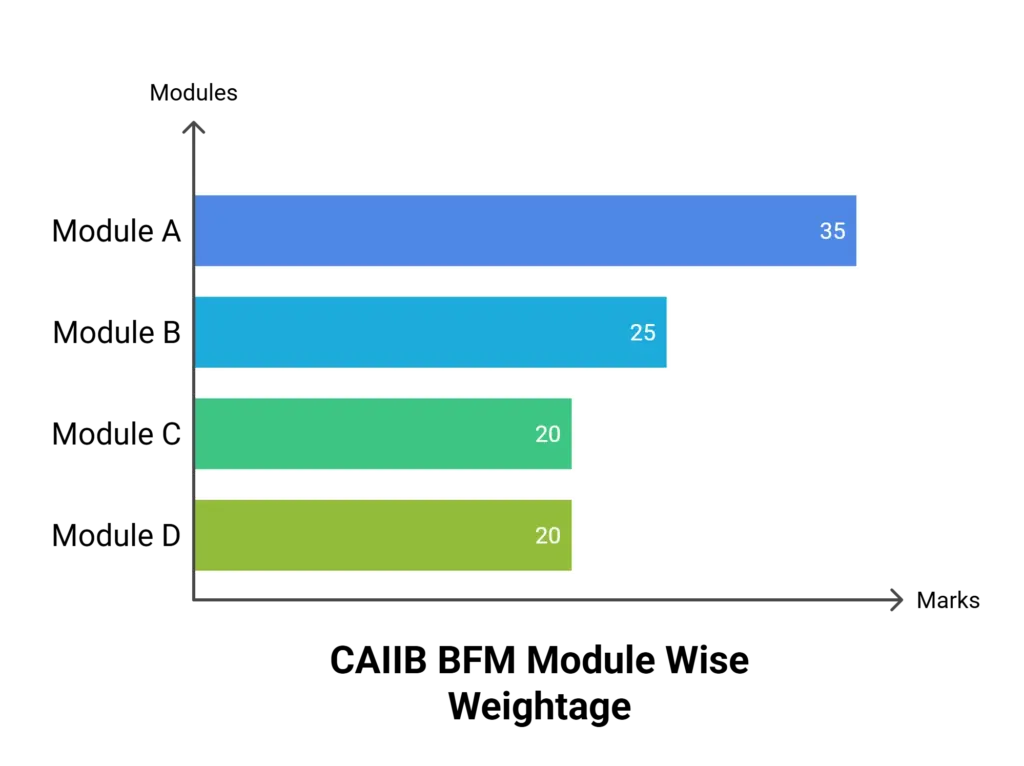
In CAIIB BFM exam, Module A and Module B are the most important, together carrying around 60 marks. These modules mainly cover areas like forex, risk management, and treasury operations.
Module C and Module D together carry about 40 marks and focus on balance sheet management and different types of banking risks. As per previous year trends, questions are asked in both theory and numerical form across all modules. So, it is important to prepare concepts and calculations together for better understanding and better scores.
Download CAIIB Numerical Practice Quiz PDF:
| Particulars | Link |
| CAIIB ABM Numericals Practice Quiz | Download Free PDF |
| CAIIB ABFM Numerical Practice Quiz | Download Free PDF |
| CAIIB BFM Numerical Practice Quiz | Download Free PDF |
CAIIB BFM Paper Exam Structure
The CAIIB 2026 exam comprise of a total of 5 papers. Out of these, four papers are compulsory ABM, BFM, ABFM, and BRBL and one paper is an elective, which candidates can choose based on their job role or interest.
The exam is conducted online by the Indian Institute of Banking & Finance. It includes multiple-choice questions (MCQs), case studies, and numerical questions to test both theoretical knowledge and practical understanding of banking concepts.
| Feature | Details |
| Total Questions | 100 objective-type multiple-choice questions |
| Total Marks | 100 marks |
| Case-Based Questions | Includes case studies and case lets |
| Numerical Input Questions | Some subjects include numerical questions requiring direct input (no options provided) |
| Exam Mode | Online (Computer-Based Test only) |
| Negative Marking | No negative marking for wrong answers |
| Exam Language | Can be attempted either in Hindi or in English |
Preparation Strategy for CAIIB BFM
The CAIIB BFM (Bank Financial Management) paper is a critical exam for banking professionals looking to advance their career. Efficient preparation requires prioritizing high-weightage modules, practicing real-world scenarios, and revising key concepts consistently.
- Prioritize Modules A & B – These modules cover approximately 60% of the marks and include foreign exchange, letters of credit, risk management, Basel norms, and treasury operations. Focus on these first.
- Practice Case Studies and Numericals – Theory alone is not sufficient. Regular practice ensures accuracy and helps in applying concepts to practical scenarios.
- Use Updated Class Notes – Stick to concise, reliable notes rather than referring to multiple books. This saves time and ensures focused preparation.
- Daily Revision of Key Topics – Focus on high-priority topics such as:
- Forex & Exchange Rates
- Liberalised Remittance Scheme (LRS) & Capital Account Transactions
- Letters of Credit & UCP Guidelines
- Treasury Products & Asset-Liability Management (ALM)
- Risk Management Frameworks & Basel Norms
- Attempt Mock Tests Regularly – Mock tests improve speed, accuracy, and time management, and highlight areas needing further revision.
- Understand Practical Application – Ensure comprehension of rules, guidelines, and frameworks in real banking operations. This is essential for solving case studies effectively.
Attempt CAIIB most repetitive practice quiz
Most repetitive MCQs are taken from topics that are often asked in recent CAIIB exams. Practicing these questions helps you focus on important and high-scoring areas. It also improves your understanding and increases your chances of clearing the CAIIB exam quickly.
| Topic | Link |
| 50 Most Repetitive CAIIB ABM MCQs | Attempt Now |
| 50 Most Repetitive CAIIB BFM MCQs | Attempt Now |
| 50 Most Repetitive CAIIB ABFM MCQs | Attempt Now |
| 50 Most Repetitive CAIIB BRBL MCQs | Attempt Now |
FAQs
Module A and Module B carry the highest weightage, contributing around 60% of marks.
Focus on these after completing Modules A and B, as they contribute around 40% of marks.
Yes, case studies are essential and appear across all modules.
Forex & exchange rates, LRS, capital account transactions, LC & UCP, treasury products, ALM, and risk management frameworks.
Understanding practical application helps solve case studies and apply theoretical concepts effectively.
- CAIIB ABFM Last 7 Days Study Plan, Check Tips for Preparation
- CAIIB Study Plan for the Next 30 Days, Check Details
- CAIIB Study Material, Best Study Resources for CAIIB
- How Mayank Gautam Cracked All CAIIB Papers in His 1st Attempt
- CAIIB ABM Last 7 Days Study Plan, Paper 1 Preparation Strategy
- CAIIB ABM 2026 Practice Quiz, Download Free PDF

Hi, I’m Aditi. I work as a Content Writer at Oliveboard, where I have been simplifying exam-related content for the past 4 years. I create clear and easy-to-understand guides for JAIIB, CAIIB, and UGC exams. My work includes breaking down notifications, admit cards, and exam updates, as well as preparing study plans and subject-wise strategies.
My goal is to support working professionals in managing their exam preparation alongside a full-time job and to help them achieve career growth.