
The Union Budget 2026–27, presented on 1 February 2026, highlighted the growing importance of the Orange Economy in India’s development strategy. The Finance Minister recognized creativity-driven sectors as key contributors to employment, innovation, exports, and India’s global soft power, with special focus on the animation, visual effects, gaming, and comics sector.
What is the Orange Economy?
The Orange Economy refers to economic activities driven by creativity, culture, and intellectual property, where value is created mainly from ideas, artistic expression, and knowledge rather than physical goods. The term was popularized by Iván Duque Márquez and Felipe Buitrago in their 2013 book The Orange Economy: An Infinite Opportunity.
- knowledge-based and creativity-driven activities
- value derived from ideas and intellectual property
- focuses on cultural and artistic output
- differs from manufacturing-led growth models
Which sectors are part of the Orange Economy?
The Orange Economy covers a wide range of creative and cultural industries that have expanded rapidly due to digital platforms and rising content consumption.
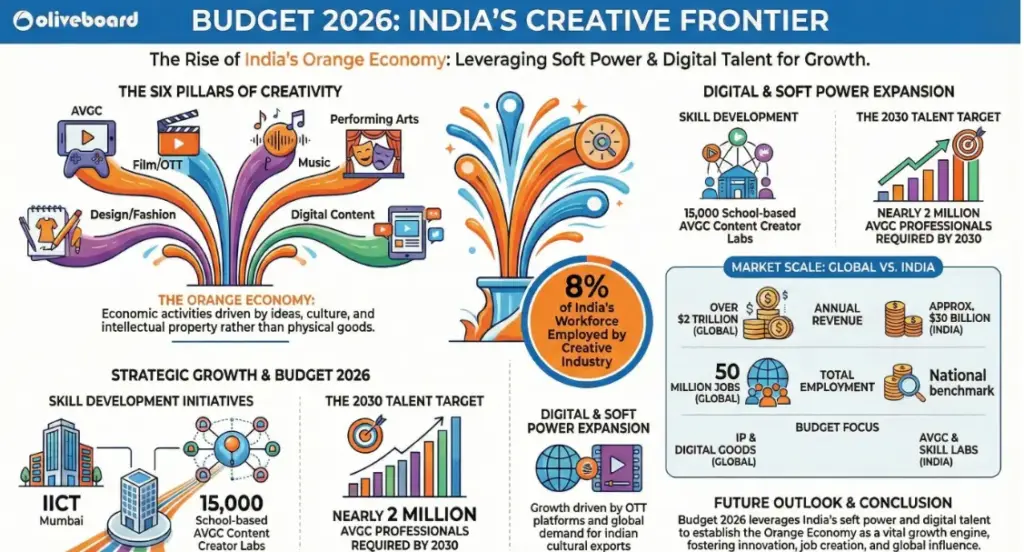
- animation, visual effects, gaming and comics
- films, television and OTT platforms
- music, live entertainment and concerts
- theatre and performing arts
- design, advertising and fashion
- digital content creation and new media
Why did Budget 2026 focus on the Orange Economy?
The emphasis on the Orange Economy reflects the government’s view that creative industries can generate large-scale employment, especially for youth, while supporting innovation and exports. Digitalization and global demand for content have made these sectors economically significant.
- high employment potential
- strong export opportunities
- growth driven by digital platforms
- rising global demand for creative content
What were the key announcements in Budget 2026?
The main Budget announcement related to the Orange Economy focused on strengthening creative education and skill development through institutional support.
- support to Indian Institute of Creative Technologies, Mumbai
- AVGC Content Creator Labs in 15,000 secondary schools
- AVGC labs in 500 colleges across the country
Why is the AVGC sector important for India?
The AVGC sector combines creativity with technology and is one of the fastest-growing segments of the Orange Economy. The government estimates that the sector will require nearly two million professionals by 2030.
- strong employment generation
- export-oriented services
- global demand for Indian creative talent
- links creativity with digital skills
Present state of the Orange Economy
Globally and in India, the Orange Economy has emerged as an important contributor to growth and jobs. India’s media and entertainment sector has expanded rapidly in recent years.
- global creative Economy generates over $2 trillion annually
- nearly 50 million jobs worldwide
- India’s creative industry size around $30 billion
- employs about 8 percent of India’s workforce
What does the Economic Survey say?
The Economic Survey 2025–26 noted that India’s media and entertainment sector has become a major pillar of the services Economy, driven by digital and platform-based delivery models.
- growth in audio-visual and digital content
- expansion of animation and gaming
- shift towards OTT and online platforms
- changing employment and revenue models
How does the Orange Economy support soft power?
The Orange Economy strengthens India’s global cultural presence through films, music, digital content and games that reach international audiences.
- enhances India’s cultural influence
- supports creative exports
- builds global recognition of Indian content
What challenges does the Orange Economy face?
Despite rapid growth, the Orange Economy faces structural and policy challenges that need to be addressed for long-term sustainability.
- limited formal skill development
- uneven access to infrastructure
- intellectual property protection issues
- funding constraints for creators
Why is the Orange Economy important for India’s future?
The Orange Economy offers a low-carbon, inclusive and innovation-driven growth path aligned with youth aspirations and digital transformation.
- supports job creation
- promotes innovation and entrepreneurship
- strengthens services-led growth
- enhances global competitiveness
Frequently asked questions
Q1: What is the Orange Economy?
A1: The Orange Economy refers to creativity-driven economic activities based on culture, ideas, and intellectual property.
Q2: Why was the Orange Economy highlighted in Budget 2026?
A2: Because it supports employment, innovation, exports, and India’s soft power.
Q3: Which sector received major support under the Orange Economy?
A3: The Animation, Visual Effects, Gaming, and Comics Sector.
Q4: What did the budget announce for the AVGC sector?
A4: Setting up AVGC Content Creator Labs in 15,000 schools and 500 colleges.
Q5: How large is India’s creative economy?
A5: It is valued at around $30 billion and employs about 8 percent of the workforce.
Q6: How does the Orange Economy help India globally?
A6: It strengthens cultural influence, exports, and global recognition of Indian content.
- IBPS RRB Vacancy 2026: 13,757 Post-Wise & State-Wise Data
- IBPS SO Marketing Officer Consumer Behaviour 2026, FREE Quiz & PDF
- IBPS SO Marketing Officer Product Life Cycle 2026, FREE PDF & Quiz
- IBPS SO Marketing Officer Sales Management 2026, FREE PDF & Quiz
- IBPS SO Marketing Officer Advertising Quiz 2026, FREE PDF & Quiz
- How T Agilan Cracks SBI CBO in His 1st Attempt with 2 Hours of Daily Study

Hi, I’m Tripti, a senior content writer at Oliveboard, where I manage blog content along with community engagement across platforms like Telegram and WhatsApp. With 3+ years of experience in content and SEO optimization related to banking exams, I have led content for popular exams like SSC, banking, railway, and state exams.