

In Quantitative Aptitude, the Rhombus is a special type of parallelogram that appears frequently in SSC, Banking, and Railway exams. It tests a candidate’s understanding of geometry properties, diagonal-based formulas, and mensuration skills. In this blog, we have provided all the details including, formulas, types, tricks, solved examples, and more.
Rhombus Questions PDF Download Link
Download Quadrilateral Questions PDF highly useful for SSC CGL Exam by clicking on the link below:
Attempt Rhombus Live Quiz
Below are some important rhombus questions for SSC CGL and other competitive exams for your practice. Attempt them live and check your score according to the real exam marking scheme.
Q1. The area of rhombus ABCD is 120 cm². The diagonals intersect at O. The area of △AOB is:
Answer: (c) 30 cm²
Q2. A rhombus has side a. Its area can be expressed as a²sin θ. For a fixed side length, area is maximum when θ equals:
Answer: (d) 90°
Q3. A rhombus has diagonals d1 and d2. If both diagonals are increased by 50%, the new area compared to original is:
Answer: (c) 225%
Q4. A rhombus has the same area as a square of side 12 cm. If the diagonals of the rhombus are equal (making it a square), the side of the rhombus is:
Answer: (b) 12 cm
Q5. The diagonals of a rhombus are 2a and 2b. A circle is inscribed in the rhombus. The radius of the inscribed circle is:
Answer: (a) ab/√(a²+b²)
Q6. In rhombus ABCD, the diagonals AC = 30 cm and BD = 40 cm. A point P is the intersection of diagonals. A circle centred at P passes through A. The area of the circle that lies inside the rhombus is:
Answer: (c) 625π/2 cm²
Q7. The vertices of a rhombus are A(3, 0), B(0, 4), C(−3, 0), D(0, −4). Its area is:
Answer: (b) 24 sq. units
Q8. The diagonals of a rhombus lie along the lines y = x and y = −x. If one vertex is at (5, 5), a side of the rhombus has length:
Answer: (c) 10
Q9. A rhombus has centre at the origin. One vertex is at (4, 0) and another at (0, 3). The area of the rhombus is:
Answer: (b) 24 sq. units
Q10. The vertices of a rhombus ABCD in order are A(1, 2), B(3, 5), C(5, 2), D(3, −1). The length of the side is:
Answer: (a) √13
Q11. One diagonal of a rhombus lies along y = 2x. The other diagonal is perpendicular to it. The equation of the other diagonal could be:
Answer: (d) x + 2y = 5
Q12. A rhombus has vertices at (0,0), (a,0), (a+b,c), (b,c). For it to be a rhombus, the condition is:
Answer: (d) b² + c² = a²
Q13. The diagonals of a rhombus have equations 3x − 4y + 5 = 0 and 4x + 3y − 7 = 0. The diagonals are:
Answer: (b) Perpendicular
Q14. A rhombus has vertices A(2, 1), C(10, 5) as endpoints of one diagonal. The other diagonal has midpoint at (6, 3). If B = (6, k) lies on the other diagonal, the area of the rhombus when k = 7 is:
Answer: (d) 32 sq. units
Q15. In coordinate plane, a rhombus has one diagonal along the x-axis from (−5, 0) to (5, 0) and another along y-axis from (0, −7) to (0, 7). The equations of the sides of the rhombus are:
Answer: (a) 7x ± 5y = ±35
Q16. A rhombus ABCD has A at (1, 1), C at (7, 5). The midpoint of AC is M. If BD passes through M perpendicular to AC, and BD has half-length 4, the area is:
Answer: (b) 40 sq. units
Q17. A rhombus is formed by joining the points (3, 0), (0, 4), (−3, 0), (0, −4). The equation of the longer diagonal is:
Answer: (a) x = 0
Q18. Rhombus PQRS has P(0,0), Q(6,0). The other two vertices R and S are such that all sides are equal. If the rhombus has angle 60° at P, the coordinates of S are:
Answer: (a) (3, 3√3)
Q19. In a rhombus ABCD, A = (0,0), B = (a,0), and the diagonals intersect at M = (a/2, a/2). Then the angle of the rhombus at A is:
Answer: (d) 90°
Q20. The vertices of a rhombus lie on the circle x² + y² = 25. One diagonal is along the x-axis. The maximum area of such a rhombus is:
Answer: (b) 50 sq. units
Quiz Summary

Sign Up
Or, register with email
 Email Id
 Mobile Number
 Password

Login
Email Id
Password
Forgot Password
Please enter the Email ID we will send you a Email with the link to reset the password.
Email Id
Or, login with

What is Rhombus in Quantitative Aptitude?
A Rhombus is a quadrilateral in which all four sides are equal and opposite sides are parallel. Its diagonals bisect each other at right angles and also bisect the interior angles.
Why it appears in exams:
- Combines properties of square and parallelogram.
- Allows testing of both side-based and diagonal-based area formulas.
Skills required:
- Shape visualization
- Application of diagonal properties
- Formula recall for area & perimeter
Why is Rhombus Important in Competitive Exams?
Rhombus questions are straightforward once you memorize the formulas, making them a scoring area in exams.
| Exam | No. of Questions | Difficulty |
| SSC CGL / CHSL | 1–2 | Easy |
| IBPS PO / SBI PO | 1–2 | Moderate |
| RRB NTPC / Group D | 1 | Easy |
| State PSC / Police | 1–2 | Moderate |
Rhombus Quantitative Aptitude Short Notes
Short notes based on the topic of rhombus are as follows:
| Term | Details |
| Sides | All sides equal |
| Opposite sides | Parallel |
| Opposite angles | Equal |
| Adjacent angles | Supplementary |
| Diagonals | Bisect each other at 90° |
| Area | ½ × d₁ × d₂ |
| Perimeter | 4 × side |
What are the Types of Rhombus Questions in Quantitative Aptitude?
Types of questions asked from the topic of rhombus are as follows:
- Direct formula-based: Find area from diagonals.
- Side-based problems: Find perimeter using given side length.
- Diagonal-length problems: Using Pythagoras theorem in halves of diagonals.
- Mixed problems: Combined with trigonometry or coordinate geometry.
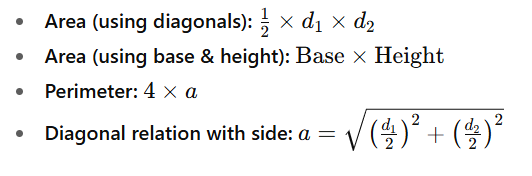
Rhombus Formulas for Quantitative Aptitude
Important formulas to solve questions based on rhombus are as follows:
Rhombus Tricks for SSC CGL and Other Exams
Tricks to solve questions based on rhombus are as follows:
- Always check if diagonals are given it’s the quickest way to find area.
- Remember: A square is a rhombus with 90° angles.
- Use Pythagoras theorem on half-diagonals to find side length.
- If perimeter is given, side length = perimeter ÷ 4.
- For coordinate geometry, use distance formula for diagonals, then apply area formula.
Common Mistakes to Avoid while Solving Rhombus Questions
Common mistakes to avoid while solving questions based on the topic rhombus are as follows:
- Assuming diagonals are equal.
- Forgetting to halve diagonals before using Pythagoras.
- Confusing rhombus with square in angle-related problems.
- Using slant length instead of height in area calculations.
- Ignoring that perimeter requires side length, not diagonal length.
FAQs
A quadrilateral with all sides equal and opposite sides parallel.
No, but they are perpendicular.
Yes, with all angles 90°.
They bisect each other at right angles.
Yes, in Geometry & Mensuration sections.
- PNB LBO Interview 2026 Types of Questions Asked, Check Details
- SSC CHSL Exam Slot Selection 2026, Check Slot Booking Link & Process
- SSC CPO Vacancy 2026, Check 1,871 Post-Wise and Force-Wise Vacancies
- Mixed Reasoning for IBPS RRB Clerk, FREE PDF & Live Quiz
- Mixed Reasoning for IBPS RRB PO, FREE PDF & Live Quiz
- IBPS RRB PO Question Papers, Shift-Wise PYPs, Download PDFs

Hi, I’m Aditi. I work as a Content Writer at Oliveboard, where I have been simplifying exam-related content for the past 4 years. I create clear and easy-to-understand guides for JAIIB, CAIIB, and UGC exams. My work includes breaking down notifications, admit cards, and exam updates, as well as preparing study plans and subject-wise strategies.
My goal is to support working professionals in managing their exam preparation alongside a full-time job and to help them achieve career growth.