

A verb is a vital part of English grammar that expresses an action, occurrence, or state of being. It is the word that tells us what the subject of a sentence is doing or what is happening to it. Verbs help form sentences that clearly communicate time, mood, and meaning, making them essential for effective language use.
In this blog, we have provided all the details about verbs, covering their definitions, types, and significance in competitive exams like SSC, IBPS, SBI PO, and RRB along with practical tricks, and recent solved examples.
Attempt Live Quiz on Verbs
Attempt them live and check your score according to the real exam marking scheme.
What is a Verb in English?
A verb is a word that expresses an action, occurrence, or state of being. It tells us what the subject is doing or what is happening to the subject.
Why do verbs appear in exams?
Verbs form the backbone of sentence structure, making them crucial for understanding grammar, tense, subject-verb agreement, and sentence correction. Competitive exams test verb usage to assess a candidate’s command over English grammar and their ability to interpret and construct meaningful sentences.
Skills required to solve verb questions:
- Logical understanding of sentence structure
- Knowledge of verb forms and tenses
- Ability to visualize the correct action or state in context
- Decoding meaning from sentence cues
Why is Verb Important in Competitive Exams?
Verbs are a core part of English grammar and are tested regularly in various exams. Their importance lies in how they affect sentence meaning and grammar correctness.
| Exam | No. of Questions | Difficulty |
| SSC CGL / SSC CHSL | 1–2 | Easy |
| IBPS PO / SBI PO | 1–2 | Moderate |
| RRB NTPC / RRB Group D | 1 | Easy |
| State PSC / Police | 1–2 | Moderate |
Characteristics of a Verb
A verb is one of the most important parts of speech because it gives meaning to a sentence by showing action, condition, or occurrence. Without verbs, sentences remain incomplete. Main characteristics of verbs are:
- Verbs show action or state.
- Verbs change form according to tense.
- Verbs agree with the subject.
- Verbs help express time and mood.
- Verbs can be main verbs or helping verbs.
Examples:
- She writes daily.
- They are playing football.
- The baby slept peacefully.
Forms of Verbs
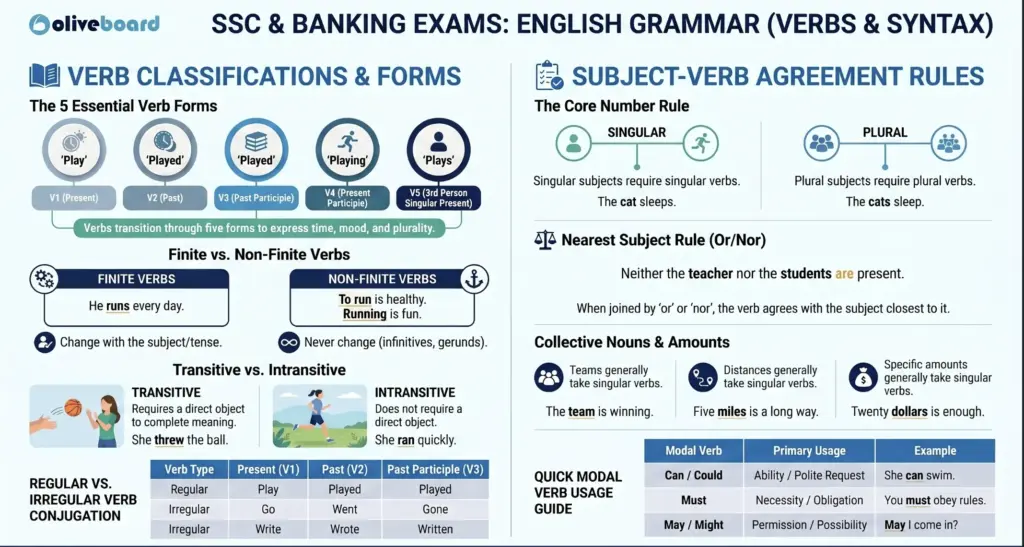
Every verb generally has five forms that are widely used in grammar questions and competitive exams.
| Verb Form | Example |
| Base Form (V1) | go |
| Past Form (V2) | went |
| Past Participle (V3) | gone |
| Present Participle (V4) | going |
| Singular Present (V5) | goes |
Example:
- I go to school.
- He went home.
- She has gone already.
- They are going now.
- Rahul goes daily.
Main Verb and Helping Verb
Verbs are mainly divided into two categories: main verbs and helping verbs. A main verb shows the primary action performed by the subject, while a helping verb supports the main verb in forming tenses, voice, mood, or questions. Understanding the difference between these two is important for solving grammar questions related to tense, sentence correction, and subject-verb agreement in competitive exams.
| Type | Definition | Examples |
| Main Verb | A main verb expresses the main action in a sentence. | She writes a letter. They play cricket. |
| Helping Verb (Auxiliary Verb) | Helping verbs assist the main verb in forming tense, voice, or mood. | He is playing. They have completed the work. She will come tomorrow. |
Finite and Non-Finite Verbs
Verbs can also be classified as finite and non-finite verbs. A finite verb changes according to the tense and subject of the sentence, whereas a non-finite verb does not change according to tense or subject. Questions based on finite and non-finite verbs are frequently asked in SSC, Banking, and other competitive exams.
| Type | Definition | Examples |
| Finite Verb | A finite verb changes according to tense and subject. | She plays daily. They played yesterday. |
| Non-Finite Verb | A non-finite verb does not change according to subject or tense. | I like to read. Swimming is good exercise. The crying baby slept. |
Types of Non-Finite Verbs
Non-finite verbs are mainly divided into three categories: infinitives, gerunds, and participles.
| Type | Example |
| Infinitive | to eat |
| Gerund | eating |
| Participle | eaten, eating |
Transitive and Intransitive Verbs
Transitive and intransitive verbs are classified based on whether they require an object or not. A transitive verb always needs an object to complete its meaning, while an intransitive verb can express complete meaning without any object.
| Type | Definition | Examples |
| Transitive Verb | A transitive verb requires an object. | She bought a book. He kicked the ball. |
| Intransitive Verb | An intransitive verb does not require an object. | The baby cried. They slept peacefully. |
Regular and Irregular Verbs
Verbs are also categorized into regular and irregular verbs based on how their past forms are formed. Regular verbs follow a fixed pattern by adding “-ed” to form the past tense, whereas irregular verbs change differently and must be memorized separately.
Regular Verbs
Regular verbs form their past tense by adding “-ed” or “-d” to the base form.
| Present Form | Past Form |
| walk | walked |
| play | played |
| clean | cleaned |
Irregular Verbs
Irregular verbs do not follow a fixed rule while forming the past tense and past participle forms.
| Present Form | Past Form |
| go | went |
| eat | ate |
| write | wrote |
Important Tip
Irregular verbs are frequently asked in SSC, Banking, RRB, CDS, and other competitive exams. Candidates should regularly revise important irregular verb forms for better accuracy.
Modal Verbs
Modal verbs are helping verbs that express ability, possibility, permission, necessity, advice, or obligation. They are widely used in spoken and written English and are commonly asked in grammar-based questions.
| Modal Verb | Usage |
| can | Ability |
| could | Past ability / polite request |
| may | Permission / possibility |
| might | Weak possibility |
| must | Necessity / obligation |
| shall | Suggestion / future |
| should | Advice |
| will | Future action |
| would | Polite request / habit |
Examples of Modal Verbs
| Sentence | Modal Used |
| She can swim. | can |
| You must obey rules. | must |
| May I come in? | may |
Subject-Verb Agreement
Subject-Verb Agreement is one of the most important grammar topics in competitive exams. It means that the verb must agree with the subject in number and person. A singular subject takes a singular verb, while a plural subject takes a plural verb. Questions from subject-verb agreement are commonly asked in error detection, sentence improvement, and fill-in-the-blank exercises.
| Rule | Example |
| Singular subject takes singular verb | He writes well. |
| Plural subject takes plural verb | They write well. |
Basic Subject-Verb Agreement Structure
| Subject Type | Verb Type | Example |
| Singular Subject | Singular Verb | She plays daily. |
| Plural Subject | Plural Verb | The boys play football. |
Important Subject-Verb Agreement Rules
| Rule | Example |
| Subjects joined by “and” take plural verb | Ram and Shyam are friends. |
| Subjects joined by “or/nor” follow nearest subject | Neither the teacher nor the students are present. |
| Each/every/everyone take singular verb | Every student is ready. |
| Collective nouns generally take singular verb | The team is winning. |
| Amounts and distances take singular verb | Ten kilometers is a long distance. |
Types of Verbs
The details about the types of verbs are as follows:
| Type | Details |
| Action Verb | Shows physical or mental action (run, think) |
| Linking Verb | Connects subject to a state/condition (is, seem) |
| Auxiliary Verb | Helps the main verb (am, have, will) |
| Transitive Verb | Requires an object (eat an apple) |
| Intransitive Verb | No object needed (sleep, arrive) |
| Regular Verb | Forms past by adding -ed (walk → walked) |
| Irregular Verb | Past forms vary (go → went) |
| Finite Verb | Shows tense, agrees with subject |
| Non-finite Verb | Infinitives, participles, gerunds (to run, running) |
Concepts to Solve Questions Based on Verbs
Concepts that are useful to solve questions are as follows:
| Concept | Explanation |
| Verb | Word showing action, state, or occurrence |
| Tense | Time of action (past, present, future) |
| Subject-Verb Agreement | Verb matches subject in number and person |
| Auxiliary Verbs | Helping verbs to form tenses and voices |
| Active and Passive Voice | Who performs the action and who receives it |
| Modal Verbs | Express possibility, permission, obligation (can, must) |
What Are the Types of Verb Questions in English?
Verb questions in exams usually test:
- Identify the correct verb form
- Choose the appropriate tense
- Subject-verb agreement
- Fill in the blanks with correct verb
- Sentence correction involving verbs
- Voice change (active/passive)
- Use of modals and auxiliaries
Verb Question Patterns in English
To solve verb questions quickly, use these templates:
- Subject-Verb Agreement Rule: Singular subject → singular verb; plural subject → plural verb
- Tense Check: Identify time marker words to decide tense (yesterday → past, now → present)
- Auxiliary Help: Use auxiliary verbs for questions/negations (Is he going? He does not run.)
- Active-Passive Conversion: Identify the subject performing the action for voice change
- Modal Usage: Know modals express mood, not tense (can, could, may)
Verb Tricks for SSC CGL and Other Exams
Here are quick tips to crack verb questions:
- Read the whole sentence carefully to understand time and subject.
- Look for time indicators like yesterday, now, soon to fix tense.
- Identify the subject clearly before selecting the verb form.
- Eliminate options that don’t match the subject in number/person.
- Check auxiliary verbs for forming correct tense/voice.
- Watch out for irregular verbs and memorize common ones.
- Practice active-passive transformations regularly.
Common Mistakes to Avoid while Solving Verb Questions
Common mistakes to avoid while solving questions based on the topic verb are as follows:
- Ignoring the subject’s number and person
- Overlooking time markers that indicate tense
- Confusing irregular verb forms
- Forgetting auxiliary verbs in compound tenses
- Misapplying singular/plural agreement in collective nouns
FAQs
Action verbs show doing; linking verbs connect the subject to a state.
The verb must agree in number and person with its subject.
A verb that forms past tense and past participle in an unpredictable way.
Identify the subject first and match the verb form accordingly.
Auxiliary verbs are placed before the subject in questions (e.g., Are you coming?).
- Top 100 SBI PO Interview Questions, Based on Previous Year Trends
- SBI PO Interview Expected Questions 2026 with Answers and Tips
- SBI PO GE Sample Topics & Practice Exercises 2026
- SBI PO GE vs Interview 2026: What to Expect?
- How to Perform Well in the SBI PO Group Exercise? Do’s & Don’ts
- SBI PO GE Do’s & Don’ts 2026: Tips to Perform Well

Hi, I’m Aditi. I work as a Content Writer at Oliveboard, where I have been simplifying exam-related content for the past 4 years. I create clear and easy-to-understand guides for JAIIB, CAIIB, and UGC exams. My work includes breaking down notifications, admit cards, and exam updates, as well as preparing study plans and subject-wise strategies.
My goal is to support working professionals in managing their exam preparation alongside a full-time job and to help them achieve career growth.