
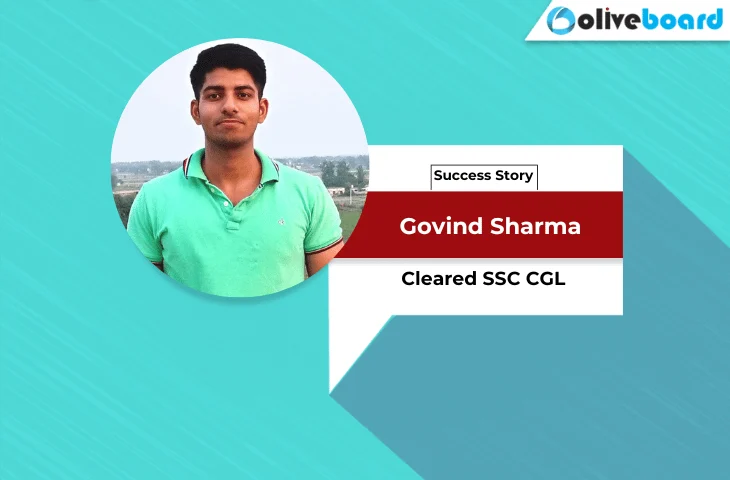
Clearing SSC CGL at the age of 20 is a significant achievement, especially when the journey involves changing career plans, identifying weaknesses and learning how to prepare strategically. For Govind Sharma from Bulandshahr, Uttar Pradesh, the turning point was understanding that completing the syllabus was only the beginning. Regular mock tests, focused revision and consistent practice helped him work towards his goal of securing a government job.
Govind, who studied at Aligarh Muslim University (AMU) and completed a BSc in Mathematics Honours, eventually secured the post of Office Superintendent under the Central Board of Direct Taxes (CBDT), with a posting in Delhi.
Here is how he approached SSC CGL preparation and the lessons aspirants can take from his journey.
From MBA Preparation to SSC CGL
Govind initially considered pursuing an MBA and began preparing for management entrance examinations. However, he found it difficult to balance MBA preparation with his interest in government examinations. After reassessing his priorities, he decided to focus on SSC CGL.
His first attempt in 2024 helped him understand the level of competition. He scored around 140 marks, while the cutoff he was targeting was approximately 153. Instead of treating the result as a reason to give up, he used the experience to recognise the gap between his preparation and the examination requirements.
He became more systematic in his approach, focusing on completing the syllabus before using mock tests to identify and improve weaker areas.
Watch his full strategy only on Oliveboard:
Govind Sharma’s SSC CGL Preparation Strategy
1. Complete the Syllabus Before Chasing Mock Scores
For Govind, covering the syllabus was a priority. He believed that aspirants should aim to understand every topic at least at a basic level rather than leave portions untouched.
This approach helped him feel better prepared for unexpected questions. If he struggled to understand a topic through one teacher, he explored other explanations until the concept became clearer.
His advice is practical: build a foundation across the syllabus first, then use tests to determine where additional effort is required.
2. Use Mock Tests to Identify Weak Areas
Mock tests played an important role in Govind’s preparation. A friend recommended Oliveboard’s live weekly mock tests, which he used regularly. He also practised sectional mocks and chapter-wise tests.
Rather than looking only at his scores, he used these tests to understand which topics needed more work. Once he identified a weak area, he returned to the relevant concepts, practised questions and tested his improvement.
This created a cycle of preparation: attempt a mock, analyse mistakes, revise the topic and practise again.
For SSC CGL aspirants, the key lesson is to treat mock tests as diagnostic tools, not merely as a way to measure performance.
3. Adapt the Strategy to Each Subject
Govind approached each section differently.
- Quantitative Aptitude: He started with arithmetic before moving to advanced mathematics. He also worked on calculations, shortcuts and miscellaneous questions relevant to the Mains examination.
- Reasoning: He found reasoning comparatively manageable for SSC CGL and used other competitive examinations to gain exposure to topics such as clocks and calendars.
- English: He revised grammar concepts, maintained notes and worked on vocabulary using resources such as the Black Book and word compilations.
- General Awareness: He relied on repeated revision and question practice. He also wrote down current affairs to reinforce what he studied.
His Mathematics background helped him develop conceptual understanding, but he recognised that competitive examinations required specific practice in speed, calculations and question-solving techniques.
Govind’s preparation combined syllabus coverage, regular testing and subject-specific revision. Instead of relying on one resource or repeatedly taking mocks without analysis, he focused on understanding concepts and correcting mistakes.
Key Takeaways for SSC CGL Aspirants
Govind’s journey offers a few practical lessons:
- Complete the syllabus before relying heavily on mock scores.
- Attempt full-length, sectional and chapter-wise tests to locate weaknesses.
- Analyse mistakes and revisit concepts instead of simply increasing the number of tests.
- Develop a different preparation approach for Quantitative Aptitude, Reasoning, English and General Awareness.
- Stay consistent even when an early attempt does not produce the desired result.
Govind believes that with disciplined preparation and fewer distractions, aspirants can make meaningful progress within a year. His experience shows that success is not only about how much you study, but also about how effectively you identify gaps and work on them.
Do you want to prepare like Govind? Explore SSC CGL Oliveboard courses and study resources to structure your preparation around the syllabus.

I started my journey with storytelling and journalism, and somewhere along the way, I discovered how much I truly love writing. Words have always been my way of connecting with people.
With 4+ years of experience in content creation, social media, and video storytelling, I focus on building meaningful conversations, not just posts. I enjoy understanding audiences, planning engaging content, and turning followers into active, connected communities.
At Oliveboard, I work on creating value-driven content that informs, engages, and brings people together.