
What do you do when you miss CAIIB by just one mark? For Praveen Gupta, the answer was not simply studying more. He changed the way he prepared, focusing on concept clarity, repeated practice and understanding how to approach the paper.
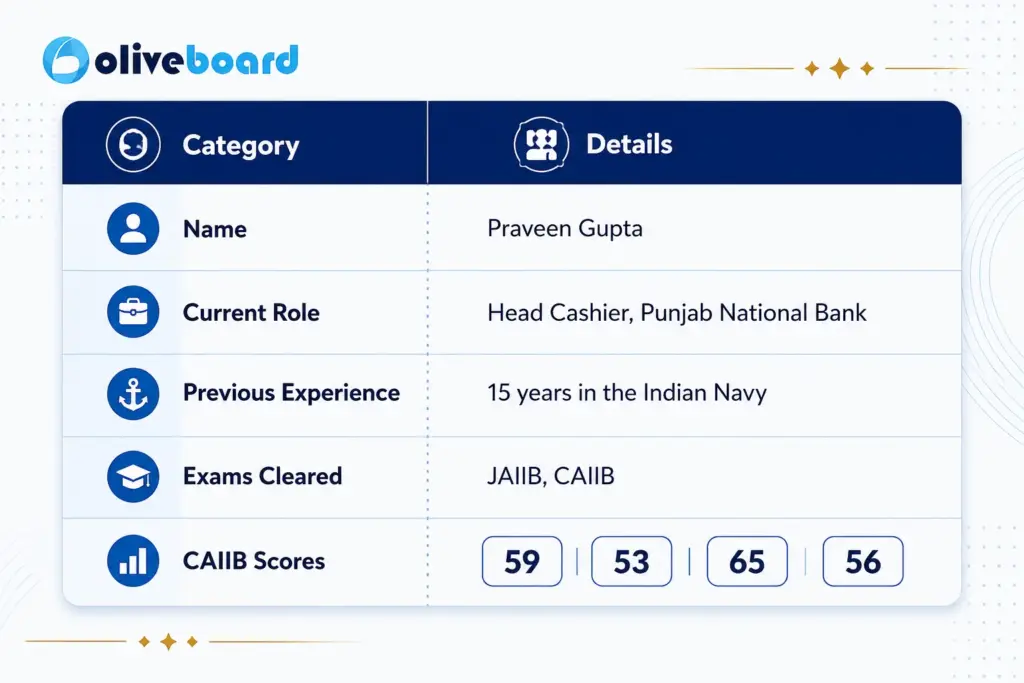
After falling short in BFM by one mark, Praveen returned with a more focused strategy. He cleared CAIIB with scores of 59, 53, 65 and 56 across the four papers.
It’s not necessary to solve 100 different numericals. Solve 10 numericals, but practise those 10 numericals 100 times.
— Praveen Gupta
Praveen’s CAIIB Success Snapshot
From the Indian Navy to Banking
Before joining banking, Praveen spent 15 years in the Indian Navy. He later moved into banking and continued working towards professional banking certifications.
His JAIIB preparation with Oliveboard gave him a positive start. He cleared all four papers with 50+ marks, including 65 marks in IIFB. That experience encouraged him to continue his preparation with Oliveboard for CAIIB as well.
Missing CAIIB by One Mark Changed His Strategy
Praveen admits that he became a little relaxed during his initial CAIIB preparation because he had already cleared JAIIB. Personal commitments also affected his consistency.
The result was a narrow miss. He fell short by one mark in BFM.
But that one mark also became his motivation.
For the next attempt, Praveen decided to prepare differently. Instead of trying to solve as many questions as possible, he focused on understanding concepts and practising questions until he could apply the concepts confidently.
Why Numerical Practice Became So Important
For Praveen, memorising formulas was not enough.
He realised that CAIIB numericals often require candidates to understand how to apply a formula step by step. Simply remembering a formula does not guarantee that you will know what to do with it in the exam.
That is why he preferred practising a smaller number of numericals repeatedly rather than attempting hundreds of different questions just once.
His approach was:
Understand the concept → Practise the numerical → Repeat → Apply it quickly in the exam
This helped him become more comfortable with numerical-heavy papers such as BFM and ABFM.
How Oliveboard Became Part of His CAIIB Preparation
Oliveboard was a consistent part of Praveen’s preparation. For BFM, he went through the full course, Crash Course, Crackers and Capsule, while also attending live classes and numerical and case-study sessions.
He followed a similar approach for other papers. For BRBL, he found case studies particularly useful because they helped him understand laws through situations rather than simply memorising them. He also attended the Crackers and Capsule batches regularly.
Praveen also appreciated Oliveboard’s faculty for simplifying difficult concepts. He specifically mentioned Pradyuman Sir and Rajiv Sir, highlighting how they made even difficult topics easier to understand.
How He Approached Different CAIIB Papers
Praveen found BFM the toughest paper, followed by ABFM.
For BFM, he relied heavily on concept-based learning and numerical practice. For ABFM, repeated practice helped him become comfortable with the application of concepts.
For BRBL, his focus was on case studies. He found that understanding a law through a particular situation made it easier to recall during the exam.
His Exam Strategy: Don’t Get Stuck
Preparation was only one part of Praveen’s strategy. He also learnt how to manage the paper when questions became difficult.
During case studies, he would sometimes read the questions first and then go back to the case study. This helped him understand exactly what information he needed and saved time.
He also didn’t hesitate to leave difficult questions and return to them later. In one instance, he attempted the easier questions first and came back to the case-study questions he had left towards the end.
For Praveen, staying calm was essential. When a paper becomes difficult, losing confidence can affect the questions that follow.
What Can CAIIB Aspirants Learn From Praveen?
Praveen’s journey offers a simple preparation framework:
Build concepts → Practise numericals → Use case studies → Revise repeatedly → Understand the exam pattern → Stay calm during the paper
His biggest advice is not to measure preparation by the number of mocks or questions completed.
He believes the current CAIIB papers require deep conceptual understanding, and simply attempting hundreds of mocks or thousands of questions is not enough.
For him, quality of practice mattered more than quantity.
From One Mark Short to CAIIB Success
Praveen Gupta’s CAIIB journey shows how a small setback can completely change the way you prepare.
Missing by one mark could have been discouraging. Instead, it pushed him to analyse his approach, strengthen his concepts and practise more deliberately.
With Oliveboard’s classes and revision resources supporting his preparation, he returned with a more focused strategy and cleared CAIIB with strong scores.
His biggest lesson is simple:
Don’t just study more. Understand better, practise smarter and stay consistent.
Frequently Asked Questions
How did Praveen Gupta prepare for CAIIB?
He focused on concept clarity, numerical practice, case studies and repeated revision, while also developing a strategy for approaching different types of questions.
What was Praveen Gupta’s CAIIB score?
He scored 59, 53, 65 and 56 across his four CAIIB papers.
What Oliveboard resources did Praveen use?
He used the full course, live classes, Crash Course, Crackers, Capsule, numerical sessions and case-study sessions as part of his preparation.
What was Praveen’s advice for CAIIB numericals?
His advice was to focus on repeated practice rather than simply solving a large number of different questions.
What was the biggest turning point in his CAIIB journey?
Missing the exam by one mark in BFM pushed Praveen to change his preparation strategy and focus more deeply on concepts and practice.

I started my journey with storytelling and journalism, and somewhere along the way, I discovered how much I truly love writing. Words have always been my way of connecting with people.
With 4+ years of experience in content creation, social media, and video storytelling, I focus on building meaningful conversations, not just posts. I enjoy understanding audiences, planning engaging content, and turning followers into active, connected communities.
At Oliveboard, I work on creating value-driven content that informs, engages, and brings people together.