

The JAIIB AFM Exam Analysis 2026 will help candidates understand the difficulty level, question pattern, and important topics covered in the Accounting and Financial Management (AFM) paper. The Indian Institute of Banking and Finance (IIBF) is scheduled to conduct the JAIIB AFM exam on 28th November 2026. Candidates appearing for the examination can check the detailed shift-wise analysis to understand the paper structure and important questions.
The detailed analysis will be updated after the exam based on candidate feedback. It will include shift-wise difficulty levels, topic-wise questions, memory-based questions, numerical problems, case studies, and the overall exam review.
When will the JAIIB AFM Exam Analysis 2026 be released?
The JAIIB AFM Exam Analysis 2026 for 28th November will be updated after the examination is conducted. The analysis will provide details about the questions asked in different shifts and the overall paper difficulty. Candidates can use this review to understand the latest exam trends and identify important topics.
What was the difficulty level of the JAIIB AFM Exam 2026?
The overall difficulty level of the JAIIB AFM paper will be updated after the examination based on feedback from candidates. The analysis will consider both theoretical and numerical questions from different modules. Candidates can check the shift-wise difficulty level in the table below, and the details will be revised soon after the exam is conducted.
| Shift | Difficulty level |
|---|---|
| Shift 1 | TBA |
| Shift 2 | TBA |
| Shift 3 | TBA |
What topics were asked in the JAIIB AFM Exam 2026?
The topic-wise analysis of the JAIIB AFM Exam 2026 will be updated after the examination on 28th November. The analysis will include questions from all four modules, along with numerical problems and case-based questions. Shift-wise topics will be added once candidate feedback becomes available.
| Shift | Topics asked |
|---|---|
| Shift 1 | TBA |
| Shift 2 | TBA |
| Shift 3 | TBA |
JAIIB AFM Exam Analysis 10th May 2026
The JAIIB Accounting and Financial Management (AFM) May 2026 exam was conducted on 10 May 2026. The paper had a moderate overall difficulty level, with a greater focus on numerical questions, accounting concepts, and financial calculations. Modules A and C were the most important, while Module C was slightly more difficult than in previous cycles. Candidates preparing for the upcoming JAIIB AFM exam can check the complete exam analysis, module-wise question distribution, important topics, and key preparation tips below.
What was the overall difficulty level of the JAIIB AFM May 2026 exam?
The overall difficulty level of the JAIIB AFM May 2026 paper was moderate. The exam included both theory-based and numerical questions, with a stronger focus on calculations in Module C. Module A remained a stable scoring area, while Module D received slightly more weightage than Module B. The paper also included case-study and numerical questions, making conceptual clarity and regular practice important for candidates.
- Overall difficulty: Difficult
- Most important modules: Module A and Module C
- Most challenging module: Module C and A with a moderate to difficult level
- Module-wise weightage: Module D was slightly more important than Module B
- Question types: Numerical, theory-based, and case-study questions
How many questions were asked from each module in the JAIIB AFM May 2026 exam?
The JAIIB AFM May 2026 exam covered four modules: Accounting Principles and Processes, Accounting and Financial Statements, Financial Management, and Accounting in Financial Management. The topic-wise analysis shows that questions were spread across accounting standards, financial statements, financial calculations, costing, taxation, and budgeting. Based on the supplied topic-wise list, the reported questions can be counted module-wise to identify the areas that received more attention.
| Module | Total reported questions | Major areas covered |
| Module A | 30 | Accounting standards, depreciation, basic accountancy, bank audits, and bank reconciliation |
| Module B | 20 | Financial statements, company accounts, cash flow, and computerised accounting |
| Module C | 30 | Accounting ratios, bonds, interest, WACC, annuities, and foreign exchange |
| Module D | 20 | Costing, GST, marginal costing, budgeting, and income tax |
| Total | 100 | All four modules |
Which topics had the highest number of questions in the JAIIB AFM May 2026 exam?
The topic-wise distribution highlights a few areas that received more attention than others. Accounting Standards had the highest reported count in Module A, while accounting ratios led in Module C. In Module B, financial statement preparation and balance sheet formats were prominent. Module D focused more on costing methods and GST, along with questions on budgeting and taxation.
| Module | Topic | Number of questions |
| A | Accounting Standards | 4 |
| A | Basic Accountancy Procedures | 3 |
| A | Methods of Depreciation | 3 |
| C | Calculation of Accounting Ratios | 4 |
| B | Company Accounts | 4 |
| B | Balance Sheet and Profit and Loss Statement | 4 |
| D | Methods and Techniques of Costing | 4 |
| D | Marginal Costing | 4 |
| A | BRS | 3 |
| A | Types of Errors and Suspense Accounts | 3 |
| B | Definition and Types of Companies | 3 |
| C | Bond Valuation | 3 |
| C | Interest, Annuity, EMI | 4 |
| C | Capital Budgeting | 3 |
| B | Components of Cash Flow | 3 |
| D | Income tax | 5 |
| D | GST | 4 |
Candidates should use this distribution to guide revision, but they should not depend only on topics with higher reported counts. Questions can vary across exam cycles, so complete syllabus coverage remains important.
How many questions were asked from numerical and theory-based topics?
The supplied module-wise analysis does not provide a verified total separating numerical and theory-based questions. However, the reported topics indicate that the paper tested both calculation skills and conceptual understanding. Module C had a strong focus on financial calculations, while Modules A and B included accounting concepts and practical applications. Module D combined costing calculations with taxation and budgeting concepts.
| Question type | Important topics reported |
| Numerical questions | Accounting ratios, depreciation, simple and compound interest, bond valuation, YTM, WACC, annuities, forward exchange rates, costing, and CVP analysis,EMI, |
| Theory-based questions | Accounting standards, types of companies, bank audits, accounting systems, GST provisions, types of leases, and budgeting, income Tax |
| Application-based questions | Preparation of financial statements, bank reconciliation, variance analysis, marginal costing, and financial management problems, rectification of error |
Preparation tip: Banking professionals preparing for the next JAIIB AFM exam should practise numerical questions regularly while revising theory-based concepts from all four modules. Previous year questions and mock tests can help improve calculation speed, accuracy, and familiarity with different question formats.
What was the module-wise distribution of questions in the JAIIB AFM May 2026 exam?
The JAIIB AFM May 2026 paper covered all four modules, including accounting principles, financial statements, financial management, costing, taxation, and budgeting. Module A included questions on accounting standards and basic accountancy, while Module B focused on financial statements and company accounts. Module C had several numerical questions related to ratios, bonds, interest, and the cost of capital. Module D covered costing methods, GST, budgeting, and income tax.
Module A: Accounting principles and processes
| Topic | Number of questions |
| Accounting Standards | 4 |
| Basic Accountancy Procedures | 4 |
| Methods of Depreciation | 4 |
| Types of Bank Audits | 3 |
| Types of Errors and Suspense Accounts | 3 |
| Rules of Debit and Credit | 3 |
| Types of Accounts | 2 |
| Bank Reconciliation Statement | 3 |
| Capital and Revenue Expenditure | 2 |
| Accounting Entries of Bills of Exchange | 1 |
| Important Terms Related to Bills of Exchange | 1 |
| Functions of Back Office | 1 |
| Reconciliation of Inter-Branch/Office Entries | 1 |
Module B: Financial statements and accounting systems
| Topic | Number of questions |
| Preparation of Financial Statements from Trial Balance | 4 |
| Form of Balance Sheet and Profit and Loss Statement | 4 |
| Definition and Types of Companies | 3 |
| Accounting for Share Capital | 3 |
| Features of Computerised Accounting | 3 |
| Components of Cash Flow | 3 |
| Balance Sheet Equation | 2 |
| Significant Features of Accounting Systems of Banks | 1 |
| Disclosure Requirements of Banks | 1 |
Module C: Financial management
| Topic | Number of questions |
| Calculation of Accounting Ratios | 5 |
| Forms of Business Organisation | 2 |
| Calculation of Simple and Compound Interest | 2 |
| Current Yield, YTM and Duration of Bond | 2 |
| Fundamentals of Foreign Exchange | 2 |
| Calculation of WACC, Cost of Equity and Cost of Debt | 2 |
| Discounted and Non-Discounted Cash Flow Methods | 2 |
| Features and Types of Lease Agreements | 2 |
| Ordinary Annuity and Annuity Due | 2 |
| Features of Bonds | 2 |
| Present and Future Value of an Annuity | 1 |
| Bond Theorem | 3 |
| Calculation of Forward Exchange Rates | 1 |
| Theories/Approaches on Capital Structuring | 2 |
| Types of Derivatives | 1 |
| Agency Problem in Finance | 1 |
| Working Capital Cycle | 1 |
| Sources for Financing Working Capital | 1 |
Module D: Accounting and financial management-related laws and costing
| Topic | Number of questions |
| Methods and Techniques of Costing | 4 |
| Introduction to GST | 3 |
| Job and Contract Costing | 2 |
| Variance Analysis and Its Accounting | 2 |
| Meaning and Application of Marginal Costing | 2 |
| Deductions in Respect of Certain Incomes | 2 |
| Absorption Costing | 2 |
| Types of Budgets | 2 |
| CVP Analysis | 1 |
| Budgetary Control System | 1 |
| Zero Base Budgeting | 1 |
| Basics of Income Tax | 4 |
Which topics were important in the JAIIB AFM 2026 exam?
The exam analysis highlights several important topics across all four modules. Candidates should focus on both conceptual understanding and numerical practice, as AFM tests the ability to apply accounting and financial management concepts. The following topic lists can help candidates plan their revision for the upcoming JAIIB AFM exam.
Module A: Accounting principles and processes
- Accounting Standards, including Ind AS
- Rules of Debit and Credit
- Rectification of Errors and Types of Errors
- Bank Reconciliation Statement
- Different Methods of Depreciation
- Capital and Revenue Expenditure
- Important Terms Related to Bills of Exchange
- Types of Audit
Module B: Financial accounting and statements
- Preparation of Balance Sheet and Profit and Loss Account
- Definition and Types of Companies
- Balance Sheet Equation
- Components of Cash Flow
- Disclosure Requirements
- Computerised Accounting
- Accounting for Share Capital
- Accounting Systems of Banks
Module C: Financial management
- Different Types of Ratios
- Calculation of Simple and Compound Interest
- Ordinary Annuity and Annuity Due
- Bond Theorems and Bond Price Volatility
- Intrinsic Value of Bonds and Current Yield
- Yield to Maturity (YTM) and Duration
- Types of Leases
- Working Capital and Working Capital Cycle
- WACC, Cost of Equity, and Cost of Debt
- Forward Exchange Rate Calculations
- Discounted and Non-Discounted Cash Flow Methods
- Types of Derivatives
- Sources of Working Capital Finance
Module D: Costing, taxation, and budgeting
- TDS, TCS, and Deductions under Sections 80C, 80TTA, and 80TTB
- GST Provisions
- Profit-Volume Ratio
- Break-Even Point and Margin of Safety
- Costing Methods and Types
- Normal and Abnormal Loss
- Types of Budgets
- Absorption Costing
- Variance Analysis
- Budgetary Control System
- Zero-Based Budgeting
- Basics of Income Tax
What was the nature of questions in the JAIIB AFM May 2026 exam?
The AFM paper included a mix of numerical, theory-based, and application-oriented questions. Candidates needed to understand accounting rules, financial statements, costing methods, and financial management concepts. The level of calculation varied across modules, with Module C requiring more formula-based and multi-step calculations. A balanced preparation strategy covering theory and numerical practice is therefore important for the upcoming examination.
| Module | Nature of questions | Important areas |
| Module A | Mix of theory and numericals; moderate difficulty | Depreciation, bank reconciliation, accounting standards, and types of errors |
| Module B | More theory-based and comparatively easier to score | Balance sheet preparation, types of companies, cash flow, and accounting systems |
| Module C | Formula-intensive, with moderate to difficult calculations | Ratios, YTM, WACC, compound interest, bonds, and forward exchange rates |
| Module D | Mix of theory and numerical questions | Costing methods, GST, marginal costing, budgeting, and income tax |
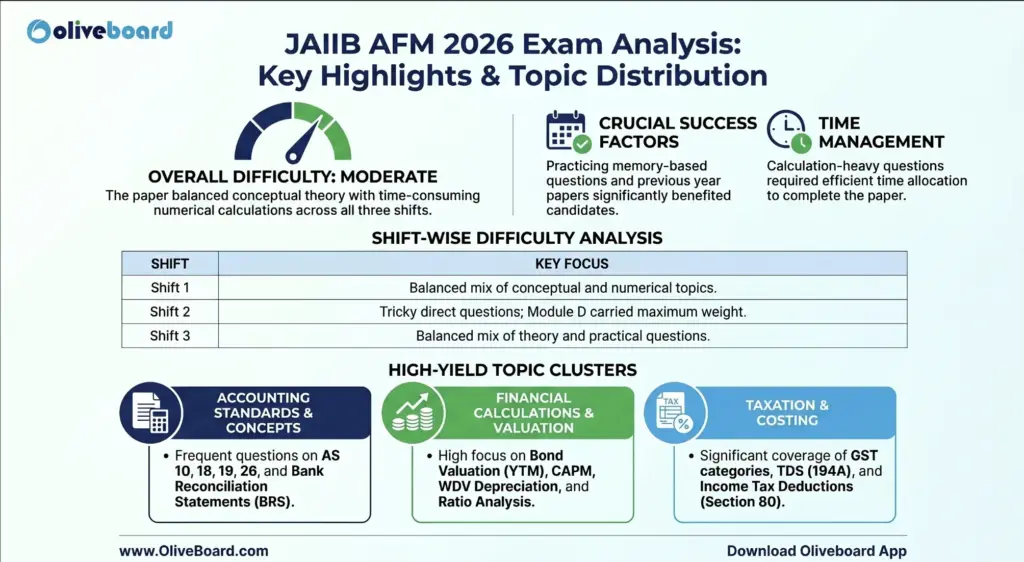
JAIIB AFM Paper November 2025 Exam Analysis
The November 2025 JAIIB AFM exam was moderate in difficulty with a good mix of conceptual and numerical questions. Around 12–15 marks were from numerical questions, while the rest focused on theory and application. The paper required clarity in accounting standards, costing concepts, and financial formulas.
How difficult was the JAIIB AFM November 2025 exam paper?
The JAIIB AFM November 2025 exam, conducted by the Indian Institute of Banking and Finance, included a balanced mix of theory and numerical questions. It tested candidates on basic accounting concepts, financial understanding, and practical problem-solving skills. Overall, the exam was moderate, though some questions required clear concept understanding.
| Aspect | Details |
| Overall Difficulty Level | Moderate |
| Numerical Questions | 12–15 marks |
| Focus Area | Accounting and financial concepts |
| Question Type | Mix of theory, numerical, and application-based questions |
| Key Topics | Capital and revenue expenditure |
What was the overall difficulty level and exam pattern in November 2025?
The JAIIB AFM November 2025 exam showed a consistent difficulty level across all shifts, with a balanced mix of conceptual and numerical questions.
| Shift | Difficulty Level | Key Observation |
| Shift 1 | Moderate | Conceptual + numerical mix |
| Shift 2 | Moderate | More accounting standard-based |
| Shift 3 | Moderate | Balanced with costing + finance |
Which topics were asked in the JAIIB AFM November 2025 exam?
The exam covered a wide range of accounting, costing, and financial management topics. Below are the complete shift-wise topics from which questions were asked.
| Shift | Topics Covered |
| Shift 1 | Journal Entry; Accounting Standards; Borrowing Cost; Current Ratio; Process Costing; GST Penalty; Forex; Depreciation Numerical; Simple Interest; Annuity Questions; Lease; Weighted Average Cost of Capital (WACC); Margin of Safety; Sinking Fund; Tandon Committee; Accounting Standard 19; Operating Lease; Narration; Forward Points; Numerical-based questions; Future Value of Annuity; Decision Making Authority; Income Credit; Schedule 18; Cost of Goods Sold; Absorption Costing; Composite Voucher; Health Insurance; Bill of Exchange Journal Entry; Non-Voting Right Shareholding; EMI Calculation; Share Premium; Dormant Company; Zero Based Budgeting; Machine Construction; Job Costing; Cross Rate; Asset Classification; Error of Commission; Error of Principle; Break-Even Point (BEP); Bank Reconciliation Statement (Cash Book Balance); Capital and Revenue Expenditure |
| Shift 2 | Accounting Standard 9 and 10; Current Yield; Ordinary Annuity; Budgeting; Cash Flow; TDS and GST; Process Costing; Absorption Costing; Numerical Questions; Entry Posting; Auditor Panel (Public and Private Company); Depreciation; GST Applicable Date; Bonds; Annuity; Schedule 10; Bank Balance Sheet; Accounting Standard 1; Front End and Back End; Expenses (Profit and Loss); Rectification of Errors; Exchange Rate; Share Premium; Supply Completion Method; Accounting Concepts (Match the Following); BRS; Bond Theorems; Journal Entry; Gold and Silver Assets; Errors; Forex Exchange (Value Date); Bill of Exchange; AS 2 (Inventories); Quick Ratio (Quick Assets); Ind AS 7; Yield to Maturity (YTM) |
| Shift 3 | Contra Entry; Commission Error; Reversal Entry; Passbook vs Cash Book; Direct Cost; Bill of Exchange; Unconditional Order; Rent Receivable (Representative Personal Account); YTM Properties; Net Present Value (NPV); Simple Interest; Ordinary Annuity; Schedule 3; Other Assets; Non-Voting Shares; Derivatives; Error of Principle; Balance Sheet; Shareholders; Prepaid Expenses; Accounting Standard 2; Net Worth; LIFO and FIFO Numerical |
JAIIB AFM May 2025 Exam Analysis
The JAIIB AFM May 2025 exam reflected a concept-driven and moderately tough paper, with a clear focus on practical application, numericals, and core accounting concepts. Across all shifts, the paper tested candidates on a wide mix of accounting, costing, and financial management topics, making it important for aspirants to have both conceptual clarity and calculation accuracy.
A key highlight of this exam was the strong presence of numerical questions, especially in later shifts, along with repeated emphasis on ratios, annuity, bonds, and costing concepts. Candidates who practiced numericals and revised formulas thoroughly found the paper more manageable.
What was the overall difficulty level of the JAIIB AFM May 2025 exam?
The overall difficulty level of the exam ranged from moderate to slightly tough, with variation across shifts.
| Shift | Difficulty Level | Key Observation |
| Shift 1 | Moderate to Tough | Conceptual + moderate numericals, heavy Module A & D |
| Shift 2 | Moderate to Tough | Higher numerical weightage (~20 marks), focus on Module C & D |
| Shift 3 | Moderate | Balanced paper with mix of theory, ratios, and finance |
What was the exam pattern and question trend?
The paper followed a balanced yet practical approach, focusing on both theory and application.
| Section Focus | Details |
| Numerical Questions | 12–20 marks (increased in Shift 2) |
| Theory Questions | Concept-based and statement-type |
| Application-Based | High focus on real scenarios and calculations |
| Repeated Topics | Ratios, YTM, EMI, Annuity, Costing |
| Question Types | MCQs, match the following, statement-based |
Which topics had the highest weightage?
The exam covered almost the full syllabus, but some topics had significantly higher weightage and repetition across shifts.
| Topic | Key Areas Covered |
| Accounting | Journal Entries, Rectification, Capital vs Revenue, Depreciation |
| Ratios | Current Ratio, Quick Ratio, Working Capital Ratio, Debt-Equity |
| Costing | Marginal Costing, Absorption Costing, Job & Batch Costing |
| Financial Management | YTM, NPV, Annuity, EMI, Capital Budgeting |
| BRS | Cash Book & Passbook-based questions |
| Accounting Standards | AS 1, AS 2, AS 10, Ind AS concepts |
| Bonds & Finance | YTM, Duration, Zero Coupon Bonds |
What type of numerical questions were asked?
Numericals played a crucial role, especially in Shift 2. The details of the topics from which questions were asked in the exam are as follows:
| Topic | Question Type |
| EMI | Calculation-based |
| YTM | Bond valuation and approximation |
| Annuity | Ordinary annuity & annuity due |
| NPV | Capital budgeting |
| Depreciation | Sum of Years Digit Method |
| Ratios | Current & Quick Ratio calculations |
| Costing | Marginal costing & profit calculation |
What were the key concepts tested in the exam and their shift-wise distribution?
The paper strongly focused on core accounting, costing, and financial concepts, with a clear emphasis on practical application and numericals across all shifts.
| Category | Topics Covered | Shift-wise Highlights |
| Accounting Concepts | Basic accounting assumptions, business entity & materiality, capital vs revenue expenditure, deferred tax (timing vs permanent difference) | Shift 2: AS 1, AS 2, AS 10 were asked |
| Journal Entries & Errors | Forfeiture of shares, prepaid expenses adjustment, rectification using suspense account, bonus issue entries | Shift 1: Journal entries (3 questions); Shift 3: accounting errors and entries |
| Costing Concepts | Marginal vs absorption costing, cost of goods sold, budgeting (capital budget), decision-making concepts | Shift 1: marginal costing numericals; Shift 3: costing basics |
| Numerical Focus Areas | EMI, YTM, annuity, depreciation (including Sum of Years Digit method) | Shift 1: EMI, YTM, depreciation; Shift 2: high numerical weightage (~20 marks), repeated EMI/YTM/annuity |
| Ratio & Financial Analysis | Current ratio, quick ratio, leverage ratios | Shift 2: ratio-based questions asked |
| Regulatory Concepts | Banking Regulation Act basics (Section 29) | Shift 2: direct conceptual question |
| Investment & Finance Concepts | NPV, present value, bond concepts | Shift 3: focus on NPV, PV, bonds |
| Shift 1 Focus | Module A & D emphasis | BRS (3 questions), marginal costing, minimal focus on golden rules |
| Shift 2 Focus | High numerical weightage (~20 marks) | Repeated numericals and accounting standards focus |
| Shift 3 Focus | Balanced paper | More conceptual clarity required across costing and accounting |
What were the most repeated topics across shifts?
Certain topics were consistently repeated, making them extremely important.
| Repeated Topic | Frequency |
| EMI | High |
| YTM | High |
| Annuity | High |
| Ratios | High |
| Depreciation (SYD Method) | Repeated |
| Costing | Moderate to High |
| Accounting Standards | Moderate |
FAQs
Ans. The exam is scheduled for 28th November 2026.
Ans. The paper is expected to be moderate with a mix of conceptual and numerical questions.
Ans. Accounting, costing, and financial management are the most important areas.
Ans. EMI, YTM, annuity, NPV, ratios, and depreciation are key numerical topics.
Ans. Shift 2 is generally expected to have higher numerical weightage.
- JAIIB PPB Exam Analysis 2026, 22nd November All Shifts Review
- Struggling with JAIIB? Read Prafulla Chandra Jha’s 3rd Attempt Success Story
- JAIIB RBWM Exam Analysis for 29 November 2026, Shift-wise Review
- JAIIB AFM Exam Analysis 2026, 28th November All Shifts Review
- JAIIB IE and IFS Exam Analysis 2026, 1st November Shift Wise Analysis
- JAIIB Exam Analysis 2026, November Cycle, All Shifts Covered

Hi, I’m Aditi. I work as a Content Writer at Oliveboard, where I have been simplifying exam-related content for the past 4 years. I create clear and easy-to-understand guides for JAIIB, CAIIB, and UGC exams. My work includes breaking down notifications, admit cards, and exam updates, as well as preparing study plans and subject-wise strategies.
My goal is to support working professionals in managing their exam preparation alongside a full-time job and to help them achieve career growth.