
The Indian Institute of Banking and Finance has released the JAIIB 2026 exam dates, and the IE and IFS paper is scheduled to be held on 3rd May 2026. The exam comprised 100 questions for 100 marks with a duration of 2 hours. In this blog, we have provided details about the paper level, module-wise difficulty level, and the topics from which questions are asked, based on reviews shared by professionals who appeared for the exam.
JAIIB Exam Analysis 3rd May 2026
Based on the feedback from professionals who appeared for the JAIIB IE and IFS Exam scheduled on 3rd May 2026, the overall difficulty level of the exam was moderate with balance of conceptual and application-based questions.
The detailed analysis on shift-wise difficulty level, module-wise weightage, and topic-wise questions is shared based on feedback from banking professionals appearing for the exam.
What was the level of the JAIIB IE and IFS paper?
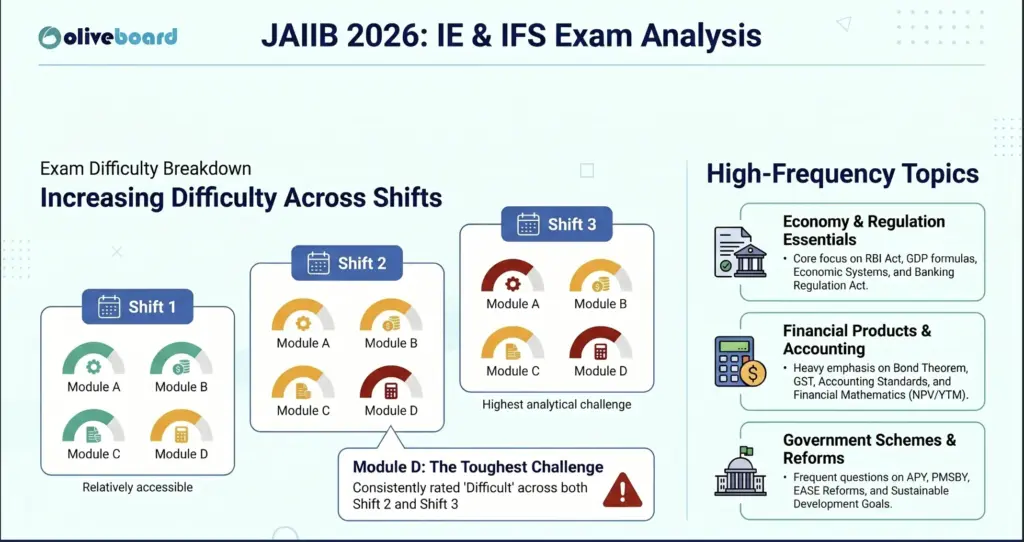
The JAIIB IE & IFS exam evaluates candidates on conceptual clarity, numerical application, and analytical understanding across all four modules. The overall difficulty level of Shift 2 was moderate, while Shift 3 was comparatively more challenging than both Shift 1 and Shift 2. The detailed module-wise distribution and topic-wise analysis has been updated below based on feedback received from candidates and experts after the examination.
| Shift | Difficulty Level |
| Shift 1 | Easy to Moderate |
| Shift 2 | Moderate to Difficult |
| Shift 3 | Moderate to Difficult |
What was the module-wise difficulty level?
The module-wise difficulty level for the JAIIB IE and IFS 2026 exam of all three shifts are updated below.
| Module | Shift 1 | Shift 2 | Shift 3 |
| Module A | Easy | Moderate | Difficult |
| Module B | Easy | Moderate | Moderate |
| Module C | Easy | Moderate | Moderate |
| Module D | Moderate | Difficult | Difficult |
What are the topics from which questions were asked?
The topic-wise question distribution for the JAIIB IE and IFS 2026 exam is updated below:
| Shift | Topics |
| Shift 1 | Bond Theorem; Factoring (Single & International); Insurance Company; Reserve Bank of India prudential limits; Section 7 of RBI Act; FDI amount in telecom; NaBFID Capital; CSR; CSR Penalty; Economic Systems; EASE Reforms (latest theme) ASBA Full Form; Full-Time Directors (Banks); FDI Limits in Private Banks; Formula of GDP; IFCI Establishment date; Brown Revolution; Brownfield Project; PRAN Number; Money Supply; Invite Related questions; Sustainable Development Goal 13; Time Notice Money; Definition of Scarcity; ARR; NC 1 & NC 2; OSOWOG; Operating Lease; RBI Paid-up Capital; Demand Curve and Supply Curve; Bank Nationalization; YH Malegam Committee; Parvatmala Ropeway; T-bills; Primary Dealers; Banking Regulation Act Section 6; LERMS; Red Herring Prospectus (RHP) |
| Shift 2 | Bill of Exchange; Promissory Note; Earnings Per Share (EPS); Balance Sheet; Case Study Questions; Rectification of Errors (Error of Commission); Contra Entry; Forward Contract (Forex); Rent Receivables (Nominal Account); Net Present Value (NPV); Simple Interest; Other Assets (Silver); Investments (Gold); Non-Voting Shares (Max 25%); Auditor Appointment (Public & Private); GST (Goods and Services Tax); Front-end and Back-end Interest; Capital and Revenue Expenditure; Tax Collected at Source (TCS); Accounting Standards (AS 1, AS 2, AS 9, AS 10, AS 19); Bank Reconciliation Statement (BRS); Quick Ratio; Share Premium; Exchange Rate/Foreign Exchange; Journal Entries; Errors in Accounting; Lease Financing; EMI Calculation; Income, Credit and Expenses; Financial Mathematics (YTM, Annuities); Cost of Capital and Budgeting; Financial Statements Preparation; Atal Pension Yojana; Bharatmala Pariyojana; Pradhan Mantri Suraksha Bima Yojana; SOFR (Secured Overnight Financing Rate); Chronology-based questions (Stock Exchange); Green Shoe Option; Insurance Ombudsman; Insurance concepts; TReDS (Trade Receivables Discounting System); Green Bond; REIT; REIT Structure (Sponsor, Trustee, SPV); SCBs (Priority Sector Lending); NARCL (Bad Bank – Bonds); Small Finance Bank; Factoring; Derivatives; Commodity (Gold/Oil); CPI (Inflation Index); NBI; IOS; Greenfield Project; CDS (Credit Default Swap); CIC; APY; Repo/Call Money concepts; Financial Market Instruments; Chronology of Stock Exchanges (BSE, CSE, OTCEI, NSE, MSE, NSE IFSC, INDIA INX) |
| Shift 3 | Demand & Supply Concepts; IS Curve; GDP Deflator; Liberalisation in Economy; Sunrise Sectors; Quinary Sector (Knowledge-based Economy); Tech-Fin; Credit Card Concepts; UK SONIA; Exchange Rate & Forex Concepts; Forward Contracts; Derivatives & Commodity (Gold/Oil); Cost of Capital & Budgeting; Financial Mathematics (YTM, Annuities, EMI); Net Present Value (NPV); Simple Interest; Income, Credit & Expense Analysis; Balance Sheet & Financial Statement Preparation; Earnings Per Share (EPS); Share Premium; Quick Ratio; Bank Reconciliation Statement (BRS); Journal Entries & Accounting Errors; Rectification of Errors (Error of Commission); Contra Entry; Capital vs Revenue Expenditure; Accounting Standards (AS 1, AS 2, AS 9, AS 10, AS 19); Lease Financing; Operating Lease & Lease vs Hire Purchase; Bill of Exchange & Promissory Note; Investments & Other Assets (Gold/Silver); GST & TCS; Auditor Appointment (Public & Private); Non-Voting Shares (up to 25%); PSL (Priority Sector Lending); Bad Bank (NARCL concept); RBI Governor & Government Nominees; PMJJBY & PMSBY Schemes; CSR Initiatives; SFURTI Scheme; EASE 5.0 Reforms; Triparty Agent Concept; CRA (Credit Rating Agencies); Coin Maximum Deposit; Atal Pension Yojana; Insurance & Financial Market Instruments; REIT & Green Bonds; TReDS Platform; Stock Exchange Chronology (BSE, NSE, etc.) |
JAIIB IE and IFS Paper November 2025 Exam Analysis
The November 2025 JAIIB IE and IFS exam reflected a clear shift towards conceptual understanding and analytical thinking. The paper was overall moderate to difficult, with some sections reaching a tricky level. The questions were largely indirect, requiring deep conceptual clarity rather than memorization.
A major highlight of the exam was the dominance of Module C and Module D, which contributed a significant portion of the paper. Questions were also frequently asked from banking reforms, financial instruments, and economic concepts
How difficult was the JAIIB IE and IFS November 2025 exam paper?
The November 2025 exam focused heavily on application-based learning. Most questions were indirect in nature, testing conceptual clarity across Indian Economy and Financial System topics.
- Overall difficulty level: Moderate to Difficult
- Questions were mostly concept-based and indirect
- Strong focus on banking reforms and financial regulations
- Repeated presence of PYQs (Previous Year Questions)
- Mix of theory, numerical, and statement-based MCQs
- Module C and Module D carried the highest weightage
What was the overall difficulty level and exam pattern in November 2025?
The exam showed variation across shifts, with increasing complexity in later shifts. Shift-wise difficulty increased progressively, making later shifts more challenging.
| Shift | Difficulty Level | Key Observation |
| Shift 1 | Moderate | Conceptual + direct questions |
| Shift 2 | Moderate to Difficult | More numerical and tricky questions |
| Shift 3 | Difficult | Highly conceptual and indirect questions |
Which topics were asked in the JAIIB IE and IFS November 2025 exam?
The JAIIB IE and IFS November 2025 exam covered a wide range of topics from Indian Economy, Banking System, Financial Markets, and Regulatory Frameworks. The questions were largely conceptual and indirect in nature, testing both theoretical understanding and application-based clarity across all shifts. The exam showed strong emphasis on banking reforms, financial instruments, and regulatory developments, with repeated focus on core economic concepts and current banking structures.
| Shift | Topics Covered |
| Shift 1 | Make in India pillars; Viksit Bharat 2047 concept; PM Vishwakarma Scheme; FDI limits and automatic route; NBFC types and regulations; FX Retail Platform; Government securities; Mutual Funds and AMCs; Monetary Policy Committee; Primary dealer borrowing limits |
| Shift 2 | IRDAI and insurance concepts; NaBFID; MSME classification; Currency with public and monetary aggregates; Shadow banking system; Repo, Call Money and Notice Money; Fiscal deficit numerical questions; IMF functions; ESG vs CSR; NITI Aayog schemes |
| Shift 3 | Mutual Funds (Large Cap concepts); Greenfield and Brownfield investments; NBFC structure and regulations; RBI Act and Banking Regulation Act; SHG and microfinance; GDP deflator and money-related concepts; Venture capital and insurance FDI; Financial markets and derivatives |
What were the module-wise questions asked in the JAIIB IE and IFS November 2025 exam?
The November 2025 exam clearly indicated a strong dominance of Module C and Module D, which together formed the backbone of the paper. The questions were largely conceptual and application-based, with significant focus on regulatory frameworks, banking reforms, and financial markets. Modules A and B also carried important conceptual weight, especially in economic indicators and policy-based topics.
| Module | Topics |
| Module A | FDI types and limits, MSME schemes, CSR and SDGs, Foreign trade policy, PSL targets, IMF and economic indicators |
| Module B | Monetary Policy Committee, Money supply concepts, GDP and fiscal deficit, IS-LM model, Inflation and demand-supply, Business cycle |
| Module C | RBI Act and Banking Regulation Act, NaBFID, NBFC classification, Insurance and pension reforms, Payment systems (NACH), NARCL and IDRCL |
| Module D | Mutual Funds and NAV, Commercial Paper and CDs, Forex market and FX platforms, Merchant banking and factoring, TReDS system, Credit rating agencies, Government securities |
JAIIB IE and IFS Paper May 2025 Exam Analysis
The May 2025 JAIIB IE and IFS exam discussion (based on banker feedback and post-exam interaction) indicated that the paper was moderate to difficult in nature, with a strong emphasis on conceptual clarity and application-based questions. Candidates reported that the paper was not heavily predictable and included mixed questions from different modules, especially Module C and Module D.
A key observation from the discussion was that many questions were statement-based, conceptual, and interlinked across modules, making the paper slightly tricky for candidates who relied only on direct theory-based preparation.
How difficult was the JAIIB IE and IFS May 2025 exam paper?
Based on real candidate feedback, the May 2025 paper was not fully direct and required good conceptual clarity.
- Overall difficulty level: Moderate to Difficult
- Paper felt easy only for well-prepared candidates
- Mix of direct + statement-based + application questions
- Higher weightage from Module C and Module D
- Numerical questions were present but manageable (easy to moderate)
- Interlinked concepts across banking, economy, and finance
Download JAIIB previous year papers PDF – Practicing previous year papers give professionals a clear idea of the exam pattern, types of questions, and difficulty level. They are one of the best tools for final revision.
| Subject | Download Link |
| JAIIB Paper 1 (ABM) | Download PDF |
| JAIIB Paper 2 (BFM) | Download PDF |
| JAIIB Paper 3 (ABFM) | Download PDF |
| JAIIB Paper 4 (BRBL) | Download PDF |
Which topics were asked in the JAIIB IE and IFS May 2025 exam?
Based on transcript discussion, the exam included a wide variety of banking and economic topics. Some key areas were:
- FDI vs FII differences (hot money concept linked to FII)
- Merchant banking vs commercial banking
- NBFC deposit-taking vs non-deposit-taking structure
- Monetary policy basics including base money (M0)
- Derivatives and underlying assets concept
- Industrial, agricultural, and service sector classification
- Economic systems: market, command, and mixed economy
- NITI Aayog features and functions
- APY (Atal Pension Yojana) related questions
- Money market instruments and financial systems
- Banking nationalization era (1969 context questions)
- Repo vs reverse repo concepts
- FX retail platform concepts
- CRR and SLR conceptual questions
- Factoring vs forfaiting differences
- Credit rating scale basics
- RBI retail direct scheme concepts
- FDI types (greenfield, brownfield, joint venture)
- Forex and derivatives-based basic numericals
- Demand concepts (including diminishing marginal utility)
- Pre-independence vs post-independence financial phases
- Global financial crisis-based classification of financial system phases
- International institutions (IMF, World Bank – twin sisters)
- RRB shareholding structure (Govt + Sponsor Bank + State Govt)
- Wealth and economic thinkers (Adam Smith, Marshall, Robbins)
- AMFI and mutual fund supervision concept
- NPS Tier I and Tier II differences
- Leasing vs hire purchase (aircraft-related question context)
Attempt JAIIB compulsory paper mock tests:
| Test Name | Link |
| JAIIB IE and IFS Mock Test | Attempt Now |
| JAIIB PPB Mock Test | Attempt Now |
| JAIIB AFM Mock Test | Attempt Now |
| JAIIB RBWM Mock Test | Attempt Now |
What was the module-wise trend in questions?
Based on candidate discussion:
- Module C and D dominated the paper
- Module A and B were present but mostly conceptual support-based
- Questions were integrated rather than strictly module-wise
| Module | Trend in Exam |
| Module A | FDI, sectors, NITI Aayog, APY, basic economics |
| Module B | Monetary policy, demand-supply, economic theories |
| Module C | RBI tools, NBFC, banking structure, regulatory concepts |
| Module D | Forex, derivatives, mutual funds, factoring, credit rating |
FAQs
Ans. The JAIIB IE and IFS exam is scheduled to be conducted on 3rd May 2026.
Ans. The exam is expected to be moderate with a strong focus on conceptual questions.
Ans. The paper is expected to include conceptual, numerical, and statement-based MCQs.
Ans. No, the detailed shift-wise analysis will be updated after the exam is conducted.
Ans. Yes, topic-wise analysis will be updated after receiving feedback from candidates.
- Attempt JAIIB RBWM Previous Year Practice Quiz, Download PDF
- Attempt JAIIB IE and IFS Previous Year Practice Quiz, Download PDF
- Attempt JAIIB AFM Previous Year Practice Quiz, Download PDF
- Attempt JAIIB PPB Previous Year Practice Quiz, Download PDF
- JAIIB 2026 Previous Year Papers, Download Free PDF
- JAIIB Certificate 2026, Download JAIIB E-Certificate PDF

Hi, I’m Aditi. I work as a Content Writer at Oliveboard, where I have been simplifying exam-related content for the past 4 years. I create clear and easy-to-understand guides for JAIIB, CAIIB, and UGC exams. My work includes breaking down notifications, admit cards, and exam updates, as well as preparing study plans and subject-wise strategies.
My goal is to support working professionals in managing their exam preparation alongside a full-time job and to help them achieve career growth.