

Preparing for the NABARD Grade A Exam becomes easier with regular practice using previous year question papers. The NABARD Grade A Previous Year Papers help candidates understand the exam pattern, difficulty level, important topics, and types of questions asked in Phase 1 and Phase 2. Practising these papers also improves speed, accuracy, time management, and confidence for the upcoming examination.
This blog provides NABARD Grade A previous year question papers from 2020 to 2025 to support effective exam preparation.
Download NABARD Grade A 2025 PYP
The section wise NABARD Grade A 2025 previous year papers are as follows:
| Paper Name | Link |
| Reasoning PYQs | Download PDF |
| English PYQs | Download PDF |
| Computer Knowledge PYQs | Download PDF |
| Quantitative Aptitude PYQs | Download PDF |
| Decision Making PYQs | Download PDF |
| General Awareness PYQs | Download PDF |
| ESI PYQs | Download PDF |
| ARD PYQs | Download PDF |
| Complete 2025 Memory Based Paper | Download PDF |
Direction (1-3): In the questions, two equations I and II are given. You have to solve both the equations to establish the correct relation between x and y and choose the correct option
1. I. x² + 4x – 96 = 0 II. y² – 25y + 144 = 0
2. I. x² – 30x + 224 = 0 II. y² – 38y + 357 = 0
3. I. 12x² – 13x + 3 = 0 II. 18y² – 21y + 6 = 0
4. Aman saves 55% of his monthly income. If his savings decrease by 20% while his expenditure increases by 25%, then find the percentage increase/decrease in his monthly income.
5. A 300-litre mixture of milk and water contains milk and water in the ratio 4:1 respectively. If (x + 10) litres of milk and (2x + 20) litres of water are added to the mixture, the ratio of milk and water becomes 5:3. Find the value of x.
6. The ratio of upstream speed to downstream speed of a boat is 5:7. If the boat covers 180 km in still water in 5 hours, find the distance covered upstream in 4 hours.
7. P and Q started a business with investments of ₹6,000 and ₹5,000 respectively. After 6 months, P reduced his investment by ₹1,000, whereas Q increased his investment by ₹1,000. Find the ratio of profit share of P to Q at the end of one year.
8. Rohan started a work alone and worked for 15 days. He completed 3/8 of the work and then left. The remaining work was completed by Karan in 25 days. Find the time taken by both of them together to complete the entire work.
9. A train P of length 420 metres is moving at a speed of 90 km/h. Another train Q of length 330 metres crosses train P running in the opposite direction in 15 seconds. Find the time taken by train Q to completely cross a platform of length 720 metres.
10. The lateral surface area of a cuboid is 864 m². The length and breadth of the cuboid are 24 m and 12 m respectively. The area of a square is 784 m². Find the difference between the side of the square and the height of the cuboid.
11. Rohit invested ₹48,000 at simple interest for 5 years and received a total amount of ₹1,08,000 at maturity. If Mohit invested ₹54,000 at the same rate of simple interest for 4 years, find the interest earned by him.
12. The cost price of an article is ₹600. It is marked 25% above the cost price and sold after allowing a discount of 20%. Find the percentage profit or loss on selling the article.
13. Find the wrong number in the following series: 850, 862, 838, 878, 822, 894, 806
Directions (21–24): Answer the questions based on the information given below. Eight persons sit in two parallel rows, i.e., Row I and Row II. Four persons – E, F, G and H – sit in Row I, while four persons – Q, R, S and T – sit in Row II. The persons in Row I face north and those in Row II face south. Each person in one row faces a person in the other row. Every person belongs to a different city among Hyderabad, Lucknow, Bhopal, Indore, Patna, Kochi, Nagpur and Ranchi.
Q belongs to Kochi. The person sitting second to the right of Q faces H. Only two persons sit between H and the person who belongs to Lucknow. The person belonging to Lucknow faces S. T sits immediately left of the person who belongs to Hyderabad. R faces the person who sits adjacent to the person belonging to Ranchi. F belongs to Patna. The person who belongs to Nagpur sits second to the left of the person who belongs to Indore. G does not sit adjacent to the person who belongs to Bhopal.
14. Who among the following sits immediately left of the one who faces the person belonging to Bhopal?
15. How many persons sit between G and E?
16. Which of the following combinations is incorrect?
17. Which of the following statements is correct?
18. Under the ULLAS – New India Literacy Programme, a State/UT is regarded as having achieved full literacy when its literacy rate reaches:
19. MUDRA loans are available through which of the following financial institutions?
20. The National Institute for Micro, Small and Medium Enterprises (NI-MSME) has its headquarters located at:
21. As of July 2025, which state recorded the highest number of farmer registrations under the PM-Kisan Maandhan Yojana?
22. Which institution released the report titled “Infra for Agri R&D: Impact Assessment of Investments in Rural Roads–Bridges under RIDF”?
23. The Rural Prosperity and Resilience Programme announced in Union Budget 2025 26 is targeted towards which of the following groups?
24. Which Indian state pioneered the Mid-Day Meal Scheme?
25. Under the Interest Subvention Scheme, interest benefits on short-term crop loans are available up to a maximum limit of:
26. In the acronym GOBARdhan, what does the letter ‘R’ represent?
27. What is the constitutional tenure of a Gram Panchayat?
28. Wallowing, a behaviour in which animals roll or lie in mud or water to regulate body temperature, is most commonly associated with which animal?
29. Which category of crop is cultivated mainly to suppress weeds by shading the soil surface and reducing the availability of sunlight to unwanted plants?
30. Which organisation is primarily responsible for promoting, developing and disseminating post-harvest technologies for horticultural produce in India?
31. The proportion of cropped area sown using certified or quality seed instead of farm-saved seed is known as:
32. Which of the following plant nutrients is categorized as a macronutrient?
33. Which of the following is NOT a function of a seed-cum-fertilizer drill?
34. Layer hens generally attain peak egg production at what age?
35. Which soil type contains excessive soluble salts and is locally referred to as Reh, Kallar or Usar?
36. The Vindhyan region falls under which agro-climatic zone of India?
37. Which soil is dominant in the Deccan Plateau and is famous for its excellent moisture retention capacity?
Quiz Summary

Sign Up
Or, register with email
 Email Id
 Mobile Number
 Password

Login
Email Id
Password
Forgot Password
Please enter the Email ID we will send you a Email with the link to reset the password.
Email Id
Or, login with

Download NABARD Grade A Phase 1 2024 Previous Year Paper
The section wise NABARD Grade A 2024 previous year papers are as follows:
| Paper Name | Link |
| Reasoning PYQs | Download PDF |
| English PYQs | Download PDF |
| Computer Knowledge PYQs | Download PDF |
| Quantitative Aptitude PYQs | Download PDF |
| Decision Making PYQs | Download PDF |
| General Awareness PYQs | Download PDF |
| ESI PYQs | Download PDF |
| ARD PYQs | Download PDF |
| Complete 2024 Memory Based Paper | Download PDF |
NABARD Grade A Phase 1 2023 Previous Year Question Paper
The section wise NABARD Grade A 2023 previous year papers are as follows:
| Paper Name | Link |
| Reasoning PYQs | Download PDF |
| English PYQs | Download PDF |
| Computer Knowledge PYQs | Download PDF |
| Quantitative Aptitude PYQs | Download PDF |
| Decision Making PYQs | Download PDF |
| General Awareness PYQs | Download PDF |
| ESI PYQs | Download PDF |
| ARD PYQs | Download PDF |
| Complete 2023 Memory Based Paper | Download PDF |
Instructions for Q.1–3: A part of each sentence is highlighted. You need to find the best replacement for the highlighted part to make the sentence grammatically and meaningfully correct.
1. A two-year-old girl in Andhra Pradesh accidentally fall onto a vessel of hot sambar on her birthday on Sunday.
2. Thirty-three people were injured when a Himachal Road Transport Corporation (HRTC) bus met on an accident in Shimla district.
3. ABG Shipyard Limited, one of India’s largest private sector shipyard firms, has been booked by the CBI for defrauding 28 banks to the tune at Rs 22,800 crore.
4. What technological advancement addressed the issues that were associated with vacuum tubes?
5. Which of these options employs qubits in its operation?
6. Name the pan-India electronic trading portal for transparent sale transactions and price discovery initially in regulated markets. It also addresses the challenges by creating a unified market through online trading platform, both, at State and National level and promotes uniformity and access to a nationwide market for the farmer.
7. Under the DAY-NRLM scheme, the households are identified with minimum 1-deprivation criterion as per the Socio Economic and Caste Census (SECC), along with households identified through Participatory Identification of the Poor (PIP) to be eligible. Which of the following verifies the list prepared under PIP?
8. Pradhan Mantri Jan-Dhan Yojana (PMJDY) is National Mission for Financial Inclusion to ensure access to financial services. Which of the following benefit is incorrectly mentioned as per benefits provided under this scheme?
9. As per the provision of NFSA 2013, government has decided to provide food grains free of cost for a period of _____ beginning from 1st Jan 2023.
10. What is the RBI lending target for small marginal farmers?
11. The threshold yield for a crop in a notified insurance unit is the average yield of the past seven years (excluding calamity year(s) as notified by State Government/UT) multiplied by the applicable ___________ for that crop in PMFBY.
12. In which of the following chemical weathering processes water molecule is being added to the chemical structure of a mineral?
13. Which of the following is the process of assessing and sorting different classes or standards of fruit based on size, color, and quality?
Quiz Summary
Sign Up
Or, register with email
Email Id
Mobile Number
Password
Login
Email Id
Password
Forgot Password
Please enter the Email ID we will send you a Email with the link to reset the password.
Email Id
Or, login with
NABARD Grade A Phase 1 2022 Question Paper, Download PDF
The section wise NABARD Grade A 2022 shift 1 and shift 2 previous year papers are as follows:
| Paper Name | Shift 1 | Shift 2 |
| Reasoning PYQs | Download PDF | Download PDF |
| English PYQs | Download PDF | Download PDF |
| Computer Knowledge PYQs | Download PDF | Download PDF |
| Quantitative Aptitude PYQs | Download PDF | Download PDF |
| Decision Making PYQs | Download PDF | Download PDF |
| General Awareness PYQs | Download PDF | Download PDF |
| ESI PYQs | Download PDF | Download PDF |
| ARD PYQs | Download PDF | Download PDF |
| Complete 2022 Memory Based Paper | Download PDF | Download PDF |
NABARD Grade A PYPs
1. ?/325 = 145/?
2. 40 × 55.96 ÷ 7 – 20% of 699.81 + 63 = ? – (11479.50 ÷ 7)
3. Pipe ‘A’ and pipe ‘B’ together can fill 32% of a tank in 8 hours while pipe ‘C’ takes 35 hours to empty it. Pipe ‘A’ and pipe ‘B’ were opened together. After 24 hours, pipe ‘C’ is also opened. Find the total time taken to fill the empty tank this way.
4. Rs.7800 is divided into two parts such that if one part be invested at 3% and the other at 5%, the annual interest from both the investments is Rs. 320. Find each part.
5. Which of the following techniques of decision making involves a process for arriving at an evaluation of decisions, in which selected individuals are asked to respond individually to key questions about a problem, then are provided with a summary of the responses all members have given and invited to respond again?
6. Which type of a decision would it be when an employee in a company is working out a schedule to ensure that all the sales staff arrive at the company conference on time?
7. What type of bias relies too heavily on one piece of information in making a final decision?
8. A manager’s freedom to make totally rational decisions is restricted by internal and external environmental factors and by the manager’s own characteristics and decision making ability. This concept is known as _________
9. Inter breeding of individuals of same breed which do not have common ancestors for 4 to 5 generations?
10. The method of farming which involves cultivating a field partitioned into long, narrow strips which are alternated in a crop rotation system. It is used when a slope is too steep or when there is no alternative method of preventing soil erosion.
Quiz Summary
NABARD Grade A Phase 1 2021 Question Paper, Download PDF
The section wise NABARD Grade A 2021 PYPs PDFs are as follows:
| Paper Name | Link |
| Reasoning PYQs | Download PDF |
| English PYQs | Download PDF |
| Computer Knowledge PYQs | Download PDF |
| Quantitative Aptitude PYQs | Download PDF |
| Decision Making PYQs | Download PDF |
| General Awareness PYQs | Download PDF |
| ESI PYQs | Download PDF |
| ARD PYQs | Download PDF |
| Complete 2021 Memory Based Paper | Download PDF |
NABARD Grade A Previous Year Question Papers
1. Samagra Shiksha is an ambitious programme for the school education till class 12. It was launched in which year?
2. Which of the following signifies the prime aim of the Beti Bachao Beti Padhao Scheme?
3. Financial Stability Report which contains an assessment of financial sectors in India and also the collective effort of various regulators through FSDC council. Who publishes this report?
4. Recently, Union Minister for Finance Smt. Nirmala Sitharaman unveiled EASE 4.0, the Public Sector Bank (PSB) Reforms Agenda 2020-21 for CLEAN and SMART banking, and the PSB EASE Reforms Annual Report 2019-20. EASE Reforms Index was launched for_______?
5. REITs and InvITs are innovative vehicles that allow developers to monetize revenue generating real estate and infrastructure assets, while enabling investors or unit holders to invest in these projects without actually owning them. InvITs has been established as
6. KCC scheme aims at providing adequate and timely credit support from the banking system under a single window with flexible and simplified procedure to the farmers, which of the following is not covered under the scheme?
7. Potamodromous fish is a freshwater fish, lives as well as migrate within fresh water. Which of the following fish is categorized as potamodromous fish?
8. What percent of India’s geographical area should be under forest cover?
9. ………… is an initiative by an Indian tobacco company (ITC) specifically designed to tackle the challenges posed by the unique features of Indian agriculture, characterized by fragmented farms, weak infrastructure and the involvement of numerous intermediaries, among others.
10. Identify the year in which Rural infrastructure development Fund has been constituted?
Quiz Summary

NABARD Grade A Phase 1 2020 Question Paper, Download PDF
The section wise NABARD Grade A 2020 PYPs PDFs are as follows:
| Paper Name | Link |
| Reasoning PYQs | Download PDF |
| English PYQs | Download PDF |
| Computer Knowledge PYQs | Download PDF |
| Quantitative Aptitude PYQs | Download PDF |
| General Awareness PYQs | Download PDF |
| ESI PYQs | Download PDF |
| ARD PYQs | Download PDF |
| Complete 2020 Memory Based Paper | Download PDF |
Aspirants can also attempt these NABARD Grade A previous year papers online to practice effectively. By using the direct link given below, candidates can submit the paper, check their scores instantly, and understand their level of preparation.
What are the NABARD Grade A Previous Year Questions based on?
The NABARD Grade A Phase 1 has qualifying and merit-based sections for General and Legal posts. Practising previous year questions helps candidates understand the exam pattern, question types, important topics, and difficulty level.
- Qualifying Sections: Reasoning, English Language, Computer Knowledge, Quantitative Aptitude, and Decision Making.
- Merit-Based Sections: General Awareness (GA), Economic & Social Issues (ESI), and Agriculture & Rural Development (ARD).
- Why Solve Previous Year Questions?
- Understand the types and pattern of questions asked.
- Identify important and frequently asked topics.
- Improve speed and accuracy through regular practice.
- Practise questions based on the actual NABARD Grade A exam pattern.
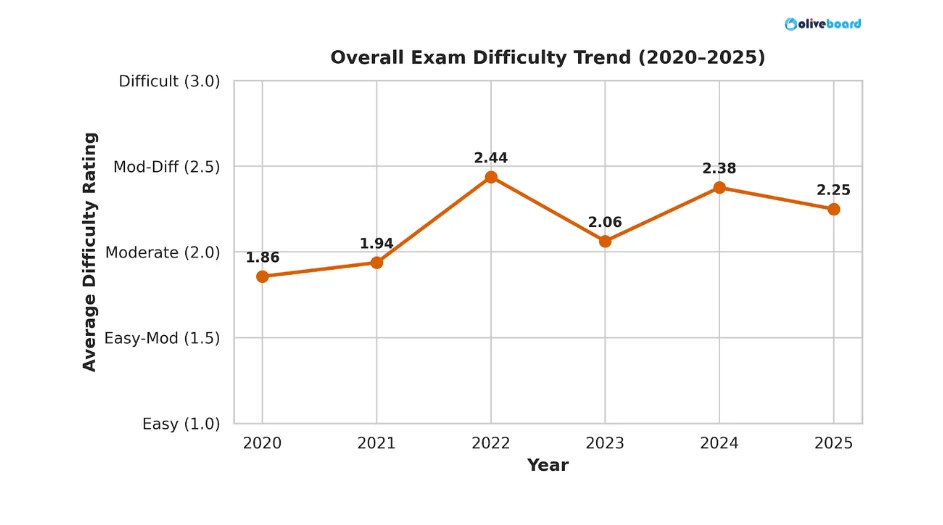
What was the overall difficulty level of NABARD Grade A Phase 1 from 2020 to 2025?
The overall difficulty level ranged from moderate to moderate to difficult across the six years. The 2020 and 2021 papers were moderate, while the 2022, 2024, and 2025 papers had more challenging questions involving reasoning, calculations, and detailed subject knowledge.
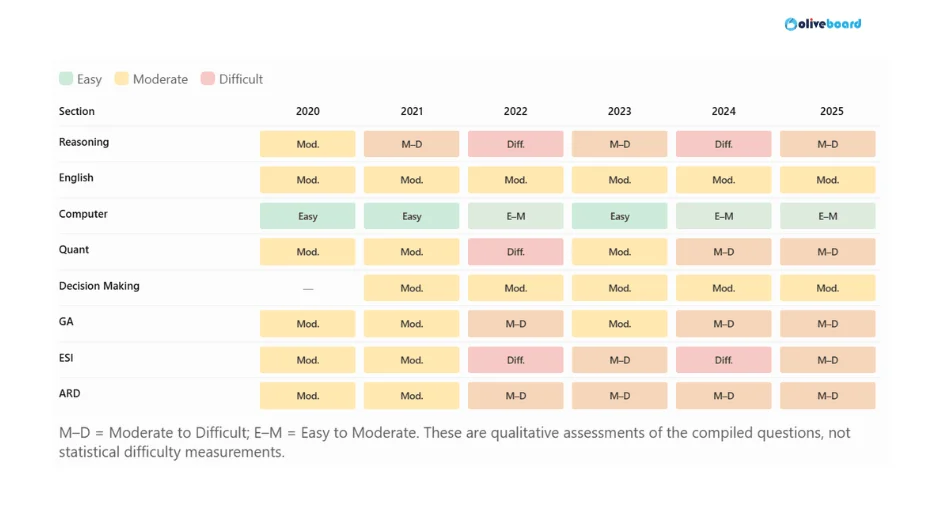
The 2023 paper was assessed as moderate overall, although Reasoning, ESI, and ARD included challenging questions. These ratings are analytical estimates based on the compiled questions, not official NABARD ratings or statistically verified assessments of the actual examinations.
| Year | Overall difficulty | Key observations |
|---|---|---|
| 2020 | Moderate | Standard aptitude questions, reading comprehension, and factual ESI and ARD questions. |
| 2021 | Moderate | Multi-condition puzzles, application-based Quant, and conceptual Decision Making. |
| 2022 | Moderate to Difficult | Complex reasoning, calculation-heavy Quant, and detailed economic and social data. |
| 2023 | Moderate | A balanced mix of aptitude, government schemes, economic concepts, and agricultural science. |
| 2024 | Moderate to Difficult | Complex arrangements, multi-step arithmetic, and detailed scheme-related questions. |
| 2025 | Moderate to Difficult | Analytical reasoning, precise factual knowledge, and specialised agricultural concepts. |
How was the NABARD Grade A Phase 1 paper in 2025?
The 2025 NABARD Grade A paper was moderate to difficult, covering aptitude, ESI, ARD, and General Awareness. Reasoning included puzzles, while Quant featured quadratic equations, percentages, income and expenditure, and mixtures. Questions also covered financial institutions, government schemes, animal husbandry, and agriculture.
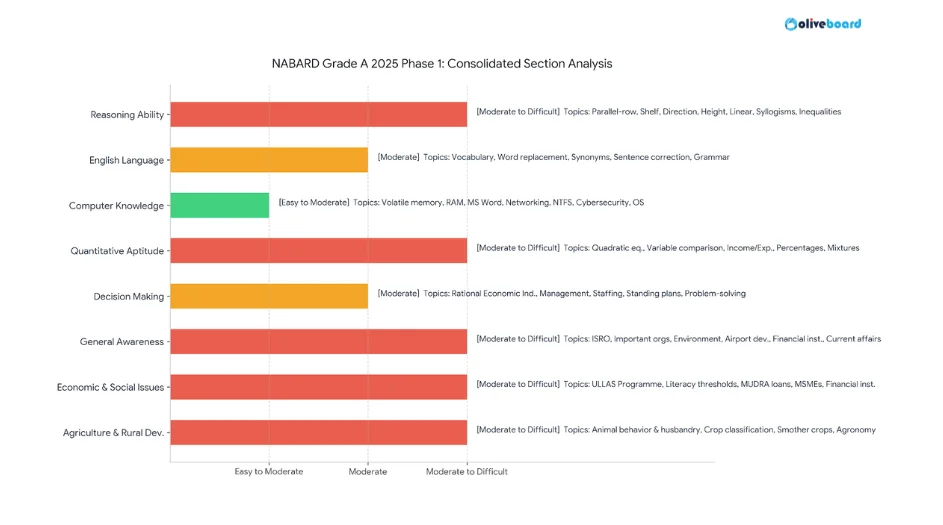
| Section | Types of questions asked | Difficulty |
|---|---|---|
| Reasoning Ability | Parallel-row seating, shelf arrangements, direction sense, height ranking, linear seating, syllogisms, inequalities, and word formation | Moderate to Difficult |
| English Language | Vocabulary, word replacement, contextual synonyms, sentence correction, and grammar | Moderate |
| Computer Knowledge | Volatile memory, RAM, MS Word, networking, NTFS file systems, cybersecurity, and operating-system concepts | Easy to Moderate |
| Quantitative Aptitude | Quadratic equations, variable comparison, income and expenditure, percentage changes, mixtures, ratios, and arithmetic | Moderate to Difficult |
| Decision Making | Rational Economic Individual, management functions, staffing, standing plans, and creative problem-solving | Moderate |
| General Awareness | ISRO, important organisations, environmental achievements, airport developments, institutions, and current affairs | Moderate to Difficult |
| Economic and Social Issues (ESI) | ULLAS – New India Literacy Programme, literacy thresholds, MUDRA loans, MSMEs, and financial institutions | Moderate to Difficult |
| Agriculture and Rural Development (ARD) | Animal behaviour, animal husbandry, crop classification, smother crops, agronomy, and rural institutions | Moderate to Difficult |
How was the NABARD Grade A Phase 1 paper in 2024?
The 2024 NABARD Grade A paper was moderate to difficult, with complex seating, floor, and flat-based puzzles in Reasoning and calculation-based questions on approximation, boats and streams, and mixtures in Quant.
ESI covered government schemes and their implementation, while ARD focused on agricultural credit and conservation methods, testing candidates’ subject knowledge and problem-solving skills.
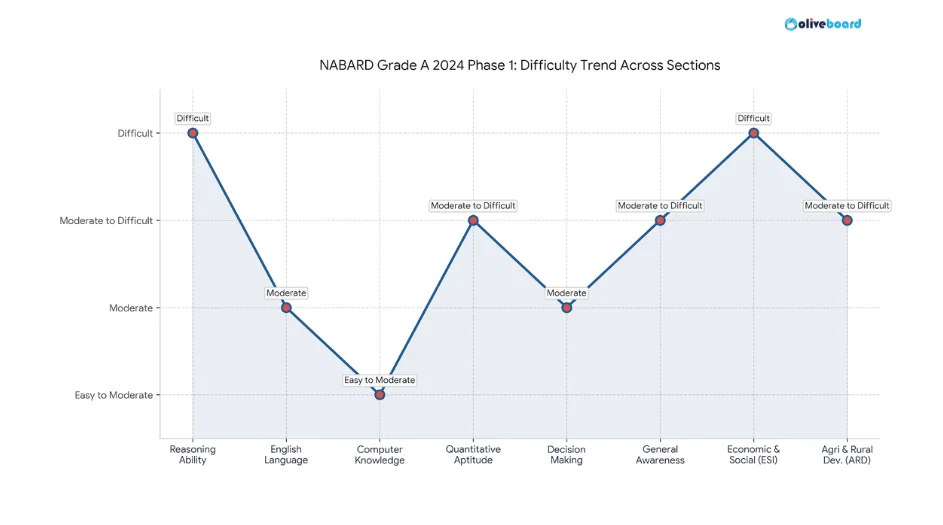
| Section | Types of questions asked | Difficulty |
|---|---|---|
| Reasoning Ability | Linear and circular seating, flat-and-floor arrangements, three-generation blood relations, ordering, sequencing, and inequalities | Difficult |
| English Language | Word replacement, synonyms, grammar correction, vocabulary, and contextual usage | Moderate |
| Computer Knowledge | AMD full form, MS Word formatting, shortcut keys, hardware, and software terminology | Easy to Moderate |
| Quantitative Aptitude | Approximation, percentages, roots, boats and streams, mixtures and alligation, ratios, and arithmetic | Moderate to Difficult |
| Decision Making | Administrative Man Model, heuristics, programmed decisions, delegation, management hierarchy, and managerial responsibilities | Moderate |
| General Awareness | Central KYC Records Registry, insurance schemes, science and technology programmes, and multiple-statement questions | Moderate to Difficult |
| Economic and Social Issues (ESI) | PMKVY 4.0, skill development, MIDH, programme assistance, ministries, and scheme provisions | Difficult |
| Agriculture and Rural Development (ARD) | Agricultural credit targets, animal husbandry, dairy, fisheries, soil conservation, ridging, and bunding | Moderate to Difficult |
How was the NABARD Grade A Phase 1 paper in 2023?
The 2023 NABARD Grade A paper was moderate in difficulty, covering both aptitude and subject-based questions. Reasoning included puzzles and arrangements, Quant focused on equations, variable comparison, and arithmetic, while English tested vocabulary, grammar, and sentence formation. ESI and ARD covered important concepts, factual topics, and government schemes.
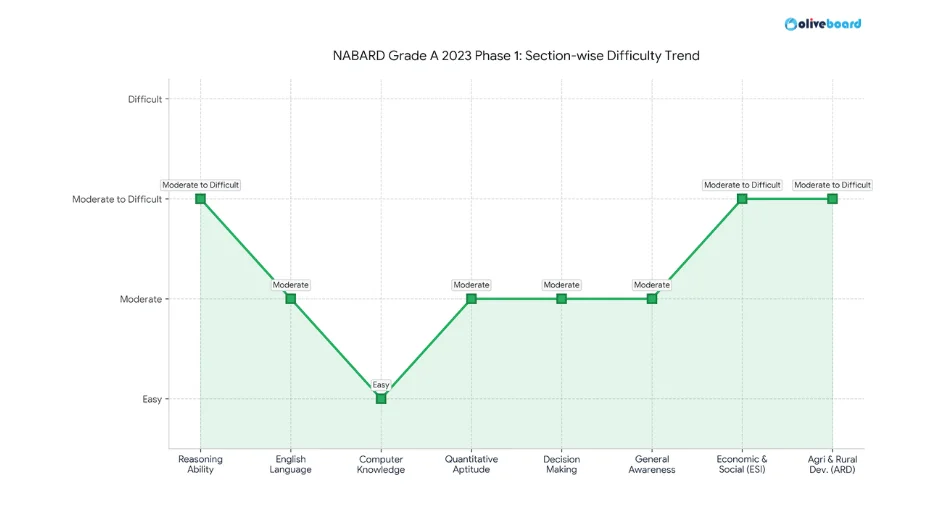
| Section | Types of questions asked | Difficulty |
|---|---|---|
| Reasoning Ability | Blood-relation puzzles, month-and-city arrangements, syllogisms, inequalities, ranking, circular seating, and data sufficiency | Moderate to Difficult |
| English Language | Double fillers, vocabulary, sentence completion, grammar, and contextual word usage | Moderate |
| Computer Knowledge | VFX full form, Windows shortcut keys, incognito browsing, cookies, browser history, and operating-system functions | Easy |
| Quantitative Aptitude | Quadratic equations, comparison of variables, arithmetic word problems, and numerical calculations | Moderate |
| Decision Making | Problem analysis, identification of contributing factors, management concepts, and decision-making methods | Moderate |
| General Awareness | Banking institutions, government schemes, financial developments, ministries, projects, and current affairs | Moderate |
| Economic and Social Issues (ESI) | Consumer Price Index (CPI), inflation, economic indicators, social programmes, and policy concepts | Moderate to Difficult |
| Agriculture and Rural Development (ARD) | Scientific names of crops and flowers, horticulture, cultivation practices, agricultural institutions, and rural development schemes | Moderate to Difficult |
How was the NABARD Grade A Phase 1 paper in 2022?
The 2022 NABARD Grade A paper was considered moderate to difficult, with morning and evening shift variations in Reasoning, Quant, and Decision Making. The exam included complex puzzles, multi-step calculations, report-based economic questions, and detailed agricultural topics, requiring strong concepts, accurate fact recall, and good time management.
| Section | Types of questions asked | Difficulty |
|---|---|---|
| Reasoning Ability | Advanced syllogisms, complex seating and floor arrangements, blood relations, direction sense, coding-decoding, inequalities, and data sufficiency | Difficult |
| English Language | Reading comprehension, grammar, vocabulary, sentence completion, word usage, and commonly confused words | Moderate |
| Computer Knowledge | MS Word formatting, gutter margins, storage, networking, operating systems, and hardware | Easy to Moderate |
| Quantitative Aptitude | Data interpretation, ratios, averages, approximation, missing-value calculations, partnership, and arithmetic | Difficult |
| Decision Making | Quantitative decision techniques, managerial decisions, leadership approaches, cognitive biases, and situation-based questions | Moderate |
| General Awareness | Current affairs, awards, personalities, geographical locations, financial awareness, and national developments | Moderate to Difficult |
| Economic and Social Issues (ESI) | Global Gender Gap Report rankings, financial inclusion indicators, socioeconomic indices, government schemes, and development data | Difficult |
| Agriculture and Rural Development (ARD) | Crop science, agricultural production, agricultural credit, rural development programmes, and technical agricultural concepts | Moderate to Difficult |
How was the NABARD Grade A Phase 1 paper in 2021?
The 2021 NABARD Grade A paper was moderate, with varied Reasoning puzzles, application-based Quant questions, and Decision Making questions on management and organisational behaviour. ESI and ARD covered government schemes, agricultural finance, and technical topics, while Reasoning had more arrangement-based puzzles with multiple conditions compared to 2020.
| Section | Types of questions asked | Difficulty |
|---|---|---|
| Reasoning Ability | Floor arrangements, parallel-row seating, scheduling, syllogisms, coding-decoding, and inequalities | Moderate to Difficult |
| English Language | Reading comprehension, grammar, contextual sentence completion, vocabulary, and sentence correction | Moderate |
| Computer Knowledge | Storage devices, hardware, software, networking, and computer applications | Easy |
| Quantitative Aptitude | Pipes and cisterns, consecutive even numbers, equations, percentages, ratios, and data interpretation | Moderate |
| Decision Making | Brainstorming, Delphi method, Nominal Group Technique, cognitive biases, leadership styles, and decision-making stages | Moderate |
| General Awareness | GDP forecasts, economic developments, reports, government initiatives, and current affairs | Moderate |
| Economic and Social Issues (ESI) | Samagra Shiksha, education programmes, social welfare schemes, implementing agencies, and economic indicators | Moderate |
| Agriculture and Rural Development (ARD) | Kisan Credit Card (KCC), agricultural credit, crop production, rural development programmes, and agricultural science | Moderate |
How was the NABARD Grade A Phase 1 paper in 2020?
The 2020 NABARD Grade A Phase 1 paper was considered moderate, focusing on basic aptitude, reasoning, reading comprehension, computer fundamentals, and economic and agricultural topics. Reasoning and Quant required careful calculations, while GA, ESI, and ARD tested factual knowledge, current affairs, government schemes, and agricultural concepts.
| Section | Types of questions asked | Difficulty |
|---|---|---|
| Reasoning Ability | Circular and linear seating arrangements, data sufficiency, blood relations, coding-decoding, inequalities, and alphabetical pairing | Moderate |
| English Language | Reading comprehension, inference-based questions, vocabulary, grammar, and contextual word usage | Moderate |
| Computer Knowledge | Computer networks, hardware, input/output devices, browsers, and basic computer terminology | Easy |
| Quantitative Aptitude | Mensuration, ratios, cylinder volumes, arithmetic, quadratic equations, and variable comparison | Moderate |
| General Awareness | International summits, awards, organisations, important events, and economic developments | Moderate |
| Economic and Social Issues (ESI) | Government schemes, financial inclusion, socioeconomic development, and economic indicators | Moderate |
| Agriculture and Rural Development (ARD) | Crop production, foodgrain estimates, horticulture, agricultural science, and agricultural schemes | Moderate |
Which NABARD Grade A sections were the most difficult from 2020 to 2025?
The section-wise analysis shows that Reasoning, Quant, ESI, and ARD often required more preparation due to complex problems, detailed facts, and technical topics. English and Computer Knowledge were generally more manageable, while Decision Making mainly focused on management concepts rather than lengthy calculations.
| Section | 2020 | 2021 | 2022 | 2023 | 2024 | 2025 |
|---|---|---|---|---|---|---|
| Reasoning | Moderate | Moderate to Difficult | Difficult | Moderate to Difficult | Difficult | Moderate to Difficult |
| English | Moderate | Moderate | Moderate | Moderate | Moderate | Moderate |
| Computer Knowledge | Easy | Easy | Easy to Moderate | Easy | Easy to Moderate | Easy to Moderate |
| Quantitative Aptitude | Moderate | Moderate | Difficult | Moderate | Moderate to Difficult | Moderate to Difficult |
| Decision Making | Not available in compilation | Moderate | Moderate | Moderate | Moderate | Moderate |
| General Awareness | Moderate | Moderate | Moderate to Difficult | Moderate | Moderate to Difficult | Moderate to Difficult |
| ESI | Moderate | Moderate | Difficult | Moderate to Difficult | Difficult | Moderate to Difficult |
| ARD | Moderate | Moderate | Moderate to Difficult | Moderate to Difficult | Moderate to Difficult | Moderate to Difficult |
What major trends can be identified from NABARD Grade A papers from 2020 to 2025?
The year-wise analysis shows that the core subjects remained consistent, with variations in question types and difficulty. Reasoning and Quant focused on problem-solving, while ESI, ARD, and General Awareness required strong conceptual knowledge and regular revision of current affairs.
- Reasoning Ability: Seating arrangements, puzzles, syllogisms, inequalities, and data sufficiency.
- Quantitative Aptitude: Arithmetic, percentages, ratios, quadratic equations, approximation, and data interpretation.
- English Language: Reading comprehension, vocabulary, grammar, sentence completion, and contextual word usage.
- Computer Knowledge: Computer fundamentals, hardware, networking, operating systems, internet, and MS Office.
- Decision Making: Management models, decision-making stages, cognitive biases, leadership, and organisational behaviour.
- General Awareness: Current affairs, awards, economic developments, government initiatives, and institutional facts.
- Economic and Social Issues (ESI): Government schemes, economic indicators, financial inclusion, socioeconomic reports, and programme provisions.
- Agriculture and Rural Development (ARD): Crop science, agricultural production, horticulture, animal husbandry, agricultural credit, and rural development schemes.
How should you prepare for NABARD Grade A based on the previous year paper analysis?
Candidates should use NABARD Grade A previous year papers to understand the exam pattern, practise important topics, and identify weak areas. Regular timed practice, mock tests, and revision of ESI, ARD, and current affairs can improve speed, accuracy, and overall preparation.
- Understand the Exam Pattern: Review the syllabus, sections, time limit, and negative marking.
- Solve Year-Wise Papers: Practise the 2020–2025 papers to understand question types and difficulty levels.
- Practise Reasoning and Quant: Focus on puzzles, seating arrangements, arithmetic, equations, and data interpretation.
- Prioritise ESI and ARD: Revise economic indicators, government schemes, agricultural science, and rural development.
- Prepare General Awareness: Cover current affairs, reports, awards, organisations, and economic developments.
- Revise English and Computer Knowledge: Practise comprehension, grammar, vocabulary, computer fundamentals, networking, and MS Office.
- Analyse Mock Tests: Review incorrect answers and identify topics that need improvement.
- Improve Time Management: Practise solving questions within the time limit and avoid spending too long on difficult questions.
FAQs
Phase 1 includes Reasoning, English, Computer Knowledge, Quantitative Aptitude, Decision Making, GA, ESI, and ARD.
PYQs help understand exam trends, identify high-weightage topics, and improve time management and accuracy.
Yes, aspirants can attempt these papers online.
- SIDBI Grade A Selection Process 2026, Know About All Phases
- SIDBI Grade A Legal Stream Syllabus 2026, Check Revised Details
- SIDBI Grade A IT Stream Syllabus 2026, Check Revised Details
- Static GK Topics for SSC & Railway Exams 2026, Check Topic-Wise Weightage
- SIDBI Grade A General Stream Syllabus 2026, Check Revised Syllabus
- ICAR Technical Assistant General English Practice Quiz, Download PDF

Hi, I’m Aditi. I work as a Content Writer at Oliveboard, where I have been simplifying exam-related content for the past 4 years. I create clear and easy-to-understand guides for JAIIB, CAIIB, and UGC exams. My work includes breaking down notifications, admit cards, and exam updates, as well as preparing study plans and subject-wise strategies.
My goal is to support working professionals in managing their exam preparation alongside a full-time job and to help them achieve career growth.