
How do you make mock tests actually improve your SSC CGL preparation? For Akhilesh Chauhan, the answer was not simply attempting more mocks. His strategy was to complete the syllabus and PYQs first, identify weak topics through mocks, analyse mistakes, and then use sectional tests to strengthen those areas.
After missing selection in his first attempt by a few marks, Akhilesh changed his approach for his next attempt. His focus shifted from simply taking tests to analysing every mock and using the results to plan his preparation. That approach helped him clear SSC CGL and join the GST department in Mumbai.
Akhilesh’s SSC CGL Success Snapshot
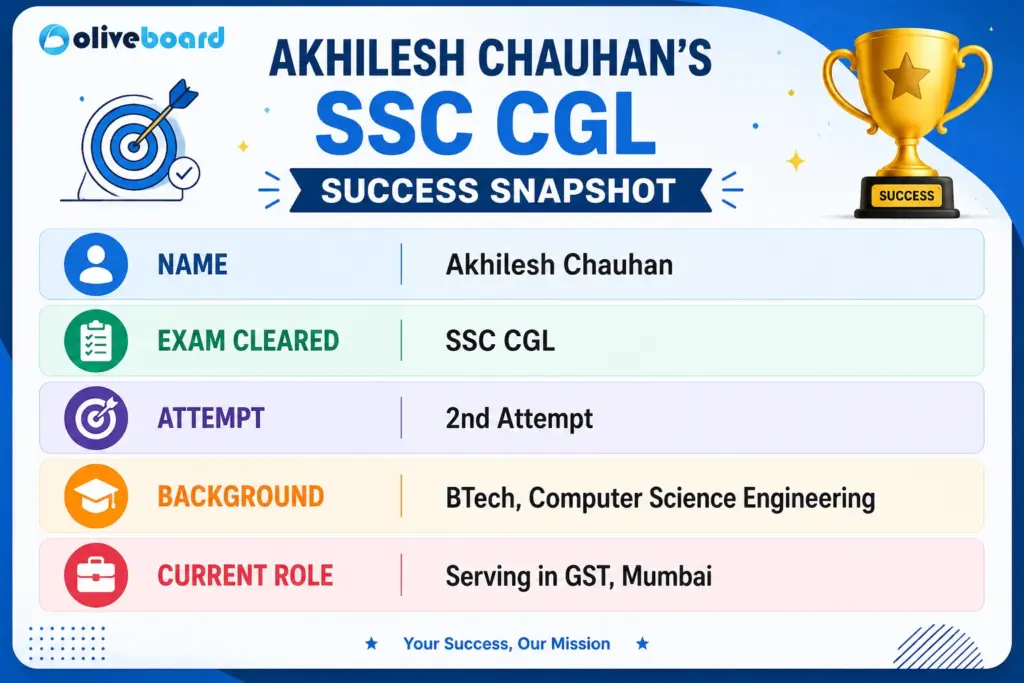
Akhilesh’s journey began with defence exam preparation. After multiple attempts and SSBs without making the final list, he shifted his focus to SSC CGL. His first attempt came close, but he missed selection by a few marks. He returned with a more structured approach.
What Was Akhilesh’s SSC CGL Mock Test Strategy?
His biggest change was learning to treat mocks as a diagnostic tool, rather than just a scorecard.
After attempting a mock, he would analyse it subject-wise. In Quant, he noted calculation-related problems and questions that took too much time. After several mocks, he created a chapter-wise collection of questions he had got wrong or found difficult.
This gave him a clear list of weak topics. Instead of revising everything, he could dedicate an entire study session to those specific areas.
Attempt the mock. Analyse it. Find the weak topic. Work on it. Then attempt again.
Why Sectional Mocks Became His Turning Point
For Akhilesh, sectional mocks were one of the biggest turning points in his preparation.
He noticed that repeated sectional practice improved both his confidence and speed. In Quant, for example, he initially found the time pressure intimidating. With repeated sectional tests, he became more comfortable attempting more questions within the allotted time. He followed a similar approach for Reasoning and English.
His preparation flow was:
Weak topic → Topic-wise practice → Sectional mocks → Analysis → Full-length mocks
He also preferred concentrating on weak topics instead of scattering a small number of questions across multiple chapters. If three Quant topics were weak, he would spend dedicated time working on those topics before returning to mocks.
Should You Attempt More Mocks When Your Scores Stop Improving?
Not necessarily.
Akhilesh experienced a phase where his mock scores became stagnant. Instead of repeatedly attempting tests hoping for a higher score, he took a 10-day break from mocks and worked on the concepts where he was struggling.
He specifically worked on topics such as Installments in Quant and Word Analogy in Reasoning. When he returned to mocks, he felt more confident and motivated to attempt them again.
The lesson is simple: when scores stop improving, analyse the reason instead of blindly increasing mock frequency.
How Oliveboard Mocks Helped Akhilesh
Akhilesh started using Oliveboard more seriously during his Mains preparation. He used its mocks extensively for Quant, Reasoning and English and found the sectional tests particularly useful for chapter-wise practice.
He also highlighted the exam-like interface and Oliveboard’s live mocks. He said the interface gave him a feel similar to the actual examination, while live mocks added a competitive element to his preparation.
He also used Oliveboard’s Mains mock series extensively and said he rarely missed the live mocks during his preparation.
How Should Beginners Start SSC CGL Mock Practice?
Akhilesh does not recommend jumping straight into mocks without understanding the syllabus.
His advice is to first build your basics, complete the syllabus and practise PYQs. Once you know what you are expected to solve, gradually move towards topic-wise tests, sectional mocks and full-length mocks.
A practical progression based on his strategy is:
Complete the syllabus → Practise PYQs → Take topic-wise tests → Attempt sectional mocks → Move to full-length mocks → Analyse → Improve
Akhilesh’s Advice for SSC CGL Aspirants
His final advice is straightforward: keep your confidence, attempt mocks, analyse them, and complete the syllabus first.
He also stresses being honest with yourself about your preparation. Instead of obsessing over mock scores, focus on whether you are genuinely improving and staying consistent.
For Akhilesh, the biggest shift was not taking more tests. It was learning what to do after every test.
And that is perhaps the most useful lesson from his SSC CGL journey:
A mock test tells you your score. Mock analysis tells you how to improve it.
Everything You Need for SSC CGL Preparation, in One Place
Akhilesh’s journey shows that effective SSC CGL preparation needs the right mix of classes, PYQs, mocks, practice and revision. Oliveboard’s SSC Super Elite brings these resources together in one course, with live and recorded classes, mock tests, PYQs, practice sessions, notes and doubt-clearing support.
So, instead of switching between multiple resources, aspirants can follow one structured preparation cycle: learn, practise, test, analyse and improve.
Frequently Asked Questions
How did Akhilesh analyse his SSC CGL mocks?
He analysed mocks subject-wise, identified incorrect and time-consuming questions, organised weak areas chapter-wise, and then worked specifically on those topics.
Are sectional mocks useful for SSC CGL?
According to Akhilesh, sectional mocks helped him improve confidence, speed and command over individual sections before attempting full-length mocks.
Should beginners attempt full-length mocks immediately?
Akhilesh recommends completing the syllabus and practising PYQs before heavily relying on mocks. Topic-wise and sectional tests can then be introduced progressively.
What is the biggest lesson from Akhilesh’s SSC CGL preparation?
Don’t chase mock scores blindly. Use every mock to identify a weakness, work on it, and return stronger.

I started my journey with storytelling and journalism, and somewhere along the way, I discovered how much I truly love writing. Words have always been my way of connecting with people.
With 4+ years of experience in content creation, social media, and video storytelling, I focus on building meaningful conversations, not just posts. I enjoy understanding audiences, planning engaging content, and turning followers into active, connected communities.
At Oliveboard, I work on creating value-driven content that informs, engages, and brings people together.