
Preparing for RBI Grade B is not just about studying books and static subjects. The exam is conducted in two phases, and in both Phase 1 and Phase 2, Current Affairs covering Economic and Social Issues (ESI) and Finance Management (FM) plays a very important role. A strong command over these topics significantly improves a candidate’s chances in the final selection. Many aspirants underestimate them in the beginning, but they eventually become the biggest score boosters when prepared in a structured and consistent manner.
General Awareness in RBI Grade B is not about rote learning facts, but about building a well-defined information system where the right selection of sources, depth of understanding, and strategic revision directly translate into high scoring potential. In this blog, we have provided a complete, practical, and exam-focused GA strategy for RBI Grade B 2026, based on what actually matters in the exam.
Why does current affairs play such a crucial role in RBI Grade B exam?
Current affairs is the backbone of both Phase 1 and Phase 2 in RBI Grade B because most sections are directly or indirectly linked to it. It includes banking awareness, economy-related topics, government schemes, and important national and international events, all of which help in both objective and descriptive questions.
In Phase 1, it helps you quickly solve factual questions from recent updates and news. In Phase 2, it becomes even more important as questions require clear explanation, data understanding, and policy awareness. The main reason is that RBI Grade B is not a memory-based exam but an application-based exam, where understanding concepts and their real-world impact is more important than simply remembering facts.
What are the high-weightage areas of RBI Grade B current affairs?
The high-weightage topics in RBI Grade B current affairs are those from which questions are most frequently asked in both Phase 1 and Phase 2. These include banking and economy news, RBI circulars and MPC decisions, government schemes, important reports and indices, and the Budget and Economic Survey. Focusing on these areas helps candidates maximize their scoring potential in General Awareness.
| Area | Exam Phase | Importance |
| Banking & Economy News | Phase 1 | Very High |
| RBI Circulars & MPC decisions | Phase 1 & 2 | Very High |
| Government Schemes | Phase 1 & 2 | High |
| Reports & Indices | Phase 2 | Very High |
| Budget & Economic Survey | Phase 1 & 2 | Critical |
Also Check: RBI Grade B Exam Pattern
What is the right RBI Grade B GA phase 1 preparation strategy?
Phase 1 of RBI Grade B is an objective exam where speed and accuracy matter the most. The GA section here is high scoring, but only if you prepare smartly. The goal is not to read everything, but to focus on high-probability topics that repeat every year. The best strategy is to build a strong base of current affairs from the last 6 months and revise it multiple times instead of constantly adding new material.
| Particulars | Details |
| Focus areas for Phase 1 GA | Banking & economy updates Government schemes & cabinet decisions Sports, awards, summits & international events RBI policy updates & monetary decisions SEBI notifications & financial market news |
| Cover last 6 months current affairs | PIB daily updates RBI official releases Monthly current affairs compilations Focus on exam-relevant content only |
| Banking and economy priority | Repo rate changes Inflation updates Banking reforms Digital banking initiatives Key macroeconomic indicators |
| General awareness topics | Sports events Awards & honors International summits Important appointments |
| Revision strategy | Monthly GA quizzes for weak areas Mock tests for speed & accuracy Flash notes for quick revision |
| Golden rule | Avoid random study Stick to limited sources Revise multiple times Focus on consistency |
What is the right GA preparation strategy for Phase 2?
Phase 2 GA is completely different from Phase 1. It is not about recognition of facts, but understanding of concepts, data, and policy impact. Here, you need depth, not breadth. You must be able to explain “why” behind every event, not just “what happened”.
| Particulars | Details |
| Core focus areas | ESI (Economic and Social Issues) Finance and banking current affairs Government policy analysis Reports and indices Budget and Economic Survey |
| Reports and indices | Key data points from reports India and global rankings Country comparisons Important policy recommendations |
| Budget and Economic Survey | Budget highlights and key announcements Economic Survey findings and trends Important government schemes Fiscal and economic data analysis |
| Answer writing practice | Practice short answer writing Write essay-based responses Work on data-based explanations Improve structure and clarity |
| Linking current & static topics | Inflation linked with monetary policy Government schemes linked with social development Banking reforms linked with financial stability Use examples for better understanding |
| Finance current affairs | RBI circulars and updates Monetary Policy Committee (MPC) decisions SEBI rules and regulations Banking sector developments |
| ESI current affairs | Government welfare schemes Social and economic issues Development programs Key reforms impacting society |
What are the 5 pillars of RBI Grade B current affairs preparation?
The RBI Grade B current affairs preparation is built on five important pillars that together cover the entire syllabus of both Phase 1 and Phase 2. These pillars include General Current Affairs, ESI, Finance, Reports & Indices, and Budget & Economic Survey. A clear understanding of these topics helps candidates prepare in a structured and exam-focused way.
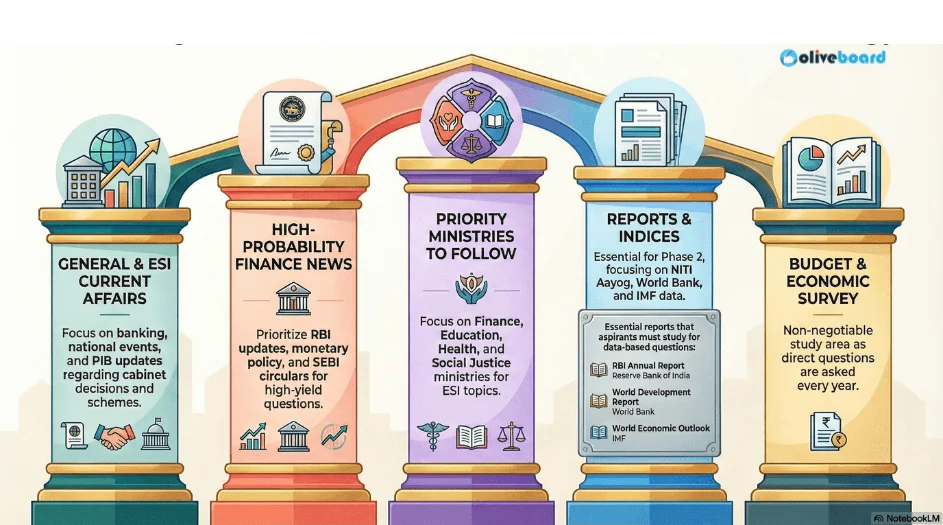
Pillar 1 General Current Affairs
This pillar builds the base of your preparation and covers important updates from national and international events along with basic banking and economic news.
- National events and developments
- International news and relations
- Banking sector updates
- Basic economic developments
Pillar 2 ESI Current Affairs
This pillar focuses on government schemes, policies, and social and economic development topics that are important for both phases.
- Government schemes and welfare programs
- Policies from key ministries (Finance, Health, Education, etc.)
- Social sector developments
- Key socio-economic issues in India
Pillar 3 Finance Current Affairs
This is the most important pillar for RBI Grade B as it covers core financial and regulatory developments.
- RBI policy updates and circulars
- SEBI regulations and market rules
- Monetary Policy Committee (MPC) decisions
- Banking and financial sector reforms
Pillar 4 Reports & Indices
This pillar includes high-value data-based topics that are frequently asked in Phase 2.
- Global and Indian economic reports
- Inflation and GDP data
- International rankings and indices
- Economic outlook and forecasts
Pillar 5 Budget & Economic Survey
This pillar connects all major economic concepts and is highly important for both phases.
- Government revenue and expenditure
- Sector-wise budget allocations
- Key schemes announced in Budget
- Economic Survey highlights and growth outlook
Which ministries should you follow for ESI current affairs?
ESI questions in RBI Grade B phase 2 exam are mainly based on government schemes and important policy announcements. Instead of trying to study everything, candidates should focus on key ministries such as:
- Ministry of Finance
- Ministry of Education
- Ministry of Health
- Ministry of Environment, Forest & Climate Change
- Ministry of New & Renewable Energy
- Ministry of Women & Child Development
- Ministry of Social Justice
- Ministry of Minority Affairs
- Ministry of Tribal Affairs
As these ministries are frequently linked to exam questions, a clear understanding of their major schemes, objectives, and recent updates helps in answering questions in a simple and effective way.
Also Check: RBI Grade B Syllabus
Which reports and indices are most important for Phase 2?
Reports and indices are one of the most important and high-scoring areas in Phase 2 of RBI Grade B as they are data-based and useful for descriptive answers. Instead of reading full reports, candidates should focus on executive summaries, key findings, and India-specific data, and revise short notes regularly. Some important reports from institutions are given in the table below, which provide key economic indicators, rankings, and policy insights for the exam.
| Report | Published by | What to focus on |
| RBI Annual Report | Reserve Bank of India | Banking stability, inflation, policy |
| Trend and Progress of Banking in India | Reserve Bank of India | NPA, credit growth |
| Report on Currency and Finance | Reserve Bank of India | Thematic economic analysis |
| World Economic Outlook | IMF | GDP, inflation forecasts |
| World Development Report | World Bank | Development themes |
What are the best sources for RBI Grade B current affairs preparation?
Choosing the right source is more important than reading multiple sources. Too many sources create confusion and reduce revision efficiency.
| Category | Details |
| Trusted sources | Press Information Bureau (PIB) daily updates Reserve Bank of India (RBI) official website SEBI official notifications IMF and World Bank reports Union Budget documents (indiabudget.gov.in) Economic Survey reports Monthly current affairs compilations Monthly GA mock tests |
| Source strategy | PIB – Daily updates on government schemes and policies RBI – Banking regulations and monetary policy updates SEBI – Stock market rules and financial regulations IMF/World Bank – Global reports, rankings, and economic data Monthly PDFs – Consolidated revision and exam preparation base |
FAQs
Current affairs is crucial because it forms the base of both Phase 1 and Phase 2 questions across GA, ESI, and Finance.
Banking, economy, RBI updates, government schemes, reports & indices, and Budget are the most important areas.
Focus on the last 6 months of updates from PIB, RBI, and monthly compilations with regular revision.
Phase 2 GA focuses on understanding concepts, data analysis, policy impact, and descriptive answer writing.
Focus on executive summaries, key findings, and India-specific data instead of reading full reports.
- Are You Eligible for RBI Grade B 2026? Check with FREE Live Tool
- RBI Grade B GA Preparation Strategy for Phase 1 and 2
- RBI Circulars 2026, Attempt Quiz and Download RBI Circulars PDFs
- Attempt RBI Grade B Quantitative Aptitude MCQs & Download PDF
- RBI Grade B Previous Year Papers, Attempt & Download PYPs PDF
- [Video] How to solve Coding & Decoding Questions IBPS, RBI, SSC CGL, SBI Exams

Hi, I’m Aditi. I work as a Content Writer at Oliveboard, where I have been simplifying exam-related content for the past 4 years. I create clear and easy-to-understand guides for JAIIB, CAIIB, and UGC exams. My work includes breaking down notifications, admit cards, and exam updates, as well as preparing study plans and subject-wise strategies.
My goal is to support working professionals in managing their exam preparation alongside a full-time job and to help them achieve career growth.