
Prepare effectively for the RBI Grade B Exam with Previous Year Question Papers. These papers help you understand the exam pattern, difficulty level, question types, and topic-wise weightage for Phase 1 and Phase 2. Regular practice also helps you identify important topics in General Awareness, Economic and Social Issues (ESI), Finance, Management, English, and Reasoning while improving your speed, accuracy, and confidence.
RBI Grade B 2025 PYP, Download PDF
The direct link to download the RBI Grade B previous year paper 2025 is provided below. Aspirants can download the PDF through the link.
| Paper Name | Link |
| RBI Grade B 2025 PYP PDF | Download Now |
RBI Grade B 2024 PYP, Download PDF
The direct link to download the RBI Grade B previous year paper 2024 is provided below. Aspirants can download the PDF through the link.
| Paper Name | Link |
| RBI Grade B 2024 PYP PDF | Download Now |
Attempt RBI Grade B Previous Year Reasoning Questions
Practise RBI Grade B Previous Year Reasoning Questions to understand the exam pattern, question types, and key topics. Regular practice helps improve speed, accuracy, and problem-solving skills while building confidence for the RBI Grade B Exam.
Directions (Q1- 2): In each of the questions below are given some statements followed by fiveconclusions. You have to take the given statements to be true even if they seem to be at variancewith commonly known facts. Read all the conclusions and then decide which of the givenconclusions logically does not follow from the given statements, disregarding commonly knownfacts.
Q.1) Only a few bananas are oranges. No banana is mango. No grapes are oranges.
Conclusions:
A. Some grapes can be mangoes
B. All bananas can be oranges
C. Some mangoes are not bananas
D. Some grapes are bananas is a possibility
E. Some oranges can be mangoes
Q.2) Some actors are dancers. Only a few dancers are singers. No singer is politician
Conclusions:
A. Some politician being actors is a possibility
B. Some dancers are not singers
C. Some dancers are not politicians is not a possibility
D. Some actors are singers
E. Some actors are singers is a possibility
Directions (Q3-7): Answer the questions based on the information given below:
Nine friends A, B, C, D, E, F, G, H and I were born on 18th of different months in the same year suchthat no one was born in March, June and November. These persons belong to different placesamong Solapur, Kanpur, Jaipur, Raipur, Jodhpur, Sultanpur, Udaipur, Nagpur and Firozpur.
B was born in a month with 31 days and three months before the person from Raipur. Threepersons were born between B and D, who is not the youngest. The person from Nagpur was bornimmediately after the one from Kanpur. The person from Kanpur was not born in a month withonly 30 days. G is not from Sultanpur.
There is a gap of only one month between the birth of G and the one from Solapur. The personfrom Jaipur is five months elder than G. F was born two months after D. Only one person wasborn between F and E, who is from Solapur. H, who is from Udaipur, was born three months afterI, who is not the eldest. A is younger than C. Person from Jodhpur was born before the one fromSultanpur.
Q.3) A is how many months older than H?
Q.4) Who among the following persons were born between C and the one from Udaipur?
I. Person from Jaipur
II. D
III. B
Q.5) The eldest person belongs to which place?
Q.6) persons were born between the person who is born in October and the one from .
Q.7) 3rd eldest person is months older than .
Directions (Q8-9): Study the following information to answer the given questions.
@ F 5 2 M $ 7 K T R 3 C + 8 B ! 9 D Q * G 6 W N
STEP 1 – Those numbers which are immediately preceded by a symbol and immediately followedby an alphabet are written at the right end in descending order.
STEP 2 – After completing step 1, the alphabet which is immediately followed by a symbol arewritten between 7th and 6th element from right end in alphabetical order from left to right.
Q.8) Which of the following element is 11th to the right of the element which is 4th fromtheright end in step 1?
Q.9) How many alphabets are immediately followed or preceded by symbol in step 2?
Directions (Q10-14): Answer the questions based on the information given below:
Nine boxes A, B, C, D, E, F, G, H and I are kept one above the other. Each box contains differentitems among Clothes, Bottles, Books, Watches, Combs, Pens, Mobiles, Shoes & Pencils. Numberof items in these boxes is different among 7, 12, 14, 18, 21, 23, 24, 30 and 27. The bottommostbox is numbered 1 and the topmost box is numbered 9.
Mobiles are kept in box 4. H is three boxes above the box with 24 items. G has 14 itemsand is oneof the four boxes above H. Third box from the top contains 2nd highest numberof items. Thereare three boxes between G and the box with 18 items. Number of bottles is six more than numberof clothes. D is immediately below the box which contains clothes and neither of these boxescontains more than 23 items. There are three boxes between the box, which contains bottles andE, which contains books.
Shoes are three boxes above B. A is immediately above F. Box, which contains Pens, isimmediately above I. C is three boxes above the box, which contains the lowest numberof items.Box with 23 items is immediately below the box, which contains watches. Number of pencils isless than number of combs. Number of Books is not less than number of shoes.
Q.10) C is how many boxes above the box which contains 21 items?
Q.11) What is the sum of number of combs and pencils?
Q.12) Which among the following box is not between the box containing the lowest andhighest number of items?
I. D
II. A
III. Box containing 14 items.
Q.13) What is the difference between the number of items in the topmost box and the numberof watches?
Q.14) Which among the following boxes are kept between the box with 21 items and boxcontaining Pens?
Directions (Q15-19): Answer the questions based on the information given below.
Fourteen persons are sitting in two parallel rows containing seven persons in each row in such away that there is an equal distance between adjacent persons. Initially, in row 1, P, Q, R, S, T, Uand V are seated and all of them are facing towards the east and in row 2, A, B, C, D, E, F and Gare seated and all of them are facing towards the west. Therefore, in the given seatingarrangement each person sitting in row 1, is facing the persons sitting in row 2 and vice versa.
They play a game of throwing a dice. They interchange their initial position according to the gamerules which are as follows:
I. On throwing the dice, if odd number comes, then the person sitting 2nd to the left ofthrowerexchanges his seat with the person sitting opposite to the one, who sits immediate right ofthrower.
II. On throwing the dice, if even number comes, then the person sitting immediate right ofthethrower exchanges his seat with one, who sits opposite to the thrower.
Before Movement:
1. T sits fourth to the left of P. Either T or P sits at an extreme end of the row.
2. The one who faces P sits second to the left of F.
3. S sits exactly in the middle of the row. C and D are immediate neighbours of each other.
4. Number of persons sitting to the left of F is twice the number of persons sitting to the rightof F.
5. The one, who faces P sits to the immediate left of G and that person is neither C nor D.
6. Number of persons sit between P and R is same as the number of persons sit between T andS.
7. T neither faces C nor D. No one sits between S and V.
8. At least two persons sit between G and E. R does not face B.
9. At most one person sit between S and Q.
10. U faces neither E nor C.
11. A throws the dice and gets 4 after that F throws the dice and gets 3 and finally, V throws the dice and gets 1.
Q.15) Who sits opposite to R after the movement?
Q.16) Who sits 2nd to the right of G before the movement?
Q.17) What is the position of T with respect to V after the movement?
Q.18) How many persons sit between A and F before the movement?
Q.19) Which of the following statement is true about B?
Directions (Q20-21): In the following question, two conclusions have been given followed byfive sets of possible statements. You have to take the given conclusions to be true even if theyseem to be at variance with the commonly known facts and then decide for the given conclusionslogically follow from which of the given set of statements disregarding commonly known facts.
Q.20) Conclusions:
1. Some gold are not silver.
2. Some gold are fabric.
Statements:
Quiz Summary

Sign Up
Or, register with email
 Email Id
 Mobile Number
 Password

Login
Email Id
Password
Forgot Password
Please enter the Email ID we will send you a Email with the link to reset the password.
Email Id
Or, login with

RBI Grade B Previous Year Paper 2023, Download PDF
The link to download the RBI Grade B previous year paper 2023 is provided below. Aspirants can download the PDF for free.
| Paper Name | Link |
| RBI Grade B 2023 PYP PDF | Download Now |
Attempt RBI Grade B Previous Year Questions
Attempt RBI Grade B Previous Year Quantitative Aptitude Questions to get familiar with the types of questions asked in the exam. Practising these questions regularly can improve your calculation speed, accuracy, and overall preparation.
Q.1) Given below are 3 equations I, II and III where ‘a’ and ‘b’ are the roots of equation I where(a < b) and ‘c’ and’d’ are roots of equation II where (c < d). On this basis, solve for equation III andfind the relationship between ‘z’ and ‘k’ given that k = 11
I. 3x(x – 12) + 72 = x²- 11x – 5
II. 5y(y – 3) – 64 = y(3y – 2) – 19
III. (z + 2a – d)² = 169
Q.2) Given below are three equations i.e. ‘I’, ‘II’ and ‘III’. If roots of the equation ‘I’ are ‘p’ and’q’, respectively such that p > q while the roots of the equation ‘II’ are ‘m’ and ‘n’ respectively suchthat m > n, then find the value of ‘K’.
I. 2x²- 6(x + 4) = 3x + 11
II. 2y²- 12(y – 4) = 7y + 6
III. (15m/2) – 8q = 9p – 4n + K²
Q.3) The series given below contains a missing number ‘P’. Find the value of ‘P’ and determinewhich among the given three statement(s) is/are true.
74, 290, 241, 753, 672, ‘P’, 1551
I: The nearest perfect square number to ‘P’ is 1600
II: ‘P’ is divisible by 11
III: (P + 28) is a multiple of 50.
Q.4) Given below are two number series I and II where the missing numbers in series I and IIare ‘P’ and ‘Q’, respectively. Find the value of ‘P’ and ‘Q’ and find which among the given optionsgives the correct value of (P – Q).
I: 5000, 4000, 3000, 2100, P, 819
II: 4, 6, 15, 56, Q, 1644
Q.5) Given below are two number series I and II where the missing numbers in series ‘I’ and ‘II’are ‘P’ and ‘Q’, respectively. Find the value of ‘P’ and ‘Q’ and find which among the given optionsgives the L.C.M of ‘P’ and ‘Q’.
I: 77, 106, 48, P, 19, 164
II: 141, 98, Q, 63, 71, 96
Q(6-10) Directions: Answer the questions based on the information given below.
A survey was conducted among certain number of players who played games in at-least one ofthe levels i.e. National and International. Players who played only at national level played in atleast one of the three trophies i.e. Ranji, Duleep and Irani while the players who played only atInternational level played in at least one of the two leagues i.e. CPL and BBL.
Out of total number of players, 10% had played at both levels and the number of players whoplayed only at national level is 250 more than number of players who played only at internationallevel. 24% of players who played only at national level had played only Ranji which was 200 lessthan players who played only in CPL. Number of players who played in all three trophies i.e. Ranji,Duleep and Irani is 144 and is 52% less than number of players who played only Ranji. Ratio ofnumber of players who played only in BBL to number of players who played in both Ranji andIrani but not in Duleep is 25:(p + 3). Number of people who played only at national level but notplayed Irani trophy is 630. (2p – 0.8)% of number of players who played only at national level hadplayed only in Irani trophy. The number of players who played only at international level andplayed only in CPL was (p + 10) % of total number of players. (2p + 1.6)% of players who played atnational level had played in both Ranji and Duleep trophy. Number of players who played bothRanji and Duleep but not Irani trophy was 125% more than number of players who played bothIrani and Duleep but not Ranji.
Q.6) Number of players who played exactly in one trophy is:
Q.7) Number of players who played only in BBL is how much percent of total number of playerswho played at the international level?
Q.8) Ratio of number of players who played in both Ranji and Irani trophy but not in Duleeptrophy to number of players who played in both Irani and Duleep trophy but not in Ranji trophyis:
Q.9) Total number of players who played in CPL is:
Q.10) Difference between number of players who played in all three trophies and number ofplayers who played in both leagues is:
Q.11-15) Directions: Following is the data regarding the revenue and expenditure of 4 companies in 2018 and in 2017. All figures are in Rs crore.
• Profit = Revenue – Expenditure
• Percentage profit = (Profit/Expenditure)*100%
2017
2018
Revenue
Expenditure Revenue
Mckinsey
5800
Expenditure
5300
BCG
6000
6000
5000
5400
Bain
5000
5600
4800
4800
5400
4800
ATK
4800
4000
5000
4000
Q.11) Which company in which year has seen the maximum percentage profit?
Q.12) Which company has seen the maximum percentage increase in profit from 2017 to 2018?
Q.13) What is the sum of the numerical values of the percentage profit of Mckinsey in 2018 andBain in 2018?
Q.14) What is the ratio of the numerical values of the percentage profit of Mckinsey in 2017 toBCG in 2017?
Q.15) For all 4 companies combined, what is the percentage (approximately) increase in the sumof their profits from 2017 to 2018?
Q.16-20) Directions: Answer the questions based on the information given below.
Five different schools of a district participated in multiple tournaments during a year. Eachschoolwon some gold, silver and bronze medals. The pie chart given below shows the percentagedistribution of number of gold medals won by each school out of total gold medals won by allschools together.
The table chart given below shows the difference between number of gold and number of silvermedals, won by each school and percentage of number of bronze medals won by each school aspercentage of number of silver medals won by that school.
School
Difference between number of goldand number of silver medals won
Percentage of number of bronzemedals won by each school aspercentage of number of silvermedals won
A
116
84%
B
186
78%
C
104
(3.5x+1)%
D
120
75%
E
144
4x%
Note: Total number of medals won by school ‘E’ were 86 more than that by school ‘D’.
Q.16) Find the sum of number of bronze medals won by schools ‘A’ and ‘C’ together.
Q.17) Find the ratio between number of bronze medals won by school ‘E’ and sum of number ofgold medals won by schools ‘B’ and ‘C’ together, respectively.
Q.18) Find the average number of medals won by schools ‘C’ and ‘D’ together.
Q.19) Find the difference between number of silver medals won by school ‘A’ and school’D’.
Q.20) If number of silver medals won by school ‘B’ were ‘m’ and number of gold medals won byschool ‘D’ were ‘n’, then find the value of 3(m – n).
Q.21) The question consists of two statements numbered “I and II” given below it. You have todecide whether the data provided in the statements are sufficient to answer the question.
A shopkeeper sold an article. Find the selling price of the article.
Statement-I: The selling price of article is 45% more than the cost price of article. Marked price ofarticle is 10% more than the selling price, and the amount of discount offered is Rs. 870.
Statement-II: Profit made by the shopkeeper is 45%. Had the article was sold for Rs. 300 more,the shopkeeper would have earned 50% profit.
Q.22) The question consists of four statements numbered “I, II, III and IV” given below it. Youhave to decide whether the data provided in any of the statement(s) alone is/are sufficient toanswer the question.
There are only three people in a family i.e. father, mother and a child. If present ages of fatherand mother are in the ratio 10:9, respectively, then find the present age of the child.
Statement I: Ten years hence from now, the age of child will be 56% less than that of the father.
Statement II: Present age of child is 70% less than that of the father and 24 years less than that ofthe mother.
Statement III: Six years ago from now, the age of mother was 5 times the age of child. Six yearshence from now, the age of father will be 28 years more than that of child.
Statement IV: Difference between present age of mother and father is 4 years and differencebetween present age of child and mother is 24 years.
Q.23) Harry, Ron and Cedrick started a business with an investment in the ratio of 14: 15: 20.After 5 months, Harry invested an additional amount which was 2/5th of the initialinvestment ofRon. 3 months after that, Ron increased his investment by an amount whichwas 1/4th of Cedrick’sinitial investment and Cedrick increased his investment by anamount which was 2/3rd of Ron’sinitial investment. After one year of business, thedifference between the profit share of Ron andHarry was what percent of that betweenRon and Cedrick?
Q.(24-26) Directions: In the question, two Quantities I and II are given. You have to solve boththe Quantity to establish the correct relation between Quantity-I and Quantity-II and choose thecorrect option.
Q.24) The speed of boat ‘B’ in still water is 8 km/h more than that of boat ‘A’. The ratio of downstream speed of boat ‘A’ to upstream speed of boat ‘B’ is 9:8. The ratio of upstream speedof boat ‘A’ to downstream speed of boat ‘B’ is 6:11. (Both the boats are travelling in the samestream)
Quantity-I: Find the sum of distance travelled by boat ‘A’ in downstream in 125 minutes anddistance travelled by boat ‘B’ in upstream in 75 minutes.
Quantity-II: Speed of Boat ‘C’ in still water is 50 km/h. Find the sum of distance travelled by boats’A’, ‘B’ and ‘C’ together while travelling in upstream for 1 hour. Boat ‘C’ is also travelling in thesame stream.
Q.25) Quantity-I: The selling price of an article when it is marked 36% above its cost price andsold after a discount of Rs. 140 is Rs. ‘P’ and the selling price of the same article when it is marked28% above its cost price and sold after a discount of Rs. 120 is Rs. ‘Q’. If P : Q = 19:18, then findthe cost price of the article.
Quantity-II: The compound interest received on investing Rs. 10,500 for 2 years at ‘y%’ p.a.,compounded annually is Rs. 2,205. Find the compound interest received on investingRs. 4,800 ata rate of (y + 5) % p.a., compounded annually for 2 years.
Q.26) Which of the following pair of symbols will define the relation between Quantity I andQuantity II and between Quantity II and Quantity III respectively?
‘p’, ‘q’ and ‘r’ are three distinct positive roots of the given equation such that ‘p’ > ‘q’ > ‘r’.
x³- 9x²+ 23x – 15 = 0
Quantity I: Find the value of ‘8p’.
Quantity II: Find the value of (q + 40).
Quantity III: Find the value of (r X 20).
Q.27) Arjun and Rajiv deposited Rs. 8400 and Rs. in scheme A at 20% and at 10% perannum compound interest compounded annually, respectively. Also, Arjun and Rajiv depositedRs. and Rs. 3700 in scheme B at 15% and at 24% per annum simple interest, respectively.
Sum of interest earned by both from both schemes together after 2 years is Rs. .The values given in which of the following options will fill the blanks in the same order in whichis it given to make the statement true:
I. 7200, 4120, 8220
II. 9600, 3640, 8540
III. 8000, 5400, 8772
Q.28) A man fell down from his boat at point ‘A’ which was 64 km away in downstream from arescue boat which started travelling immediately for his rescue. Till the time, the rescue boatreached point ‘A’, the man travelled with help of stream only. As soon as the boat reached thepoint ‘A’, the man started swimming towards the boat such that his speed in still water is 5 km/hand the boat rescued him after 48 minutes after it reached point ‘A’. The speed of the stream is60% of that of the rescue boat in still water. Find the total distance covered by the rescue boat inthe time it meets the man.
Q.29) Paper A is in the form of a square of side 130mm. Four quadrants of diameter 14mm is cutfrom the four corners of the square. Paper B is in the form of a rectangle whose one side is 150mmand this side is 20% more than the shorter side. Two semicircles of diameter equal to the smallerside of the rectangle is cut from both the edges of the rectangle. By what percent is the remainingarea of paper B more or less than that of paper A?
Q.30) A natural number, N, is divisible by at most two distinct divisors of 12. What will the HCFof all possible values of N be?
Directions (31-33): In the following questions three equations are given in variables x. Thirdequation is equal to the sum of the first two equations. You have to solve the questions basedon given information.
Ax 2 + bx + 4 = 0
Ax 2 + 3x + c = 0
2×2 + 7x + √ (49-13) = 0
Note: Eq 3 = Eq 1 + Eq 2
Q31. What is the value of (b+c)?
Q32. What is the product of the roots of equation III?
Q33. What is the square of the larger root of equation II?
Q34. Lateral surface area of a cube is 420 cm2 less than the lateral surface area of a cylinder.Height of cylinder is 2R cm and radius is R cm. If the side of cube is equal to the radius of cylinder,find the approximate area of a circle whose radius is (R+3) cm.
Directions (35-36): Each question below contains a statement followed by Quantity I andQuantity II. You have to study the information along with the question and compare the valuederived from Quantity I and Quantity II, then answer:
Q35.
Quantity I: Value of ‘p’ such that (√ (ap))2 = a4/√ (a16)
Quantity II: 1
Q36.Quantity I: (a3- b3)/(a-b) – 3ab
Quantity II: 1-𝟏/a- -𝟏/b
Note: a > 1 > b > 0
Quiz Summary
Sign Up
Or, register with email
Email Id
Mobile Number
Password
Login
Email Id
Password
Forgot Password
Please enter the Email ID we will send you a Email with the link to reset the password.
Email Id
Or, login with
RBI Grade B Previous Year Question Paper 2022, Download PDF
The direct link to download the RBI Grade B previous year paper 2022 is provided below. Aspirants can download the PDF through the link.
| Paper Name | Link |
| RBI Grade B 2022 PYP PDF | Download Now |
RBI Grade B Past Year Paper 2021, Download PDF
The direct link to download the RBI Grade B memory-based paper for the year 2021 is provided below. Aspirants can download the PDF through the link.
| Paper Name | Link |
| RBI Grade B 2021 PYP PDF | Download Now |
RBI Grade B PYP 2020, Download PDF
The direct link to download the RBI Grade B memory-based paper for the year 2020 is provided below. Aspirants can download the PDF through the link.
| Paper Name | Link |
| RBI Grade B 2020 PYP PDF | Download Now |
RBI Grade B Previous Year Paper 2019, Free PDF
The direct link to download the RBI Grade B memory-based paper for the year 2019 is provided below. Aspirants can download the PDF through the link.
| Paper Name | Link |
| RBI Grade B 2019 PYP PDF | Download Now |
RBI Grade B Previous Year Paper 2018, Free PDF
The direct link to download the RBI Grade B memory-based paper for the year 2018 is provided below. Aspirants can download the PDF through the link.
| Paper Name | Link |
| RBI Grade B 2018 PYP PDF | Download Now |
What does the RBI Grade B PYPs analysis tell about exam trends?
RBI Grade B Previous Year Paper Analysis helps candidates understand the exam trend, difficulty level, and important topics. It also shows the sections that need more attention and helps aspirants plan their preparation in a better way.
- Quantitative Aptitude & Reasoning: Challenging; focuses on problem-solving, logical thinking, and calculation-based questions.
- English: Moderate; covers reading comprehension, grammar, vocabulary, and language skills.
- General Awareness: Current affairs, banking awareness, RBI-related updates, and important national and economic events.
What is the difficulty level of the RBI Grade B Phase 1 exam?
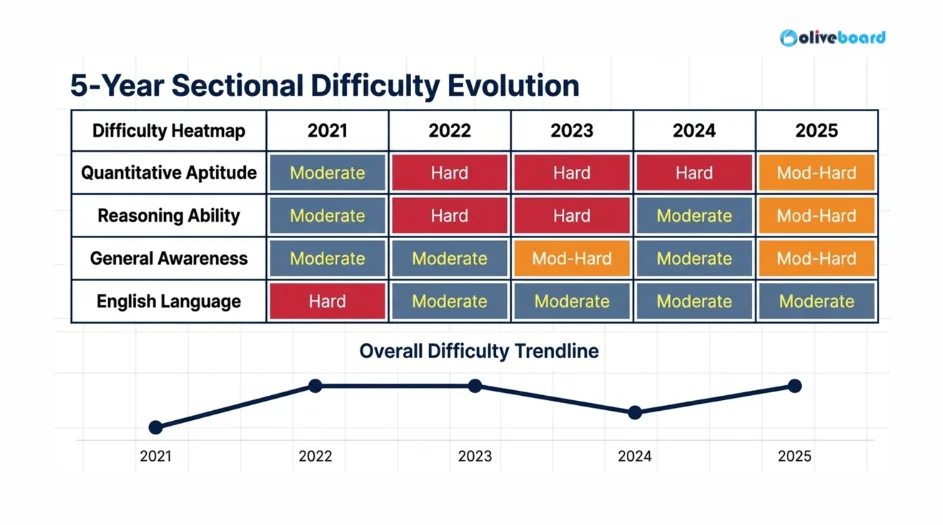
The RBI Grade B Phase 1 exam conducted by RBI is generally moderate to difficult in nature. While some sections remain scoring, others like Quant and Reasoning often test speed, accuracy, and conceptual clarity.
| Year | Section-wise Difficulty | Overall Difficulty |
| 2025 | Quant: Moderate–Hard, Reasoning: Moderate–Hard, English: Moderate, GA: Moderate–Hard | Moderate–Hard |
| 2024 | Quant: Hard, Reasoning: Moderate, English: Moderate, GA: Moderate | Moderate |
| 2023 | Quant: Hard, Reasoning: Hard, English: Moderate, GA: Moderate–Hard | Hard |
| 2022 | Quant: Hard, Reasoning: Hard, English: Moderate, GA: Moderate | Hard |
| 2021 | Quant: Moderate, Reasoning: Moderate, English: Hard, GA: Moderate | Moderate |
Also Check: RBI Grade B Syllabus
Which Quantitative Aptitude topics are most important in RBI Grade B previous year papers?
Quantitative Aptitude in RBI Grade B focuses heavily on data-based and arithmetic questions. Regular practice of high-weightage topics like Data Interpretation improves accuracy and speed significantly.
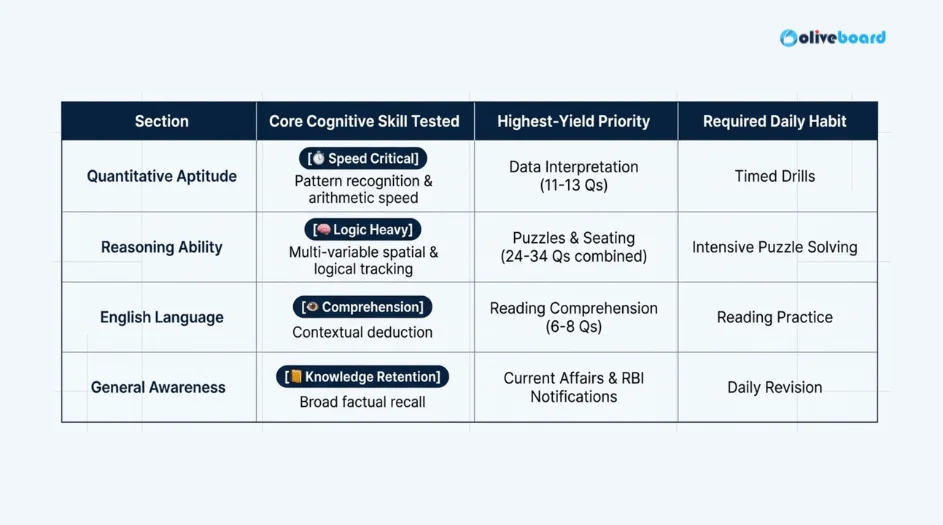
| Topic | Avg Questions per Year | Key Details |
| Data Interpretation | 11–13 | Highest weightage, appears every year, includes tables, charts |
| Number Series | 3–4 | Regular, tests pattern recognition |
| Quadratic Equations | 2–4 | Moderate difficulty, scoring topic |
| Data Sufficiency | 2–3 | Concept-based, irregular but important |
| Profit & Loss | 1–2 | Basic arithmetic, lower frequency |
| Time, Work & Distance | 1–2 | Occasional, needs formula clarity |
| Miscellaneous Arithmetic | 1–2 | Mixed topics, low priority |
Which Reasoning Ability topics are commonly asked in RBI Grade B exams?
Reasoning Ability in RBI Grade B is highly puzzle-driven and requires strong logical thinking and practice. Most questions come from puzzles and seating arrangements.
| Topic | Approx. Questions | Key Details |
| Puzzles | 15–20 | Most important, high difficulty, asked every year |
| Seating Arrangement | 9–14 | Linear and circular arrangements, very scoring |
| Critical Reasoning | 8–12 | Statement-based logical questions |
| Input–Output | 5 | Moderate difficulty, pattern-based |
| Syllogism & Inequalities | 4–5 | Conceptual but scoring |
| Direction Sense | 1–3 | Easy, less frequent |
| Miscellaneous Topics | 1–5 | Coding-decoding, blood relations, etc. |
Also Download RBI Grade B PYQs of 7 years
Which English Language topics are important in RBI Grade B exam?
English Language in RBI Grade B is usually moderate and scoring for candidates with regular reading and grammar practice. Reading comprehension plays the most important role in this section.
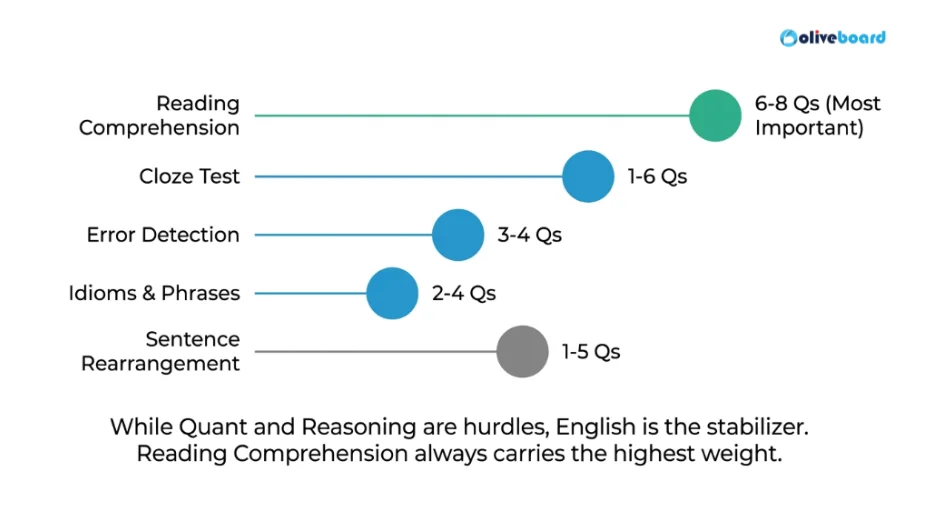
| Topic | Avg Questions | Key Details |
| Reading Comprehension | 6–8 | Most important, passage-based questions |
| Cloze Test | 1–6 | Vocabulary and grammar-based |
| Error Detection | 3–4 | Basic grammar rules |
| Idioms & Phrases | 2–4 | Vocabulary improvement required |
| Sentence Rearrangement | 1–5 | Logical sentence formation |
Download RBI Grade B 2024 AIR 1 Handwritten Notes
What are the key General Awareness topics in RBI Grade B exams?
General Awareness in RBI Grade B is mainly focused on current affairs, especially from financial and economic domains. Regular updates from RBI and government reports play a key role.
| Topic | Avg Questions | Key Details |
| Current Affairs | 15–20 | Most important; includes sports, awards, science, defense |
| RBI Notifications & Reports | 7–12 | Banking policies, circulars, and economic reports |
| Finance & Schemes | 5–8 | Government schemes, economic updates |
| Static GK | 6–12 | History, geography, important facts |
FAQs
Quantitative Aptitude and Reasoning are usually the most difficult sections.
It generally ranges from moderate to difficult depending on the year.
English and General Awareness are usually easier compared to Quant and Reasoning.
Around 15-20 questions usually come from puzzles every year.
Mostly current affairs, RBI updates, finance, and government schemes are asked.
- PFRDA Grade A Cut Off 2026, Previous Year Cut Off Score
- PFRDA Grade A Syllabus & Exam Pattern 2026, Check Revised Details
- PFRDA Grade A Phase 2 Admit Card 2026, Download Hall Ticket PDF
- PFRDA Grade A Result 2026, Download Grade A Scorecard PDF
- IBPS RRB Officer Scale I vs Office Assistant 2026
- English for IBPS RRB 2026: Important Topics, Preparation Tips and Resources
Hi, I’m Aditi. I work as a Content Writer at Oliveboard, where I have been simplifying exam-related content for the past 4 years. I create clear and easy-to-understand guides for JAIIB, CAIIB, and UGC exams. My work includes breaking down notifications, admit cards, and exam updates, as well as preparing study plans and subject-wise strategies.
My goal is to support working professionals in managing their exam preparation alongside a full-time job and to help them achieve career growth.