
The Railway Recruitment Board conducts several recruitment examinations for different categories of posts in Indian Railways. Among them, RRB Group D and RRB NTPC are two major recruitment routes. Although both exams offer opportunities in the Railways, they differ in educational qualification, exam stages, job profile, physical requirements, salary level, and preparation approach.
Candidates often compare RRB Group D and RRB NTPC to understand which exam may suit their preparation level and career preference better. This article provides an updated comparison of the two exams.
Overview of RRB Group D and RRB NTPC
RRB Group D and RRB NTPC serve different recruitment purposes and cater to different educational backgrounds. Understanding their structure is the first step in comparing difficulty levels.
| Feature | RRB Group D | RRB NTPC |
| Recruitment Level | Level 1 posts | Undergraduate and Graduate posts |
| Typical Posts | Track Maintainer, Pointsman, Assistant and other Level 1 posts | Junior Clerk cum Typist, Commercial cum Ticket Clerk, Trains Clerk, Station Master, Goods Train Manager, CCTS, JAA, Senior Clerk |
| Minimum Qualification | As prescribed for Level 1 posts in the notification | 12th pass for UG posts; Graduation for Graduate posts |
| Main Written Stages | CBT | CBT 1 + CBT 2 |
| Additional Stage | Physical Efficiency Test | Typing Skill Test or CBAT for applicable posts |
| Physical Test | Yes | No PET |
| Pay Level | Level 1 | Level 2 to Level 6 |
| Initial Basic Pay | ₹18,000 | ₹19,900 to ₹35,400 depending on post |
What is the exam pattern for RRB Group D vs RRB NTPC?
The RRB Group D exam pattern has been divided into four sections – Mathematics, General Intelligence & Reasoning, General Science, and General Awareness. On the other hand, the NTPC exam pattern consists of sections like – Mathematics, General Intelligence & Reasoning, General Awareness and General Science.
RRB Group D Exam Pattern
The RRB Group D Exam Pattern for CBT tests candidates on basic general knowledge, mathematics, reasoning, and science.
- Total Questions: 100
- Duration: 90 minutes
- Subjects & Marks Distribution:
| Section | Questions | Marks |
| Mathematics | 25 | 25 |
| General Intelligence & Reasoning | 25 | 25 |
| General Science | 25 | 25 |
| General Awareness | 25 | 25 |
RRB NTPC Exam Pattern
RRB NTPC Exam Pattern has a two-stage Computer-Based Test (CBT) structure.
CBT-1
- Total Questions: 100
- Duration: 90 minutes
- Sections & Marks:
| Section | Question | Marks |
| Mathematics | 30 | 30 |
| General Intelligence & Reasoning | 30 | 30 |
| General Awareness | 40 | 40 |
CBT-2
- Duration: 90 minutes
- Total Questions: 120
- Sections: In-depth testing of relevant subjects depending on the post
- Aptitude Test: Required for specific technical posts
What is the syllabus for RRB Group D and RRB NTPC?
The RRB Group D Syllabus consists of subjects like Mathematics, Reasoning, General Science and General Awareness. NTPC also has the same subjects, but the level and topics vary. Check out the details below:
| Subject | RRB Group D | RRB NTPC |
| Mathematics | Basic arithmetic, fractions, percentages, ratio & proportion, averages | Advanced arithmetic, algebra, geometry, data interpretation, ratio & proportion |
| Reasoning | Simple puzzles, analogy, odd-one-out, coding-decoding | Complex puzzles, seating arrangement, blood relations, coding-decoding, inequality |
| General Science | Physics, Chemistry, Biology (10th standard) | Physics, Chemistry, Biology (12th standard level and practical applications) |
| General Awareness | Current Affairs, Indian History, Geography, Polity | Current Affairs, Economy, Budget, Railway Awareness, International Events |
RRB Group D vs RRB NTPC Eligibility Criteria Comparison
The table below shows the RRB Group D vs RRB NTPC eligibility criteria comparison for the applicants. Check out the important details:
| Aspect | RRB NTPC | RRB Group D |
| Educational Qualification | Minimum: 12th Pass (Intermediate) or equivalent from a recognized board. | Minimum: 12th Pass (Intermediate) or equivalent from a recognised board. |
| Age Limit (General Category) | 18–33 years (varies slightly by post). | 18–33 years (varies slightly by post). |
| Age Relaxation | SC/ST: +5 years; OBC: +3 years; Ex-Servicemen, PwBD: as per rules. | SC/ST: +5 years; OBC: +3 years; Ex-Servicemen, PwBD: as per rules. |
| Physical Standards | No strict physical standards; mainly for clerical and commercial posts. | Strict physical standards required for physically demanding posts (e.g., Track Maintainer, Helper). |
| Medical Standards | Medical exam is required, but less stringent compared to Group D. | Medical exam is stricter due to physical nature of work; vision, hearing, and endurance tested. |
| Skill/Typing Test | For certain posts (like Junior Clerk, Typist) – typing/skill test mandatory. | No typing test; some posts require physical efficiency test (PET). |
| Experience Requirement | Generally, not required; freshers eligible. | Generally, not required; freshers eligible. |
| Nature of Work | Clerical, administrative, commercial, or technical assistance. | Manual labor, track maintenance, helpers, porters, or technical support roles. |
What is the initial RRB NTPC vs RRB Group D Salary?
The initial RRB NTPC salary varies from ₹19,900 – ₹35,400 depending upon the level. Whereas Group D salary varies from ₹19,900 – ₹63,200/ Given below are the details:
| Category | RRB Group D | RRB NTPC |
| Pay Level | Level 1 | Level 2 to Level 6 |
| Initial Basic Pay | ₹18,000 | ₹19,900 to ₹35,400 |
| Lowest NTPC Level | — | Level 2: ₹19,900 |
| Highest Current NTPC Level | — | Level 6: ₹35,400 |
| DA | As applicable | As applicable |
| HRA | As applicable according to city classification | As applicable according to city classification |
| Transport Allowance | As applicable | As applicable |
| In-Hand Salary | Varies by posting and deductions | Varies by post, city, allowances and deductions |
Which exam is more difficult?
The difficulty level entirely depends on the capabilities of a candidate. If compared NTPC requires 12th-level knowledge, whereas Group D is restricted to 10th-grade level. Some of the details are given below:
| Factors | RRB Group D (Easier) | RRB NTPC (Tougher) |
| Syllabus | Limited to 10th-grade level | Requires 12th-grade knowledge; more advanced topics |
| Exam Structure | Shorter exam with fewer stages | Two-tier CBT with post-specific Aptitude Test |
| Competition | Less competition due to lower pay scale | Higher competition due to better pay, career growth, and attractive job profile |
| Question Nature | Basic, straightforward | Analytical and concept-based questions |
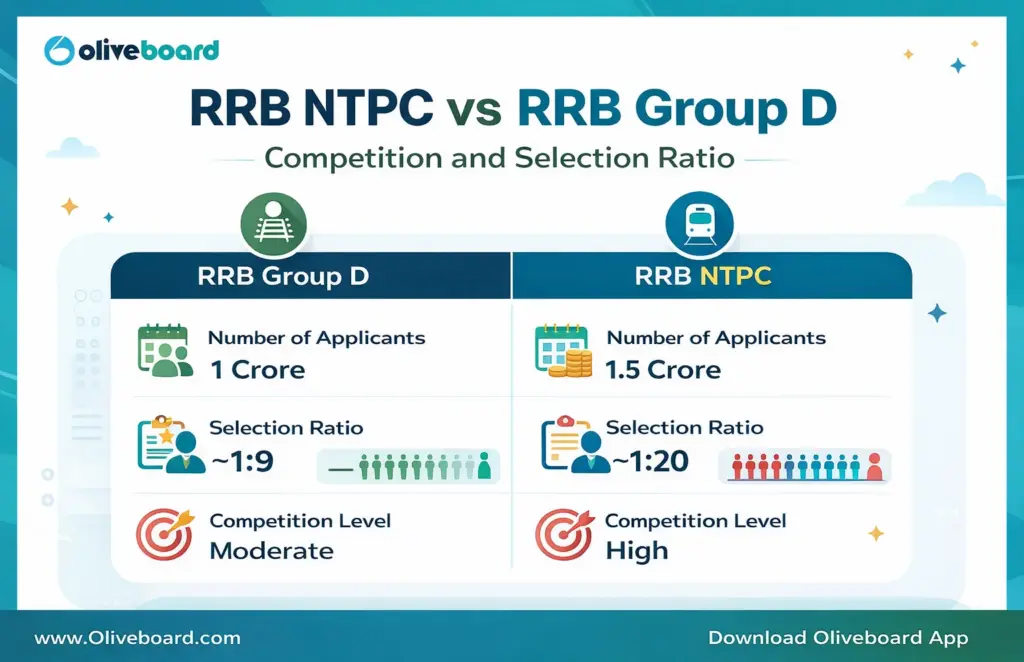
How do competition and selection ratio vary between these exams?
Competition and selection ratios vary as the number of applicants is nearly equal. NTPC is significantly more competitive because of higher perks and long-term career prospects. Check out the details given below:
Preparation Strategy Differences
Candidates must prepare well for both RRB Group D and the RRB NTPC exam. Some of the preparation strategies are given below for both exams:
| Preparation Area | RRB Group D Tips | RRB NTPC Tips |
| Mathematics & Reasoning | Focus on basic mathematics and reasoning | Strong focus on advanced mathematics and reasoning |
| Science | Revise 10th-standard science concepts | Not a major focus; only basic concepts may appear |
| Current Affairs | Stay updated with last 6–12 months | In-depth current affairs and Railway-specific knowledge |
| Practice | Solve previous years’ papers | Solve mock tests for CBT-2 level |
| Time Management | Not very critical due to shorter exams | Crucial due to longer exams and multiple stages |
Key Points
The key points of the article are summarized below for the candidates. Check them out:
- Educational Requirement: Group D (10th), NTPC (12th)
- Syllabus Complexity: NTPC > Group D
- Exam Stages: NTPC (2 CBT + Aptitude) > Group D (1 CBT + PET)
- Competition: NTPC has higher competition and a lower selection ratio
- Career Growth: NTPC provides better long-term career and salary prospects
- Preparation Difficulty: NTPC requires analytical thinking and time management, making it tougher overall
FAQs
RRB Group D is generally easier than RRB NTPC because it has a simpler syllabus, fewer exam stages, and lower analytical requirements. NTPC is tougher due to advanced syllabus, two-tier CBTs, and higher competition.
RRB Group D: 10th Pass
RRB NTPC: 12th Pass
RRB Group D has a single CBT followed by a Physical Efficiency Test (PET), while NTPC has two CBTs and an Aptitude Test for certain posts, making NTPC more complex and time-consuming.
RRB NTPC sees higher competition because of better pay scales, long-term career growth, and more applicants per vacancy compared to Group D.
Group D: Focus on 10th-grade mathematics, reasoning, general science, and current affairs.
NTPC: Emphasize advanced mathematics, analytical reasoning, in-depth current affairs, mock tests, and time management for CBT-2.
- RRB Group D Mock Drill 2026, Check Section Wise Questions
- RRB NTPC Undergraduate Apply Online 2026, Check Last Date to Apply
- RRB NTPC Undergraduate Exam Date 2026, Check CBT 1 Schedule
- RRB NTPC Undergraduate Salary 2026, Check Basic Pay & More
- RRB NTPC Undergraduate Syllabus 2026, Check CBT 1 & 2 Exam Pattern
- RRB NTPC Undergraduate Vacancy 2026, Check 1,688 Post Wise Vacancies

Hello! This is Arijit Dutta. I am a skilled Content Writer at Oliveboard with nearly 3+ years of experience in crafting engaging, informative, and exam-focused content for the Railways Domain. With a strong command of language and a keen understanding of learner needs, I contribute significantly to Oliveboard’s mission of delivering high-quality educational resources. Passionate about clear communication and continuous learning, I consistently create content that helps government job aspirants achieve their goals. Outside of work, I enjoy playing cricket and listening to music, which helps me stay balanced and creative in my professional journey.