

Preparing for SSC CGL requires more than just completing the syllabus. The real difference between an average candidate and a top ranker lies in how effectively they use mock tests. The analysis of SSC CGL 2025 toppers: AIR 1, AIR 3, AIR 4, and AIR 6, clearly shows that while their preparation journeys were different, their success was built on structured mock practice, performance tracking, and continuous improvement.
This detailed breakdown will help SSC aspirants understand how toppers approached mock tests, how their performance evolved over time, and what strategies can be adopted to improve scores.
SSC CGL 2025 Toppers’ Mock Test Analysis
The topper data highlights that there is no fixed timeline or single strategy to crack SSC CGL. Some toppers prepared over nearly two years, while others achieved top ranks within six months. However, all of them relied heavily on mock tests and data analysis to guide their preparation.
| Rank | Name | Mocks Attempted | Preparation Duration |
| AIR 1 | Dhruv Rana | 124 | 14 Months |
| AIR 3 | N Ramcharan | 111 | 21 Months |
| AIR 4 | Bitan Majumdar | 69 | 6 Months |
| AIR 6 | Anirudh Sharma | 97 | 23 Months |
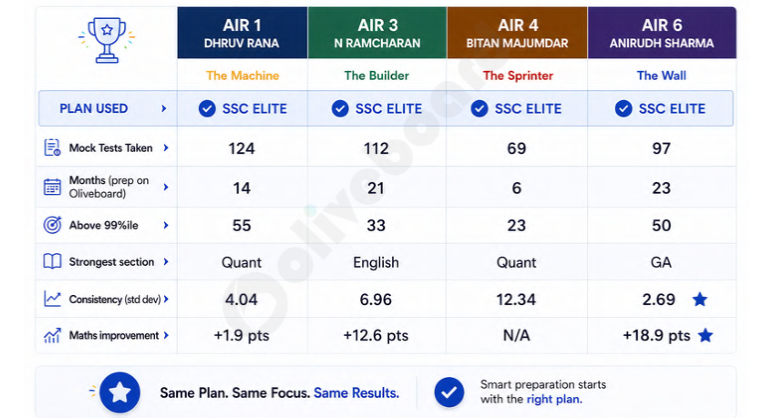
The combined number of mock tests attempted by these four toppers is 401, which shows the level of practice required to secure a top rank. On average, each topper attempted around 100 mock tests, and during peak preparation phases, they attempted more than one mock per day.
AIR 1 Dhruv Rana: Consistency as the Core Strategy
Dhruv Rana’s preparation stands out because of his unwavering consistency across the entire preparation period. From his very first mock test, he consistently performed within the top 1–2 percent of candidates, and this performance level remained stable throughout 124 mock tests over 14 months.
What makes his journey unique is that there were no major fluctuations in performance. Many aspirants tend to show irregular performance patterns, but Dhruv maintained a steady score regardless of exam pressure or difficulty level. This indicates a high level of conceptual clarity and exam temperament.

Performance Analysis
His preparation reflects a system where mock tests became a routine rather than an occasional activity. Over time, this consistency translated into automatic accuracy and strong time management skills.
- Maintained top 1–2 percent performance across most tests
- Scored 99 percentile or above in 55 tests
- Achieved 100 percentile in Quant multiple times
- Did not take any significant breaks during preparation
Key Takeaway
Dhruv’s strategy demonstrates that consistent performance over a long period reduces dependency on last-minute preparation and minimizes performance variability in the actual exam.
AIR 3 N Ramcharan: Strategic Improvement of Weak Areas
N Ramcharan’s journey highlights the importance of identifying weak areas and systematically improving them. Unlike AIR 1, his performance shows a clear upward trend, especially in the Quant section, which was initially his weakest subject.
Over 21 months and 111 mock tests, he used performance data to track his weaknesses and focused on improving them without compromising his strong areas like English.

Performance Analysis
This improvement in Maths percentile played a crucial role in pushing his rank higher. Instead of focusing only on strengths, he invested time in converting his weakest section into a competitive one.
- Maths percentile improved from 78 to 91
- Scored 100 percentile in English 15 times
- Maintained strong performance in English while improving Quant
- Used mock analysis to identify gaps and work on them consistently
Key Takeaway
Ramcharan’s preparation shows that improving weak sections has a direct and significant impact on overall rank. A balanced score across sections is more valuable than excelling in just one area.
AIR 4 Bitan Majumdar: High-Intensity Short-Term Preparation
Bitan Majumdar’s journey proves that a shorter preparation timeline does not limit success if the preparation intensity is high. He started his preparation relatively late but compensated with extremely aggressive mock test practice.
Within just 6 months, he attempted 69 mock tests, including an intense phase where he attempted 51 mock tests in 38 days.

Performance Analysis
This sharp improvement indicates that frequent testing combined with immediate analysis can compress months of learning into weeks. After Tier 1, he continued the same intensity for Tier 2 preparation.
- Attempted 51 mocks in 38 days before Tier 1
- First 25 mocks average percentile: 91.1
- Last 26 mocks average percentile: 98.1
- Showed rapid improvement within a short period
Key Takeaway
Bitan’s strategy demonstrates that even with limited time, focused effort and high mock frequency can lead to rapid performance improvement.
AIR 6 Anirudh Sharma: Balanced and Stable Performance
Anirudh Sharma’s preparation is an example of long-term stability and balanced performance across all sections. Over 23 months and 97 mock tests, he maintained one of the most consistent records among all toppers. Unlike others who had one dominant section, Anirudh ensured that no section became a weak link.

Performance Analysis
His ability to maintain a high percentile consistently over a long period indicates strong fundamentals and effective revision strategies.
- 31 consecutive tests above 97 percentile
- Scored 100 percentile 12 times in Maths
- Scored 100 percentile 13 times in English
- Only two low-performance instances across 97 tests
Key Takeaway
Anirudh’s preparation shows that a balanced approach reduces risk in the exam and ensures stable performance across all sections.
Comparison of All Four Toppers
A comparative analysis of the four toppers helps in understanding how different strategies can lead to similar outcomes.
- Dhruv Rana relied on consistent high performance without major fluctuations, ensuring he stayed at the top throughout.
- N Ramcharan focused on improving his weakest section, which significantly boosted his overall rank.
- Bitan Majumdar compensated for a late start with extremely high intensity, showing that time can be managed with effort.
- Anirudh Sharma maintained balance across subjects, reducing the risk of score drops due to any single section.
| Factor | Dhruv Rana (AIR 1) | N Ramcharan (AIR 3) | Bitan Majumdar (AIR 4) | Anirudh Sharma (AIR 6) |
| Strategy Type | Consistency-focused | Weakness improvement | High-intensity short-term | Balanced long-term |
| Preparation Duration | 14 Months | 21 Months | 6 Months | 23 Months |
| Total Mocks | 124 | 111 | 69 | 97 |
| Key Strength | Stable performance | Improvement in Maths | Rapid improvement | Balanced sections |
| Performance Trend | Consistent | Gradual improvement | Sharp rise | Highly stable |
Common Patterns Observed in All SSC Toppers
Despite differences in timelines and strategies, certain patterns are common across all four toppers. These patterns provide a clear roadmap for SSC aspirants.
Key Observations
The data also shows that none of the toppers relied on guesswork or last-minute preparation. Their performance was the result of structured and sustained effort.
- All toppers attempted a high number of mock tests
- Regular mock analysis was a core part of preparation
- Weak areas were actively identified and improved
- Consistency was maintained throughout preparation
- No topper relied on shortcuts or selective preparation
Role of Mock Tests in Rank Improvement
Mock tests played a central role in shaping the preparation strategies of all toppers. They were not used merely for practice but as a tool for continuous evaluation and improvement.
How do SSC toppers use mock tests?
Mock test data acted as feedback, allowing toppers to adjust their preparation strategy based on performance.
- To track percentile trends over time
- To identify weak sections and topics
- To improve time management under exam conditions
- To simulate real exam pressure
- To decide readiness for the actual exam
FAQs
Q1: How many mock tests should I attempt for SSC CGL?
A1: You should aim to attempt around 80–100 mock tests during your preparation. This level of practice helps improve speed, accuracy, and familiarity with the exam pattern.
Q2: Can SSC CGL be cracked in 6 months?
A2: Yes, it is possible if you follow a focused strategy with regular mock tests, proper revision, and consistent practice throughout the 6 months.
Q3: Is mock test analysis important?
A3: Yes, analyzing mock tests is essential because it helps you identify mistakes, understand weak areas, and improve your performance in future tests.
Q4: Should I focus more on weak subjects?
A4: Yes, along with maintaining strong subjects, you should focus on improving weak areas as they have a major impact on your overall score.
Q5: How often should I take mock tests?
A5: You can start with 2–3 mock tests per week and gradually increase the frequency to 4–5 tests per week or even daily during the final phase of preparation.
- Physics Questions asked in SSC CGL Exams with Solutions, Check Now
- SSC CGL Trigonometry Questions 2026, Practice Quiz Live
- SSC CGL Number System Questions, Get Live Quiz with Solutions & PDF
- SSC CPO Reasoning Questions 2026, Attempt Live Quiz & Download PDF
- SSC CPO 2026 Preparation Tips, Subject-Wise Strategy & Study Plan
- SSC GD Constable Vs SSC CPO, Which is Easier to Crack?

Hi, I’m Tripti, a senior content writer at Oliveboard, where I manage blog content along with community engagement across platforms like Telegram and WhatsApp. With 3+ years of experience in content and SEO optimization related to banking exams, I have led content for popular exams like SSC, banking, railway, and state exams.