

The RRB NTPC Exam is a highly competitive examination that requires candidates to have a strong grasp of quantitative aptitude. One of the most frequently tested topics in the Mathematics section is Average. Understanding the concept of average and mastering effective tricks for average can save precious time and boost your accuracy in the exam. This article provides an in-depth analysis of averages, key concepts, formulas, shortcuts, and more for the applicants.
What is Average?
In simple terms, the average represents the central value of a set of numbers. It is the value that reflects the overall “typical” performance of a group. The most common type of average used in exams is the arithmetic mean. The formula is:
Average = Sum of Observations/Number of Observations
What are the types of averages commonly asked in RRB NTPC Exam?
The types of averages in RRB NTPC Syllabus include arithmetic mean, weighted average, combined average, moving average, and more. Check out the details given below:
| Type of Average | Description | Example |
| Arithmetic Mean | Sum of observations divided by the total number | (40+50+60) /3 = 50 |
| Weighted Average | When some observations have more importance (weight) than others | Marks in subjects with different credits |
| Combined Average | Average of two or more groups combined | Average of two classes of students |
| Moving Average | Average of a subset of data over time | Used in time-based performance analysis |
Important Concepts of RRB NTPC
Before jumping to shortcuts, it’s crucial to understand key concepts. Check out the details given below:
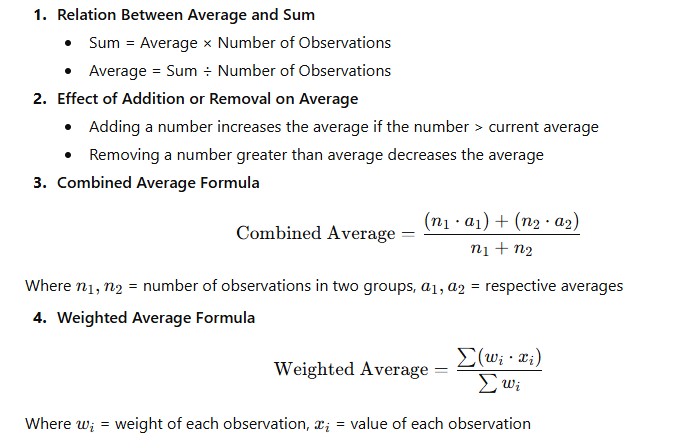
What are the tricks for average in RRB NTPC Exam?
The different tricks for average in RRB NTPC exam include shortcuts for the combined average, use of the deviation method, and more. Given below are the details:
1. Shortcut for Combined Average
When two groups are combined:
- Step 1: Find total sum of both groups using Sum = Average × Number of Observations
- Step 2: Add sums and divide by total number of observations
Example:
Group A: 20 students, average 50
Group B: 30 students, average 60

2. Use of Deviation Method:
When numbers are close to a base value, deviation method saves time:

3. Quick Trick for Missing Observation:
If average before and after adding/removing a number is given, missing number can be calculated:

4. Weighted Average for Exams:
Weighted average often appears in questions involving marks or performance with different weightage:
Example:
Physics = 80 marks (weight 2)
Math = 90 marks (weight 3)
Chemistry = 70 marks (weight 1)
Weighted average =

5. Increment/Decrement Trick
- If all numbers increased by ‘x’, average also increases by ‘x’
- If all numbers decreased by ‘x’, average also decreases by ‘x’
Example:
Average of 5 numbers = 20. All numbers increased by 3 → New Average = 23
6. Using Ratios to Simplify Problems:
Sometimes averages can be solved faster using ratios instead of calculating sums.
Example:
Average marks of boys = 60, girls = 40, number of boys:girls = 3:2

What are the common types of average questions in RRB NTPC?
The common types of average questions include finding the average of given numbers, finding missing numbers, and more. Check out the table below to know the commonly asked type in the NTPC exam:
| Type | Trick/Formula |
| Find the combined average of 2 groups | Use direct sum ÷ total numbers |
| Find combined average of 2 groups | Find the average of given numbers |
| Missing number in series | Use relation: Sum = Average × Number |
| Increase/decrease problem | Use the weighted sum method |
| Weighted average | Multiply each value by its weight, divide by total weight |
| Numbers close to base | Apply the increment/decrement trick |
What is the right approach for solving Average Problems in RRB NTPC?
The right approach for solving average problems in the RRB NTPC exam should start from reading the questions carefully and determining their types. Given below are the details:
- Read the question carefully – Identify if it’s simple, combined, weighted, or missing number type
- Determine the type – Select the correct formula or trick
- Calculate sum quickly – Use base or weight wherever applicable
- Apply shortcuts – Use the deviation or increment/decrement trick for speed
- Check for errors – Cross-verify with the estimated average to avoid silly mistakes
Time-Saving Tips for RRB NTPC Exam
We have given below some time-saving tips to solve the average problems for RRB NTPC exam. Check them out:
- Memorise formulas for combined average, weighted average, and missing number problems
- Always look for numbers near a common base → Use the deviation method
- Use approximation for large numbers to verify the answer quickly
- Practice previous year questions → Most average questions follow a pattern
- Avoid calculating large sums directly if shortcuts are applicable
FAQs
The quickest way is to use shortcuts and tricks such as the deviation method, weighted average formulas, and increment/decrement techniques. Memorising formulas for combined average and using base values for numbers close to each other can save significant time.
For combined average, calculate the total sum of each group using Sum = Average × Number, then add the sums and divide by the total number of observations. Using this method avoids calculating each number individually.
Yes. Weighted average questions are common, especially when marks or performances have different importance or weightage.
Use the formula:
Missing Number = (New Average×New Total) − Sum of Other Observations
The deviation method is extremely useful. Choose a base close to the numbers, calculate deviations, sum them up, and then adjust the base with the average deviation. This reduces calculation time and avoids mistakes.

Hello! This is Arijit Dutta. I am a skilled Content Writer at Oliveboard with nearly 3+ years of experience in crafting engaging, informative, and exam-focused content for the Railways Domain. With a strong command of language and a keen understanding of learner needs, I contribute significantly to Oliveboard’s mission of delivering high-quality educational resources. Passionate about clear communication and continuous learning, I consistently create content that helps government job aspirants achieve their goals. Outside of work, I enjoy playing cricket and listening to music, which helps me stay balanced and creative in my professional journey.