
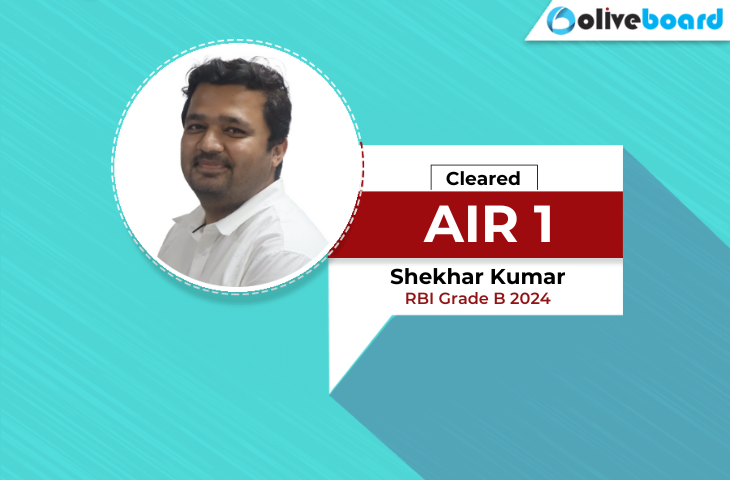
Preparing for the RBI Grade B exam requires a clear strategy, consistent practice, and the right guidance. Shekhar Kumar secured AIR 8 in the RBI Grade B 2024 exam by following and adapting the preparation strategy of Tanay Gaurav, AIR 1. From General Awareness and mock tests to descriptive writing and interview preparation, Tanay’s approach helped Shekhar focus on important topics and avoid unnecessary confusion. In this blog, we will explore Shekhar Kumar’s preparation journey and the key strategies he followed to prepare for the RBI Grade B exam.
How did Shekhar Kumar secure AIR 8 in the RBI Grade B exam?
Shekhar Kumar was determined to clear the competitive RBI Grade B exam but faced challenges in managing the vast syllabus and limited preparation time. He found Tanay Gaurav’s preparation strategy useful and adapted it to his own needs. Instead of using too many study resources, he focused on important topics, regular revision, and consistent practice. His preparation covered all three stages of the exam: Phase 1, Phase 2, and the interview. The key elements of his preparation were:
- Structured preparation: Followed a clear study plan to manage the syllabus.
- Focused learning: Prioritised important topics instead of using too many resources.
- Regular revision: Revised notes and concepts to improve retention.
- Consistent practice: Used mock tests and previous year questions to improve performance.
- Mentorship: Applied Tanay Gaurav’s guidance to make his preparation more effective.
How did Shekhar Kumar prepare for RBI Grade B Phase 1?
RBI Grade B Phase 1 is the first major stage of the selection process. Shekhar followed a focused study plan to prepare for General Awareness, Quantitative Aptitude, Reasoning Ability, and English. He used current affairs, short notes, mock tests, and previous year question papers to improve his preparation. Following Tanay Gaurav’s approach, he gave importance to regular practice, revision, speed, and accuracy.
How did he prepare for General Awareness?
Shekhar focused on current affairs and important banking and economic updates to strengthen his General Awareness preparation. He followed Tanay’s strategy of revising notes regularly instead of repeatedly studying the same material from different sources. He also used short notes to revise important facts quickly. His General Awareness preparation included:
- Daily current affairs: Followed important national, international, banking, and economic news.
- RBI Bulletins: Read RBI updates to understand developments in the banking and financial sectors.
- PIB updates: Referred to Press Information Bureau releases for government schemes, policies, and announcements.
- Static GK: Prepared one-line notes to revise important facts in less time.
How did he improve Quantitative Aptitude and Reasoning Ability?
Shekhar focused on improving his speed and accuracy in Quantitative Aptitude and Reasoning Ability. Instead of switching between multiple books, he gave more importance to mock tests, practice questions, and previous year papers. This helped him understand the exam pattern and become more comfortable solving questions within the given time. His preparation strategy included:
- RBI Grade B mock tests: Practised regularly to improve speed, accuracy, and time management.
- Previous year question papers: Solved past questions to understand the exam pattern and question types.
- Performance analysis: Reviewed mistakes after each test and worked on weak areas.
- Regular practice: Solved questions within the time limit to improve efficiency.
Why were mock tests important in his preparation?
Mock tests were an important part of Shekhar’s RBI Grade B preparation. Like Tanay Gaurav, he used regular tests to check his progress and identify areas that needed improvement. He did not stop after attempting a test but analysed his performance to understand his mistakes. This helped him improve his accuracy, speed, and time management. The key lessons from his mock test strategy were:
- Attempt mock tests regularly under exam-like conditions.
- Analyse incorrect answers and understand the reasons behind mistakes.
- Identify weak topics and practise them separately.
- Track performance to improve speed, accuracy, and confidence.
How did Shekhar Kumar prepare for RBI Grade B Phase 2?
RBI Grade B Phase 2 requires a deeper understanding of Economics, Finance, and Management, along with strong descriptive writing skills. Shekhar continued to follow Tanay Gaurav’s strategy while adapting his preparation to his strengths and weaknesses. He focused on understanding concepts, preparing short notes, following relevant current affairs, and practising answer writing. This approach helped him study important topics without getting overwhelmed by too many resources.
How did he prepare for Economic and social issues (ESI)?
Shekhar focused on building a clear understanding of Economic and Social Issues (ESI). He followed Tanay’s recommendation to use Mrunal’s videos to understand important concepts and then connected those concepts with current economic developments. He also studied key government reports to strengthen his knowledge of the Indian economy. His ESI preparation included:
- Mrunal’s videos: Used them to understand economic concepts and important topics.
- Economic current affairs: Connected theoretical concepts with recent economic developments.
- Economic Survey: Studied key findings, economic trends, and government priorities.
- Union Budget: Focused on major announcements, policies, and economic measures.
How did he prepare for Finance and management (FM)?
For Finance and Management, Shekhar kept his preparation simple and focused on understanding core concepts. He prepared short notes to make revision easier and referred to Tanay Gaurav’s handwritten notes for support. This approach helped him revise important topics without spending too much time switching between different study materials. His FM preparation strategy included:
- Focus on the core concepts of Finance and Management.
- Prepare short notes for quick and regular revision.
- Refer to Tanay Gaurav’s handwritten notes for important topics.
- Revise key concepts regularly to improve understanding and recall.
How did he improve his descriptive writing skills?
Descriptive writing was another important part of Shekhar’s Phase 2 preparation. Tanay Gaurav recommended practising one or two essays every day to improve writing skills through regular practice. Shekhar followed this approach and worked on presenting his ideas in a clear, organised, and meaningful way. He also used real-world examples to make his answers more relevant. His descriptive writing strategy included:
- Daily essay practice: Wrote one or two essays on different topics.
- Clear structure: Focused on a proper introduction, organised main points, and a suitable conclusion.
- Relevant examples: Used real-world examples to support his arguments.
- Content quality: Worked on clarity, depth, and relevance while answering questions.
- Regular improvement: Reviewed his writing to identify areas that needed more attention.
How did Shekhar Kumar prepare for the RBI Grade B interview?
The interview is the final stage of the RBI Grade B selection process. Shekhar prepared by focusing on common HR questions, RBI-related topics, and questions based on his personal and academic profile. He also kept himself updated on current affairs, economic issues, RBI policies, and banking reforms. Following Tanay’s advice, he worked on answering questions calmly, confidently, and clearly.
How did mock interviews help him?
Shekhar participated in several mock interviews to understand the interview process and improve his responses. These practice sessions helped him prepare for different types of questions and become more comfortable speaking about his background and knowledge. His mock interview preparation included:
- Practising common HR and personality-based questions.
- Preparing for profile-based questions related to his background.
- Revising RBI policies, banking developments, and economic issues.
- Improving the clarity and relevance of his answers.
How did he build confidence for the interview?
Shekhar followed Tanay Gaurav’s advice to remain calm and confident during the interview. He focused on giving concise answers instead of adding unnecessary details. His preparation also helped him discuss economic and banking topics with greater clarity. The key lessons from his interview strategy were:
- Stay calm and composed while answering questions.
- Understand the question before responding.
- Give clear, relevant, and concise answers.
- Keep up with current affairs and important RBI developments.
- Be confident and honest when answering unfamiliar questions.
Key Takeaways from Tanay Gaurav’s Strategy
Here are the most important lessons Shekhar learned from Tanay Gaurav’s strategy:
- Follow a structured approach: Focus on one strategy and stick to it just like Personalized Guidance from AIR 1 helped Shekhar.
- Use quality over quantity: Don’t get lost in too many resources. Stick to what’s essential and revise it well.
- Practice writing every day: This will not only improve your writing skills but also help you tackle descriptive papers with ease.
- Mock tests are crucial: Regularly test your knowledge and analyze your performance to improve.
- Stay calm during the interview: Confidence is key — stay calm, stay prepared, and answer with clarity.
Download RBI Grade B 2024 AIR 1 Handwritten Notes
Shekhar Kumar’s Final Thoughts on His Success
“Tanay bhaiya’s mentorship and strategy were a game-changer for me. His advice and approach helped me avoid unnecessary confusion and focus on what truly mattered in the preparation. I owe a significant part of my success to his guidance.”
Shekhar Kumar’s success story highlights the importance of mentorship, strategic learning, and consistent practice. Tanay Gaurav’s approach not only helped him prepare effectively but also gave him the confidence to handle the challenges of the RBI Grade B exam. If you are an aspiring candidate, remember that it’s not just about working hard, but about working smart and learning from those who have already succeeded.
Questions on RBI Grade B Preparation (Answered Shekhar Kumar)
Ans: Start with a clear strategy. I began by understanding the syllabus and focusing on current affairs, mock tests, and descriptive answer writing. A structured plan really helped me stay consistent.
Ans: For GA and ESI, I followed PIB, RBI Bulletins, and Economic Survey extensively. Mrunal’s videos gave me strong conceptual clarity. I also referred to Oliveboard’s current affairs notes and monthly compilations.
Ans: I kept things simple and stuck to limited resources. I focused more on concept clarity and consistent revision. Oliveboard’s material and summaries were very helpful in covering key topics quickly.
Ans: Descriptive writing is crucial in Phase 2. I made it a habit to write 1–2 answers daily. This improved both my speed and quality. I followed a structured format and used real examples wherever possible.
Ans: I gave mock interviews and worked on improving my confidence and clarity. Staying updated with RBI policies and current economic issues was key. I also focused on framing answers honestly and precisely.
Ans: Absolutely! Tanay’s (AIR 1) mentorship gave me a clear direction. His approach to preparation, time management, and mock practice was instrumental in shaping my own strategy.
Ans: Oliveboard’s mock tests, descriptive answer evaluation, and structured content played a major role in my preparation. Their targeted approach saved me a lot of time.
- JAIIB IE and IFS Exam Analysis 2026, 1st November Shift Wise Analysis
- Attempt Government Scheme Practice Quiz and Download Free PDF
- Government Schemes 2026, List of Central & State Gov. Schemes
- RBI Grade B 75 Days Strategy by AIR 1, Check Details
- PFRDA Grade A Phase 2 Shift Timings 2026, Reporting Time
- Fisheries Ebook for NABARD Grade A, Download Free PDF
Hi, I’m Aditi. I work as a Content Writer at Oliveboard, where I have been simplifying exam-related content for the past 4 years. I create clear and easy-to-understand guides for JAIIB, CAIIB, and UGC exams. My work includes breaking down notifications, admit cards, and exam updates, as well as preparing study plans and subject-wise strategies.
My goal is to support working professionals in managing their exam preparation alongside a full-time job and to help them achieve career growth.