

Key Takeaways
- RRB NTPC Exam Trends show evolving patterns and increased difficulty in sections like Mathematics and Reasoning.
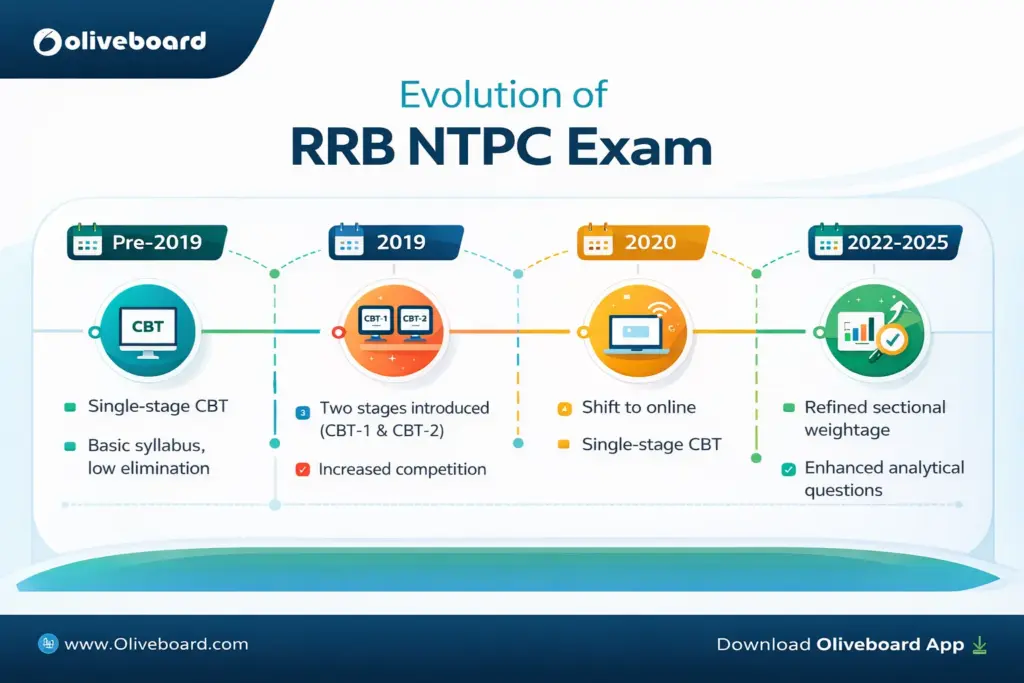
- The exam has transitioned from a single-stage CBT to a multi-stage process, enhancing candidate evaluation.
- Aspirants must focus on analytical thinking and current affairs, moving away from rote memorization.
- Time allocation should emphasize Mathematics (40%), General Awareness (30%), and Reasoning (30%).
- Common mistakes include neglecting mock tests and time mismanagement in practice.
RRB NTPC Exam Trends: The Railway Recruitment Board Non-Technical Popular Categories (RRB NTPC) exam has evolved significantly over the years – not only in syllabus and pattern but also in the way aspirants prepare and strategise. Understanding RRB NTPC Exam Trends and section-wise difficulty levels is crucial for aspirants to outperform in one of India’s most competitive government exams. This article goes beyond the basics and provides a deep overview of the RRB NTPC Exam Trends for the applicants.
Evolution of RRB NTPC Exam
The RRB NTPC exam has been conducted in multiple phases over the past decade. Initially comprising only a single tier, the exam has transformed into a multi-stage evaluation process to ensure depth and fairness in candidate selection.
What is the RRB NTPC Exam Pattern?
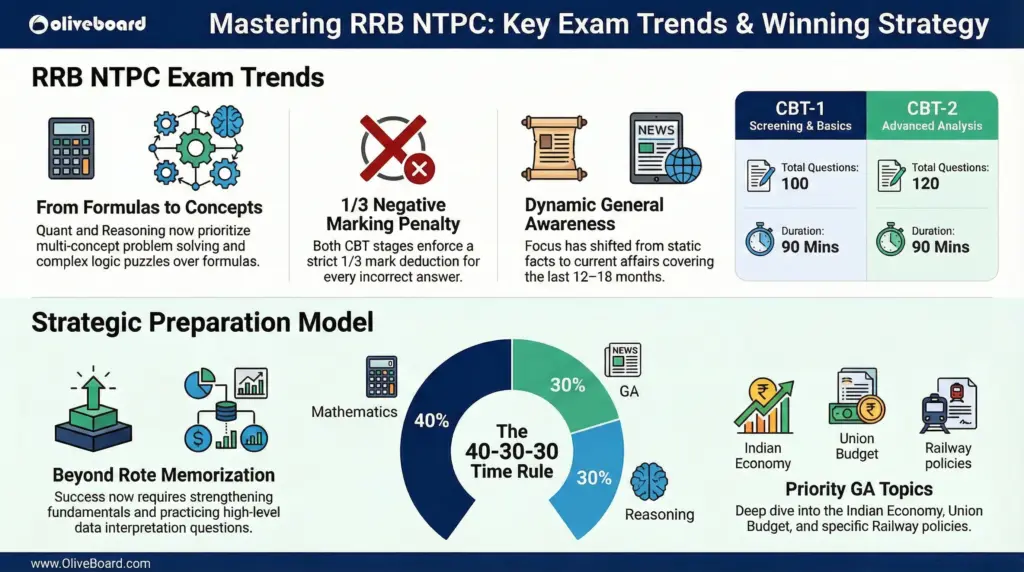
The RRB NTPC Exam Pattern for CBT 1 consists of 100 questions. Whereas for CBT 2, the total number of questions is 120. Each question carries one mark. There is also a negative marking of -1/3 for every incorrect answer. Check out the details below:
| Stage | Sections | Questions | Duration | Maximum Marks |
| CBT-1 | General Awareness Mathematics Reasoning | 100 | 90 min | 100 |
| CBT-2 | General Awareness Mathematics Reasoning & General Intelligence | 120 | 90 min | 120 |
What are the major RRB NTPC Exam Trends?
The major RRB NTPC exam trends can be seen in maths question style, in the reasoning section, and others. Check out the details given below:
| Aspect | Earlier Trend | Current Trend |
| Quantitative Aptitude | Straightforward, single-concept calculations | Multi-concept problem solving combining topics like interest, ratio, time & work |
| Math Question Style | Simple percentage and profit/loss problems | Case-based questions and data interpretation with real-world applications |
| General Awareness (GA) | Mostly static General Knowledge (GK) | High focus on current affairs of the last 12–18 months |
| GA Topic Coverage | Limited to basic facts | Increased emphasis on Economy, Budget, and Railway policies |
| Reasoning Section | Traditional analogy and classification | More analytical questions like logic puzzles and pattern recognition |
| Section Overlap | Questions often overlapped across sections | Clear domain-specific questions promoting concept clarity and reducing guesswork |
What are the common mistakes candidates make?
Common mistakes such as not attempting mock tests regularly, neglecting puzzle reasoning should be avoided. Some of them are given below:
- Over-reliance on rote GA memorization
- Ignoring the depth of data interpretation
- Neglecting puzzle reasoning till late stages
- Time mismanagement in sectional practice
- Ignoring mock tests
- Not practicing previous year papers
Time Allocation Model for RRB NTPC Subjects
A perfect time allocation model must be followed by every exam applicant. We have provided below the section wise time allocation model for the candidates:
| Section | Suggested Time Allocation |
| Mathematics | 40% |
| GA | 30% |
| Reasoning | 30% |
FAQs
The latest RRB NTPC Exam Trends show an increased emphasis on analytical thinking, especially in Mathematics and Reasoning. Questions are now more concept-based, data-driven, and often combine multiple topics. General Awareness has also shifted towards in-depth current affairs from the last 12–18 months rather than purely static GK.
Based on recent trends, Mathematics and Reasoning are considered the most challenging sections. Mathematics includes multi-concept numerical problems and Data Interpretation, while Reasoning increasingly features complex puzzles and analytical logic questions. The difficulty level is generally moderate to high.
Yes, the difficulty level has gradually increased each year. Earlier exams focused more on direct and formula-based questions, while recent papers demand deeper conceptual clarity, faster calculation skills, and better time management, especially in CBT-2.
Current affairs play a crucial role, particularly in the General Awareness section. Questions are often analytical and related to government schemes, economy, budget highlights, and railway-related developments. Covering at least 12–18 months of current affairs is strongly recommended.
Aspirants should focus on:
Strengthening fundamentals before shortcuts
Practicing high-level mock tests regularly
Analyzing section-wise performance
Prioritizing Mathematics and Reasoning practice
Keeping General Awareness preparation updated and conceptual
- RRB NTPC GK Questions, Solve General Knowledge MCQs
- RRB NTPC Graduate Vacancy 2026-27, 3,477 Vacancies Approved
- RRB NTPC Undergraduate Vacancy, Check Posts Available in 2026-27
- RRB NTPC Undergraduate Exam 2026, Check Latest Updates and Details
- RRB NTPC vs SSC CGL vs IBPS Clerk, Check Complete Analysis
- RRB NTPC Vacancy Analysis Over the Years, Check Details

Hello! This is Arijit Dutta. I am a skilled Content Writer at Oliveboard with nearly 3+ years of experience in crafting engaging, informative, and exam-focused content for the Railways Domain. With a strong command of language and a keen understanding of learner needs, I contribute significantly to Oliveboard’s mission of delivering high-quality educational resources. Passionate about clear communication and continuous learning, I consistently create content that helps government job aspirants achieve their goals. Outside of work, I enjoy playing cricket and listening to music, which helps me stay balanced and creative in my professional journey.