

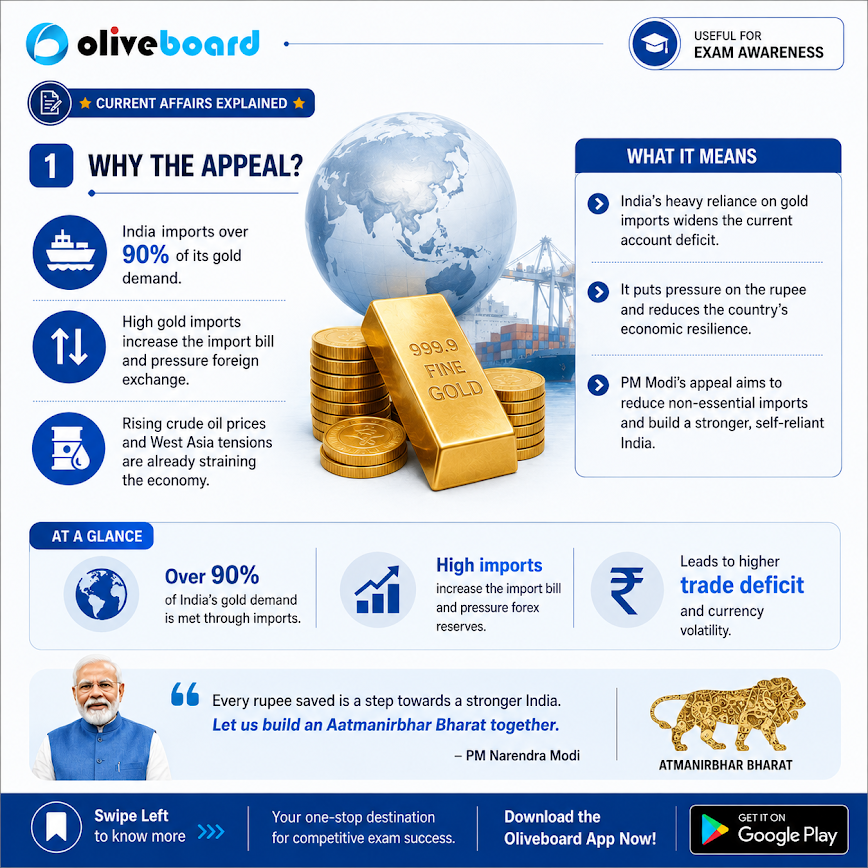
Why did PM Modi ask people to avoid buying too much gold?: Prime Minister Narendra Modi’s remarks on reducing excessive gold purchases came during a period when India was dealing with pressure on its foreign exchange reserves, a weakening rupee, and a widening current account deficit. The appeal was not a ban on buying gold but a request for citizens to understand the economic consequences of large-scale gold imports. Since India imports most of the gold consumed domestically, rising demand directly increases the country’s import bill and creates pressure on the economy.
Key reasons behind the concern:
- India imports most of its gold from foreign countries
- Gold imports require payment in US dollars
- Excessive imports increase the trade deficit
- Rising dollar demand weakens the rupee
- Economic pressure increases during uncertain periods
Why is gold so popular in India?
Gold is considered both an emotional and financial asset in India. Families buy gold during weddings and festivals such as Diwali and Akshaya Tritiya and as a traditional form of savings. Many households also consider gold a safer investment during inflation or financial instability. Rural households often prefer gold because it is tangible, easily tradable, and culturally trusted across generations.
Why did PM Modi ask Indians to avoid buying gold?
The central concern behind the statement was the growing pressure on India’s economy due to excessive gold imports. When citizens buy imported gold in large quantities, India has to spend more dollars on imports. At the same time, exports may not rise at the same pace. This imbalance increases the trade deficit and ultimately affects the current account deficit. The government wanted citizens to shift their savings towards productive financial investments instead of physical gold so that domestic capital could support economic growth.
What was the economic context behind the appeal?
At the time of the appeal, India was facing a falling rupee, rising import costs, and concerns over foreign exchange reserves. Gold imports had become one of the biggest contributors to the country’s import bill after crude oil. The government and the Reserve Bank of India were attempting to stabilize the economy by reducing unnecessary imports and improving investor confidence. Reducing gold demand was viewed as one of the practical steps to control the external imbalance.
Why did gold imports become a major problem?
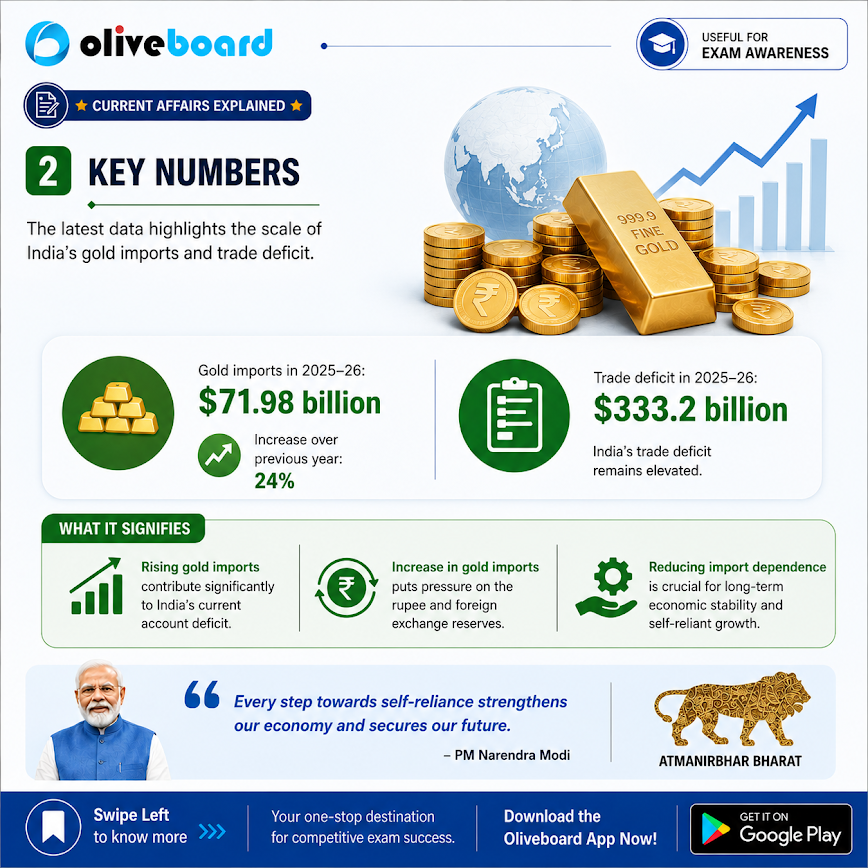
Gold imports became a major concern because they were increasing India’s import bill at a very fast pace. The country was already spending heavily on crude oil imports, and rising gold demand added extra pressure on foreign exchange reserves. Economists and policymakers believed that if imports continued increasing without proper control, the country could face larger financial imbalances and further weakening of the rupee.
- Increase in economic uncertainty
- Higher pressure on foreign currency reserves
- Increase in trade deficit
- Rising current account deficit
- Weakening value of the rupee
Did PM Modi completely discourage gold ownership?
The appeal was not against owning gold at all. The concern was related to excessive dependence on imported gold as a savings instrument. The government encouraged citizens to consider alternative investment options such as bank deposits, mutual funds, sovereign gold bonds, and other financial instruments that contribute more directly to economic productivity. The objective was to reduce unnecessary import pressure while still respecting cultural traditions.
What is a Trade Deficit?
A trade deficit occurs when a country imports more goods and services than it exports. In India’s case, heavy imports of gold and crude oil often increase the trade deficit because the country spends more foreign currency on purchases from abroad than it earns through exports. A persistent trade deficit can weaken economic stability if not balanced by investment inflows or strong export growth.
| Economic issue | Impact on India |
| Rising gold imports | increased pressure on reserves |
| Higher imports than exports | trade deficit increased |
| More dollar demand | rupee became weaker |
| Expensive imports | inflation pressure increased |
| Rising foreign payments | economic imbalance grew |
What is the current account deficit?
The current account deficit, commonly called CAD, measures the gap between the money flowing out of a country and the money coming into it through trade, investments, and transfers. When imports significantly exceed exports, the current account deficit widens. High gold imports were considered one of the major reasons behind India’s widening CAD during the period discussed in the infographic.
Why does the rupee fall when gold imports rise?
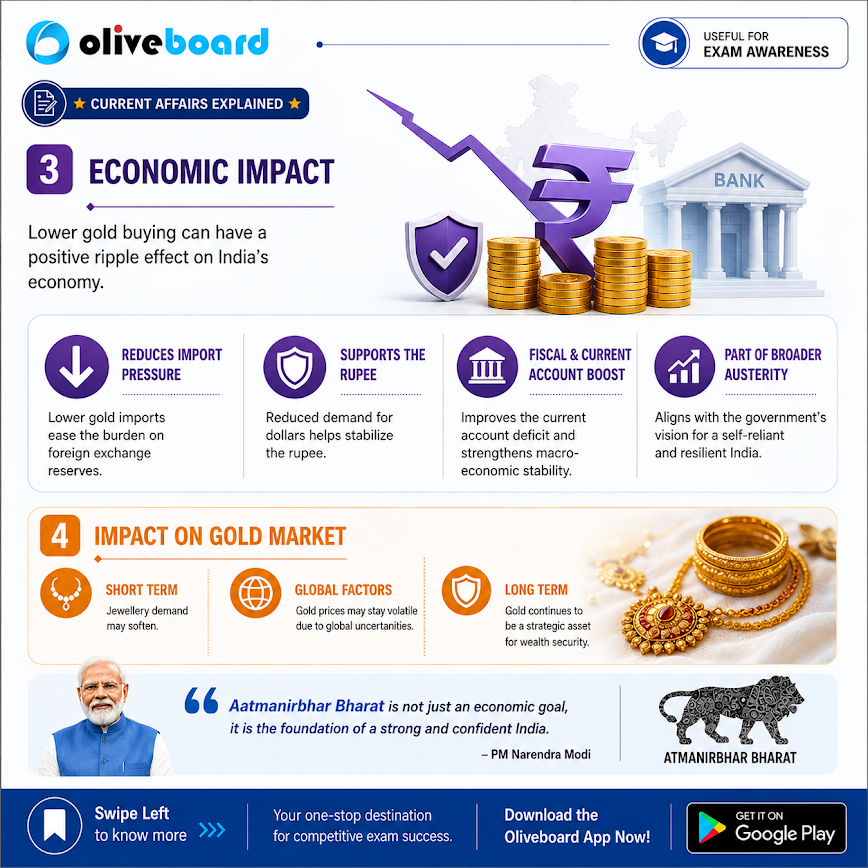
A rise in gold imports increases demand for US dollars because international trade is mostly settled in dollars. When the demand for dollars rises faster than the supply, the Indian rupee loses value against the dollar. A weaker rupee makes imports even more expensive and can contribute to inflationary pressure in the domestic economy.
What are foreign exchange reserves?
Foreign exchange reserves are assets held by a country’s central bank in foreign currencies, especially US dollars. These reserves help the country pay for imports, stabilize the currency, and maintain financial confidence during global uncertainty. Excessive imports of non-essential items like gold can reduce reserve strength if the outflow of dollars becomes too large.
How does gold buying affect inflation?
Large-scale gold imports can indirectly contribute to inflation because they increase pressure on the rupee. When the rupee weakens, imported products such as fuel become more expensive. Rising fuel prices increase transportation and production costs across sectors, which can eventually push up the prices of everyday goods and services.
Why did the Government Promote Financial Investments Instead?
The government wanted household savings to move towards financial instruments that support economic development. Investments in banks, bonds, equity markets, and infrastructure-related schemes help circulate money within the economy and support businesses, industries, and employment generation. Physical gold, on the other hand, often remains locked as an idle asset without directly contributing to productive economic activity.
What is a Sovereign Gold Bond?
A sovereign gold bond is a government-backed investment linked to the price of gold. Instead of purchasing physical gold, investors buy bonds that reflect gold value while also earning interest. Such instruments reduce the need for importing physical gold and provide a safer, regulated investment option for households.
| Investment type | Contribution to economy |
| Physical gold | limited direct economic activity |
| Bank deposits | supports lending and businesses |
| Mutual funds | helps companies raise capital |
| Infrastructure bonds | supports development projects |
| Equity investments | encourages industrial growth |
What was the impact on the gold market?
The government’s appeal, combined with import restrictions and higher duties, affected domestic gold demand and pricing patterns. Import controls reduced official gold inflows, while jewelers and traders experienced changes in consumer buying behavior. Over time, the market adjusted through policy changes and the introduction of alternative investment products.
Impact of PM Modi’s Appeal on Ordinary Citizens
Jewelers, government measures such as higher import duties and restrictions on gold imports made gold more expensive in domestic markets. Middle-class families, jewelers, and small traders were affected because gold prices increased significantly. Many households that traditionally depended on gold for savings slowly started exploring other investment options due to rising costs and changing financial conditions.
- Awareness about economic impact increased
- Domestic gold prices increased
- Jewellery demand slowed temporarily
- Financial investments gained popularity
- Import volumes reduced
Key Economic Terms Explained
Understanding economic terms is important to clearly understand why the government was concerned about rising gold imports. Terms such as trade deficit, current account deficit, inflation, and rupee depreciation were repeatedly discussed during that period because they were directly linked to the country’s economic condition and financial stability.
| Term | Explanation |
| Gold Imports | Gold purchased by India from foreign countries using foreign currency. |
| Trade Deficit | The gap created when imports exceed exports. |
| Current Account Deficit (CAD) | A broader measure of money flowing out of the country compared to money coming in. |
| Foreign Exchange Reserves | Foreign currency assets held by the Reserve Bank of India. |
| Rupee Depreciation | A fall in the value of the Indian rupee against other currencies. |
| Inflation | A rise in the prices of goods and services over time. |
| Sovereign Gold Bond | A government-backed investment linked to gold prices. |
| Import Bill | The total amount spent by a country on imported goods. |
Why was reducing gold imports considered important?
Reducing gold imports was viewed as essential for stabilizing India’s external finances and protecting the rupee. Policymakers believed that lowering dependence on imported gold could improve the trade balance, reduce pressure on foreign exchange reserves, and encourage more productive use of household savings within the domestic economy.
Could gold still be considered a safe investment?
Gold continues to be viewed globally as a hedge against inflation and financial uncertainty. However, governments often encourage balanced investment strategies so that household savings are diversified across productive sectors. The issue highlighted by PM Modi was not the existence of gold as an asset but the economic consequences of excessive import dependence
| Free Bank Exam Preparation PDFs | Download Link |
| Last 6 Months Current Affairs in Hindi & English | Click Here |
| Monthly Current Affairs | Click Here |
| Banking & Financial Awareness | Click Here |
| Important Banking Terms | Click Here |
| Static Banking Awareness | Click Here |
- Types of Economics and Basic Economic Problems, Download PDF
- Last 6 Months’ Current Affairs PDF & Quiz: April to September 2026
- Economy BOLT Static GK Ebook, FREE PDF & Live Quiz
- Financial Awareness 2026, FREE PDF & LIVE Quiz
- September Current Affairs 2026 PDF & Live Quiz, 200+ Questions
- Impact of Globalization on India, Download Notes for JAIIB IE & IFS

Hi, I’m Tripti, a senior content writer at Oliveboard, where I manage blog content along with community engagement across platforms like Telegram and WhatsApp. With 3+ years of experience in content and SEO optimization related to banking exams, I have led content for popular exams like SSC, banking, railway, and state exams.