
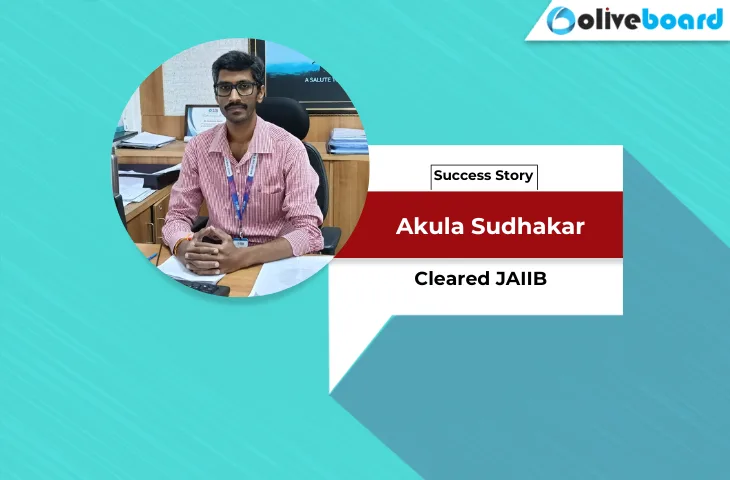
Clearing JAIIB while managing a full-time banking job is challenging, but Akula Sudhakar, a Scale III officer at SBI, made it happen with the right strategy. After an initial failed attempt in 2021, he came back with a structured plan and cleared all papers with solid scores, including 61 in Indian Economy and 65 in RBWM. His journey shows that success in JAIIB is less about luck and more about clarity, consistency, and the right resources.
From Delay to Determination: His Turning Point
Like many bankers, Akula initially underestimated JAIIB. “Earlier, I thought I could clear other exams, so I didn’t put much effort into JAIIB.” With a busy work schedule, preparation kept getting delayed.
The turning point came when he understood the importance of JAIIB for career growth and increments. That is when he shifted to a more structured preparation approach using Oliveboard courses, recorded classes, and concept-based video lectures. Having everything in one place helped him stay consistent even with a tight schedule.
A Simple Yet Effective Preparation Strategy
Akula Sudhakar followed a very clear and repeatable strategy instead of randomly solving questions. His focus was on building strong fundamentals first and then moving to practice.
He explains it simply: “First conceptual clarity, then notes preparation, and finally MCQs, mock tests, and revision.”
His preparation approach looked like this:
- Start with concept-building through video classes and structured courses
- Prepare short notes for quick revision
- Practice MCQs and previous year questions only after understanding concepts
- Revise consistently using notes and tests
Using Oliveboard’s video lectures and structured courses helped him avoid confusion and saved time by giving him a clear path to follow.
Section-Wise Preparation Approach
Each paper required a slightly different strategy, and Akula adapted accordingly.
Indian Economy (IFS): Dynamic and Current-Based
IFS required regular updates with current affairs and economic developments. “You have to stay updated with business news, budget, and latest developments,” he said.
He used structured content along with regular updates and maintained personal notes. Practicing previous year questions helped him understand the pattern of recurring topics.
PPB: Conceptual and Practical
For PPB, the preparation was more straightforward. Since it is largely static and based on banking practices, he relied on concept clarity through classes and revision through notes.
Using topic-wise practice tests and sectional tests helped him strengthen weak areas without wasting time.
AFM: The Toughest Paper
Coming from a non-commerce background, AFM was the most challenging paper for him. “It felt like a different language at first,” he admitted.
He focused heavily on concept-building through detailed video lectures and practiced regularly using MCQs and tests. Over time, repeated practice made even complex topics manageable.
RBWM: Smart Preparation and Revision
For RBWM, he relied on concise notes, revision, and targeted practice. Instead of over-studying, he focused on understanding key concepts and reinforcing them through tests.
The Role of Mock Tests and Practice
Mock tests were a game-changer in his preparation. He treated them as seriously as the actual exam.
“Mock tests are very important because they help you experience the real exam environment,” he explained.
He attempted around 10 full-length mock tests and made sure to analyze each one. This helped him improve:
- Time management
- Accuracy under pressure
- Question selection strategy
Practicing with Oliveboard mock tests gave him a real exam-like experience and helped him identify exactly where he was going wrong.
Managing Time as a Working Banker
Time management is the biggest challenge for bankers, and Akula solved it with discipline. Instead of waiting for free time, he created a routine.
“I used to wake up at 5 AM and study for one to one and a half hours. In the evening, I gave another hour.”
He consistently studied around 2 hours daily. He also made tough choices like skipping outings and social events close to the exam.
His message is clear: “You have to sacrifice early mornings and late nights. Otherwise, it is not easy to crack this exam.”
Why Conceptual Clarity Matters More Than Luck
Akula strongly believes that relying on luck is risky. Many candidates underestimate the exam and depend on guesswork.
“Without preparation, you might get 30 to 40 marks, but to safely clear the exam, you should aim for 60 to 70,” he explained.
With exams becoming more concept-driven, strong fundamentals are essential. This is where structured courses, concept videos, and topic-wise tests play a crucial role.
Using a platform like Oliveboard gives access to everything in one place, including classes, previous year questions, mock tests, and revision material, which makes preparation much more efficient.
Final Advice for Aspirants
Akula’s biggest advice is to build internal motivation and start early. “Until you are internally motivated, it is very difficult to clear this exam.”
He also warns against last-minute preparation. With increasing difficulty level, consistency is the only way forward.
His formula is simple and proven:
- Conceptual clarity
- Notes preparation
- Practice and PYQs
- Mock tests and revision
If you are preparing for JAIIB 2026, now is the best time to start. With the right strategy and access to structured courses, mock tests, and practice material, clearing the exam in one attempt becomes achievable.

I started my journey with storytelling and journalism, and somewhere along the way, I discovered how much I truly love writing. Words have always been my way of connecting with people.
With 4+ years of experience in content creation, social media, and video storytelling, I focus on building meaningful conversations, not just posts. I enjoy understanding audiences, planning engaging content, and turning followers into active, connected communities.
At Oliveboard, I work on creating value-driven content that informs, engages, and brings people together.