

Height and Distance is one of the most visual and scoring topics in Quantitative Aptitude. It primarily involves the application of trigonometric ratios to calculate heights, distances, and angles in real-life or exam-based scenarios. In this blog we have provided all the details about height and distance, important formulas, tricks, types of questions, solved examples from 2026 exams.
Download Height and Distance Questions E-Book PDF
Download Height and Distance Questions E-Book PDF to practice the most important mathematics questions for SSC, Bank, Railway Exams, and other competitive exams. This e-book includes concept-based questions, solved examples, shortcut techniques, previous year questions, and practice sets to improve your accuracy in height, distance, and trigonometry-based problems.
Practice Height and Distance Questions for Live
Prepare for SSC CGL, CHSL, GD, MTS, and other competitive exams with these important Height and Distance questions. These practice sets will help improve your trigonometry skills, problem-solving ability, and speed in the quantitative aptitude section.
Q1) How many degrees does the hour hand rotate in 1 hour?
Q2) How many degrees does the minute hand rotate in 1 hour?
Q3) How many degrees does the minute hand rotate in 15 minutes?
Q4) How many degrees does the hour hand rotate in 30 minutes?
Q5) What is the angle between hour and minute hand at 3:00?
Q6) What is the angle between the hands of a clock at 6:00?
Q7) What is the angle between the hands at 12:00?
Q8) Find the angle between the hour and minute hand at 4:00.
Q9) How many degrees does the hour hand rotate from 12:00 to 4:00?
Q10) What is the angle traced by the minute hand in 20 minutes?
Q11) Find the angle between hour and minute hand at 9:00.
Q12) Through how many degrees will the hour hand rotate from 5 AM to 10 AM?
Q13) Find the angle between the hour and minute hands at 3:30.
Q14) Find the angle between the hands at 6:30.
Q15) At what time between 4 and 5 o’clock will the hands be at right angles?
Quiz Summary

Sign Up
Or, register with email
 Email Id
 Mobile Number
 Password

Login
Email Id
Password
Forgot Password
Please enter the Email ID we will send you a Email with the link to reset the password.
Email Id
Or, login with

What is Height and Distance in Quantitative Aptitude?
Height and Distance refers to problems that involve measuring the vertical height of an object or the horizontal distance between two points, using the concept of angles of elevation and depression in trigonometry.
In competitive exams, these questions test a candidate’s visualization skills, trigonometric knowledge, and problem-solving speed.
Skills Required:
- Understanding of basic trigonometric ratios (sin, cos, tan)
- Ability to draw diagrams from word problems
- Logical sequencing of given data
Why is Height and Distance Important in Competitive Exams?
Height and Distance is a high-scoring topic because it often appears as a single, straightforward question in the Quantitative Aptitude section.
| Exam | No. of Questions | Difficulty |
| SSC CGL / CHSL | 1–2 | Easy |
| IBPS PO / SBI PO | 1–2 | Moderate |
| RRB NTPC / Group D | 1 | Easy |
| State PSC / Police | 1–2 | Moderate |
Height and Distance Quantitative Aptitude Short Notes
Height and Distance questions use angles of elevation and depression along with trigonometric formulas to calculate unknown measures.
| Term | Definition |
| Angle of Elevation | Angle between the horizontal line and the line of sight to an object above the horizontal level. |
| Angle of Depression | Angle between the horizontal line and the line of sight to an object below the horizontal level. |
| Line of Sight | The imaginary line drawn from the observer’s eye to the object. |
| Horizontal Distance | The straight-line distance along the ground between two points. |
| Vertical Height | The perpendicular height from the base to the top of the object. |
Height and Distance Quick Revision Summary
The quick revision concepts for the topic Height and Distance are as follows:
| Concept | Explanation |
| Tan θ | Opposite side / Adjacent side |
| Sin θ | Opposite side / Hypotenuse |
| Cos θ | Adjacent side / Hypotenuse |
| Angle of Elevation | Eye looking upward to see an object |
| Angle of Depression | Eye looking downward to see an object |
| Common Exam Ratios | sin 30° = 1/2, cos 60° = 1/2, tan 45° = 1 |
What are the types of Height and Distance Questions in Quantitative Aptitude?
In exams, Height and Distance questions can be asked in various forms such as:
- Direct – Straightforward application of trigonometric ratios.
- Two-step problems – Using multiple angles or heights in a single problem.
- Object movement – Object changes position and alters the angle of elevation.
- Mixed-concept – Combined with time-speed-distance or geometry.
Height and Distance Formulas for Quantitative Aptitude
The formulas used to solve height and distance questions are as follows:
- tan θ = Opposite / Adjacent
- sin θ = Opposite / Hypotenuse
- cos θ = Adjacent / Hypotenuse
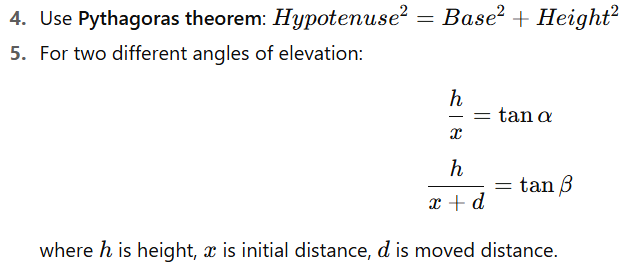
Height and Distance Tricks for SSC CGL and Other Exams
Tricks to solve height and distance questions in less time are as follows:
- Always draw a diagram before solving.
- Label all given angles and distances clearly.
- Remember tan = height / distance for most cases.
- Memorise standard trigonometric values (0°, 30°, 45°, 60°, 90°).
- In two-angle problems, solve step by step — do not combine prematurely.
Common Mistakes to avoid while Solving Height and Distance Questions
Common mistakes to avoid while solving questions based on height and distance are as follows:
- Not drawing a diagram leads to misinterpretation.
- Confusing angle of elevation with depression – always check direction.
- Mixing up base and height in tan/sin/cos formulas.
- Forgetting to convert units (meters, kilometers).
- Skipping standard value memorization wastes time in calculation.
FAQs
Draw the figure, mark known angles/distances, and apply the correct trigonometric ratio without extra steps.
Mainly:
tan θ = Opposite / Adjacent
sin θ = Opposite / Hypotenuse
cos θ = Adjacent / Hypotenuse
Pythagoras theorem for right-angled triangles.
Yes, you must know basic ratios and standard angle values (0°, 30°, 45°, 60°, 90°).
Commonly used:
sin 30° = 1/2, cos 30° = √3/2, tan 30° = 1/√3
sin 45° = 1/√2, cos 45° = 1/√2, tan 45° = 1
sin 60° = √3/2, cos 60° = 1/2, tan 60° = √3
Elevation: looking up at an object.
Depression: looking down at an object.
- BOB LBO Admit Card 2026 Out: Download Call Letter
- SBI Clerk Prelims Exam Analysis 2026, 26th & 27th September, All Shifts
- SSC CGL Last Minute Tips 2026, Tier 1 Final Revision Strategy
- How Many Hours to study for SSC CGL? Check Full Details
- SSC CHSL Study Plan for Tier 1 Exam, Crack Exam in 60 Days
- SSC CHSL Study Plan for 45 Days 2026, Check For Tier 1

Hi, I’m Aditi. I work as a Content Writer at Oliveboard, where I have been simplifying exam-related content for the past 4 years. I create clear and easy-to-understand guides for JAIIB, CAIIB, and UGC exams. My work includes breaking down notifications, admit cards, and exam updates, as well as preparing study plans and subject-wise strategies.
My goal is to support working professionals in managing their exam preparation alongside a full-time job and to help them achieve career growth.