
Cracking SSC CGL in the first serious attempt is rare. Making it to multiple lists in the same cycle is even rarer. Adarsh Singh, a 22-year-old aspirant from Pratapgarh, Uttar Pradesh, achieved exactly that. Not only did he clear SSC CGL 2025, but he also secured a Level 6 post by strategically improving his preparation after learning from his previous attempt.
His journey is not just about hard work, but about understanding the exam deeply, identifying weaknesses, and using the right resources at the right time.
From Defense Aspirant to SSC CGL Success
Adarsh began his preparation journey during his graduation. Initially focused on defense exams like NDA and Coast Guard, he even cleared the written stage of one recruitment. However, he consciously decided to shift towards SSC exams with a long-term goal in mind.
He started serious SSC preparation around March–April 2024, gradually moving from basic subject understanding to a structured, exam-oriented approach. During this phase, he relied on a mix of concept-building through online classes and structured courses, along with regular practice to build speed and accuracy.
The Breakthrough: Practice Over Perfection
One of the biggest shifts in Adarsh’s preparation came when he stopped overthinking and started giving mocks consistently.
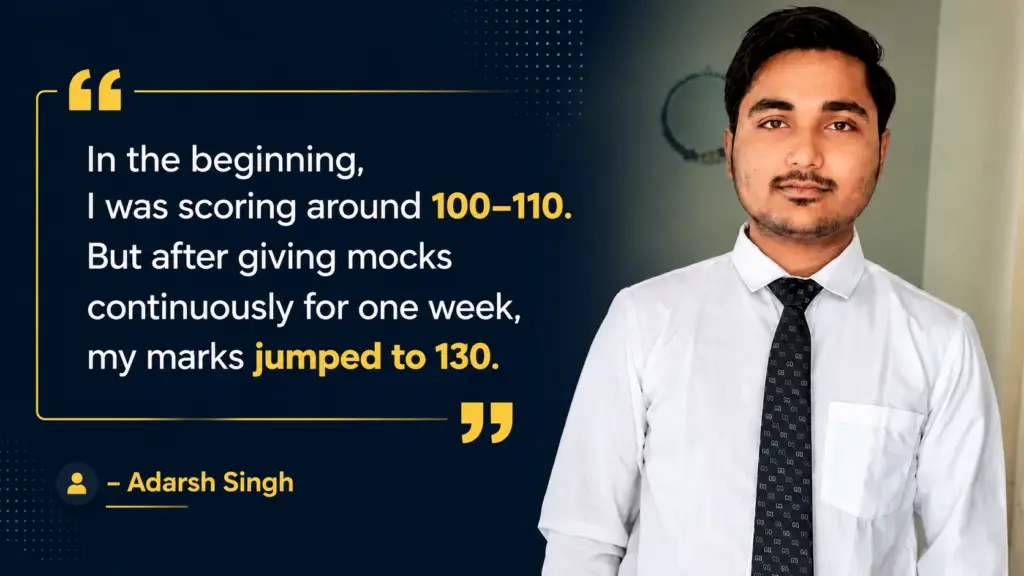
This phase helped him realize that consistent practice, especially through Oliveboard’s mock tests and previous year questions, is what truly drives improvement. He regularly attempted Oliveboard’s live mocks, sectional tests, and PYQ-based tests, which exposed him to a wide range of question patterns and difficulty levels.
The combination of structured courses, concept videos, and continuous testing helped him move from average scores to competitive performance in a short span.
Watch his full interview:
Section-Wise Strategy That Made the Difference
Adarsh’s preparation was built around optimizing strengths and managing weaknesses effectively.
English: Turning Strength into a Scoring Weapon
With a CBSE background, his reading habit gave him an edge in English. Instead of overloading himself with vocabulary, he focused on comprehension, cloze tests, and accuracy. Regular practice through sectional tests and question banks helped him maintain consistency in this section.
Reasoning: Self-Practice and Concept Clarity
Reasoning was largely self-prepared. Whenever he encountered difficult topics, he used concept videos and practice sets to strengthen his understanding. Continuous practice through sectional tests and mock analysis ensured high accuracy.
Quant: Selective Preparation Strategy
Instead of covering every topic, he focused on high-weightage areas and PYQs. His preparation included:
- Arithmetic topics like Percentage, Ratio, and Mensuration
- Repeated practice of SSC Previous Year Questions
- Improving calculation speed through timed tests
He used structured practice sets and PYQ-based question banks to build familiarity with exam-level questions.
General Awareness: The Weakest Link
GK remained his weakest area throughout preparation. Instead of trying to perfect it, he ensured that other sections compensated for it. In his second attempt, he improved his GK preparation by focusing more on PYQs, revision notes, and topic-wise practice.
The Game Changer: Mains Preparation Before Results
One of the most impactful decisions Adarsh made was starting Mains preparation early, even before the official notification or Prelims result.
He used Oliveboard’s Mains mock tests and sectional practice sets to understand the exam level in advance. This early exposure helped him gradually improve, even though his initial scores were low.
Alongside mocks, he also revised concepts through recorded classes and practiced advanced-level questions, which helped him bridge the gap between Prelims and Mains difficulty.
Learning from Failure and Making a Comeback
In his first attempt, despite scoring well, Adarsh missed selection. Instead of getting discouraged, he analyzed his mistakes and made clear improvements in his next attempt. He worked on weak areas like GK, increased his practice through mocks and PYQs, and focused more on accuracy.
He also realized the importance of tracking mistakes, especially the small ones that often go unnoticed. Maintaining error logs and revisiting weak areas played a key role in his improvement.
Smart Risk-Taking and Exam Strategy
Adarsh emphasized the importance of calculated risk, particularly in GK. Instead of leaving too many questions, he learned to take smart guesses when needed.
He believes that, in GK, you have to take chances. Sometimes questions you are sure about go wrong, and guesses turn out correct.
He also followed a balanced attempt strategy, avoiding both over-attempting and under-attempting. Practicing through mock tests helped him develop this judgment over time.
Final Advice for SSC Aspirants
Adarsh’s journey highlights practical strategies that every aspirant can apply:
- Focus on PYQs to understand exam trends
- Give regular mock tests to build speed and confidence
- Use structured courses and concept videos to strengthen basics
- Start Mains preparation early
- Identify weak areas and improve them strategically
Consistency, combined with the right mix of practice and learning resources, played a key role in his success.
Adarsh Singh’s story shows that clearing SSC CGL is not just about hard work, but about smart preparation. With the right approach, consistent mock practice, PYQ analysis, and structured learning through classes and courses, even a short preparation window can lead to success.
If you are preparing for SSC CGL 2026, now is the right time to start.

I started my journey with storytelling and journalism, and somewhere along the way, I discovered how much I truly love writing. Words have always been my way of connecting with people.
With 4+ years of experience in content creation, social media, and video storytelling, I focus on building meaningful conversations, not just posts. I enjoy understanding audiences, planning engaging content, and turning followers into active, connected communities.
At Oliveboard, I work on creating value-driven content that informs, engages, and brings people together.