

Cracking SBI PO is one of the most competitive achievements in the banking exam space. But securing All India Rank 1 while battling health challenges, job pressure, and uncertainty makes Niranjan Jain’s journey stand out even more.
In this interview, Niranjan shares how he built a structured preparation system, relied on disciplined execution, and focused on consistent practice instead of short-term motivation. His story is a reminder that success in banking exams is less about perfect conditions and more about how effectively you execute under pressure.
His Background
Niranjan’s journey was not a smooth, uninterrupted preparation cycle. As a working professional, he had to manage job responsibilities along with SBI PO preparation. Alongside this, sudden health complications led to hospitalization and serious physical limitations.
At one point, he was advised complete rest and was unsure whether he would even be able to attempt the exam. Family concerns and medical advice added further pressure.
Despite all of this, he made a decision just days before the exam that changed everything.
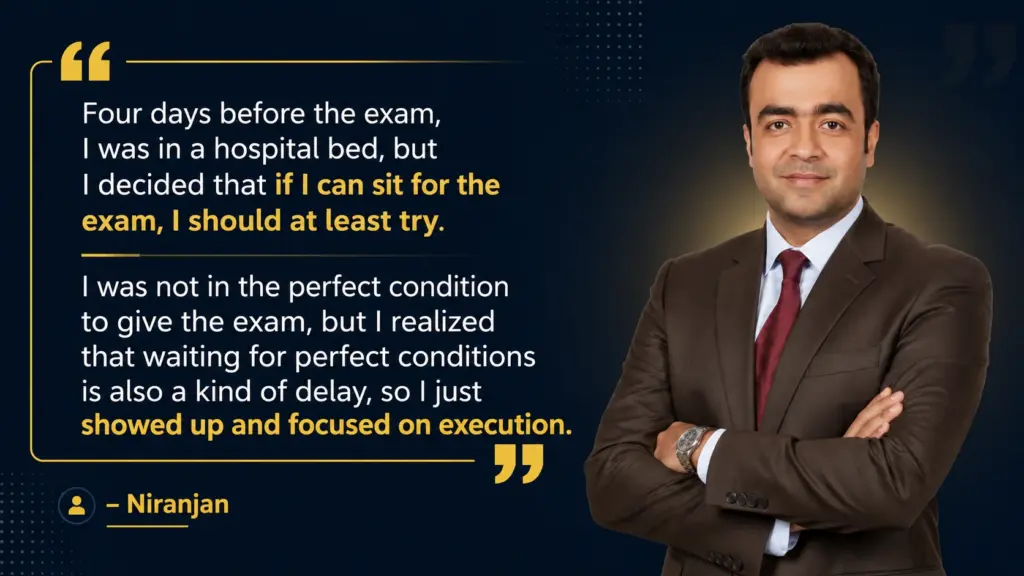
This mindset shift from preparation to execution became the turning point of his journey.
Preparation Strategy
One of the strongest takeaways from Niranjan’s preparation journey is his clear rejection of motivation-driven study. Instead, he built a disciplined system that worked even on low-energy days.
His preparation was built on consistency and structure rather than intensity.
Key elements of his strategy included:
- Completing syllabus in a structured and planned manner
- Regular revision instead of last-minute cramming
- Consistent mock test practice with detailed analysis
- Prioritizing accuracy over random attempt volume
He strongly believes that banking exams reward consistency more than motivation spikes. The goal is not to study when you feel like it, but to study because it is non-negotiable.
Mock Test Strategy
Mock tests played a crucial role in shaping Niranjan’s final performance. However, what mattered most was not how many mocks he attempted, but how deeply he analyzed them.
Each mock test was treated as a learning tool rather than a scoring benchmark. He focused on identifying mistakes, improving selection strategy, and refining accuracy.
This is exactly where structured platforms like Oliveboard become useful, as they help simulate real exam pressure with exam-level mocks and detailed performance analysis.
To build the same level of exam readiness, aspirants should focus on:
- Full-length mock tests for real exam simulation
- Sectional tests for targeted improvement
- Detailed performance tracking to identify weak areas
Smart Concept Application
Niranjan does not believe in shortcuts, but he strongly believes in smarter application of concepts. In quantitative aptitude, he focused on improving logic-based solving instead of relying on traditional lengthy methods.
This helped him save valuable time per question, sometimes up to 10 to 15 seconds, simply by applying clearer conceptual understanding.
However, he is clear that this improvement only comes after building strong fundamentals. Without conceptual clarity, speed techniques do not work consistently in exams like SBI PO.
Accuracy First Approach
In reasoning, Niranjan emphasizes avoiding shortcut dependency, especially in mains-level exams where questions are complex and layered.
His strategy focused on building structured thinking instead of rushing into solutions.
Key aspects of his reasoning approach:
- Creating multiple possibilities for puzzles instead of forcing one assumption
- Using elimination methods for clarity
- Strengthening basics to handle statement-based complexity
He believes reasoning success comes from repetition and exposure rather than tricks. The more patterns you see, the faster your brain adapts.
The Most Challenging Phase
One of the most defining parts of Niranjan’s journey was the period right before the exam when he was hospitalized and under strict medical supervision.
With very limited preparation time left, he did not attempt to overload himself with new content. Instead, he focused on revising mock test insights and strengthening already familiar concepts.
This decision helped him stay mentally stable and avoid confusion during the exam.
More importantly, it forced him to focus on execution rather than anxiety, which ultimately improved his performance.
Final Advice for Aspirants
Niranjan’s advice to SBI PO aspirants is simple but powerful. According to him, success does not come from motivation or external pressure, but from disciplined consistency.
He strongly recommends:
- Starting preparation seriously from day one
- Avoiding irrelevant content and distractions
- Focusing more on mock analysis than just attempting mocks
- Keeping preparation structured and time-bound
He also emphasizes that preparation should not stretch endlessly. A focused 1 to 2-year plan with discipline is far more effective than a scattered long-term attempt.
Execution Wins Over Circumstances
Niranjan Jain’s SBI PO AIR 1 journey proves that success is not about ideal conditions. It is about disciplined preparation, smart practice, and execution under pressure.
From a hospital bed to the top rank in one of India’s toughest banking exams, his story highlights one clear truth: consistency always beats circumstance.
For aspirants, building the right practice environment is crucial. Structured mock tests, sectional practice, and exam-focused preparation tools like those offered by Oliveboard can help bridge the gap between preparation and real exam performance.\

I started my journey with storytelling and journalism, and somewhere along the way, I discovered how much I truly love writing. Words have always been my way of connecting with people.
With 4+ years of experience in content creation, social media, and video storytelling, I focus on building meaningful conversations, not just posts. I enjoy understanding audiences, planning engaging content, and turning followers into active, connected communities.
At Oliveboard, I work on creating value-driven content that informs, engages, and brings people together.