
Preparing for the RBI Grade B Phase 1 Exam 2027 requires a clear study plan, regular practice, and a good understanding of all four subjects. General Awareness, Quantitative Aptitude, Reasoning Ability, and English Language test different skills, so each subject needs a different preparation approach. Instead of spending too much time on one section, aspirants should focus on accuracy, time management, and regular revision.
In this blog, we cover subject-wise preparation tips, important topics, daily practice methods, and mock-test strategies to help you prepare effectively for RBI Grade B Phase 1.
Download free RBI Grade 2027 preparation strategy PDF
The RBI Grade B 2027 Preparation Strategy PDF provides a step-by-step guide to cover the syllabus effectively. It includes the exam pattern, important subject-wise topics, a practical study schedule, mock test tips, and revision methods to help aspirants prepare for Phase 1 and Phase 2.
What is the RBI Grade B Phase 1 exam pattern?
Before starting your preparation, understand the Phase 1 exam pattern and the subjects included in the examination. The General cadre Phase 1 exam is an objective test that assesses candidates across four sections. General Awareness carries the highest weightage, while Quantitative Aptitude, Reasoning Ability, and English Language require regular practice.
| Subject | Marks |
|---|---|
| General Awareness | 80 |
| Reasoning Ability | 60 |
| English Language | 30 |
| Quantitative Aptitude | 30 |
| Total | 200 |
How should you prepare General Awareness for RBI Grade B Phase 1?
General Awareness carries 80 marks in RBI Grade B Phase 1 and covers banking, finance, economics, and national developments. Follow reliable current affairs sources, prepare short notes, revise regularly, and connect recent events with banking and economic concepts to improve your score.
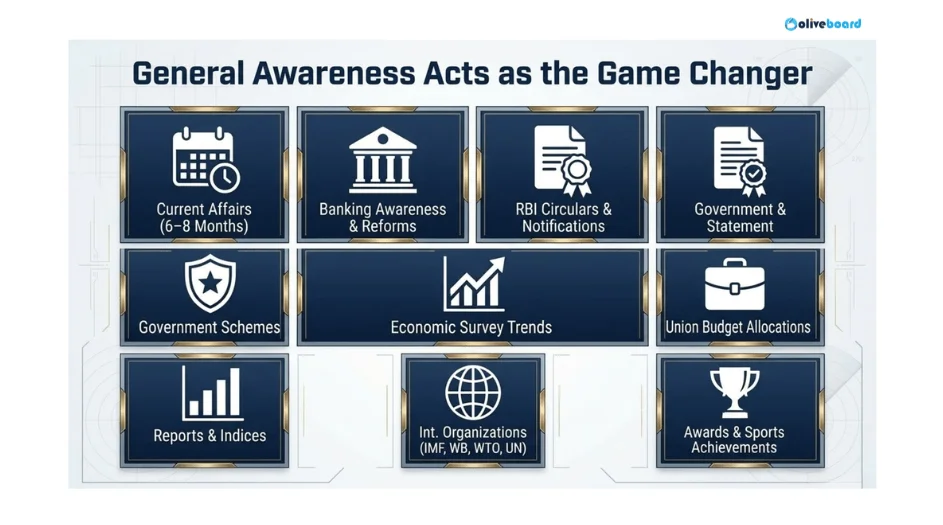
- Current affairs: Focus on important national and international events, economic developments, government policies, and major appointments.
- Banking awareness: Study banking terms, financial institutions, banking reforms, digital payments, and recent developments in the financial sector.
- RBI updates: Follow monetary policy announcements, important circulars, regulatory changes, and financial inclusion initiatives.
- Government schemes: Learn the objectives, beneficiaries, implementing ministries, and key features of important schemes.
- Reports and indices: Cover major reports, rankings, indices, and the organisations that publish them.
- Union Budget and Economic Survey: Understand important announcements, economic trends, and key policy recommendations.
- International organisations: Revise the functions and important updates of organisations such as the IMF, World Bank, WTO, and United Nations.
- Awards and sports: Cover major awards, important tournaments, winners, and significant achievements.
How can you improve Quantitative Aptitude for RBI Grade B?
The Quant section is not extremely difficult, but it requires accuracy and smart question selection. Candidates should focus on core topics rather than trying to master every chapter.
- Percentage: Learn how to calculate percentage increase, decrease, and percentage-based comparisons, as these concepts form the foundation of many arithmetic questions.
- Profit and Loss: Understand how to calculate profit percentage, loss percentage, discount, marked price, and selling price, as these topics are frequently asked in banking exams.
- Ratio and Proportion: Focus on comparing quantities, partnership problems, and mixture-based questions, which are commonly tested in the Quant section.
- Time and Work: Learn concepts related to work efficiency, combined work, and work completion time to solve questions quickly and accurately.
- Simple Interest and Compound Interest: Understand interest calculations, annual growth, and investment-related concepts that are important for banking examinations.
- Time, Speed and Distance: Practice questions related to trains, boats and streams, average speed, and relative speed to strengthen your problem-solving ability.
- Data Interpretation (DI): Learn to analyze tables, bar graphs, pie charts, and line graphs, as DI is one of the most important scoring areas in RBI Grade B.
- Number Series: Practice identifying patterns and logical sequences to improve speed in solving missing and wrong number series questions.
- Quadratic Equations: Learn shortcut methods and comparison techniques to solve quadratic equation questions within a few seconds.
What is the best strategy for Reasoning Ability?
Reasoning Ability is one of the most scoring sections in RBI Grade B Phase 1. A strong command over puzzles and logical reasoning can help candidates score well above the cut-off.
- Seating Arrangement: Learn linear, circular, and rectangular seating arrangements, as these questions are commonly asked in RBI Grade B.
- Floor Puzzles: Practice questions involving multiple floors, persons, and conditions to improve logical thinking.
- Box Puzzles: Develop the ability to arrange boxes based on different conditions and clues provided in the question.
- Distribution Puzzles: Learn how to distribute people, objects, or categories according to given conditions efficiently.
- Syllogism: Understand logical statements and conclusions using Venn diagrams and shortcut techniques.
- Inequalities: Practice coded and direct inequality questions to improve logical reasoning skills.
- Blood Relations: Learn family relationship concepts and family tree-based questions.
- Direction Sense: Practice questions involving directions, distances, and movements to strengthen analytical skills.
- Coding-Decoding: Understand pattern recognition and coding techniques used to decode information.
How can you clear the English Language section easily?
Many candidates find English challenging, but the section can be cleared comfortably with consistent practice. Regular reading and grammar improvement are the keys to success.
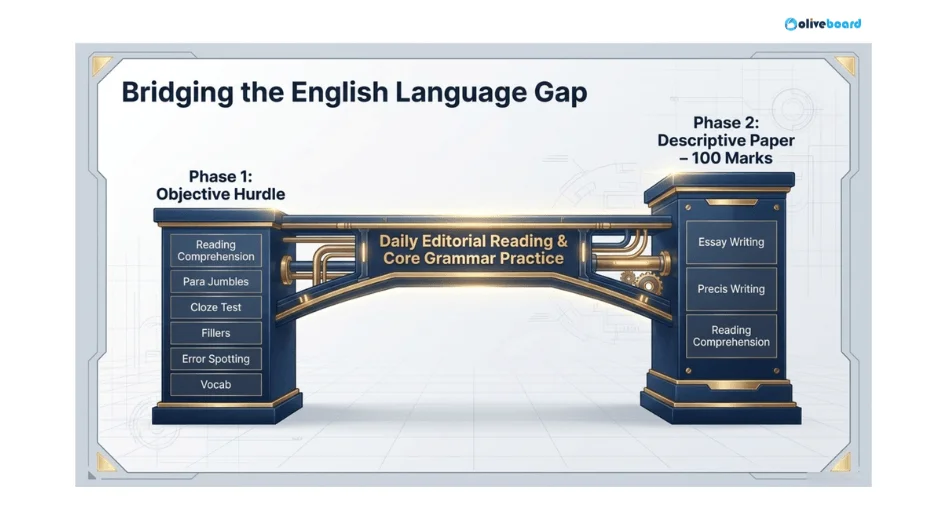
- Reading Comprehension: Develop reading skills and learn to identify main ideas, facts, and inferences from passages.
- Para Jumbles: Practice arranging sentences logically to form meaningful paragraphs.
- Cloze Test: Improve vocabulary and contextual understanding to select the correct words in a passage.
- Fillers: Learn to choose appropriate words based on sentence meaning and grammar rules.
- Error Spotting: Strengthen grammar concepts to identify mistakes in sentence structure and usage.
- Vocabulary: Build a strong word bank by learning new words, meanings, synonyms, and antonyms regularly.
- Sentence Rearrangement: Practice organizing jumbled sentences into a coherent and meaningful sequence.
How should you prepare for Economic and Social Issues (ESI)?
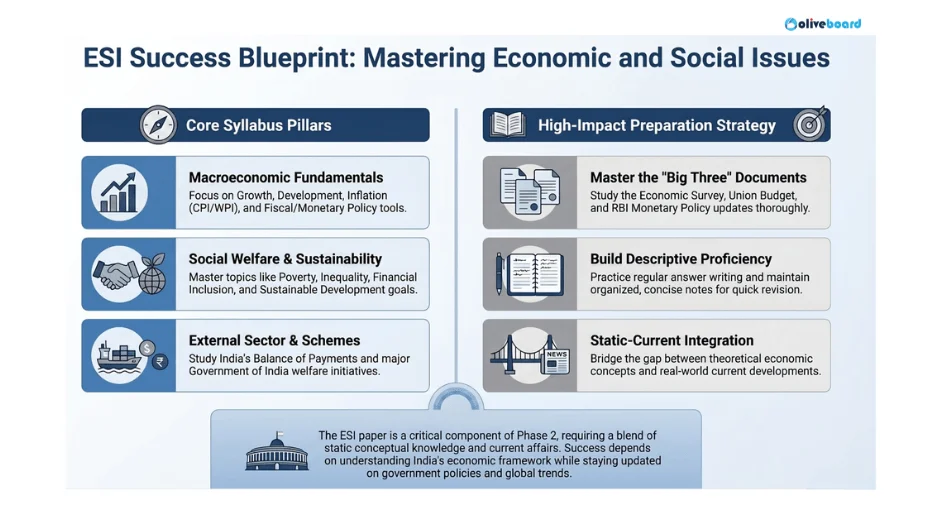
Economic and Social Issues is one of the most important papers in Phase 2. It requires a combination of static concepts and current affairs knowledge.
- Growth and Development: Study economic growth, human development, and sustainable development.
- Inflation: Learn the causes, effects, CPI, WPI, and inflation targeting.
- Monetary Policy: Understand how the RBI uses the Repo Rate, Reverse Repo Rate, CRR, and SLR to manage money supply and inflation.
- Fiscal Policy: Cover taxation, government spending, budget deficits, and economic development.
- Poverty and Inequality: Study poverty, income inequality, unemployment, and related government welfare schemes.
- Sustainable Development: Learn about climate change, environmental protection, renewable energy, and sustainable growth.
- Balance of Payments: Understand India’s trade transactions, current and capital accounts, foreign exchange reserves, and trade deficits.
- Financial Inclusion: Study initiatives that improve access to banking, credit, insurance, and other financial services.
- Government Schemes: Prepare key central government welfare schemes, their objectives, and target beneficiaries.
ESI Preparation Strategy
A focused preparation strategy is essential to score well in Economic and Social Issues (ESI). Candidates should understand key concepts, follow current economic developments, revise regularly, and practise answer writing to improve their objective and descriptive performance.
- Study the Economic Survey Thoroughly: The Economic Survey provides valuable insights into India’s economic performance, challenges, and policy recommendations.
- Follow Union Budget Highlights: Focus on important budget announcements, government spending priorities, taxation reforms, and sector-specific allocations.
- Read RBI Monetary Policy Updates: Stay updated with RBI policy decisions, inflation outlook, interest rate changes, and economic projections.
- Prepare Descriptive Notes: Create short and organized notes for important ESI topics to make revision easier before the examination.
- Practice Answer Writing Regularly: Develop the habit of writing structured answers to improve presentation, clarity, and time management in descriptive papers.
What Is the best way to prepare Finance and Management (FM)?
Finance and Management is another important Phase 2 paper. Candidates should focus on both theoretical concepts and current banking developments.
| Subject | Important topic | Key points to cover |
|---|---|---|
| Finance | Indian Financial System | – Structure of India’s financial system – Banks, financial institutions, and financial markets – Financial regulatory bodies |
| Finance | RBI Functions | – Monetary policy implementation – Currency issuance and management – Banking regulation and supervision |
| Finance | Capital Markets | – Equity and debt markets – Stock exchanges and their functions – Role of capital markets in economic growth |
| Finance | SEBI | – Role and functions of the Securities and Exchange Board of India – Securities market regulation – Investor protection |
| Finance | NBFCs | – Meaning and functions of Non-Banking Financial Companies – Importance of NBFCs in providing financial services – Differences between NBFCs and commercial banks |
| Finance | Banking Regulation | – Important banking laws and regulations – Prudential norms and compliance requirements – Rules governing banking operations |
| Finance | Insurance Sector | – Structure of the insurance industry – Types of insurance products – Role of insurance regulators |
| Management | Planning | – Setting organisational goals – Developing plans and strategies – Choosing suitable actions to achieve objectives |
| Management | Organising | – Allocating resources and responsibilities – Dividing tasks among employees – Improving organisational efficiency |
| Management | Staffing | – Recruitment and selection – Employee training and development – Performance management |
| Management | Leadership | – Different leadership styles and theories – Role of leaders in guiding teams – Employee motivation and teamwork |
| Management | Motivation Theories | – Maslow’s Hierarchy of Needs – Herzberg’s Two-Factor Theory – McGregor’s Theory X and Theory Y |
| Management | Corporate Governance | – Ethical business practices – Transparency and accountability – Responsible decision-making and management |
| Management | Corporate Social Responsibility (CSR) | – Business contributions to social welfare – Environmental sustainability – Community development initiatives |
FM Preparation Tips
Finance and Management requires a balanced approach that combines theoretical concepts with current financial developments. Regular revision and staying updated with banking and financial news can significantly improve performance in this paper.
- Prepare Concise Notes: Create short notes for important finance concepts, management theories, and regulatory frameworks for quick revision.
- Learn Management Theories Thoroughly: Focus on understanding key management principles and their practical applications.
- Follow RBI and SEBI Updates: Stay informed about recent circulars, policy changes, and regulatory developments.
- Revise Banking News Regularly: Keep track of major banking sector developments, mergers, policy announcements, and financial reforms.
- Practice Descriptive Answers: Write answers regularly to improve content organization, presentation skills, and writing speed.
How important is the English writing paper?
The English Writing paper carries 100 marks and can significantly improve a candidate’s final rank. Many aspirants ignore this paper, which becomes a major disadvantage.
- Essay Writing: Candidates are required to write a well-structured essay on topics related to economics, banking, finance, social issues, or current affairs.
- Precis Writing: This section tests the ability to summarize lengthy passages into concise and meaningful content while retaining the main idea.
- Reading Comprehension: Candidates must read a passage carefully and answer questions that assess comprehension, analytical ability, and language skills.
English Writing Preparation Strategy
The English Writing paper can significantly influence a candidate’s overall Phase 2 score. Regular writing practice, strong reading habits, and a clear understanding of answer structure are essential for performing well in this paper.
- Write One Essay Every Week: Regular essay writing helps improve content organization, idea generation, and writing confidence.
- Practice Precis Writing Frequently: Develop summarization skills by practicing how to condense lengthy passages into concise and effective content.
- Read Quality Editorials Daily: Reading newspapers and editorials improves vocabulary, comprehension, and understanding of current issues.
- Focus on Structure and Clarity: Ensure that essays and answers have a proper introduction, body, and conclusion with clear and logical flow.
- Improve Writing Speed Gradually: Regular practice helps candidates complete descriptive questions within the prescribed time limit while maintaining quality.
What are the safe score targets for RBI Grade B 2027?
Setting score targets helps candidates measure progress and identify improvement areas.
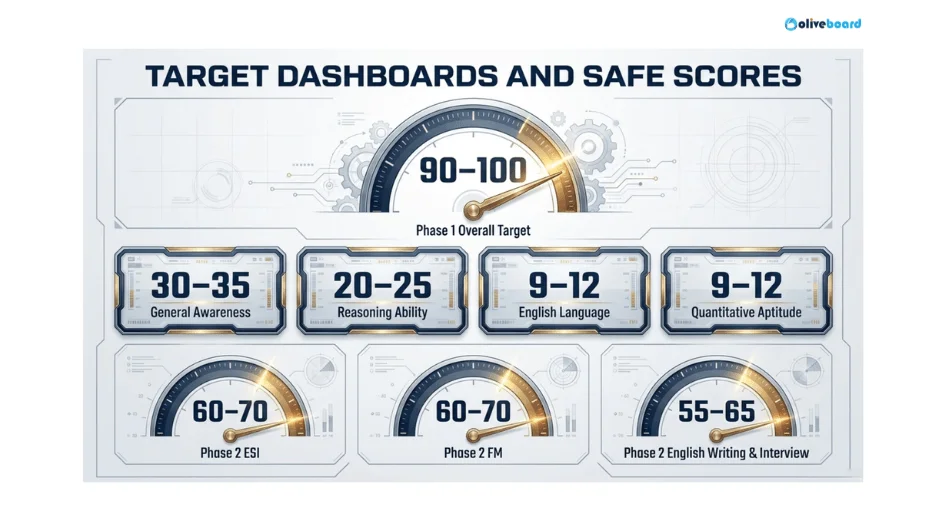
| Stage | Section/Paper | Safe Target Score |
| Phase 1 | General Awareness | 30–35 |
| Phase 1 | Reasoning Ability | 20–25 |
| Phase 1 | English Language | 9–12 |
| Phase 1 | Quantitative Aptitude | 9–12 |
| Phase 1 | Overall Score | 90–100 |
| Phase 2 | Economic & Social Issues (ESI) | 60–70 |
| Phase 2 | English Writing | 55–65 |
| Phase 2 | Finance & Management (FM) | 60–70 |
| Interview | Personality Test | 55–65 |
What is the ideal 6 month study plan for RBI Grade B 2027?
A structured study plan helps candidates complete the syllabus on time and ensures proper revision before the exam.
| Preparation Phase | Duration | Details |
| Phase 1: Foundation Building | Days 1–45 | Building strong fundamentals and understanding core concepts Complete the basics of Quantitative Aptitude, Reasoning Ability, English Language, Economic and Social Issues (ESI), and Finance & Management (FM). Develop a daily Current Affairs reading habit and create short notes for revision. |
| Phase 2: Exam Alignment | Days 46–90 | Applying concepts through practice and testing Start attempting sectional and mock tests, strengthen Current Affairs preparation, improve performance in weaker sections, and continue covering ESI and FM topics systematically. |
| Phase 3: Revision and Improvement | Days 91–120 | Enhancing accuracy, speed, and answer-writing skills Focus on improving speed and accuracy through mock tests, begin serious descriptive answer writing practice, revise important static concepts, and thoroughly cover the Economic Survey and Union Budget. |
| Phase 4: Exam Mode | Days 121–180 | Final revision and exam readiness Attempt full-length mock tests regularly, revise notes and current affairs consistently, avoid starting new topics, and focus on exam temperament, time management, and confidence building. |
How should you use mock tests for RBI Grade B Phase 1 preparation?
Mock tests help you understand the RBI Grade B Phase 1 exam pattern, improve time management, and identify weak areas. Regular practice, combined with proper analysis, can help you improve accuracy and build confidence before the exam.
| Mock test strategy | Details |
|---|---|
| Start with sectional tests | Practise General Awareness, Quantitative Aptitude, Reasoning Ability, and English Language separately. |
| Attempt full-length mocks | Take complete mock tests once you understand the basic concepts and question types. |
| Analyse every mock test | Review incorrect answers, skipped questions, and questions that took too much time. |
| Maintain an error log | Record common mistakes and revise them regularly to avoid repeating them. |
| Track sectional scores | Monitor your performance in all four subjects and give extra time to weaker areas. |
| Improve question selection | Learn which questions to attempt first and when to move on from difficult ones. |
| Practise under exam conditions | Attempt mocks with a timer and minimal distractions to improve time management. |
| Set realistic score targets | Track your progress and aim to improve accuracy and speed gradually. |
| Revise weak topics | Use mock-test results to plan additional practice and revision sessions. |
What common mistakes should RBI Grade B aspirants avoid?
Many candidates fail because of avoidable mistakes rather than lack of preparation. Identifying these mistakes early can improve overall performance.
- Ignoring Quant and Reasoning: Give adequate time to all four Phase 1 subjects.
- Depending Only on Current Affairs: Cover current affairs along with static GK and subject basics.
- Using Too Many Study Resources: Stick to a few reliable books, notes, and study materials.
- Skipping Mock Test Analysis: Review each mock test to identify mistakes and weak areas.
- Delaying Descriptive Writing Practice: Start essay, precis, and answer-writing practice early for Phase 2.
- Ignoring the Union Budget and Economic Survey: Study both thoroughly for Phase 2 preparation.
- Starting New Topics Near the Exam: Focus on revision, mock tests, and covered topics in the final weeks.
- Lack of Regular Revision: Revise important concepts, notes, and current affairs regularly.
- Not Tracking Progress: Monitor mock test scores and set weekly improvement targets.
- Inconsistent Study Routine: Follow a fixed study schedule with clear daily targets and regular practice.
Also Check:
| Particulars | Link |
| RBI Circulars Practice Quiz | Download Free PDF |
| RBI Bulletin Practice Quiz | Download Free PDF |
| SEBI Circular Quiz | Download Free PDF |
What is the success formula for RBI Grade B 2027?
Success in the RBI Grade B 2027 exam requires consistency, discipline, and smart preparation. Follow a daily study plan, revise regularly, practise mock tests, stay updated on banking and economic developments, and improve your basic concepts and answer-writing skills. With balanced preparation and consistent effort, you can work towards a rewarding career at the Reserve Bank of India.
FAQs
Yes, RBI Grade B is considered one of the most competitive banking exams due to its vast syllabus and limited vacancies.
A focused preparation period of 6–8 months is generally sufficient for most aspirants.
Yes, with a structured study plan, consistent practice, and regular revision, beginners can clear the exam in their first attempt.
General Awareness is the most important section as it carries the highest weightage in Phase 1.
Mock tests are essential for improving speed, accuracy, time management, and exam readiness.
- RBI Grade B Phase 1 Information Handout 2027, Download PDF
- Important Topics for RBI Grade B Phase1 & 2, Subject Wise Topics List
- RBI Grade B Latest Update 2027, Complete Notification Detail
- Important Reports for RBI Grade B 2026, Downloadable PDF
- RBI Grade A vs. Grade B: Check All Differences Between Grade A & B
- RBI Grade B PYPs, Attempt Quiz and Download Free PDF

Hi, I’m Aditi. I work as a Content Writer at Oliveboard, where I have been simplifying exam-related content for the past 4 years. I create clear and easy-to-understand guides for JAIIB, CAIIB, and UGC exams. My work includes breaking down notifications, admit cards, and exam updates, as well as preparing study plans and subject-wise strategies.
My goal is to support working professionals in managing their exam preparation alongside a full-time job and to help them achieve career growth.