

SEBI Grade A Previous Year Papers help candidates prepare for the Securities and Exchange Board of India (SEBI) Grade A Assistant Manager Exam 2026. Solving these papers helps them understand the exam pattern, important topics, marking scheme, and difficulty level of Phase 1 and Phase 2. It also improves time management, accuracy, and overall exam preparation.
Download SEBI Grade A 2020 to 2025 PYPs PDF
Candidates can download the SEBI Grade A Previous Year Papers through the direct link provided below.
| SEBI Grade A Papers | Link |
|---|---|
| SEBI Grade A Phase 1 Paper 1 PYP 2025 | Download PDF |
| SEBI Grade A Phase 1 Paper 2 PYP 2025 | Download PDF |
| SEBI Grade A Phase 2 Paper 1 PYP 2025 | Download PDF |
| SEBI Grade A Phase 2 Paper 2 PYP 2025 | Download PDF |
| SEBI Grade A Phase 1 Paper 1 PYP 2024 | Download PDF |
| SEBI Grade A Phase 1 Paper 2 PYP 2024 | Download PDF |
| SEBI Grade A Phase 2 Paper 1 PYP 2024 | Download PDF |
| SEBI Grade A Phase 2 Paper 2 PYP 2024 | Download PDF |
| SEBI Grade A Phase 1 Paper 1 PYP 2022 | Download PDF |
| SEBI Grade A Phase 1 Paper 2 PYP 2022 | Download PDF |
| SEBI Grade A Phase 2 Paper 1 PYP 2022 | Download PDF |
| SEBI Grade A Phase 2 Paper 2 PYP 2022 | Download PDF |
| SEBI Grade A Phase 1 Paper 1 PYP 2020 | Download PDF |
| SEBI Grade A Phase 1 Paper 2 PYP 2020 | Download PDF |
| SEBI Grade A Phase 2 Paper 1 PYP 2020 | Download PDF |
| SEBI Grade A Phase 2 Paper 2 PYP 2020 | Download PDF |
Attempt SEBI Grade A Previous Year Practice Quiz
Practising with SEBI Grade A Previous Year Practice Quiz helps candidates understand the exam pattern, question difficulty level, and important topics. Attempt these practice questions to improve accuracy, speed, and overall preparation for the SEBI Grade A exam.
GENERAL AWARENESS
1. As of 2024, which among the following Indian-origin mathematicians is the only recipient of the prestigious Abel Prize?
2. Which of the following regulatory authorities is responsible for overseeing the functioning and regulation of Real Estate Investment Trusts (REITs) in India?
3. Which of the following Indian cities has recently earned the distinction of becoming the country's first member of the UNESCO Creative Cities Network under the category of 'City of Literature'?
4. The Fédération Internationale de Football Association (FIFA) has awarded the hosting rights for the 10th edition of the FIFA Women's World Cup, scheduled to be held in 2027, to which of the following countries?
5. The DigiLocker platform enables citizens to securely store and access various official digital documents issued by authorised institutions. Which of the following categories of documents can be uploaded or accessed through DigiLocker?
6. Individuals opting to file their income tax return using ITR-4 (Sugam) are subject to an annual income threshold. What is the maximum annual income permitted for filing ITR-4?
7. Before its shareholding was transferred to a consortium of leading banks, Central Depository Services (India) Limited (CDSL) was originally promoted by which of the following entities?
8. In 2024, who became the first Indian to receive South Africa's prestigious 'Nelson Mandela Lifetime Achievement Award' in recognition of contributions to the film industry?
9. Which of the following companies introduced the world's first large-scale 100% hydrogen-ready engine power plant, marking a significant milestone towards carbon-neutral power generation?
10. According to Kroll's latest celebrity brand valuation report titled 'Brands, Business, Bollywood', who emerged as the most valuable celebrity personality?
11. Under the Atal Innovation Mission (AIM), an Established Incubation Centre (EIC) must have been operational for at least how many years to qualify for financial scale-up support?
12. What is the maximum investment limit prescribed under the National Savings Certificate (NSC) – VIII Issue?
13. Indian Railways successfully conducted the trial run of a MEMU train on the world's highest railway bridge, which stands approximately 35 metres taller than the Eiffel Tower. This bridge has been constructed over which river?
14. SEBI, through its March 2024 circular on simplifying Offer Documents for Mutual Fund Schemes, introduced the acronym SID. In this context, what does the letter 'S' represent?
15. Which one of the following statements regarding the National Savings Recurring Deposit Account Scheme is incorrect?
16. Under the National Electricity Fund (Interest Subsidy) Scheme approved by the Government of India, which of the following is classified as a Special Category/Focused State?
17. Which of the following central banks are members of the Bank for International Settlements (BIS)?
18. The Financial Education Programme for Adults (FEPA), launched by the National Centre for Financial Education (NCFE) in 2019, primarily targets which of the following groups?
19. How many medals did India secure at the Asian Armwrestling Championship 2024, held in Tashkent, Uzbekistan?
20. According to the World Economic Forum's Travel & Tourism Development Index (TTDI) 2024, which of the following countries did not feature among the top five ranked destinations?
ENGLISH
21. Direction (Q1-Q7) – Read the passage carefully and answer the questions that follow
The interaction between humans and the natural environment has resulted in extensive and far-reaching changes across ecosystems worldwide. Over the years, activities such as rapid urbanisation, industrial expansion, and large-scale deforestation have significantly altered the Earth's ecological balance. Industrial development, driven by increased dependence on machinery, infrastructure, and energy resources, has transformed natural landscapes and contributed to the destruction of habitats that once supported a rich diversity of plant and animal life. Forests, wetlands, and grasslands, which previously sustained numerous species, have steadily declined because of expanding human activities.
The growth of urban centres has further intensified environmental degradation. As cities continue to expand, they occupy previously undisturbed regions, fragmenting ecosystems and reducing the space available for wildlife. Such expansion not only causes habitat destruction but also leads to greater pollution as the demand for energy, transportation, housing, and other resources rises. Industrial emissions and vehicle exhaust have deteriorated air quality, creating serious health concerns for both humans and animals. Likewise, contamination of rivers, lakes, and groundwater through industrial discharge, agricultural runoff, and improper waste disposal has adversely affected aquatic ecosystems and the availability of safe water for human use.
Another major environmental concern is climate change, which is largely attributed to the increasing concentration of greenhouse gases such as carbon dioxide and methane in the atmosphere. The accumulation of these gases has accelerated global warming, disrupting long-established weather patterns and increasing the occurrence as well as the intensity of extreme climatic events. Floods, droughts, heatwaves, and severe storms are becoming more frequent, posing significant threats to agriculture, biodiversity, infrastructure, and human settlements across different regions.
Although technological progress and environmental awareness have improved considerably in recent decades, balancing economic development with ecological preservation continues to be a complex challenge. Governments, industries, and communities have adopted measures such as promoting sustainable practices, expanding renewable energy, and strengthening conservation initiatives to reduce environmental damage. Nevertheless, achieving long-term environmental sustainability requires continuous commitment, innovative policymaking, scientific advancements, and coordinated efforts from multiple stakeholders to ensure that developmental needs are met without compromising the well-being of future generations.
Q1.
According to the passage, which of the following has been identified as a major consequence of industrialisation on the natural environment?
22. What does the passage identify as a major impact of rapid urban expansion?
23. Which one of the following has NOT been highlighted in the passage as an environmental challenge?
24. According to the passage, climate change has resulted in which of the following outcomes?
25. Which of the following words is closest in meaning to the word "transformed" as used in the passage?
26. Which of the following words is the opposite in meaning of "degradation" as used in the passage?
27. The passage suggests that one of the greatest difficulties in achieving sustainable development is:
28. Directions (Q8–Q12)
Each sentence contains one blank. Choose the most appropriate word to complete the sentence.
Q8.
Handmade presents can be perfectly ________ to match the tastes and preferences of the recipient.
29. After carefully weighing all the options, Ted finally ________ not to travel overseas during the summer vacation.
30. Bryan remained completely ________ in his belief that the Earth is flat despite evidence to the contrary.
31. The craftsman was extremely ________ while preparing the noodles and refused to allow anyone else to perform the task.
32. Had it not been for the ________ circumstances, he would almost certainly have lost his employment.
33. Directions (Q13–Q16)
In each question, four words marked (A), (B), (C) and (D) are highlighted. Some of these may be incorrectly placed. Identify the correct replacement.
Q13.
Some American officials lead (A) to hope that resumed sanctions (B) on Iran will appear (C) to a popular uprising (D).
34. Tariffs (A) has imported (B) higher China (C) on 603 items imposed (D) from the US.
35. NATO ally world (A) leads the Turkey (B) in the journalists (C) of number (D) jailed.
36. In 2016, rising (A) violence in Pathankot (B) by Islamic militants culminated (C) in attacks on Indian forces at Uri and Kashmir (D).
37. Directions (Q17–Q20)
Read each sentence carefully and identify the part containing the grammatical error. If there is no error, choose (E).
Q17.
She held something (A) / at her side which (B) / was totally hiding (C) / by the folds of her sari. (D) / No Error (E)
38. The father forbade his son (A) / to walk in the sun (B) / and play with (C) / his friends on the road. (D) / No Error (E)
39. The movement, which aims to (A) / raise awareness about climate change, hopes (B) / to bring people together to think about (C) / what they can do to reduce harmful pollution. (D) / No Error (E)
40. I declined the invitation (A) / not because I did not (B) / want to go but (C) / because I have no time. (D) / No Error (E)
QUANTITATIVE APTITUDE
41. A shopkeeper marks an article 80% above its cost price. After offering a 25% discount, he sells it for ₹1,620. At what price would the article be sold if, instead, a 15% discount had been allowed?
42. A vessel M contains 154 litres of a milk-water mixture in the ratio 3 : 4 respectively. Another vessel N contains 220 litres of mixture in which the quantity of water exceeds milk by 44 litres. If the contents of both vessels are mixed together, what will be the ratio of milk to water in the final mixture?
43. Out of ₹2,500, Ramlal invested ₹x at 20% compound interest per annum for 2 years and kept the remaining amount as savings. If the maturity value of the investment after two years was ₹2,160, how much money did he save?
44. Directions (Q4–Q6)
Study the information carefully and answer the questions.
Three schools A, B and C have male and female students.
School A has 480 male students, which is 25% more than the number of female students in School B.
The ratio of female students in B : C is 16 : 15.
School C has a total of 800 students.
The total number of male students in all three schools is 1,500.
The number of female students in School A is 160 fewer than the number of male students in School B.
Q4.
The number of female students in School C is what percentage more or less than the number of male students in School A?
45. Find the average number of female students across Schools A, B and C.
46. Find the ratio of the total students in School A to the combined number of male students in Schools B and C.
47. The present ages of A and B are in the ratio 5 : 4. Eight years from now, their ages will be in the ratio 7 : 6. If C is 4 years older than A, what is the present age ratio of B : C?
48. Directions (Q8–Q10)
Identify the incorrect number in each of the following number series.
Q8.
128, 238, 372, 526, 708, 918
49. 18, 109, 547, 2190, 6577, 13159
50. 51, 60, 79, 134, 215, 336
51. Directions (Q11–Q15)
Study the table carefully and answer the questions that follow.
The table below provides the number of MI Stores in five different cities, the average number of employees per store, and the ratio of male to female employees.
Q11.
What is the ratio of the male employees working in MI Stores of City A to the female employees working in MI Stores of City B?
52. Determine the total number of male employees in MI Stores located in City D.
53. Find the combined number of employees working in MI Stores of Cities A and C.
54. The number of female employees in MI Stores of City E is what percentage of the number of female employees in City B?
55. The number of male employees in City F is 18 more than that in City C. If the ratio of male to female employees in City F is 3 : 2, how many female employees are there in City F?
56. Set A consists of six consecutive odd numbers, while Set B contains five consecutive multiples of 3. The last element of Set A is equal to the second element of Set B. If the average of Set A is 16, what is the average of Set B?
57. Directions (Q17–Q20)
Each question contains two equations. Solve them separately and determine the relationship between x and y.
Q17
(I) x2−32x+240=0
(II) y2+8y+15=0
58. Q18
(I) x2+19x+78=0
(II) y2+4y−117=0
59. Q19
(I) 8×2−22x+15=0
(II) 3y2−13y+14=0
60. Q20
(I) 9×2−26x+16=0
(II) 3y2−16y+20=0
REASONING
61. Directions (Q1–Q4)
Study the following information carefully and answer the questions.
A certain number of people are seated in a straight line facing north. No two known persons sit next to each other.
There are four persons between M and X, where X sits third to the right of F.
There are five persons between X and D.
There are four persons between D and S, and S is seated three places away from R.
R occupies one of the extreme ends.
The number of persons between M and F is the same as the number of persons between R and D.
C sits fifth to the right of F.
Q1.
How many people are seated in the row?
62. Who sits third to the right of C?
63. What is the position of S with respect to F?
64. How many persons are sitting between C and D?
65. Directions (Q5–Q8)
Study the following information carefully and answer the questions.
Eight persons—P, Q, R, S, T, U, V and W—are seated around a square table. Four persons occupy the corners and face the centre, while the remaining four sit at the middle of the sides and face outward.
Each person likes a different musical instrument—Flute, Violin, Cello, Sitar, Banjo, Drums, Guitar and Piano.
The following information is known:
P sits third to the left of Q, who likes Cello.
P does not like Guitar.
Exactly two persons sit between Q and R.
Q sits opposite the person who likes Piano.
S likes Flute and faces W, who likes Violin.
Neither R nor Q is adjacent to S.
U sits immediately to the left of the person who likes Banjo.
The person who likes Drums sits second to the right of T.
V, who is not seated at the middle of a side, sits second to the left of the person who likes Guitar.
Q5.
Who is seated third to the left of W?
66. Who sits fifth to the right of U?
67. Which of the following statement(s) is/are true?
I. R sits immediately to the left of T.
II. S sits second to the left of the person who likes Cello.
III. V faces W.
68. Four of the following five are alike in a certain way based on their positions in the above arrangement and form a group. Which one does not belong to that group?
69. In the number 256749768, 2 is added to each prime digit, while 4 is subtracted from each non-prime digit. The resulting digits are then arranged in ascending order from left to right.
What is the difference between the digit that is third from the right and the digit that is fifth from the left in the new arrangement?
70. A statement is followed by three inferences numbered A, B, and C. Consider the statement to be true even if it appears to contradict commonly known facts. Determine which inference(s) logically follow(s).
Statement:
Although shepherding is one of the oldest and most respected occupations, shepherds have never attracted the same level of attention from American filmmakers as cowboys.
Inferences:
A. More American films have been made about cowboys than about shepherds.
B. Films featuring shepherds became popular before films based on cowboys.
C. Cowboys are generally younger than shepherds.
71. Read the following situation carefully and identify the most appropriate reason.
The International Olympic Committee (IOC) is evaluating applications from Country A and Country D to host the upcoming Olympic Games. While assessing the proposals, the IOC is considering factors such as infrastructure, sustainability, legacy planning, and overall preparedness. The final decision regarding the host country has not yet been announced.
Which of the following is the most plausible reason that could justify selecting Country A?
72. Directions (Q12–Q15)
Study the following information carefully and answer the questions.
Six persons—A, B, C, D, E, and F—are seated in a straight line facing north. Each of them likes a different vegetable.
The following information is known:
F sits second from one of the extreme ends.
Exactly one person sits between D and F.
F likes neither Pumpkin nor Potato.
D does not like Potato, while C does not like Pumpkin.
The number of persons to the right of D is the same as the number of persons to the left of C.
The person who likes Bottle Gourd sits fourth to the left of the person who likes Spinach, who occupies an extreme end.
Neither B nor C likes Spinach.
B sits somewhere to the right of A, and A is not adjacent to D.
A likes Brinjal.
The person who likes Pumpkin is not seated adjacent to the person who likes Potato.
Q12.
Who sits immediately to the left of the person who likes Pumpkin?
73. Who is seated third to the right of C?
74. How many persons are sitting between the person who likes Capsicum and the person who likes Brinjal?
75. How many persons are sitting to the left of the person who likes Potato?
76. Directions (Q16–Q18)
Study the following information carefully and answer the questions.
Eleven family members—P, Q, R, S, T, U, V, W, X, Y, and Z—belong to a three-generation family. There are only three married couples in the family.
The following information is given:
Z is the sister of P.
R and S are brothers.
R is the brother-in-law of T, who has no siblings.
Q is the mother-in-law of U, who is the mother of X.
V and W are the sons of T and U, respectively.
S is the father of V.
P is the father-in-law of T.
X is the daughter of R.
T has only one daughter.
Q16.
How is Z related to X?
77. How is Q related to X?
78. How many female members are there in the family?
79. How many pairs of letters are there in the word "IMPOSING", each of which has the same number of letters between them in the word as in the English alphabetical order (considering both forward and backward directions)?
80. If a meaningful three-letter word can be formed using the second, fourth, and tenth letters of the word "TRIANGULATION", what will be the last letter of the newly formed word?
Mark X as your answer if more than one meaningful word can be formed.
Mark Z if no meaningful word can be formed.
PAPER 2
81. Which segment of the money market deals with funds borrowed for a period of more than one day but less than fifteen days?
82. A 10% debenture with a face value of ₹100 is currently trading at ₹80. What is its current yield?
83. Which of the following institutions is responsible for regulating the microfinance sector in India?
84. Which of the following institutions is supervised by NABARD?
85. A company intending to issue Commercial Paper (CP) must have a minimum tangible net worth of:
86. Which of the following best defines a Forward Rate Agreement (FRA)?
87. Securities are issued in dematerialised form in accordance with the provisions of which Act?
88. Which day count convention is generally followed in India for calculating bond days?
89. When the Reserve Bank of India (RBI) raises loans on behalf of State Governments, it is required to consult the Ministry of Finance and which of the following?
90. The International Organization of Securities Commissions (IOSCO) is a global body. What is its primary objective?
91. Which of the following is generally regarded as a risk-free investment instrument?
92. Which type of communication barrier arises when people develop different mindsets because of differences in their backgrounds and traditions?
93. Which style of leadership focuses on inspiring and motivating people while creating a compelling vision to achieve organizational goals?
94. In the context of management, what does the function of organizing primarily involve?
95. Which type of leader gathers information, listens to subordinates, conducts analysis, and makes well-informed decisions for the organization?
96. Which school of management emphasizes addressing contemporary global and modern organizational challenges?
97. Which type of competency refers to the technical and specialized skills required to perform a specific job effectively?
98. What is the process of identifying and developing employees with the potential to take up higher responsibilities and future organizational roles?
99. What is the likely outcome of enhanced training and skill development of employees that contributes directly to organizational performance?
100. In project or task management, what term is used to define the planned start and end points of work activities?
101. Which of the following is considered a limitation of a Fund Flow Statement?
102. Under the Cash Flow Statement, which of the following is classified as an investing activity?
103. A company has Current Assets of ₹8,00,000, Current Liabilities of ₹4,80,000, and Inventory worth ₹2,00,000. What is its Quick Ratio?
104. Which accounting system is most widely used to ensure the accuracy and completeness of financial records?
105. Preparation of consolidated financial statements is mandatory for which of the following?
106. According to Ind AS 36, what is meant by impairment of an asset?
107. For what duration should a Rights Issue remain open for subscription by investors?
108. Which of the following is a systematic approach aimed at improving equipment maintenance and enhancing productivity?
109. The primary objective of which of the following approaches is waste elimination?
110. Which of the following is a group technology approach that forms an important part of Lean Manufacturing and Just-in-Time (JIT) systems?
111. In Standard Costing, the costs determined before the commencement of production are known as:
112. If the P/V Ratio is 30% of sales, the remaining 70% of sales represents:
113. In Activity-Based Costing (ABC), costs are assigned primarily on the basis of:
114. Royalty paid to the State Government based on the quantity of production is classified as:
115. Under the Companies Act, within how many days after the expiry of the initial 30-day dividend payment period must the unpaid dividend be transferred to the Unpaid Dividend Account?
116. Within what period can an appeal against an order of the National Company Law Tribunal (NCLT) be filed before the National Company Law Appellate Tribunal (NCLAT)?
117. Under Section 54 of the Companies Act, what is the lock-in period applicable to Sweat Equity Shares?
118. Which of the following is NOT covered under Section 186(4) of the Companies Act?
119. An auditor appointed in a company (government or non-government) may be removed before the expiry of the term only after obtaining prior approval from the:
120. As per the Companies Act, a Board Meeting must be convened by giving directors at least how many days' notice at their registered address?
121. What is the maximum permissible age for the Chairperson of the National Company Law Appellate Tribunal (NCLAT)?
122. A listed company may appoint one director as a ________ shareholder director.
123. A company is generally prohibited from issuing shares at a discount. Which of the following is a recognized exception?
124. Which of the following correctly represents the formula for Per Capita Income?
125. Which concept measures the responsiveness of quantity demanded to changes in price?
126. Which measure represents the total value of goods and services produced within the domestic territory during a given period?
127. Stagflation is characterized by which of the following combinations?
128. Which of the following is a defining characteristic of perfect competition?
129. The IS-LM model represents equilibrium in the:
130. Structural unemployment primarily arises due to:
Quiz Summary

Sign Up
Or, register with email
 Email Id
 Mobile Number
 Password

Login
Email Id
Password
Forgot Password
Please enter the Email ID we will send you a Email with the link to reset the password.
Email Id
Or, login with

Why should you solve SEBI Grade A Previous Year Papers?
SEBI Grade A Previous Year Papers give candidates a clear understanding of the actual examination. They help candidates identify important areas and prepare according to the latest pattern followed by the Securities and Exchange Board of India.
- Understand the latest SEBI Grade A exam pattern.
- Learn the section-wise weightage of topics.
- Identify frequently asked concepts.
- Improve speed and accuracy.
- Develop better time management.
- Understand the difficulty level of the exam.
- Build confidence before the examination.
- Evaluate preparation through self-assessment.
What is the SEBI Grade A exam pattern?
The SEBI Grade A Exam consists of three stages: Phase 1 (Prelims), Phase 2 (Mains), and Interview. Phase 1 is qualifying in nature, while the final merit list is prepared using Phase 2 and Interview marks in an 85:15 ratio. Negative marking is applicable in all objective papers.
| Stage | Paper | Subjects | Type | Marks | Duration |
| Phase 1 | Paper 1 | GA, English, Quant, Reasoning | Objective | 100 | 60 Minutes |
| Phase 1 | Paper 2 | Stream-Specific Subjects | Objective | 100 | 60 Minutes |
| Phase 2 | Paper 1 | Descriptive English | Descriptive | 100 | 60 Minutes |
| Phase 2 | Paper 2 | Stream-Specific Subjects | Objective/Descriptive | 100 | Varies |
| Interview | – | Personality Assessment | Interview | 100 | – |
What is the selection process for SEBI Grade A officers?
The SEBI Grade A selection process is conducted in three stages. Candidates must qualify at every stage to move to the next round. The final selection depends on Phase 2 performance and Interview scores.
| Stage | Details |
| Phase 1 | Online Screening Test (Qualifying) |
| Phase 2 | Online Examination (Merit-Based) |
| Interview | Conducted in Hindi or English |
| Final Merit | Phase 2 (85%) + Interview (15%) |
| Additional Marks | Applicable for Legal, Civil, and Electrical streams based on relevant experience |
Attempt A Free SEBI Mock Test
| Mock Test | Mock Test | Mock Test |
| SEBI Grade A | SEBI Grade A IT | SEBI Grade A Legal |
How do SEBI Grade A Previous Year Papers help in preparation?
Previous year papers act as a practical revision tool. They help candidates understand their strengths and weaknesses and provide a real exam-like experience before the actual examination.
| Preparation Area | Benefits of Previous Year Papers |
| Exam Pattern | Understand the structure of the exam |
| Question Trends | Identify important and repeated topics |
| Time Management | Learn to complete papers on time |
| Accuracy | Reduce mistakes through practice |
| Self-Assessment | Measure preparation level |
| Revision | Revise concepts effectively |
What is the SEBI Grade A Phase 1 exam pattern?
SEBI Grade A Phase 1 consists of two objective papers conducted online. Paper 1 is common for all streams, while Paper 2 tests candidates on their chosen specialization. Candidates must clear both sectional and overall cut-offs to qualify for Phase 2.
| Paper | Subjects | Questions | Marks | Duration |
| Paper 1 | General Awareness | 20 | 25 | 60 Minutes |
| Paper 1 | English Language | 20 | 25 | 60 Minutes |
| Paper 1 | Quantitative Aptitude | 20 | 25 | 60 Minutes |
| Paper 1 | Reasoning Ability | 20 | 25 | 60 Minutes |
| Paper 2 | Stream-Specific Subjects | 50 | 100 | 40 Minutes |
What is the SEBI Grade A Phase 2 exam pattern?
Phase 2 is an important stage of the recruitment process as its marks are considered for the final merit list. This stage includes 2 papers a Descriptive English paper and a paper based on the candidate’s chosen stream.
| Paper | Marks | Duration | Type |
| Descriptive English | 100 | 60 Minutes | Descriptive |
| Stream-Specific Paper | 100 | Varies by Stream | Objective/Descriptive |
Stream-wise Phase 2 Paper 2
The nature of SEBI Grade A Phase 2 Paper 2 varies across different streams. While some streams have objective-type papers, others include descriptive or a combination of objective and descriptive questions.
| Stream | Nature of Paper |
| General | Objective |
| Legal | Objective + Descriptive |
| Information Technology | Objective |
| Research | Descriptive |
| Official Language | Descriptive |
| Civil Engineering | Objective |
| Electrical Engineering | Objective |
Which sections should candidates focus on while solving SEBI Grade A Previous Year Papers?
Candidates should spend adequate time practising both aptitude and professional subjects. Since Paper 2 carries significant weightage in both Phase 1 and Phase 2, stream-specific preparation is equally important.
| Section | Topics Covered |
| General Awareness | Financial Markets, Economy, Current Affairs |
| English Language | Grammar, Vocabulary, Reading Comprehension |
| Quantitative Aptitude | Percentage, Ratio, DI, Time & Work |
| Reasoning Ability | Puzzles, Seating Arrangement, Syllogism |
| Commerce & Finance | Accounting, Costing, Finance |
| Management | Leadership, HRM, Organizational Behaviour |
| Economics | Macro & Micro Economics |
| Stream Subjects | Legal, IT, Research, Official Language, Engineering |
What is the marking scheme for the SEBI Grade A exam?
SEBI follows a transparent marking scheme across all stages. Candidates should be careful while attempting objective questions because negative marking can impact their final score.
| Criteria | Marking Scheme |
| Correct Answer | +1 Mark |
| Wrong Answer | -0.25 Mark |
| Unanswered Question | No Penalty |
| Phase 1 Weightage | Qualifying Only |
| Phase 2 Weightage | 85% |
| Interview Weightage | 15 |
How should candidates use SEBI Grade A Previous Year Papers effectively?
Candidates should complete the syllabus before attempting full-length papers. They should solve papers in a timed environment and analyse every mistake carefully. Maintaining an error notebook and revising weak areas regularly can significantly improve performance.
- Complete the syllabus before solving papers.
- Attempt papers within the actual exam duration.
- Analyse incorrect answers after every attempt.
- Revise weak topics regularly.
- Maintain short notes for revision.
- Combine previous year papers with mock tests.
- Track your performance after each paper.
- Practise descriptive writing for Phase 2.
What was the overall difficulty level of SEBI Grade A Previous Year Papers?
The SEBI Grade A previous year papers range from moderate to difficult, depending on the subject and paper. Phase 1 covers aptitude, English, General Awareness, and subject knowledge, while Phase 2 tests descriptive English and specialised subjects.
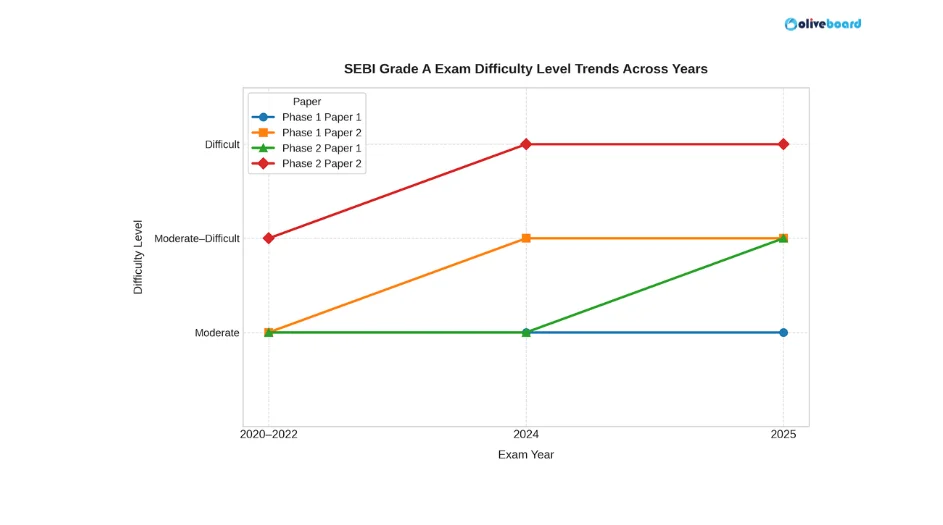
| Year | Phase 1 Paper 1 | Phase 1 Paper 2 | Phase 2 Paper 1 | Phase 2 Paper 2 |
|---|---|---|---|---|
| 2020–2022 (combined) | Moderate | Moderate | Moderate | Moderate–Difficult |
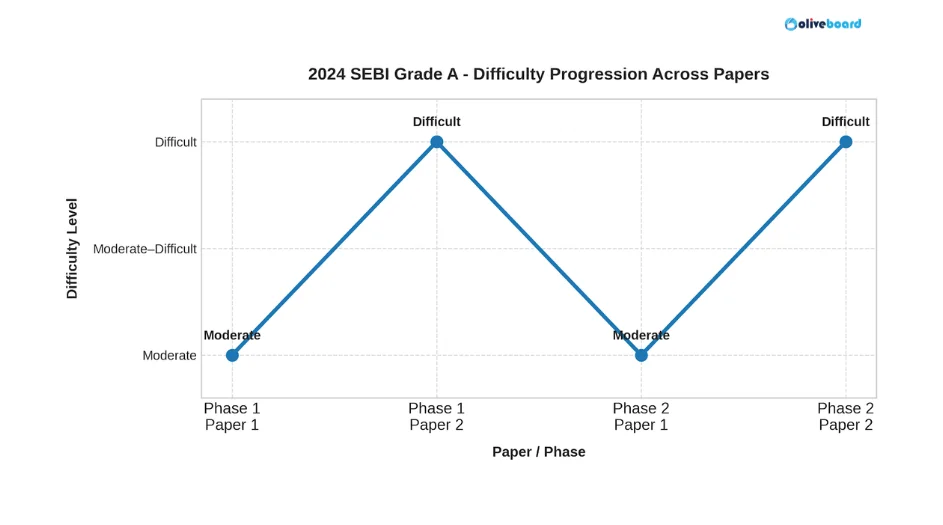
| 2024 | Moderate | Moderate–Difficult | Moderate | Difficult |
| 2025 | Moderate | Moderate–Difficult | Moderate–Difficult | Difficult |
What was the SEBI Grade A Exam difficulty level in 2025?
The 2025 SEBI Grade A papers were moderate to difficult. Phase 1 Paper 1 had manageable aptitude questions, but puzzles and data interpretation needed good time management. Subject-specific papers covered accounting standards, financial applications, and economic concepts. Phase 2 Paper 1 included current topics such as quick commerce, international trade, social media, and environmental sustainability.
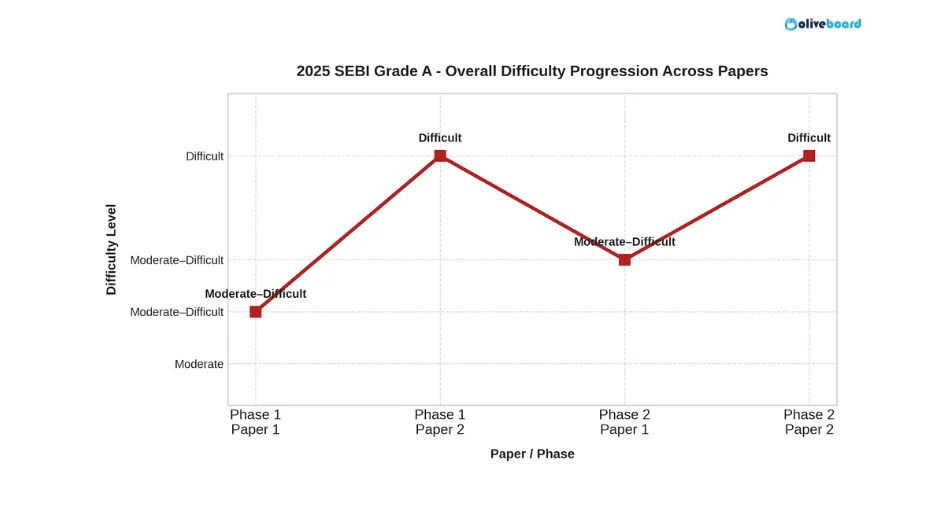
How difficult was Phase 1 Paper 1 in 2025?
Phase 1 Paper 1 was moderate to difficult, with Reasoning Ability being one of the challenging sections. Quantitative Aptitude covered approximation, percentages, and data interpretation, while English tested grammar and sentence construction, and General Awareness included current affairs, securities markets, awards, and science and technology.
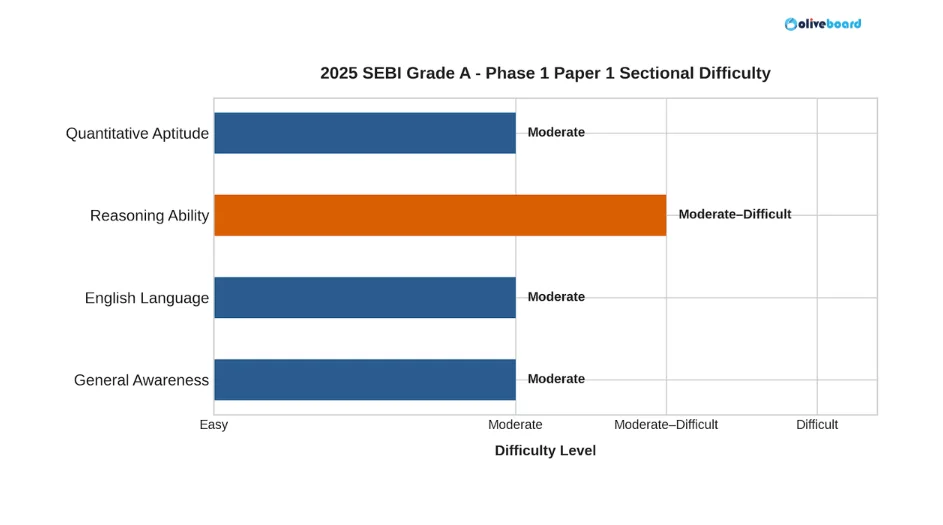
| Section | Important topics | Difficulty |
|---|---|---|
| Quantitative Aptitude | Approximation, percentages, ratios, data interpretation | Moderate |
| Reasoning Ability | Parallel-row seating, box arrangements, logical puzzles | Moderate–Difficult |
| English Language | Word swapping, sentence correction, connectors, grammar | Moderate |
| General Awareness | NSE, financial markets, awards, national initiatives, science and technology | Moderate |
Which topics were important in Phase 1 Paper 2 in 2025?
Phase 1 Paper 2 was difficult, as questions required applying accounting and financial concepts to practical situations. Topics included depreciation, inventory valuation, Accounting Standards, Balance of Payments entries, and management questions on business risks caused by market changes.
- Commerce and Accountancy: Calls in advance, depreciation, financial statements, and inventory valuation.
- Accounting Standards: AS 2 and practical accounting treatments.
- Finance: Financial instruments, financial management, and financial risks.
- Economics: Balance of Payments, foreign exchange flows, and economic transactions.
- Management: Strategic risk, decision-making, and organisational effectiveness.
- Company Law: Corporate and statutory concepts.
How difficult was Phase 2 Paper 1 in 2025?
Phase 2 Paper 1 was moderate to difficult, testing clear arguments, concise summaries, and detailed reading skills. Essay topics included social media and elections, quick commerce, high-speed rail vs. air travel, and Indians in global leadership, while precis and comprehension covered international trade, data centres, and freshwater use.
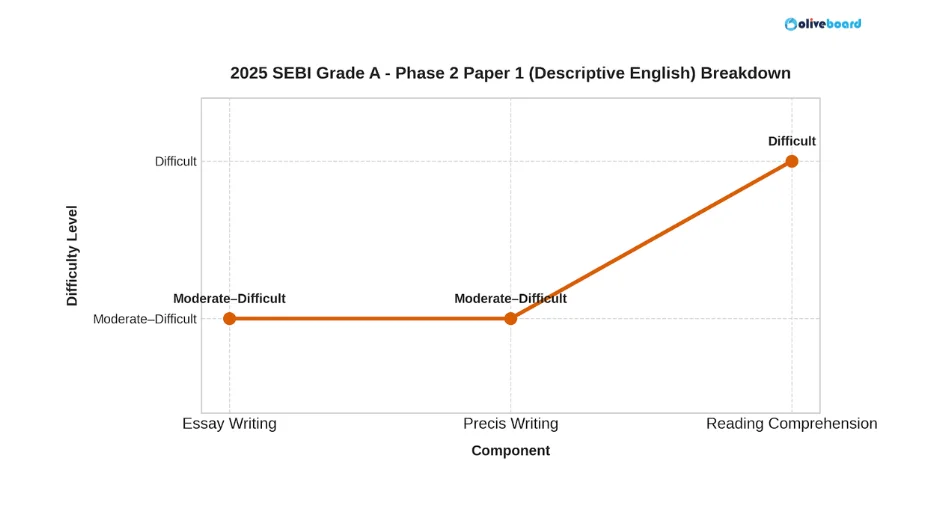
| Component | Topics covered | Difficulty |
|---|---|---|
| Essay Writing | Social media, elections, quick commerce, transport, global leadership | Moderate–Difficult |
| Precis Writing | International trade, tariffs, US–China trade tensions, implications for India | Moderate–Difficult |
| Reading Comprehension | Data centres, freshwater use, cooling technology, sustainability | Difficult |
Why was Phase 2 Paper 2 difficult in 2025?
Phase 2 Paper 2 was difficult, requiring detailed knowledge of Accounting Standards and their practical use. Questions covered inventories, property, plant and equipment, cash flow statements, cost calculations, net realisable value, and the treatment of production and selling costs.
- Accountancy: AS 2, AS 3, AS 10, inventory valuation, and cash flow statements.
- Costing: Net realisable value, production costs, cost classification, and numerical applications.
- Finance: Financial concepts and application-based questions.
- Economics: Economic theories and financial relationships.
- Management: Business and managerial concepts.
- Company Law: Corporate accounting and relevant legal and financial requirements.
What was the SEBI Grade A exam difficulty level in 2024?
The 2024 question sets indicate a moderate to difficult exam, with specialist papers requiring more preparation than the general aptitude paper. Finance, Economics, Accountancy, and Costing were key topics, while the descriptive paper covered business, technology, and environmental issues, testing conceptual understanding, calculation accuracy, and practical application.
How difficult was Phase 1 Paper 1 in 2024?
Phase 1 Paper 1 was moderate in difficulty. Quantitative Aptitude covered arithmetic and data interpretation, while Reasoning tested puzzles and logical thinking. English focused on grammar and understanding words in context. General Awareness included financial institutions, regulatory updates, government schemes, and current affairs.
| Section | Important topics | Difficulty |
|---|---|---|
| Quantitative Aptitude | Profit and loss, discounts, compound interest, ratios, averages, data interpretation | Moderate |
| Reasoning Ability | Puzzles, logical arrangements, ordering, deduction | Moderate |
| English Language | Grammar, vocabulary, comprehension, verbal reasoning | Moderate |
| General Awareness | Financial institutions, securities markets, government schemes, current affairs | Moderate |
Which topics made Phase 1 Paper 2 difficult in 2024?
Phase 1 Paper 2 was difficult, testing detailed knowledge of financial instruments, accounting principles, and regulatory rules. Questions covered notice money, debenture yields, forward rate agreements, and institutions supervised by NABARD, requiring both conceptual understanding and practical application.
- Finance: Notice money, debentures, current yield, forward rate agreements, and financial intermediaries.
- Commerce and Accountancy: Accounting principles, corporate accounting, and financial calculations.
- Economics: Economic principles and financial systems.
- Company Law: Corporate regulations and securities issuance.
- Financial Regulations: Depositories Act, 1996, dematerialisation, and regulatory institutions.
- Management: Organisational and business concepts.
What did Phase 2 Paper 1 test in 2024?
Phase 2 Paper 1 was assessed as moderate. Essay writing required candidates to develop balanced arguments, while precis writing tested their ability to summarise long passages. Reading comprehension focused on understanding details and explaining ideas in clear language.
| Component | Topics represented in the compilation | Main preparation focus |
|---|---|---|
| Essay Writing | ESG norms, global business, organisational culture, artificial intelligence | Current affairs and structured arguments |
| Precis Writing | Gaming industry, technology, consumer behaviour | Concise and accurate summaries |
| Reading Comprehension | Social media influencers, digital marketing, communication | Passage interpretation |
Why was Phase 2 Paper 2 difficult in 2024?
Phase 2 Paper 2 was assessed as difficult because it included numerical questions and concepts that required practical application. Costing questions involved differential costs, process costing, break-even analysis, and the P/V ratio. Finance questions covered investment concepts and securities market regulations, while Economics included inflation and growth models.
- Finance: Rule of 72, arbitrage, IPOs, and securities markets.
- Economics: Demand-pull inflation, economic growth models, and economic indicators.
- Costing: Differential costing, overheads, process costing, and break-even analysis.
- Commerce and Accountancy: Financial accounting and corporate accounting.
- Company Law and Management: Corporate obligations, business organisation, and strategic principles.
Enroll in SEBI Grade A Online Courses Today!
| Online Course | Online Course | Online Course |
| SEBI Grade A | SEBI Grade A IT | SEBI Grade A Legal |
What Was the SEBI Grade A Exam Difficulty Level in 2020–2022?
The combined 2020–2022 papers covered aptitude, financial awareness, Commerce, Accountancy, Economics, Finance, Management, and descriptive English on economic, social, and business topics. Reasoning puzzles and application-based specialist questions were more challenging than direct factual questions, so the analysis covers the combined period without assigning separate difficulty ratings to individual years.
How difficult was Phase 1 Paper 1 in 2020–2022?
Phase 1 Paper 1 was moderate overall, with Reasoning Ability being more challenging. Quantitative Aptitude covered arithmetic, number series, equations, and data interpretation, while English tested grammar, vocabulary, and reading comprehension, and General Awareness focused on current affairs and financial developments.
| Section | Important topics | Difficulty |
|---|---|---|
| Quantitative Aptitude | Percentages, profit and loss, interest, mixtures, number series, data interpretation | Moderate |
| Reasoning Ability | Seating arrangements, floor puzzles, syllogisms, family relationships, critical reasoning | Difficult |
| English Language | Reading comprehension, error detection, para jumbles, vocabulary | Moderate |
| General Awareness | RBI, SEBI, government schemes, banking, finance, current affairs | Moderate |
What types of questions were asked in Phase 1 Paper 2?
Phase 1 Paper 2 was moderate, covering core General Stream subjects such as accounting principles, financial markets, management theories, economics, and company law. While some questions tested direct knowledge, numerical problems and practical financial concepts required deeper understanding and preparation.
- Commerce and Accountancy: Accounting equations, financial ratios, partnership accounts, provisions, and balance sheets.
- Finance: Mutual funds, financial institutions, debentures, financial markets, and liquidity ratios.
- Economics: Market concepts, taxation, and monetary and financial institutions.
- Management: Leadership, motivation, SWOT analysis, and organisational control.
- Company Law: Incorporation, registration of charges, negotiable instruments, and contractual principles.
- Costing: Contribution, cost calculations, and profit-volume relationships.
How difficult was Phase 2 Paper 1 in 2020–2022?
Phase 2 Paper 1 was assessed as moderate because the topics were generally familiar but required clear and structured writing. The paper included essay writing, precis writing, and reading comprehension. Candidates needed to explain ideas logically, identify the main points in passages, and follow the prescribed word limits.
| Component | Topics covered | Main skill tested |
|---|---|---|
| Essay Writing | Financial literacy, mental health, teamwork, financial fraud, mergers and acquisitions | Argument development |
| Precis Writing | Behavioural finance, quality management, and topical passages | Summarisation |
| Reading Comprehension | Money, agriculture, weather forecasting, and related themes | Understanding and interpretation |
Why was Phase 2 Paper 2 challenging in 2020–2022?
Phase 2 Paper 2 was moderate to difficult, combining subject knowledge with numerical and practical questions on financial instruments, economics, accounting, and company law. Topics such as derivatives, taxation, and financial calculations required clear concepts and practical understanding beyond memorising definitions.
- Economics: Inflation, business cycles, the law of demand, and the Phillips Curve.
- Finance: Derivatives, securities markets, investment calculations, and financial instruments.
- Commerce and Accountancy: GST, financial accounting, taxation, and profitability.
- Management: Organisational behaviour and management theories.
- Company Law and Costing: Corporate obligations, cost calculations, and profitability analysis.
FAQs
Yes, they are useful for General, Legal, IT, Research, Official Language, Civil Engineering, and Electrical Engineering streams.
No. Previous year papers should be used along with the latest syllabus, mock tests, and regular revision.
Exact questions may not repeat, but concepts and question patterns are often similar.
Yes, Phase 2 previous year papers include Descriptive English and stream-specific descriptive questions wherever applicable.
Candidates should ideally solve at least 5–10 previous year papers along with multiple mock tests before the examination.
- SEBI Law Officer Recruitment 2026, Check Revised Eligibility Criteria
- SEBI IT Officer Recruitment 2026 Eligibility Criteria Revised
- SEBI Grade A PYPs, Download Free Previous Year Papers PDF
- SEBI Grade A Practice Quiz, Download Free PDF
- SEBI Grade A Phase 1 Study Plan for the Next 45 Days, Check Details
- UPSC EPFO EO vs SEBI Gr. A vs RBI Gr. B – Which One To Choose?

Hi, I’m Aditi. I work as a Content Writer at Oliveboard, where I have been simplifying exam-related content for the past 4 years. I create clear and easy-to-understand guides for JAIIB, CAIIB, and UGC exams. My work includes breaking down notifications, admit cards, and exam updates, as well as preparing study plans and subject-wise strategies.
My goal is to support working professionals in managing their exam preparation alongside a full-time job and to help them achieve career growth.