

The Indian Institute of Banking and Finance has conducted JAIIB AFM 2026 Exam successfully on 10th May 2026. The exam consists of 100 questions for 100 marks with a duration of 2 hours. In this blog, we have provided complete details about the paper level, shift-wise difficulty level, and detailed topic coverage, based on previous exam trends and feedback from banking professionals.
JAIIB AFM Exam Analysis 10th May 2026
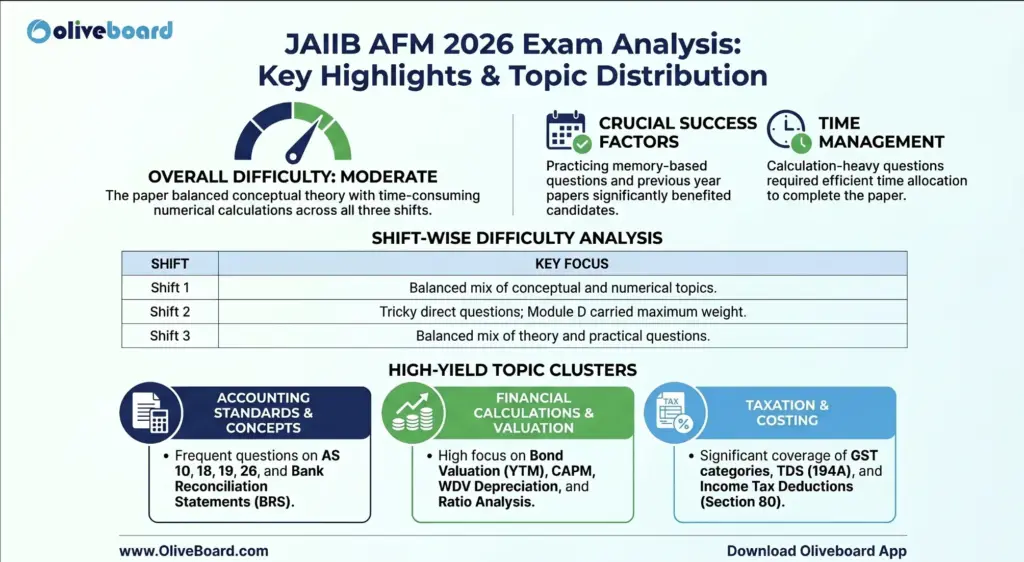
Based on feedback from professionals who appeared for the JAIIB AFM Exam scheduled on 10th May 2026, the detailed analysis is updated below. The paper was moderate in difficulty with a balanced mix of conceptual and numerical questions.
The paper included accounting, costing, and financial management topics, with a strong focus on practical application, numerical clarity, and conceptual understanding. A complete shift-wise and topic-wise analysis is updated below.
What was the level of the JAIIB AFM 2026 paper?
The overall difficulty level of the JAIIB AFM 2026 paper was Moderate. The exam pattern was similar to previous papers, which benefited candidates who had practiced memory-based and previous year questions. While most sections were manageable, calculation-based questions were slightly time-consuming, making time management an important factor during the exam.
| Shift | Difficulty Level |
| Shift 1 | Moderate |
| Shift 2 | Moderate |
| Shift 3 | Moderate |
What was the shift-wise difficulty level?
The complete shift-wise difficulty analysis has been provided below. Similar to previous JAIIB exam sessions, the difficulty level varied slightly across shifts, particularly in questions involving calculations and numerical concepts.
| Shift | Difficulty Level | Key Observation |
| Shift 1 | Moderate | Questions were balanced with a mix of conceptual and numerical topics |
| Shift 2 | Moderate | Most questions were direct in nature but slightly tricky; Module D carried maximum weightage |
| Shift 3 | Moderate | The paper was considered moderate by candidates with a balanced mix of theory and practical questions |
What are the topics from which questions were asked?
The detailed topic-wise distribution for all three shifts is updated below:
| Shift | Topics |
| Shift 1 | Forensic Audit; Accounting Standard 26; Value Accounting, CSR Section 135; Journal Entry Golden Rules in statement format; Accommodation Bill; Promissory Note; Population based question; Bond intrinsic value calculation; Gross Profit; Forex; Gordon formula; Inventory turnover ratio; CAPM (Capital Asset Pricing Model) DSCR; Suspense Account; Multiple Costing; ECL; NPA provision; WDV (Written Down Value); Income Tax Standard Deduction; Data turnover ratio; Cumulative preference shares; Bonus Section 63; Bill of Exchange Journal entry; BRS (OD balance); Error of Principal; Balance Sheet format schedule 3; Capital and Revenue Expenditure; Accounting Standard 19; Going concern concept; Unearned income adjustment entry; RBIA (Risk Based Internal Audit); Agency Conflict; Forfeiture Journal Entry; 80E Deduction; Zero Coupon Bond; DPG (Deferred Payment Guarantee); 194A (TDS); Finance Lease; Sales Book; Prime Cost; RCM (Reverse Charge Mechanism); Leveraged Lease; Pie Ratio; EPS; Zero Based Budgeting; Arbitrage; |
| Shift 2 | Forward Exchange Rates; Straight Line Depreciation Method; GST Categories; Bank Reconciliation Statement (BRS); Present Value of Annuity; Company Final Accounts; Error of Principle in Accounting; Working Capital & Quick Ratio Inventory Questions; Bond Valuation and Duration; Standard Costing Concepts; AS 10 Accounting Standard; Dividend Yield Calculation; Transfer Pricing Mechanism; Capital Paid-Up Calculations; Journal Adjustment Entries; WDV Depreciation Problems; Tax Deductions under Section 80; Margin of Safety Formula; Golden Rules of Accounting; Spot Rate & Maturity Value Questions; Job Costing Techniques; Provision for Taxation; Contribution Analysis; Bank Balance Sheet Format; EMI Computation; Closing Stock Calculation; Neo Banking Concepts; Income Tax Exemptions under Section 10; Deferred Revenue/Deferred Account; Future Value Problems; Bond Theory Basics; Debit and Credit Classification of Accounts; Schedule-Based Numerical Questions; Trust Income Tax Exemption; Analog Computer Concepts. |
| Shift 3 | Current Yield & Yield to Maturity (YTM); Weighted Average & Costing Techniques; Effective Interest Rate Calculations; Pro-Rata Allocation Method; Written Down Value (WDV) Depreciation; Capital Asset Pricing Model (CAPM); Bank Reconciliation Statement Concepts; Accounting Standard AS 18; AS 3 Cash Flow Inflows; Standard Costing vs Marginal Costing; Future Value of Investments; Ordinary Annuity Present Value Problems; Grace Period Related Theory; Debt-Equity Ratio Analysis; Suspense Account Adjustments; Rectification of Accounting Errors; Salvage Value in Depreciation; Depreciation Methods with Nil Closing Value; Neo Banking Services; Sinking Fund Calculations; Current Ratio & Quick Ratio Questions; TCS Provisions; Matching Principle in Accounting Standards; Financial Accounting Methods and Concepts. |
JAIIB AFM Paper November 2025 Exam Analysis
The November 2025 JAIIB AFM exam was moderate in difficulty with a good mix of conceptual and numerical questions. Around 12–15 marks were from numerical questions, while the rest focused on theory and application. The paper required clarity in accounting standards, costing concepts, and financial formulas.
How difficult was the JAIIB AFM November 2025 exam paper?
The JAIIB AFM November 2025 exam, conducted by the Indian Institute of Banking and Finance, included a balanced mix of theory and numerical questions. It tested candidates on basic accounting concepts, financial understanding, and practical problem-solving skills. Overall, the exam was moderate, though some questions required clear concept understanding.
| Aspect | Details |
| Overall Difficulty Level | Moderate |
| Numerical Questions | 12–15 marks |
| Focus Area | Accounting and financial concepts |
| Question Type | Mix of theory, numerical, and application-based questions |
| Key Topics | Capital and revenue expenditure |
What was the overall difficulty level and exam pattern in November 2025?
The JAIIB AFM November 2025 exam showed a consistent difficulty level across all shifts, with a balanced mix of conceptual and numerical questions.
| Shift | Difficulty Level | Key Observation |
| Shift 1 | Moderate | Conceptual + numerical mix |
| Shift 2 | Moderate | More accounting standard-based |
| Shift 3 | Moderate | Balanced with costing + finance |
Which topics were asked in the JAIIB AFM November 2025 exam?
The exam covered a wide range of accounting, costing, and financial management topics. Below are the complete shift-wise topics from which questions were asked.
| Shift | Topics Covered |
| Shift 1 | Journal Entry; Accounting Standards; Borrowing Cost; Current Ratio; Process Costing; GST Penalty; Forex; Depreciation Numerical; Simple Interest; Annuity Questions; Lease; Weighted Average Cost of Capital (WACC); Margin of Safety; Sinking Fund; Tandon Committee; Accounting Standard 19; Operating Lease; Narration; Forward Points; Numerical-based questions; Future Value of Annuity; Decision Making Authority; Income Credit; Schedule 18; Cost of Goods Sold; Absorption Costing; Composite Voucher; Health Insurance; Bill of Exchange Journal Entry; Non-Voting Right Shareholding; EMI Calculation; Share Premium; Dormant Company; Zero Based Budgeting; Machine Construction; Job Costing; Cross Rate; Asset Classification; Error of Commission; Error of Principle; Break-Even Point (BEP); Bank Reconciliation Statement (Cash Book Balance); Capital and Revenue Expenditure |
| Shift 2 | Accounting Standard 9 and 10; Current Yield; Ordinary Annuity; Budgeting; Cash Flow; TDS and GST; Process Costing; Absorption Costing; Numerical Questions; Entry Posting; Auditor Panel (Public and Private Company); Depreciation; GST Applicable Date; Bonds; Annuity; Schedule 10; Bank Balance Sheet; Accounting Standard 1; Front End and Back End; Expenses (Profit and Loss); Rectification of Errors; Exchange Rate; Share Premium; Supply Completion Method; Accounting Concepts (Match the Following); BRS; Bond Theorems; Journal Entry; Gold and Silver Assets; Errors; Forex Exchange (Value Date); Bill of Exchange; AS 2 (Inventories); Quick Ratio (Quick Assets); Ind AS 7; Yield to Maturity (YTM) |
| Shift 3 | Contra Entry; Commission Error; Reversal Entry; Passbook vs Cash Book; Direct Cost; Bill of Exchange; Unconditional Order; Rent Receivable (Representative Personal Account); YTM Properties; Net Present Value (NPV); Simple Interest; Ordinary Annuity; Schedule 3; Other Assets; Non-Voting Shares; Derivatives; Error of Principle; Balance Sheet; Shareholders; Prepaid Expenses; Accounting Standard 2; Net Worth; LIFO and FIFO Numerical |
JAIIB AFM May 2025 Exam Analysis
The JAIIB AFM May 2025 exam reflected a concept-driven and moderately tough paper, with a clear focus on practical application, numericals, and core accounting concepts. Across all shifts, the paper tested candidates on a wide mix of accounting, costing, and financial management topics, making it important for aspirants to have both conceptual clarity and calculation accuracy.
A key highlight of this exam was the strong presence of numerical questions, especially in later shifts, along with repeated emphasis on ratios, annuity, bonds, and costing concepts. Candidates who practiced numericals and revised formulas thoroughly found the paper more manageable.
What was the overall difficulty level of the JAIIB AFM May 2025 exam?
The overall difficulty level of the exam ranged from moderate to slightly tough, with variation across shifts.
| Shift | Difficulty Level | Key Observation |
| Shift 1 | Moderate to Tough | Conceptual + moderate numericals, heavy Module A & D |
| Shift 2 | Moderate to Tough | Higher numerical weightage (~20 marks), focus on Module C & D |
| Shift 3 | Moderate | Balanced paper with mix of theory, ratios, and finance |
What was the exam pattern and question trend?
The paper followed a balanced yet practical approach, focusing on both theory and application.
| Section Focus | Details |
| Numerical Questions | 12–20 marks (increased in Shift 2) |
| Theory Questions | Concept-based and statement-type |
| Application-Based | High focus on real scenarios and calculations |
| Repeated Topics | Ratios, YTM, EMI, Annuity, Costing |
| Question Types | MCQs, match the following, statement-based |
Which topics had the highest weightage?
The exam covered almost the full syllabus, but some topics had significantly higher weightage and repetition across shifts.
| Topic | Key Areas Covered |
| Accounting | Journal Entries, Rectification, Capital vs Revenue, Depreciation |
| Ratios | Current Ratio, Quick Ratio, Working Capital Ratio, Debt-Equity |
| Costing | Marginal Costing, Absorption Costing, Job & Batch Costing |
| Financial Management | YTM, NPV, Annuity, EMI, Capital Budgeting |
| BRS | Cash Book & Passbook-based questions |
| Accounting Standards | AS 1, AS 2, AS 10, Ind AS concepts |
| Bonds & Finance | YTM, Duration, Zero Coupon Bonds |
What type of numerical questions were asked?
Numericals played a crucial role, especially in Shift 2. The details of the topics from which questions were asked in the exam are as follows:
| Topic | Question Type |
| EMI | Calculation-based |
| YTM | Bond valuation and approximation |
| Annuity | Ordinary annuity & annuity due |
| NPV | Capital budgeting |
| Depreciation | Sum of Years Digit Method |
| Ratios | Current & Quick Ratio calculations |
| Costing | Marginal costing & profit calculation |
What were the key concepts tested in the exam and their shift-wise distribution?
The paper strongly focused on core accounting, costing, and financial concepts, with a clear emphasis on practical application and numericals across all shifts.
| Category | Topics Covered | Shift-wise Highlights |
| Accounting Concepts | Basic accounting assumptions, business entity & materiality, capital vs revenue expenditure, deferred tax (timing vs permanent difference) | Shift 2: AS 1, AS 2, AS 10 were asked |
| Journal Entries & Errors | Forfeiture of shares, prepaid expenses adjustment, rectification using suspense account, bonus issue entries | Shift 1: Journal entries (3 questions); Shift 3: accounting errors and entries |
| Costing Concepts | Marginal vs absorption costing, cost of goods sold, budgeting (capital budget), decision-making concepts | Shift 1: marginal costing numericals; Shift 3: costing basics |
| Numerical Focus Areas | EMI, YTM, annuity, depreciation (including Sum of Years Digit method) | Shift 1: EMI, YTM, depreciation; Shift 2: high numerical weightage (~20 marks), repeated EMI/YTM/annuity |
| Ratio & Financial Analysis | Current ratio, quick ratio, leverage ratios | Shift 2: ratio-based questions asked |
| Regulatory Concepts | Banking Regulation Act basics (Section 29) | Shift 2: direct conceptual question |
| Investment & Finance Concepts | NPV, present value, bond concepts | Shift 3: focus on NPV, PV, bonds |
| Shift 1 Focus | Module A & D emphasis | BRS (3 questions), marginal costing, minimal focus on golden rules |
| Shift 2 Focus | High numerical weightage (~20 marks) | Repeated numericals and accounting standards focus |
| Shift 3 Focus | Balanced paper | More conceptual clarity required across costing and accounting |
What were the most repeated topics across shifts?
Certain topics were consistently repeated, making them extremely important.
| Repeated Topic | Frequency |
| EMI | High |
| YTM | High |
| Annuity | High |
| Ratios | High |
| Depreciation (SYD Method) | Repeated |
| Costing | Moderate to High |
| Accounting Standards | Moderate |
FAQs
Ans. The exam is scheduled for 10th May 2026.
Ans. The paper is expected to be moderate with a mix of conceptual and numerical questions.
Ans. Accounting, costing, and financial management are the most important areas.
Ans. EMI, YTM, annuity, NPV, ratios, and depreciation are key numerical topics.
Ans. Shift 2 is generally expected to have higher numerical weightage.
- JAIIB 2026 Previous Year Papers, Download Free PDF
- JAIIB IE & IFS Module-Wise Mind Maps, Download Free PDF
- Functions of Bank Relationships, Norms and Download Free PDF
- JAIIB PPB Important RBI Guidelines and Banking Limits
- Essentials of Bank Computerization for JAIIB, Download Free eBook
- JAIIB AFM Formulas and Short Tricks, Check Details

Hello there! I’m a dedicated Government Job aspirant turned passionate writer & content marketer. My blogs are a one-stop destination for accurate and comprehensive information on exam categories like Regulatory Bodies, Banking, SSC, State PSCs, and more. I am on a mission to provide you with all the details you need, conveniently in one place. When I am not writing and marketing, you will find me happily experimenting in the kitchen, cooking up delightful treats. Join me on this journey of knowledge and flavors!