

The Indian Economy is one of the most important pillars of the JAIIB IE & IFS Exam, especially for banking professionals who need to understand how economic policies, RBI decisions, and government actions impact day-to-day banking operations. This section is not just theoretical it directly connects with real-world banking such as loans, inflation control, interest rate changes, credit growth, and financial stability. A strong understanding of this topic helps candidates handle both conceptual and case-based questions with confidence.
In this blog, we have covered structured notes, core concepts, preparation strategies, and practice quiz and more.
Download practice quiz on JAIIB IE and IFS Indian Economy paper
Strengthen your preparation for the JAIIB IE & IFS Indian Economy section with well-structured practice quizzes designed to cover all important concepts. These quizzes focus on key areas like GDP, inflation, monetary policy, fiscal policy, and banking-related economic topics.
Attempt quiz on JAIIB IE and IFS Indian Economy paper
Boost your exam preparation by attempting targeted quizzes based on the JAIIB IE & IFS Indian Economy syllabus. These quizzes include concept-based, analytical, and application-level questions to test your understanding of core topics like RBI policies, inflation trends, and economic indicators.
1. As per economist Angus Maddison’s data, the combined contribution of India and China to global GDP in the year 1000 AD was approximately:
2. As per Angus Maddison’s data, the combined contribution of India and China to global GDP in the year 1600 AD increased to approximately:
3. As per Angus Maddison’s data, India’s individual contribution to global GDP around 1600 AD was approximately:
4. As per Angus Maddison’s data, China’s individual contribution to global GDP around 1600 AD was approximately:
5. As per IMF estimates referenced in current affairs notes, India’s present contribution to global GDP is approximately:
6. The drastic decline in India’s share of global GDP over the centuries, despite an early lead, is mainly attributed to:
7. Gross Domestic Product (GDP) is best defined as:
8. While computing a country’s GDP, production occurring within its geographical boundary is counted irrespective of the:
9. Among the ‘Four Engines of GDP’, which one is the largest contributor to India’s GDP?
10. Household consumption (C) contributes approximately what percentage to India’s GDP?
11. In the GDP equation GDP = C + I + G + (X − M), the term (X − M) denotes:
12. India’s Net Exports (NX) figure is generally:
13. Purchasing Power Parity (PPP) is a concept used to measure:
14. As per the PPP-based GDP ranking referenced in the notes, which country ranks 1st?
15. As per the PPP-based GDP ranking referenced in the notes, India’s rank is:
16. As per the PPP-based GDP ranking referenced in the notes, China’s rank is:
17. Despite being one of the fastest-growing economies in the world, India is also characterized by:
18. The World Bank classifies economies into income categories primarily on the basis of:
19. As per the World Bank’s income classification, India currently falls under which category?
20. As per the World Bank’s classification referenced in the notes, the per capita income range for ‘Lower Middle Income’ countries is:
Quiz Summary

Sign Up
Or, register with email
 Email Id
 Mobile Number
 Password

Login
Email Id
Password
Forgot Password
Please enter the Email ID we will send you a Email with the link to reset the password.
Email Id
Or, login with

What is Indian Economy in JAIIB IE & IFS and how does it help banking professionals?
The Indian Economy in the JAIIB IE & IFS syllabus refers to the systematic study of India’s economic framework, including its structure, functioning, and policy environment. It covers key areas such as national income, inflation, monetary policy, fiscal policy, and sectoral development. Institutions like the Reserve Bank of India (RBI), Government of India, World Bank, and IMF (International Monetary Fund) play a major role in shaping economic direction.
For banking professionals, this topic is extremely relevant because it explains how economic changes influence banking activities like credit availability, deposit rates, liquidity conditions, and investment decisions. It also helps in understanding how RBI controls inflation and ensures financial stability through monetary tools like repo rate, CRR, and SLR. In exams, questions are often application-based, requiring both conceptual clarity and awareness of current economic developments.
Check out the detailed JAIIB Notification 2026
What are the topics covered under IE and IFS paper?
The Indian Economy section in the JAIIB IE & IFS paper focuses on giving banking professionals a clear understanding of India’s economic structure, growth patterns, and policy developments. The details of the topics covered under Indian Economy JAIIB IE and IFS paper are as follows:
- Overview of Indian Economy
- Evolution of Indian Economy
- Basic Characteristics of Indian Economy
- Indian Economy in Pre-British Period
- Economy till 2008 & After 2008
- Structural Changes in Indian Economy
Also: Check out the detailed JAIIB IE and IFS Syllabus
Why Indian Economy is Important in JAIIB IE & IFS paper?
Understanding the Indian Economy is crucial for banking professionals as this topic helps you grasp how economic trends, government policies, and RBI regulations influence banking operations.
- On average, 2–4 questions appear from this topic in the IE & IFS paper.
- Questions can be direct, calculation-based, or scenario-driven.
- Knowledge of Indian Economy helps in analyzing RBI policies, fiscal data, and economic indicators relevant to banking operations.
Core concepts of Indian Economy
A clear understanding of fundamental concepts is essential because most exam questions are framed around them.
| Concept | Meaning | Banking Relevance | Example |
| GDP (Gross Domestic Product) | Total value of goods and services produced in India | Measures economic growth and performance | High GDP growth indicates strong economy |
| GNP (Gross National Product) | GDP + income from abroad | Shows national income strength | Used in macroeconomic analysis |
| Inflation (CPI/WPI) | Rise in general price levels | Impacts interest rates and purchasing power | CPI used by RBI for policy decisions |
| Monetary Policy | RBI policy to control money supply | Controls liquidity and inflation | Repo rate adjustments |
| Fiscal Policy | Government revenue & expenditure plan | Impacts taxes, subsidies, and growth | Union Budget |
| Economic Sectors | Agriculture, Industry, Services | Shows GDP contribution structure | Services dominate India’s GDP |
| Financial System | Banks, NBFCs, markets | Supports credit flow and investment | RBI regulates banking system |
| Economic Reforms | Liberalization, Privatization, Globalization | Boosts efficiency and growth | 1991 LPG reforms |
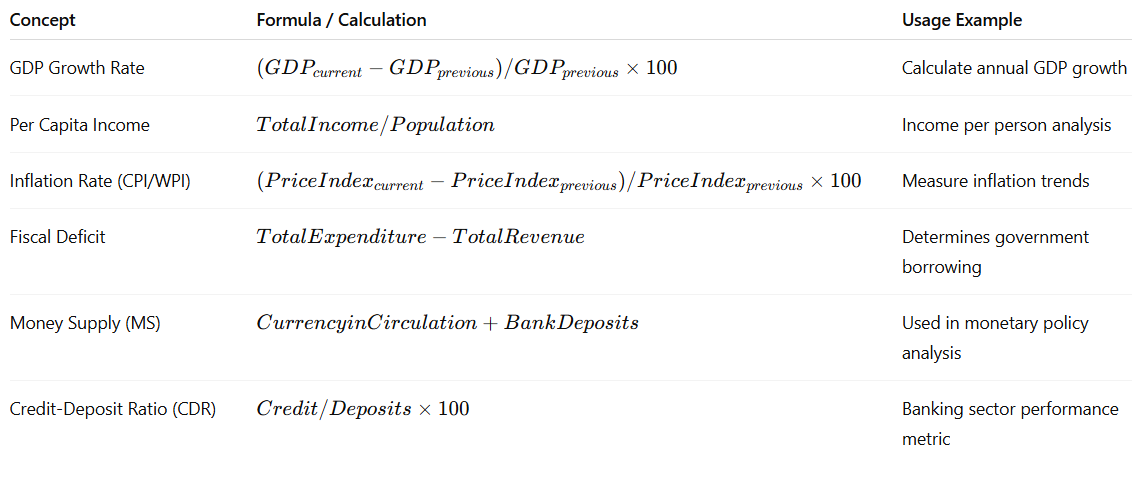
Important economic calculations and formulas
The important formulas for the Indian Economy topic are as follows:
What types of questions are asked from Indian Economy in JAIIB IE & IFS paper?
In the JAIIB IE & IFS paper, questions from the Indian Economy test both conceptual clarity and practical understanding. They cover a range of topics including macroeconomics, sectors of the economy, monetary and fiscal policies, the banking system, and international economic issues.
- Macroeconomic Concepts: Questions may cover GDP, national income, inflation, money supply, and the role of RBI in monetary policy.
- Economic Growth & Development: You may be asked about the difference between growth and development, economic planning, and structural changes in the economy.
- Sectors of the Economy: Expect questions on primary, secondary, and tertiary sectors, organized vs. unorganized sectors, priority sector, and MSMEs.
- Indian Financial System: Questions can include banking structure, financial institutions, and markets governed by RBI and other regulations.
- International Economy: Some questions focus on global organizations like IMF, World Bank, and trade policies including FDI and globalization effects.
- Definitions & Explanations: Simple definitions of key terms.
- Theories: Basic economic theories relevant to banking.
- Comparisons: Compare concepts like FDI vs. FII or sectors of the economy.
- Current Policies & Reforms: Recent government initiatives such as Atmanirbhar Bharat and Make in India.
Preparation Strategies for Indian Economy in IE & IFS Paper
Some of the preparation strategies while covering Indian Economy topic are as follows:
- Prepare structured notes for quick revision.
- Practice case-study based MCQs to apply concepts.
- Use formulas only when necessary; focus on understanding.
- Keep track of recent RBI circulars, government budgets, and economic updates.
- Revise key terms and indicators daily before the exam.
Tricks to remember Indian Economy Concepts Quickly
Some of the tricks useful for the Indian Economy paper are as follows:
- Relate theory to real banking examples such as credit trends, NPA recovery, or policy impacts.
- Use flowcharts or tables to visualize complex topics.
- Break long topics into keywords or bullet points for faster recall.
- Apply mnemonics to remember schemes, policies, and economic indicators.
- Solve previous year memory-based questions to identify patterns.
Supercharge Your JAIIB IE & IFS Prep, Get the Complete Strategy Today!
Common Mistakes to Avoid in IE & IFS Indian Economy Questions
Common mistakes to avoid while preparing for Indian Economy topic under IE and IFS paper are as follows:
- Ignoring RBI circulars or government updates
- Misapplying economic formulas
- Misinterpreting case studies
- Not revising recent syllabus changes
- Relying only on rote learning instead of understanding concepts
FAQs
Revise short notes, practice case studies, and solve mock questions.
Use mnemonics and connect with real banking examples.
Yes, repo/reverse repo and monetary policies are often tested.
Yes, relevant schemes like PMMY or Atmanirbhar Bharat may appear.
Only key formulas; conceptual understanding is more important.
- Essentials of Bank Computerization for JAIIB, Download Free eBook
- JAIIB AFM Formulas and Short Tricks, Check Details
- Attempt JAIIB PPB Case Studies Quiz on KYC, Lending and NPA Recovery
- IIBF JAIIB 2026, Sum of Years Digits, How to calculate? Check Details
- Laws Relating to Securities and Mode of Charges for JAIIB Exam 2026
- JAIIB AFM Module-Wise Mind Maps, Download Free PDF

Hi, I’m Aditi. I work as a Content Writer at Oliveboard, where I have been simplifying exam-related content for the past 4 years. I create clear and easy-to-understand guides for JAIIB, CAIIB, and UGC exams. My work includes breaking down notifications, admit cards, and exam updates, as well as preparing study plans and subject-wise strategies.
My goal is to support working professionals in managing their exam preparation alongside a full-time job and to help them achieve career growth.