
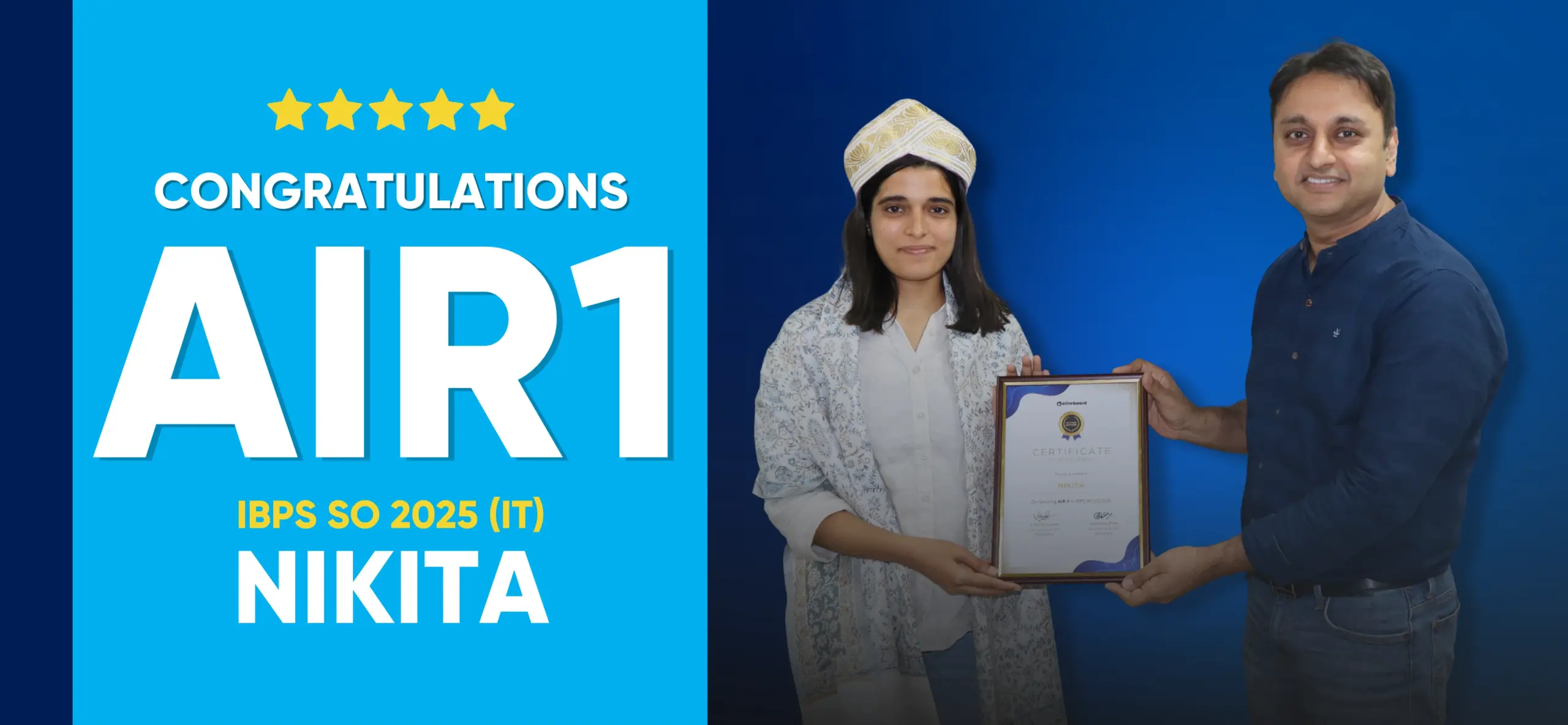
Securing All India Rank 1 in IBPS SO IT is a dream come true for Nikita and an inspiration for every banking aspirant. Her journey reflects dedication, consistency, and a focused approach. In this blog, we will take you through Nikita’s preparation strategy, daily routine, mindset, and her advice for aspirants preparing for IBPS SO and other banking exams.
Success Story of Nikita
Nikita’s success in IBPS SO IT demonstrates determination, discipline, and strategic preparation. She completed her B.Tech in Computer Engineering from NIT Kurukshetra in the 2019–2023 batch. Coming from a family where her father is a farmer, her mother is a homemaker, and has a younger brother, Nikita was always supported by her family. She chose IBPS SO IT for job stability, security, and a better work-life balance compared to corporate jobs. Despite belonging to the EWS category, she cleared all stages through the general cutoff and achieved the highest overall score.
Interview with IBPS SO IT Topper Nikita, AIR 1
Here is Nikita’s preparation journey in her own words.
Q1. How did you feel when you first saw your result?
A: The day the result came, first I was just happy that I was selected. I didn’t even check my marks at first. Later, after sharing my marks with friends, they told me I had the highest score. That was beyond what I could have imagined. I had even overthought whether I would be selected or not, but I got the highest marks, so I was very happy.
Q2. What was your family’s reaction?
A: My mother said she always had confidence that I would get a top rank. My parents never made it feel like a big deal because they knew I was determined and would do well.
Q3. Can you tell us about your education and family background?
A: I did B.Tech in Computer Engineering from NIT Kurukshetra in the 2019–2023 batch. My family includes my father, mother, and brother. My father is a farmer, and my mother is a homemaker.
Q4. Why did you choose IBPS SO IT?
A: I wanted job stability and security. Considering the market conditions and layoffs happening, I thought IBPS SO IT would be good. Also, work-life balance is better here than in corporate jobs, where hours are longer.
Q5. Do you remember your scores in prelims, mains, and interview?
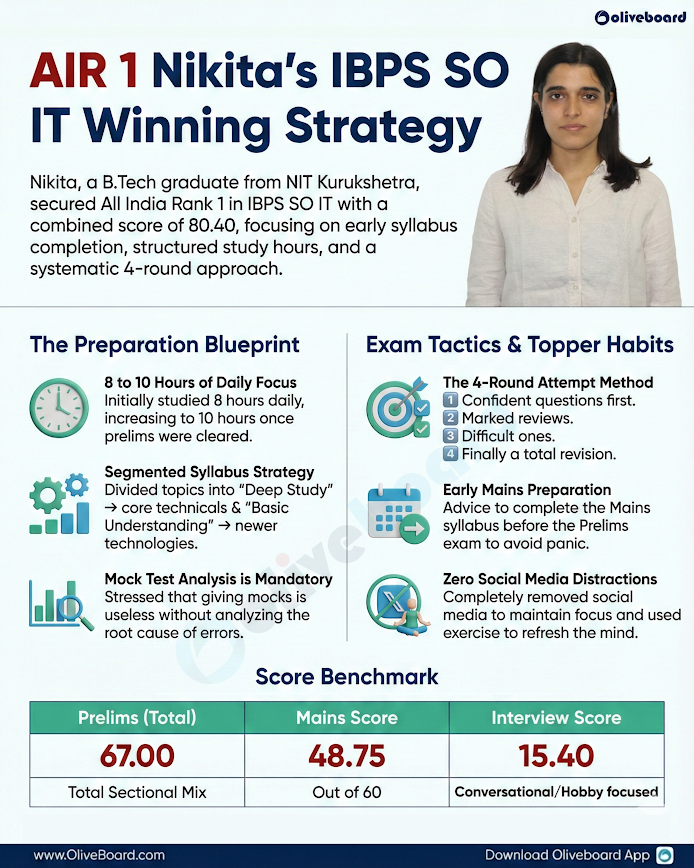
A: Yes. In prelims, I scored 67 in total: 23.38 in English, 22 in reasoning, and 21 in maths. In mains, I scored 48.75 out of 60. In the interview, I got 15.4.
Q6. Was this what you expected?
A: No, my marks were much higher than I expected. Even in mains, after checking my answers, I realized I had scored much more than I thought. In the interview, I was only hoping to cross the passing marks, so getting high marks exceeded my expectations.
Q7. How did you prepare for prelims?
A: I didn’t need much preparation because I have a mathematical mindset, and English is my strength. I gave Oliveboard mocks to check where I stood and scored around 65. After that, I focused on MCQ practice and bank-specific topics.
Q8. How was your daily routine during preparation?
A: In the mornings, I revised theory and tricks topic-wise. In the evenings, I practiced MCQs. When I was preparing for mains, I focused more on subjects that required deep understanding, like computer networks and operating systems. For subjects like machine learning, I studied only basic points.
Q9. When did Oliveboard come into your preparation?
A: I have been referring to Oliveboard since the beginning, especially for previous year questions. IBPS does not release them, so Oliveboard helped me analyze the pattern and plan preparation. For mains, I used Oliveboard videos and YouTube playlists to cover topics and make short notes.
Q10. How many hours did you study daily?
A: Around 8 hours initially when prelims were not cleared. After prelims, about 10 hours a day.
Q11. How was your mains preparation strategy?
A: I divided subjects into two sections. Section A needed deep preparation, using graduation notes and previous year questions. Section B was basic, for which I used YouTube playlists and Google to cover important points. I also made short notes for faster revision and did multiple revisions for each topic.
Q12. How was your interview experience?
A: I was very nervous before the interview. I didn’t know what questions would be asked or what the panel would be like. But the panel was very calm and conversational. Most questions were about my hobbies, especially working out. Technical questions were very few. The chairman focused on my hobby section, and the interview went smoothly.
Q13. What was your mindset on exam day?
A: Before the exam, I used to overthink a lot. In the exam hall, I focused on my own paper. I did deep breathing exercises to stay calm. My approach was in rounds: first, I attempted questions I was 100% confident about, then solved questions marked for review, and finally checked questions I had left. I also revised all marked questions at the end to avoid mistakes.
Q14. What were the major struggles you faced?
A: IBPS does not release previous year questions, which makes strategy planning difficult. Otherwise, I did not face major struggles. Oliveboard helped cover that gap. My preparation strategy was clear, and I followed it consistently.
Q15. Did you get distracted during long study hours? How did you stay focused?
A: I removed all distractions. I am not on social media, which helped a lot. I also work out to refresh my mind. Talking to family or friends when I felt low helped too.
Q16. How did your family support you?
A: My family was very supportive. They adjusted their schedule to suit mine. If I needed something prepared at night or wanted space to study, they helped immediately.
Q17. What major mistakes should future aspirants avoid?
A: My major mistake was not giving mocks in prelims. Always give as many mocks as possible and analyze them properly. Analysis is very important; just giving mocks without understanding mistakes won’t help.
Q18. Any suggestions for future aspirants?
A: Focus on your work and daily targets. Don’t overthink about the category. Give mocks and analyze them thoroughly. Cover your mains syllabus before prelims. Remove distractions and stay disciplined. Hard work always pays off.
- IBPS SO IT Officer Success Story: From Java Developer to PNB IT Officer
- SSC CGL Success Story: How Govind Sharma Got Selected at 20
- Success Story Of Tanay Gaurav, AIR 1 In RBI Grade B 2024
- How Abadhoot Rajaram Prepared for SBI PO and Other Banking Exams
- What Changed When Dilip Kumar Started Analysing Every SSC CGL Mock
- How Mayank Gautam Cracked All CAIIB Papers in His 1st Attempt

Hi, I’m Tripti, a senior content writer at Oliveboard, where I manage blog content along with community engagement across platforms like Telegram and WhatsApp. With 3+ years of experience in content and SEO optimization related to banking exams, I have led content for popular exams like SSC, banking, railway, and state exams.