
Key Takeaways
- The blog provides free SSC CGL Polity Notes focusing on the Making of Indian Constitution, essential for exam preparation.
- The Constituent Assembly formed on December 9, 1946, had 389 members: 296 from British India and 93 from Princely States.
- Seats in the Assembly were allocated based on population, with roughly one seat per million for Princely States and specific community representation for British Provinces.
- The Drafting Committee, essential for creating the Constitution, was established on August 29, 1947, with key members like Dr. B.R. Ambedkar.
- Important events during the Assembly include the election of Dr. Rajendra Prasad as President and the adoption of the National Anthem.
To help strengthen your preparation, we are providing free SSC CGL Polity Notes in this blog. In this edition, we focus on the important topic making of the Indian Constitution, which is frequently asked in the SSC CGL exam and other competitive exams. Understanding this topic is essential to grasp how India’s Constitution was framed, the ideas behind it, and the process of its creation. The notes are presented in a simple and exam-oriented manner to help you revise quickly and effectively.
Making of Indian Constitution
For aspirants preparing for the SSC CGL Exam, understanding the making of Indian Constitution is very important as it is a frequently asked topic in Polity. The Making of the Indian Constitution started 72 years from now on December 9, 1946 When the First session of the Constituent Assembly took place. The journey of being a democratic nation started on that day as it marked the making of national anthem, national flag and also a status of national symbol. The idea of Constituent Assembly for India was suggested by M.N Roy.
Constituent Assembly formation
The Cabinet Mission Plan had formulated a scheme for the formation of Constituent Assembly. Some features of this scheme are as follows -:
- The Constituent Assembly in total consisted of 389 members. Among these 93 seats were allotted to Princely States and 296 seats were allotted to British India.
- The seats were allotted to Princely States according to the population of that particular state. On an average one seat was allotted for every million population.
- The seats allocated for the Constituent Assembly to each British Province was to be decided by considering the population of the three principal communities Muslims, Sikhs and General (All Except Muslims and Sikhs) in each province.
- During a provincial legislative assembly the members of that community elect the representative of each community.
- The head of the princely states nominated the representative of the princely states.
Who were the important members of the Constituent Assembly?
Several important leaders played different roles in the making of the Indian Constitution. For SSC CGL, questions are commonly framed by matching a person with their position or responsibility in the Constituent Assembly.
| Person | Important Role |
| Dr. Sachchidananda Sinha | Temporary Chairman of the Constituent Assembly |
| Dr. Rajendra Prasad | President of the Constituent Assembly |
| H.C. Mookherjee | Vice-President of the Constituent Assembly |
| Dr. B.R. Ambedkar | Chairman of the Drafting Committee |
| B.N. Rau | Constitutional Adviser |
| Jawaharlal Nehru | Moved the Objectives Resolution; headed important Union-related committees |
| Sardar Vallabhbhai Patel | Chaired important committees dealing with provincial constitution, fundamental rights and minorities |
How did the Strength of the Constituent Assembly Change After Partition?
The composition of the Constituent Assembly changed after the Partition of India. The Cabinet Mission scheme originally provided for 389 members, but the strength of the Indian Constituent Assembly was subsequently reduced to 299.
| Category | Original Strength | After Partition |
| British Indian Provinces/territories | 296 | 229 |
| Princely States | 93 | 70 |
| Total | 389 | 299 |
This 389 → 299 change is an important one-line fact for SSC Polity revision.
Was the Constituent Assembly Directly Elected?
No, the Constituent Assembly was not directly elected on the basis of universal adult franchise. Under the Cabinet Mission scheme, representatives from the provinces were chosen indirectly through the Provincial Legislative Assemblies, while representatives of the princely states were nominated according to the applicable arrangements. For SSC exams, remember:
Constituent Assembly → Indirect Election → Provincial Legislative Assemblies
What were the Major Committees of the Constituent Assembly?
The Constitution was not prepared by the Drafting Committee alone. The Constituent Assembly created several committees to examine different constitutional subjects before their recommendations were debated by the full Assembly.
| Committee | Chairman | Major Area |
| Drafting Committee | Dr. B.R. Ambedkar | Preparation and revision of Draft Constitution |
| Union Powers Committee | Jawaharlal Nehru | Powers of the Union |
| Union Constitution Committee | Jawaharlal Nehru | Structure of Union Government |
| Provincial Constitution Committee | Sardar Vallabhbhai Patel | Provincial constitutional structure |
| Advisory Committee on Fundamental Rights, Minorities and Tribal Areas | Sardar Vallabhbhai Patel | Rights, minorities and related safeguards |
| Rules of Procedure Committee | Dr. Rajendra Prasad | Procedure of the Constituent Assembly |
The Union Constitution Committee was headed by Nehru, while the Provincial Constitution Committee and the major Advisory Committee were chaired by Patel.
Who were the Original Members of the Drafting Committee?
The Drafting Committee was appointed on 29 August 1947 to scrutinise and prepare the constitutional draft based on decisions already taken by the Constituent Assembly. Dr. B.R. Ambedkar became its Chairman. The original seven members were:
| S.No. | Drafting Committee Member |
| 1 | Dr. B.R. Ambedkar |
| 2 | Alladi Krishnaswami Ayyar |
| 3 | N. Gopalaswami Ayyangar |
| 4 | K.M. Munshi |
| 5 | Syed Mohammad Saadullah |
| 6 | B.L. Mitter |
| 7 | D.P. Khaitan |
Later, N. Madhava Rau replaced B.L. Mitter, while T.T. Krishnamachari replaced D.P. Khaitan. Your existing article currently lists the replacements among the seven without clearly separating them from the original composition, so this section would make that distinction clearer.
How much time did the Constituent Assembly Spend Framing the Constitution?
The Constituent Assembly worked for nearly three years to complete the Constitution. It held 11 sessions, and Dr. B.R. Ambedkar recorded that the Assembly sat for 165 days, of which 114 days were devoted to considering the Draft Constitution.
| Fact | Details |
| First meeting | 9 December 1946 |
| Number of sessions | 11 |
| Total sitting days | 165 |
| Days spent considering Draft Constitution | 114 |
| Constitution adopted | 26 November 1949 |
Important Events
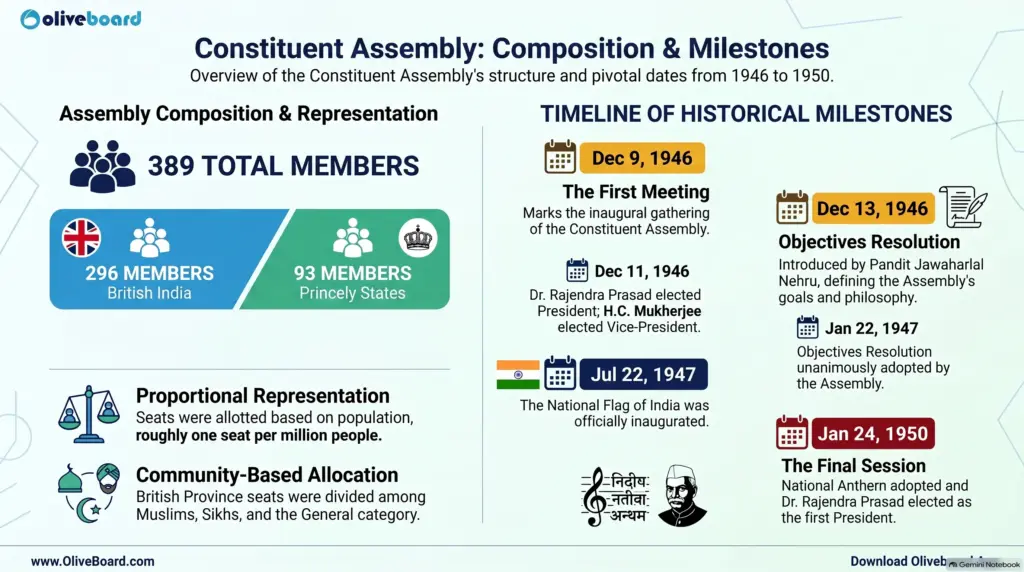
The Constituent Assembly was formed based on the Cabinet Mission Plan, which outlined the scheme for representation and election. The Assembly had 389 members, with 296 from British India and 93 from Princely States. Representation Details:
- Princely States: Seats were allotted according to population, roughly 1 seat per million people. The head of each princely state nominated their representative.
- British Provinces: Seats were allocated based on the population of three communities – Muslims, Sikhs, and General (all except Muslims and Sikhs). Members of each community elected their representatives in the provincial legislative assemblies.
| Date | Event |
| Dec 9, 1946 | First meeting of the Constituent Assembly |
| Dec 11, 1946 | Dr. Rajendra Prasad elected President, H.C.M. Mukherjee elected Vice-President |
| Dec 13, 1946 | ‘Objectives Resolution’ passed by Pandit Jawaharlal Nehru |
| Jan 22, 1947 | Objectives Resolution unanimously adopted |
| Jul 22, 1947 | National Flag inaugurated |
| Jan 24, 1950 | National Anthem adopted; Dr. Rajendra Prasad elected first President; Final session of Constituent Assembly held |
Drafting Committee
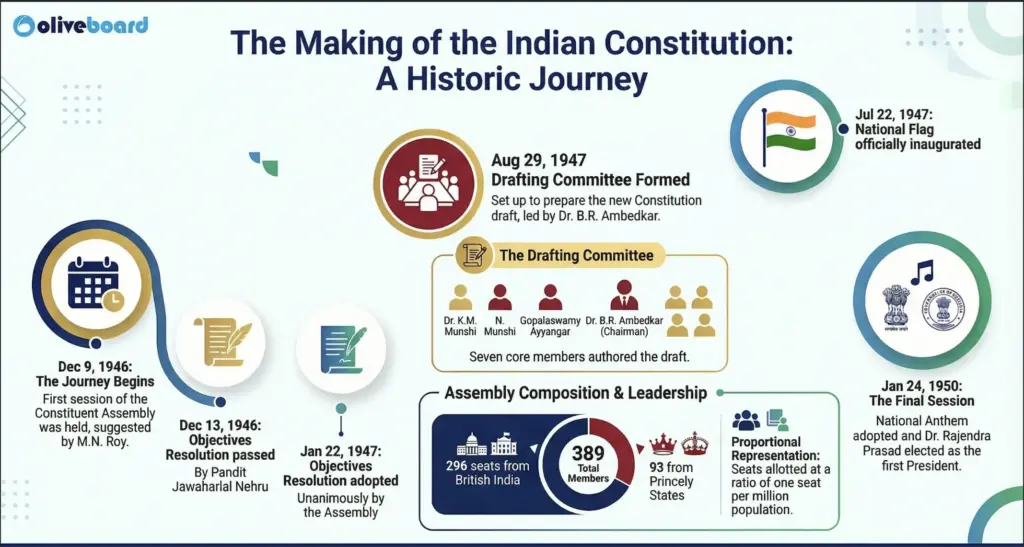
The Drafting Committee was one of the most important committees among the constituent Assembly. It was set up on August 29, 1947. This committee was entitled with the responsibility of preparing the draft of the new Constitution.
The name of the members who had contributed are as follows;
- Dr B.R Ambedkar
- Dr K. M Munshi
- Syed Mohammad Saadullah
- N. Gopalaswamy Ayyangar
- Alladi Krishnaswamy Ayyar.
- T. T Krishnamchari (replaced D.P Khaitan as he died in 1948)
- N Mandhava Rau (replaced B. L Mittal who had withdrawn due to medical reasons)
FAQs
The first session was held on December 9, 1946.
Total 389 members: 296 from British India and 93 from Princely States.
Seats were allotted according to the population of each state, roughly 1 seat per million people. The head of the princely state nominated their representative.
Based on the population of three principal communities: Muslims, Sikhs, and General (all except Muslims & Sikhs). Members of each community in provincial legislative assemblies elected their representatives.
The idea was suggested by M.N. Roy.
- Top 100 SSC CGL General Awareness Questions, Download PDF
- SSC CGL Polity Study Material, Making of Indian Constitution
- Schedules in Indian Constitution, Polity Study Notes for SSC Exams
- SSC CGL Polity Study Notes, Know Writ Jurisdiction in Indian Constitution
- Most Repeated Quantitative Aptitude Questions for SSC CHSL 2026
- Indian Constitution Questions for SSC Exams, Attempt Quiz & Download PDF

The most comprehensive online preparation portal for MBA, Banking and Government exams. Explore a range of mock tests and study material at www.oliveboard.in