
Ace Data Interpretation & Data Sufficiency for SBI PO Exam: Data Interpretation (DI) and Data Sufficiency (DS) are two of the most important components of the SBI PO Quantitative Aptitude section. These topics are designed to evaluate not just your calculation ability, but also your speed, logical clarity, and decision-making under pressure. Many candidates find them challenging because they approach them without a clear structure. With the right understanding and consistent practice, both DI and DS can become reliable scoring areas.
Data Interpretation (DI): Concept and Exam Relevance
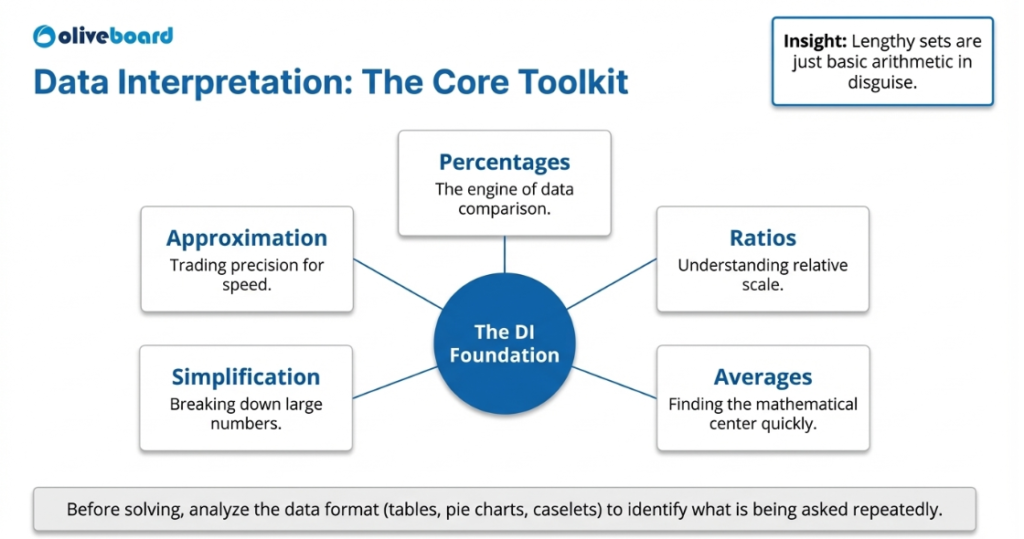
Data interpretation involves analyzing and solving questions based on data presented in formats such as tables, pie charts, bar graphs, and caselets. In SBI PO, DI sets are often lengthy and appear difficult at first glance, but most questions are based on basic arithmetic concepts.
Before solving, it is important to understand the nature of the data and identify what is being asked repeatedly. This helps in reducing effort and improving accuracy. Some key skills required for DI include:
- Strong command over percentages, ratios, and averages
- Ability to simplify large numbers
- Quick comparison and approximation skills
Example of a Table-Based DI Set
The following table shows production and sales of three companies:
| Company | Production (Units) | Sold (Units) |
| A | 500 | 400 |
| B | 600 | 480 |
| C | 800 | 600 |
This type of data is commonly used to test percentage calculations, ratios, and comparisons.
Solved Example 1: Percentage-Based Question
Question: What is the percentage of unsold units for Company A?
First, calculate the unsold units by subtracting sold from production. Then convert it into a percentage.
- Unsold units = 500 − 400 = 100
- Percentage = (100 ÷ 500) × 100 = 20%
This example shows that DI questions are straightforward when broken into steps.
Solved Example 2: Ratio Comparison
Question: Which company has the highest sold-to-production ratio?
Instead of performing lengthy calculations, convert values into percentages for easier comparison.
- Company A → 400/500 = 80%
- Company B → 480/600 = 80%
- Company C → 600/800 = 75%
So, Companies A and B have the highest ratio.
This highlights an important approach:
- Convert values into percentages for quick comparison
- Avoid unnecessary long division
- Focus on relative values rather than exact numbers
How to approach DI sets in the exam?
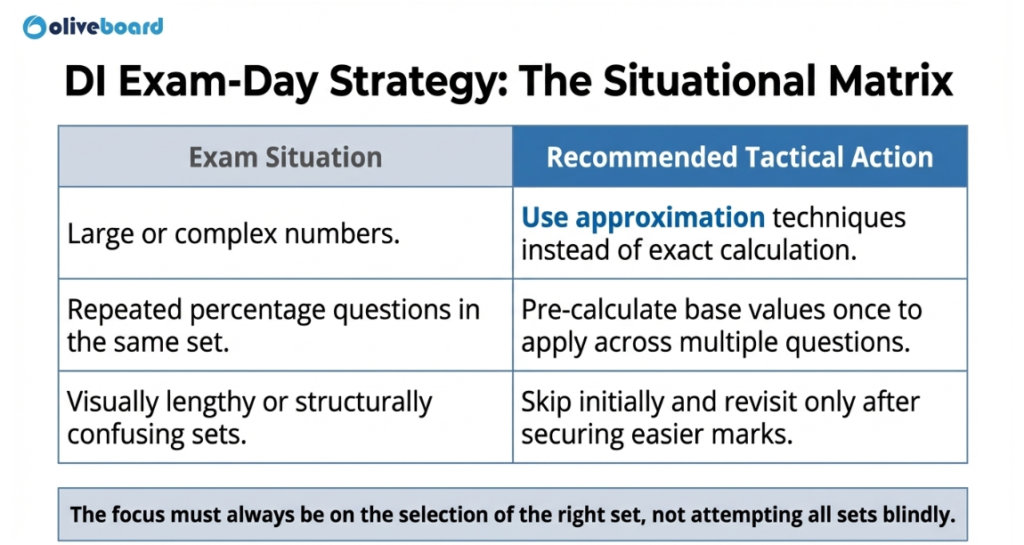
A proper approach can save significant time in DI. Instead of solving blindly, spend a few seconds analyzing the set. After understanding the set, apply these strategies:
- If numbers are complex, use approximation instead of exact calculation
- If multiple questions use the same base value, calculate it once
- If the set looks too lengthy, skip it initially and return later
| Situation | Recommended Approach |
| Large or complex numbers | Use approximation techniques |
| Repeated percentage questions | Pre-calculate base values |
| Lengthy or confusing sets | Skip and revisit later |
The focus should always be on selection of the right set, not attempting all sets.
Data Sufficiency (DS): Concept and Exam Relevance
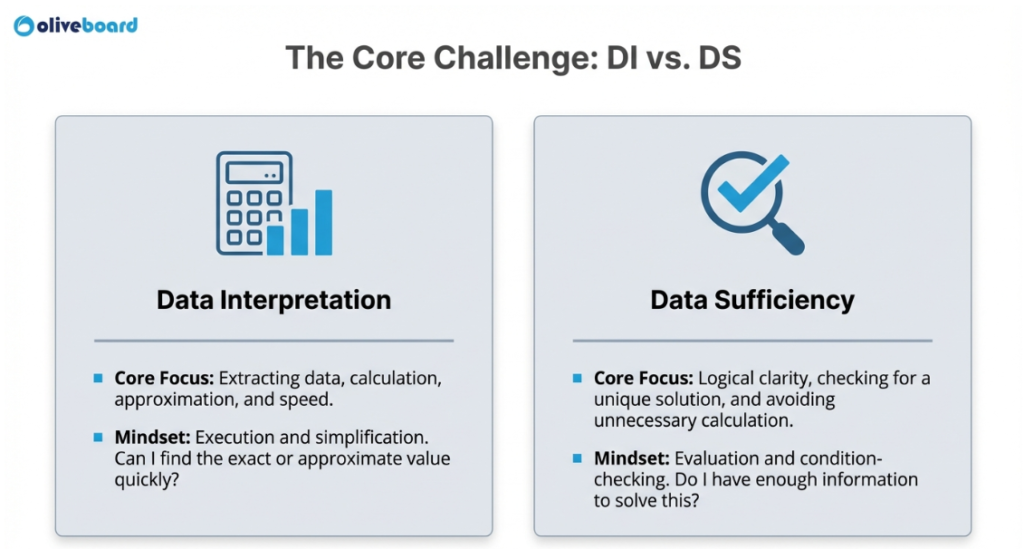
Data sufficiency questions test your ability to determine whether the given information is enough to answer a question. Unlike DI, you are not required to calculate the final answer. Instead, you must evaluate whether a solution is possible. This requires a shift in mindset from solving to analyzing. Key aspects of DS include:
- Understanding what exactly needs to be determined
- Checking whether the answer is unique
- Avoiding unnecessary calculations
| Option | Meaning |
| A | Statement I alone is sufficient |
| B | Statement II alone is sufficient |
| C | Both statements together are sufficient |
| D | Either statement alone is sufficient |
| E | Not sufficient |
Solved Example 1: Equation-Based DS
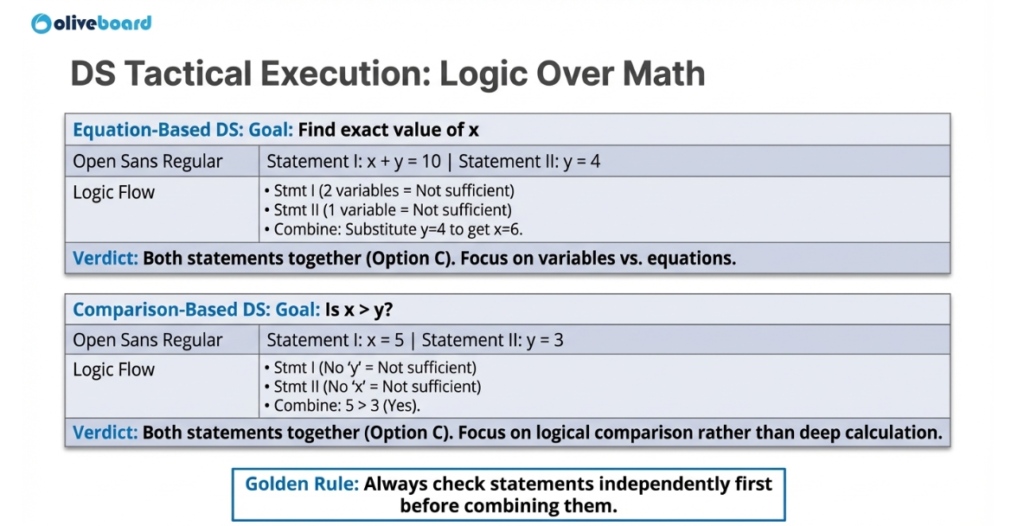
Question: What is the value of x?
Statement I: x + y = 10
Statement II: y = 4
Evaluate each statement separately:
- Statement I → Two variables, no unique value → Not sufficient
- Statement II → Only one variable given → Not sufficient
Now combine both:
- Substitute y = 4 → x + 4 = 10 → x = 6
Thus, both statements together are sufficient.
This example shows:
- Focus on number of variables vs equations
- Do not jump to full calculation immediately
Solved Example 2: Comparison-Based DS
Question: Is x greater than y?
Statement I: x = 5
Statement II: y = 3
Evaluate individually:
- Statement I → No info about y → Not sufficient
- Statement II → No info about x → Not sufficient
Combine both:
- Compare values → 5 > 3 → Yes
Thus, both statements together are sufficient.
Important takeaway:
- DS often involves logical comparison rather than calculation
- Always check statements independently first
How to approach data sufficiency questions?
A step-by-step approach ensures accuracy and avoids confusion.
- Step 1: Identify what the question is asking (value, comparison, or condition)
- Step 2: Check Statement I independently
- Step 3: Check Statement II independently
- Step 4: Combine only if required
| Step | Action |
| Step 1 | Understand requirements. |
| Step 2 | Evaluate Statement I |
| Step 3 | Evaluate Statement II |
| Step 4 | Combine if needed |
Following this structure helps in avoiding logical errors.
Common Mistakes to Avoid
Many mistakes in DI and DS come from poor execution rather than lack of knowledge. Being aware of them can significantly improve performance.
- Spending too much time on one DI set
- Solving DS questions completely instead of checking sufficiency
- Ignoring approximation techniques
- Misreading values in tables or graphs
- Attempting all questions instead of selecting wisely
Final Strategy for SBI PO
To perform well in DI and DS, your preparation must combine concept clarity with regular practice. Focus on building strong fundamentals and improving speed through timed practice. During the exam, keep the following in mind:
- Attempt fewer DI sets but ensure high accuracy
- Use approximation to save time wherever possible
- Solve DS questions logically without over-calculating
- Prioritize question selection over blind attempts
With consistent effort and a structured approach, DI and DS can become predictable and scoring sections in the SBI PO exam.
FAQs
Q1: How many DI questions are asked in the SBI PO exam?
A1: In SBI PO Prelims, Data Interpretation questions are usually limited and appear in simpler forms. However, in SBI PO Mains, DI becomes a major part of the Quant section, typically consisting of 2 to 4 sets, which can make up around 10 to 20 questions. These sets are often moderate to difficult in level.
Q2: What is the best way to improve speed in Data Interpretation?
A2: The best way to improve speed is by strengthening basic calculations and practicing regularly under timed conditions. When your understanding of percentages, ratios, and approximations improves, you naturally become faster and more accurate in solving DI sets.
Q3: Is Data Sufficiency easier than Data Interpretation?
A3: Data Sufficiency is not necessarily easier, but it is different in nature. It involves less calculation and more logical thinking. Candidates who understand how to evaluate the sufficiency of data without fully solving the question often find it more manageable than Data Interpretation.
Q4: How much time should be spent on a DI set in the exam?
A4: Ideally, a candidate should spend around 4 to 6 minutes on a DI set. If a set appears too lengthy or calculation-heavy, it is better to skip it and return later if time permits. Proper time management plays a crucial role in maximizing attempts.
Q5: What are the most important topics to prepare for DI and DS?
A5: Both Data Interpretation and Data Sufficiency are based on core arithmetic concepts such as percentages, ratios, averages, and basic algebra. A strong command over these topics makes it much easier to handle questions in both sections effectively.
- SBI PO GE vs Interview 2026: What to Expect?
- SBI PO GE Sample Topics & Practice Exercises 2026
- SBI PO GE Do’s & Don’ts 2026: Tips to Perform Well
- SBI PO Group Exercise 2026, Complete Guide
- SBI PO Group Exercise Topics 2026, Check Expected Topics
- Top SBI PO GE Topics 2026 to Prepare for Group Exercise

Hi, I’m Tripti, a senior content writer at Oliveboard, where I manage blog content along with community engagement across platforms like Telegram and WhatsApp. With 3+ years of experience in content and SEO optimization related to banking exams, I have led content for popular exams like SSC, banking, railway, and state exams.