
Key Takeaways
- Indian Polity is crucial for competitive exams and offers concise, revision-friendly notes covering key topics like the Constitution and Fundamental Rights.
- Candidates can download the Indian Polity Notes PDF for offline study, which includes important Articles, amendments, and more.
- The notes help candidates quickly recall significant information, making them ideal for last-minute revisions.
- Key areas to study include the Preamble, Fundamental Rights, Judiciary, and Centre-State relations among others.
- Indian Polity covers essential facts, Articles, and provisions, serving as a valuable resource for exam preparation.
Indian Polity is an important subject for competitive exams such as SSC, Railway, UPSC, State PSC and other government examinations. This blog provides Indian Polity Notes in a concise and revision-friendly format, covering the Constitution, Fundamental Rights, Parliament, Judiciary, Constitutional Bodies, important Articles, Amendments and Schedules. Candidates can also use the topic-wise tables, one-liner facts and downloadable Indian Polity Notes PDF for quick preparation and revision.
What are Indian Polity Notes?
Indian Polity Notes provide concise revision material on the Constitution, Fundamental Rights, Parliament, President, Prime Minister, Judiciary, Constitutional Bodies, Centre-State Relations, Local Government, amendments and other important topics. These notes are useful for candidates preparing for SSC, Railway, UPSC, State PSC and other competitive examinations.
Instead of reading lengthy explanations during revision, candidates can use these Indian Polity Notes to quickly recall important Articles, constitutional provisions, amendments, Schedules and institutions. After completing the notes, candidates can practice objective questions through the dedicated Indian Polity Questions page.
Download Indian Polity Notes PDF
Candidates can download the Indian Polity Notes PDF for offline revision. The PDF should contain topic-wise notes, important Constitutional Articles, major amendments, Schedules, Fundamental Rights, constitutional bodies and frequently tested Polity facts. The downloadable notes can be especially useful during the final phase of preparation when candidates need to revise a large number of constitutional facts within a limited time.
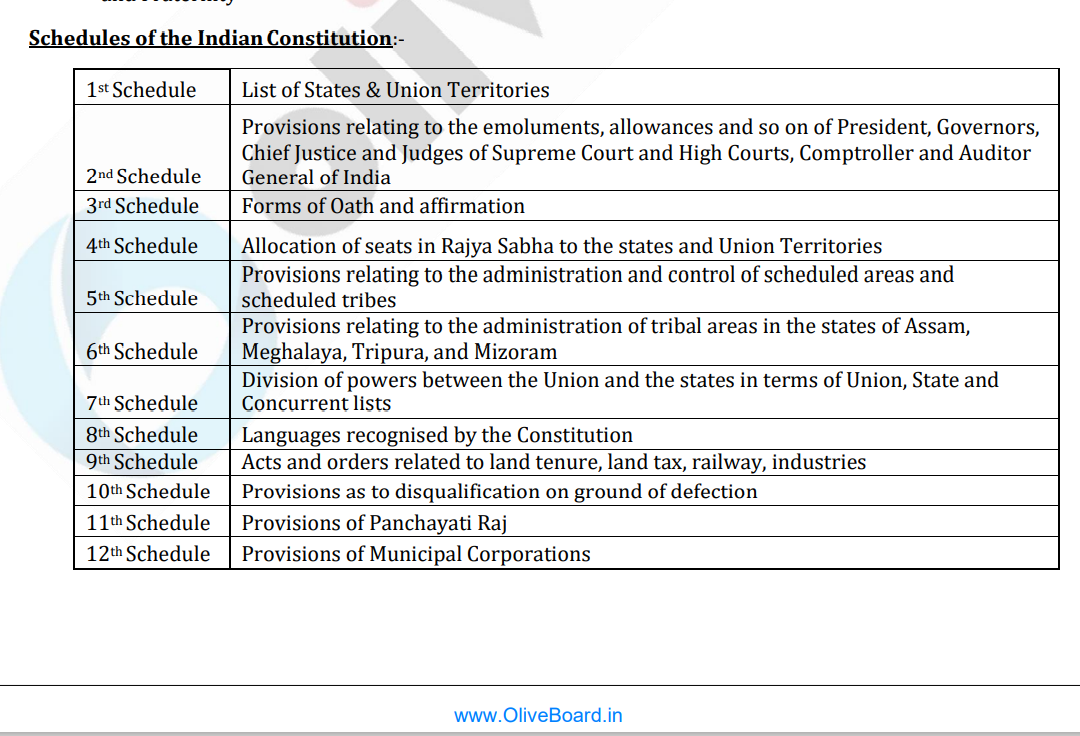
Indian Polity- A glance of the free E-book
What topics are covered in Indian Polity Notes?
Indian Polity covers several interconnected constitutional and governance topics. For effective revision, candidates should divide the subject into smaller sections and prepare the important facts, Articles and provisions associated with each one.
| Topic | Key Areas to Revise |
| Constitution | Constituent Assembly, adoption, enforcement, features |
| Preamble | Keywords, objectives and amendment |
| Fundamental Rights | Articles 12–35 |
| DPSP | Articles 36–51 |
| Fundamental Duties | Article 51A |
| Citizenship | Articles 5–11 |
| Parliament | Lok Sabha, Rajya Sabha, Bills, Committees |
| Union Executive | President, Vice President, PM, Council of Ministers |
| Judiciary | Supreme Court, High Courts, Writs, Judicial Review |
| Centre-State Relations | Legislative, administrative and financial relations |
| Emergency Provisions | Articles 352, 356 and 360 |
| Constitutional Bodies | ECI, CAG, Finance Commission, UPSC |
| Local Government | Panchayats and Municipalities |
| Amendments | Major Constitutional Amendments |
| Schedules | Important Schedules of the Constitution |
What are the important facts about the Indian Constitution?
The Constitution is the foundation of Indian Polity, and several direct questions in competitive examinations are based on its making, adoption, enforcement and structure. These facts should be among the first things candidates revise.
| Fact | Details |
| Constitution adopted | 26 November 1949 |
| Constitution came into force | 26 January 1950 |
| Drafting Committee Chairman | Dr. B. R. Ambedkar |
| President of Constituent Assembly | Dr. Rajendra Prasad |
| Constitutional system | Parliamentary system with a federal structure |
| Amendment procedure | Mainly dealt with under Article 368 |
| Fundamental Rights | Part III |
| DPSP | Part IV |
| Fundamental Duties | Part IVA |
Candidates looking for question-based practice specifically on the Constitution can use the Indian Constitution MCQs for SSC Exams page.
What are the key notes on the Preamble?
The Preamble summarises the philosophy and objectives of the Indian Constitution. It is frequently tested through questions based on its keywords and the Constitutional Amendment that modified it. India is described in the Preamble as a Sovereign, Socialist, Secular, Democratic Republic. For quick revision, candidates should remember both the original constitutional ideals and the changes made through the 42nd Amendment. The Preamble seeks to secure:
- Justice
- Liberty
- Equality
- Fraternity
The words Socialist, Secular and Integrity were added through the 42nd Constitutional Amendment Act, 1976.
What are the Important Fundamental Rights Notes?
Fundamental Rights are contained mainly in Part III of the Constitution from Articles 12 to 35. They protect individual liberty and equality and can be enforced through constitutional remedies. The major Fundamental Rights and their Articles are given below.
| Fundamental Right | Articles |
| Right to Equality | Articles 14–18 |
| Right to Freedom | Articles 19–22 |
| Right against Exploitation | Articles 23–24 |
| Right to Freedom of Religion | Articles 25–28 |
| Cultural and Educational Rights | Articles 29–30 |
| Right to Constitutional Remedies | Article 32 |
The Right to Property is no longer a Fundamental Right. It is protected as a constitutional right under Article 300A.
What are the important Writs in the Indian Constitution?
Writs are constitutional remedies through which courts can protect rights and exercise judicial control. The Supreme Court can issue writs under Article 32 for enforcement of Fundamental Rights, while High Courts have broader writ jurisdiction under Article 226. The five important writs are summarized below.
| Writ | Purpose |
| Habeas Corpus | Protection against unlawful detention |
| Mandamus | Commands a public authority to perform a legal duty |
| Prohibition | Prevents a lower court or tribunal from exceeding jurisdiction |
| Certiorari | Quashes an order of a lower court or tribunal in appropriate cases |
| Quo Warranto | Questions the legal authority of a person holding a public office |
Candidates who want detailed conditions, examples and comparisons should read the dedicated Writ Jurisdiction article instead of relying only on these short notes.
What are the Important DPSP Notes?
The Directive Principles of State Policy are contained in Part IV from Articles 36 to 51. They guide the State in establishing social and economic welfare but are not directly enforceable by courts. Some frequently tested DPSP Articles are given below.
| Article | Provision |
| Article 39 | Certain principles of State policy |
| Article 39A | Equal justice and free legal aid |
| Article 40 | Organisation of Village Panchayats |
| Article 44 | Uniform Civil Code |
| Article 45 | Early childhood care and education |
| Article 48A | Protection and improvement of environment |
| Article 50 | Separation of Judiciary from Executive |
What are the important Fundamental Duties Notes?
Fundamental Duties are provided under Article 51A in Part IVA of the Constitution. They describe responsibilities expected from citizens towards the nation, Constitution, environment and society. Fundamental Duties were added through the 42nd Constitutional Amendment Act, 1976. An additional duty concerning educational opportunities for children was added later through the 86th Constitutional Amendment Act, 2002.
What are the Important Citizenship Notes?
Citizenship provisions at the commencement of the Constitution are contained in Articles 5 to 11. Parliament has the power to regulate citizenship through legislation.
| Article | Subject |
| Article 5 | Citizenship at commencement |
| Article 6 | Rights of certain migrants from Pakistan |
| Article 7 | Rights relating to certain migrants to Pakistan |
| Article 8 | Persons of Indian origin residing outside India |
| Article 9 | Voluntary acquisition of foreign citizenship |
| Article 10 | Continuance of citizenship rights |
| Article 11 | Parliament’s power to regulate citizenship |
Note: India follows the principle of single citizenship under its constitutional system.
What are the Important Parliament Notes?
The Parliament of India consists of the President, Rajya Sabha and Lok Sabha. Article 79 provides for the constitution of Parliament. Candidates should revise the basic differences between the two Houses along with important parliamentary procedures.
| Area | Revision Point |
| Lok Sabha | House of the People |
| Rajya Sabha | Council of States |
| Rajya Sabha | Permanent House; not dissolved |
| Money Bill | Defined under Article 110 |
| Joint Sitting | Generally presided over by Lok Sabha Speaker |
| Question Hour | Members ask questions to the government |
| Zero Hour | Parliamentary practice for raising urgent matters |
| Parliamentary Committees | Assist in legislative and financial oversight |
What are the important notes on the President, Vice President and Prime Minister?
The President, Vice President and Prime Minister are key parts of the Union Executive. The President is the constitutional head of the Union, the Vice President holds the second-highest constitutional office and serves as the ex officio Chairman of the Rajya Sabha, while the Prime Minister heads the Council of Ministers and plays the central role in the functioning of the Union Government.
| Office | Important Points for Revision |
| President | Article 52, election through an electoral college, five-year term, executive, legislative, financial and pardoning powers, Ordinance-making power under Article 123, emergency-related powers |
| Vice President | Article 63, election, qualifications, five-year term, removal process, ex officio Chairman of the Rajya Sabha |
| Prime Minister | Head of the Council of Ministers, appointment, role in policy and administration, relationship with the President and Parliament |
| Council of Ministers | Article 74, aids and advises the President, collective responsibility to the Lok Sabha |
| Ministers | Article 75 contains important provisions relating to appointment, tenure and responsibility of ministers |
What are the Important Judiciary Notes?
The Judiciary interprets the Constitution, protects rights and reviews the legality of legislative and executive actions. The Supreme Court is provided for under Article 124, while Article 214 provides for High Courts for states. Important Judiciary topics include:
| Topic | What to Revise |
| Supreme Court | Composition, jurisdiction and constitutional role |
| High Courts | Powers and jurisdiction |
| Judicial Review | Review of laws and executive actions |
| Writs | Articles 32 and 226 |
| PIL | Public Interest Litigation |
| Judge Removal | Constitutional removal procedure |
| Original Jurisdiction | Certain disputes involving Union and States |
Note: Candidates should also revise major constitutional cases such as Kesavananda Bharati and Minerva Mills at a basic level.
What is the Basic Structure Doctrine?
The Basic Structure Doctrine holds that Parliament’s amending power cannot be used to destroy certain fundamental features of the Constitution. The doctrine is closely associated with the Kesavananda Bharati v. State of Kerala (1973) judgment.
What are the Important Centre-State Relations Notes?
The Constitution distributes powers between the Union and the States. Centre-State Relations are generally classified into legislative, administrative and financial relations. The Seventh Schedule is particularly important because it contains the Union List, State List and Concurrent List.
| Relation | Main Area |
| Legislative | Distribution of law-making powers |
| Administrative | Coordination and administrative control |
| Financial | Distribution of revenues and grants |
What are the important Emergency Provisions Notes?
The Indian Constitution provides three major types of emergency provisions. Questions commonly test their Article numbers and constitutional implications.
| Emergency | Article |
| National Emergency | Article 352 |
| President’s Rule | Article 356 |
| Financial Emergency | Article 360 |
What are Constitutional Bodies in India?
Constitutional Bodies are institutions whose existence and functions are provided directly by the Constitution. Questions often ask candidates to match these bodies with their corresponding Articles.
| Constitutional Body | Relevant Article |
| Comptroller and Auditor General | Article 148 |
| Finance Commission | Article 280 |
| Union Public Service Commission | Article 315 |
| Election Commission of India | Article 324 |
What is Local Government in Indian Polity?
Local Government enables administration and democratic participation at the grassroots level. Rural local government operates through Panchayati Raj institutions, while urban areas are governed through municipalities. The 73rd Constitutional Amendment Act strengthened Panchayati Raj institutions, while the 74th Constitutional Amendment Act dealt with urban local bodies. Important areas include:
- Gram Sabha
- Gram Panchayat
- Panchayat Samiti
- Zila Parishad
- Municipalities
- State Election Commission
- State Finance Commission
- Eleventh Schedule
- Twelfth Schedule
Constitutional Bodies are institutions whose existence and functions are provided directly by the Constitution. Questions often ask candidates to match these bodies with their corresponding Articles.
What are Constitutional Amendments?
A Constitutional Amendment changes, adds or removes provisions of the Constitution according to the prescribed constitutional procedure. Article 368 deals with the amendment procedure for provisions falling within its scope. Some important amendments frequently studied in Indian Polity include:
| Amendment | Major Area |
| 42nd Amendment | Fundamental Duties and several major constitutional changes |
| 44th Amendment | Important post-42nd Amendment changes and Right to Property |
| 52nd Amendment | Anti-Defection Law |
| 61st Amendment | Voting age reduced to 18 years |
| 73rd Amendment | Panchayati Raj |
| 74th Amendment | Municipalities |
| 86th Amendment | Right to Education |
What are the Important Schedules of the Indian Constitution?
Schedules contain additional details relating to different constitutional provisions. Several Schedules are frequently tested in competitive examinations.
| Schedule | Important Subject |
| First Schedule | States and Union Territories |
| Second Schedule | Provisions relating to certain constitutional authorities |
| Third Schedule | Forms of oaths and affirmations |
| Fourth Schedule | Allocation of Rajya Sabha seats |
| Fifth Schedule | Scheduled Areas and Scheduled Tribes |
| Sixth Schedule | Tribal Areas in certain northeastern states |
| Seventh Schedule | Union, State and Concurrent Lists |
| Eighth Schedule | Recognised languages |
| Tenth Schedule | Anti-Defection provisions |
| Eleventh Schedule | Panchayats |
| Twelfth Schedule | Municipalities |
What is Citizenship in Indian Polity?
Citizenship determines membership of the Indian political community and is addressed in the opening provisions of the Constitution along with statutory law enacted by Parliament. Articles 5 to 11 contain constitutional provisions relating to citizenship at the commencement of the Constitution and Parliament’s authority over the subject. Candidates should study:
- Citizenship at commencement
- Acquisition and termination concepts
- Single citizenship
- Relevant constitutional Articles
- Parliament’s power regarding citizenship
Which articles are important in Indian Polity?
Competitive examinations frequently ask candidates to identify the Article associated with a particular right, institution or constitutional provision. Some important Articles for revision are given below.
| Article | Provision |
| Article 14 | Equality before law |
| Article 19 | Certain freedoms |
| Article 21 | Protection of life and personal liberty |
| Article 21A | Right to Education |
| Article 32 | Constitutional Remedies |
| Article 51A | Fundamental Duties |
| Article 74 | Council of Ministers |
| Article 123 | President’s Ordinance-making power |
| Article 124 | Supreme Court |
| Article 148 | CAG |
| Article 280 | Finance Commission |
| Article 315 | Public Service Commissions |
| Article 324 | Election Commission |
| Article 352 | National Emergency |
| Article 356 | Failure of constitutional machinery in a State |
| Article 368 | Constitutional amendment |
Candidates who need detailed topic-wise revision material can refer to our Indian Polity Notes page.
What are the important One-Liner Indian Polity Facts?
One-line facts are useful during last-minute revision because they allow candidates to recall high-frequency information quickly.
| Question Area | Quick Fact |
| Constitution adopted | 26 November 1949 |
| Constitution enforced | 26 January 1950 |
| Fundamental Rights | Part III |
| DPSP | Part IV |
| Fundamental Duties | Part IVA |
| Amendment procedure | Article 368 |
| Money Bill | Article 110 |
| Supreme Court | Article 124 |
| CAG | Article 148 |
| Finance Commission | Article 280 |
| Election Commission | Article 324 |
| National Emergency | Article 352 |
| President’s Rule | Article 356 |
| Financial Emergency | Article 360 |
| Anti-Defection | Tenth Schedule |
| Panchayats | Eleventh Schedule |
| Municipalities | Twelfth Schedule |
FAQs
Indian Polity Notes are concise study and revision materials covering the Constitution, Fundamental Rights, Parliament, Judiciary, constitutional bodies, amendments, Articles and other important Polity topics.
Candidates can use the PDF download section on this page to access Indian Polity notes for offline revision.
Yes. They can be used to revise important Articles, amendments, constitutional bodies, Fundamental Rights, Parliament and other topics frequently studied for SSC examinations.
Candidates can begin with Articles 14, 19, 21, 21A, 32, 51A, 74, 110, 123, 124, 148, 280, 324, 352, 356 and 368.
Short notes are most useful for revision. Candidates should first understand the major concepts and then use notes, previous-year questions and mock tests to strengthen preparation.
- Indian Polity Notes PDF, Know Important Topics & Download PDF
- Indian Polity for Competitive Exams, Complete Guide & Notes
- Important Indian Polity Questions for SSC Exams 2026, Attempt Now
- Top Indian Polity Questions for Government Exams, Download PDF
- SSC CGL English Questions with Answers, Download Free PDF
- Cube and Dice Tricks for SSC and Railways Exams, Attempt Live Quiz

Hi, I’m Tripti, a senior content writer at Oliveboard, where I manage blog content along with community engagement across platforms like Telegram and WhatsApp. With 3+ years of experience in content and SEO optimization related to banking exams, I have led content for popular exams like SSC, banking, railway, and state exams.