

For many UPSC CSE aspirants, having a Plan B does not mean giving up on the Civil Services Examination. It means choosing another serious career option where the preparation already done can be used effectively. In 2026, UPSC EPFO APFC stands out as a strong option because its syllabus overlaps with several areas of UPSC CSE preparation, while the additional subjects are focused and manageable.
With 80 APFC vacancies released and the Recruitment Test scheduled for 20th December 2026, the question is not simply whether APFC is a Plan B, but whether it is the right Plan B for you.
Why are UPSC CSE aspirants considering UPSC EPFO as a Plan B?
UPSC EPFO APFC offers something particularly useful to UPSC aspirants a large part of the preparation can be reused. The APFC syllabus includes Indian Culture, Freedom Movements, Economy, Constitution, Governance, General Science and Current Affairs, all of which are familiar areas for serious UPSC preparation.
- Considerable overlap with General Studies preparation
- Recruitment conducted by UPSC
- Group A officer-level opportunity
- Permanent Central Government position
- Level 10 Pay Matrix
- Specialised role under EPFO
- Separate Recruitment Test followed by Interview
- Existing UPSC preparation remains useful
- Additional syllabus is clearly identifiable
- Preparation can be combined with an ongoing CSE strategy
What makes EPFO APFC different from UPSC CSE?
Although both exams are conducted by UPSC, APFC and CSE are completely different recruitment processes for different career roles. UPSC CSE is a multi-stage examination involving Prelims, Mains and Personality Test, while APFC recruitment is based on a Recruitment Test followed by an Interview.
| UPSC CSE Selection Process | UPSC EPFO APFC Selection Process |
| Civil Services Examination | Recruitment for Assistant Provident Fund Commissioner |
| Multiple stages: Prelims, Mains and Interview | Recruitment Test and Interview |
| Broad General Studies + Optional Subject in Mains | Nine broad syllabus areas |
| Strong focus on analytical and descriptive preparation | Strong focus on objective MCQ preparation |
| Final selection through the CSE merit process | RT + Interview with 75:25 weightage |
| Wide range of services | Specialised role in EPFO |
| Long preparation cycle | More focused additional preparation after building the common base |
How much of the UPSC EPFO APFC syllabus overlaps with UPSC CSE preparation?
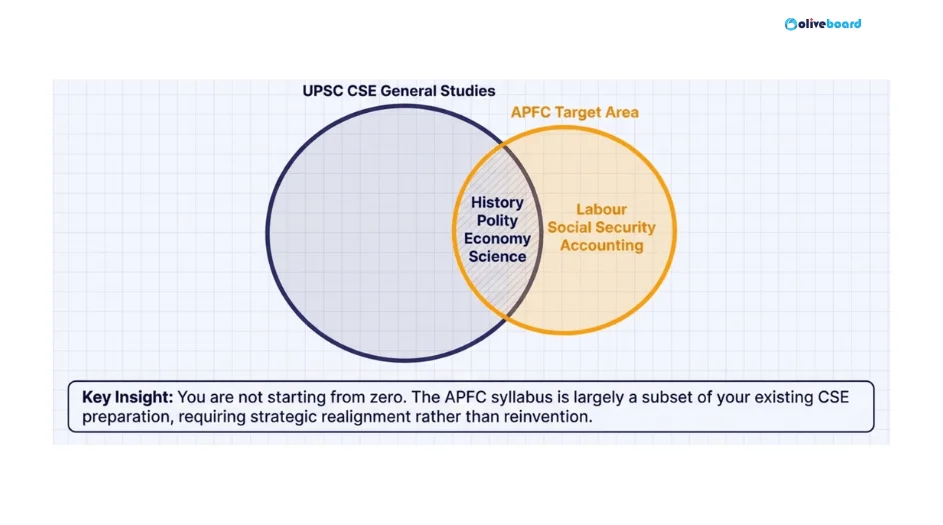
The overlap is significant, but it should not be misunderstood as “the entire APFC syllabus is already covered.” A UPSC aspirant will have a strong advantage in History, Culture, Economy, Polity, Governance, Science and Current Affairs. However, the APFC-specific areas can become decisive because they are not normally covered in the same depth during CSE preparation.
| UPSC EPFO Syllabus | Benefit from UPSC CSE Preparation | Additional APFC Preparation |
| General English | Limited | Separate practice |
| Indian Culture & Freedom Movements | High | Factual revision + MCQs |
| Indian Economy | High | Employment and labour-related updates |
| Constitution & Governance | High | Factual revision + MCQs |
| General Science | Moderate to High | Quick revision |
| Computer Applications | Limited | Basic computer preparation |
| Mathematics, Statistics & Mental Ability | Some overlap through CSAT | APFC-specific practice |
| Industrial Relations | Limited | Detailed preparation required |
| Labour Codes | Limited | Detailed preparation required |
| Social Security | Moderate | Focused preparation required |
| Accountancy | Limited | Study from basics |
| Auditing | Limited | Separate preparation |
| Insurance | Limited | Separate preparation |
| Current Affairs | High | Add labour, employment and social-security focus |
Which UPSC EPFO APFC subjects can you largely carry forward from UPSC CSE?
The biggest advantage for a UPSC CSE aspirant is that several APFC subjects do not require starting from zero. The existing notes, books and revision material can continue to be used. The main change should be the way you revise them less time on lengthy conceptual study and more time on facts, MCQs and quick revision.
| Subject | What You Can Carry Forward from UPSC CSE Preparation | What to Add/Focus on for UPSC EPFO APFC |
| Indian Culture & Freedom Movements | • Ancient and Medieval Indian Culture • Art and Architecture • Literature • Religious and Cultural Movements • Modern Indian History • Revolt of 1857 • Major Freedom Movement events • Important Personalities • Constitutional Developments | • Important Dates and Events • Important Organisations and Personalities • Factual MCQs • One-liner Revision • Previous-year Questions |
| Indian Economy | • Economic Growth and Development • Inflation • Monetary Policy • Fiscal Policy • Banking and Financial System • Poverty and Unemployment • Inclusive Growth | • Employment Trends • Unemployment • Labour Force Participation • Social Welfare Programmes • Worker-focused Government Initiatives • Financial Inclusion • Recent Economic Developments • Important Economic Reports • Employment-related Data |
| Constitution & Governance | • Preamble • Fundamental Rights and Duties • Directive Principles • President and Vice-President • Prime Minister and Council of Ministers • Parliament • Supreme Court and High Courts • Constitutional and Statutory Bodies • Centre-State Relations • Local Government • Constitutional Amendments • Governance and Public Policy | • Important Constitutional Articles • Functions of Important Bodies • Factual Questions • Topic-wise Polity MCQs |
| General Science | • Basic Physics • Basic Chemistry • Biology • Human Body • Diseases and Nutrition • Everyday Science • Environment-related Science • Important Scientific Developments | • Quick Revision of Basic Concepts • Factual Science MCQs • Basic Computer Applications • Computer Fundamentals and Common Terms |
Which UPSC EPFO APFC topics will require the most extra preparation?
This is where a UPSC CSE aspirant needs to be realistic. APFC is not simply another General Studies paper. The specialised subjects can make a major difference because candidates coming from different educational and professional backgrounds may have very different levels of familiarity with them.
| Topic | What to Study for UPSC EPFO APFC |
| Industrial Relations | • Meaning and importance of Industrial Relations • Employer-employee relations • Trade unions • Collective bargaining • Industrial disputes • Strikes and lockouts • Labour welfare • Worker participation in management • Labour administration |
| Labour Codes | • Code on Wages, 2019 • Industrial Relations Code, 2020 • Code on Social Security, 2020 • Occupational Safety, Health and Working Conditions Code, 2020 • Important definitions and provisions • Applicability and coverage • Key authorities and worker protections |
| Social Security | • Meaning and importance of social security • Social insurance and social assistance • Provident Fund • Pension • Insurance • Gratuity • Maternity benefits • Employee welfare • EPFO and ESIC • Social security schemes for organised and unorganised workers |
| Accountancy | • Basic accounting principles • Journal and Ledger • Trial Balance • Cash Book • Final Accounts • Profit and Loss Account • Balance Sheet • Depreciation • Capital and Revenue Expenditure |
| Auditing | • Meaning and objectives of auditing • Types of audit • Internal control • Internal audit • Audit evidence • Errors and fraud • Duties and responsibilities of an auditor |
| Insurance | • Basic insurance concepts • Meaning and types of risk • Life Insurance • General Insurance • Principles of insurance • Types of insurance policies • Basic insurance regulation |
| Computer Applications | • Computer fundamentals • Hardware and software • Operating systems • Internet and networking • MS Office basics • Cybersecurity basics • Common computer terms and applications |
| Elementary Mathematics | • Number system • Simplification • Percentage • Ratio and proportion • Average • Profit and loss • Simple and compound interest • Time and work • Time, speed and distance |
| Statistics | • Collection and classification of data • Measures of central tendency • Mean, median and mode • Measures of dispersion • Basic probability • Data interpretation • Tables and graphical presentation of data |
| General Mental Ability | • Logical reasoning • Analogy and classification • Series • Coding-decoding • Blood relations • Direction and ranking questions • Basic syllogism • Statement-based questions • Simple analytical reasoning |
Why are Labour Codes and Industrial Relations important for APFC?
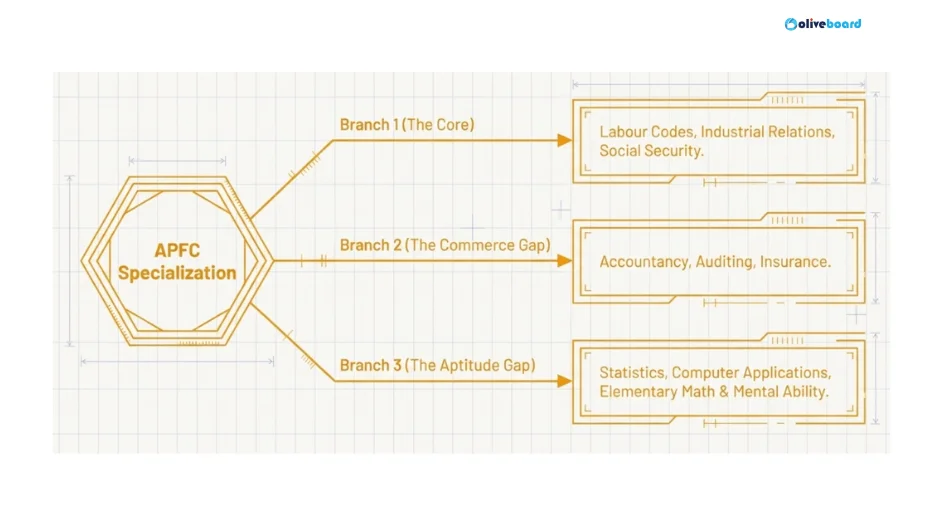
The APFC post is closely connected with labour administration and social security, so candidates should not treat Labour Codes and Industrial Relations as small add-on subjects. These topics require understanding of workers’ rights, trade unions, industrial disputes, wages, working conditions and social-security provisions.
- Prepare Industrial Relations through:
- Meaning and importance of industrial relations
- Employer-employee relations
- Trade unions
- Collective bargaining
- Industrial disputes
- Strikes and lockouts
- Labour welfare
- Worker participation
- Labour administration
- Important labour institutions
- For Labour Codes, cover:
- Code on Wages, 2019
- Industrial Relations Code, 2020
- Code on Social Security, 2020
- Occupational Safety, Health and Working Conditions Code, 2020
- Important definitions
- Applicability
- Major provisions
- Key authorities
- Worker benefits and protections
- Relevant recent developments
Apply Online for the UPSC EPFO Exam 2026
Why is Social Security especially important for UPSC EPFO APFC?
Social Security should be treated as a core APFC subject, not simply as another current-affairs topic. EPFO is an important part of India’s social-security framework, making knowledge of provident funds, pensions, insurance and employee benefits directly relevant to the examination and the post.
- Meaning and importance of social security
- Social insurance
- Social assistance
- Provident fund
- Pension
- Insurance
- Gratuity
- Maternity benefits
- Employee welfare
- EPFO
- ESIC
- Major social-security schemes
- Social security for organised and unorganised workers
Do UPSC CSE aspirants need to study Accountancy, Auditing and Insurance?
Yes, these subjects are among the clearest areas where a CSE aspirant may have to start from the basics. The objective is not to become a professional accountant or auditor but to understand the principles, terminology and basic applications that can be tested in the APFC Recruitment Test.
| Subject | Important Areas |
| Accountancy | Basic accounting principles, journal, ledger, trial balance, cash book, final accounts, profit and loss account, balance sheet, depreciation, capital and revenue expenditure |
| Auditing | Meaning, objectives, types of audit, internal control, internal audit, audit evidence, errors, fraud and auditor’s duties |
| Insurance | Basic concepts, types of insurance, life insurance, general insurance, risk, principles of insurance and basic insurance regulation |
How important are Current Affairs for UPSC EPFO APFC?
Current Affairs is common to both examinations, but the selection of topics should be slightly different. A CSE aspirant may already follow national and international developments in depth; for APFC, this preparation should be supplemented with labour, employment and social-security developments.
- Labour and employment
- Social security
- EPFO-related developments
- Pension reforms
- Government welfare schemes
- Ministry of Labour and Employment initiatives
- Economic developments
- Important reports and indexes
- National and international organisations
- Important appointments and awards
What advantage does a UPSC CSE aspirant have over a fresh APFC aspirant?
A CSE aspirant’s biggest advantage is not simply subject overlap. It is the ability to understand a large syllabus, connect static concepts with current affairs and revise under pressure. This can significantly reduce the time needed to build the common part of the APFC syllabus.
| Existing UPSC Preparation | How It Helps in APFC |
|---|---|
| History preparation | Covers major parts of Culture and Freedom Movements |
| Polity preparation | Covers Constitution and Governance |
| Economy preparation | Covers major economic concepts |
| Science preparation | Helps with General Science |
| Current Affairs | Provides a strong base for national and international events |
| CSAT preparation | Helps with basic aptitude and mental ability |
| Extensive note-making | Useful for quick APFC revision |
| Previous-year question practice | Helps understand objective-question patterns |
| Mock-test experience | Helps improve speed and accuracy |
What is the biggest disadvantage for a UPSC CSE aspirant preparing for APFC?
The biggest mistake is assuming that CSE preparation alone will be enough. A candidate may be excellent in Polity and Economy but still lose marks because of weak Labour Codes, Social Security, Accountancy or Insurance preparation.
- Ignoring APFC-specific subjects
- Treating Labour Codes as a last-minute topic
- Reading CSE-level material for every APFC subject
- Ignoring Accountancy because of a non-Commerce background
- Skipping Computer Applications
- Not practising objective questions
- Spending too much time on Mains-style answer writing
- Ignoring negative marking
- Using only CSE mock tests
- Delaying APFC preparation until the last few weeks
Is the APFC Recruitment Test easier than UPSC CSE?
It would be misleading to simply call APFC “easy.” The examinations test different skills. APFC has a shorter, objective Recruitment Test, but its syllabus combines General Studies with specialised subjects such as Labour Codes, Social Security, Accountancy, Auditing and Insurance.
The APFC Recruitment Test carries 300 marks and is conducted for two hours, with objective questions and one-third negative marking for a wrong answer. The Interview carries 100 marks, with the final selection based on a 75:25 weightage between the Recruitment Test and Interview.
What is the salary and career value of UPSC EPFO APFC?
The 2026 APFC recruitment places the post at Level 10 of the 7th CPC Pay Matrix, making it a Group A Central Government opportunity. The 2026 recruitment has 80 vacancies, and the post is under EPFO, Ministry of Labour & Employment.
| Factor | UPSC EPFO APFC 2026 |
| Organisation | Employees’ Provident Fund Organisation |
| Ministry | Ministry of Labour & Employment |
| Post | Assistant Provident Fund Commissioner |
| Group | Group A |
| Vacancies | 80 |
| Pay Level | Level 10 |
| Recruitment Test | 20 December 2026 |
| Selection | Recruitment Test + Interview |
| RT Marks | 300 |
| Interview | 100 marks |
| Weightage | 75% RT + 25% Interview |
How much time should UPSC CSE aspirants give to APFC preparation?
There is no single percentage that will work for every candidate because the answer depends on how much of the CSE syllabus has already been completed. A candidate who has finished Prelims-level GS may need much less time for common subjects than someone still building the foundation.
| Candidate Situation | Suggested APFC Focus |
| Strong CSE preparation | Focus mainly on APFC-specific subjects and MCQs |
| CSE Prelims-level preparation completed | Revise common GS + build specialised subjects |
| CSE preparation in progress | Integrate common topics and add APFC-specific study |
| Starting APFC separately | Follow the complete APFC syllabus systematically |
| Commerce background | Give extra time to Labour, Social Security and other non-Commerce areas |
| Non-Commerce background | Give additional time to Accountancy, Auditing and Insurance |
Also Check: UPSC EPFO APFC Admit Card 2026
Should you prepare for UPSC CSE and APFC together?
Yes, if your CSE preparation is already reasonably stable. The two can be combined because a large portion of the APFC syllabus sits within the broader General Studies preparation. However, trying to prepare both from scratch at full intensity can divide your attention.
- Keep CSE as the primary long-term goal if that remains your preference.
- Use existing CSE preparation for common APFC subjects.
- Add dedicated APFC blocks for Labour and Social Security.
- Cover Accountancy, Auditing and Insurance systematically.
- Practise APFC-specific MCQs.
- Increase APFC mock-test frequency as 20 December approaches.
- Do not let APFC preparation completely disrupt your CSE study plan.
FAQs
Yes, APFC can be a strong Plan B because several subjects overlap with UPSC CSE preparation and it offers a Group A Central Government career.
Major areas such as Indian Culture, Freedom Movements, Economy, Constitution, Governance, General Science and Current Affairs overlap with CSE preparation.
Yes, existing CSE preparation provides a strong foundation for many APFC subjects, but candidates must also prepare the APFC-specific topics.
APFC should not simply be considered easier, as it tests a different combination of General Studies, specialised subjects and objective-question skills.
The UPSC EPFO APFC Recruitment Test 2026 is scheduled to be held on 20 December 2026.
- UPSC EPFO Principles of Accountancy, Auditing and Insurance Syllabus 2026
- UPSC EPFO Labour Laws Syllabus 2026 for APFC: Topic-Wise Details
- UPSC EPFO APFC Exam Centre List, City Allocation & Exam-Day Rules
- UPSC EPFO APFC OMR Sheet Filling Rules and Common Mistakes
- UPSC EPFO PYPs, Download EPFO Previous Year Question Papers
- UPSC EPFO APFC Study Material 2026, Download Free Notes

Hi, I’m Aditi. I work as a Content Writer at Oliveboard, where I have been simplifying exam-related content for the past 4 years. I create clear and easy-to-understand guides for JAIIB, CAIIB, and UGC exams. My work includes breaking down notifications, admit cards, and exam updates, as well as preparing study plans and subject-wise strategies.
My goal is to support working professionals in managing their exam preparation alongside a full-time job and to help them achieve career growth.