

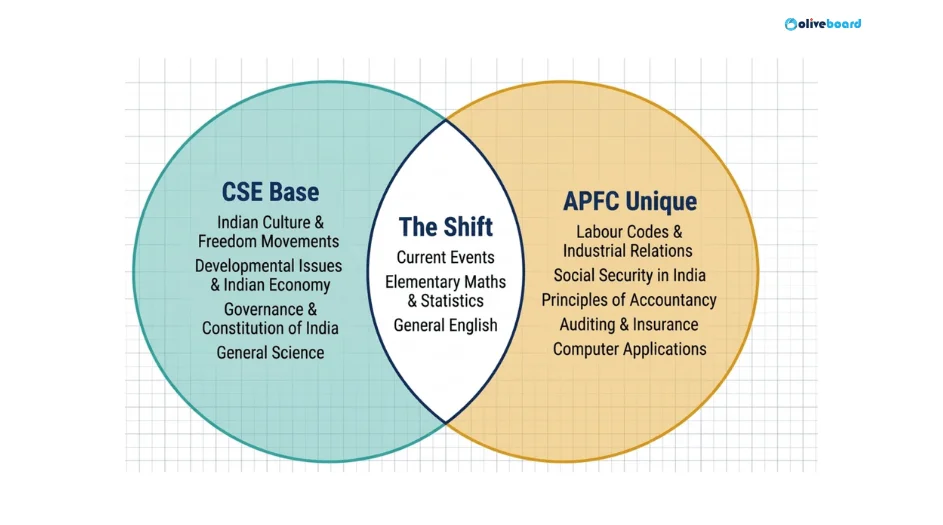
Preparing for the UPSC EPFO APFC exam becomes easier for candidates who are already preparing for the UPSC Civil Services Examination (CSE) because several subjects are common in both exams. History, Indian culture, economy, Constitution, governance, general science and current affairs form a strong common base. However, APFC also has specialised topics such as Industrial Relations, Labour Codes, Social Security, Accountancy, Auditing and Insurance, which need separate preparation.
With the UPSC EPFO APFC Recruitment Test scheduled for 20 December 2026, UPSC aspirants can use their existing preparation and focus their additional time on these exam-specific areas.
What is the UPSC EPFO APFC exam pattern 2026?
The UPSC EPFO APFC Recruitment Test is an objective-type examination conducted in Pen and Paper mode. The test carries 300 marks and has a duration of 2 hours, with one-third negative marking for every incorrect answer. Candidates shortlisted through the Recruitment Test are called for an Interview, and the final selection gives 75% weightage to the Recruitment Test and 25% to the Interview.
| Particulars | Details |
| Post | Assistant Provident Fund Commissioner (APFC) |
| Recruiting Organisation | Employees’ Provident Fund Organisation (EPFO) |
| Conducting Body | UPSC |
| Exam | Recruitment Test |
| Date | 20 December 2026 |
| Mode | Pen and Paper |
| Type of Questions | Objective/MCQ |
| Duration | 2 hours |
| Maximum Marks | 300 |
| Negative Marking | One-third of the marks assigned to the question |
| Interview Marks | 100 |
| RT : Interview Weightage | 75 : 25 |
What is the UPSC EPFO APFC syllabus 2026?
The UPSC EPFO APFC 2026 syllabus consists of nine broad areas. Unlike the UPSC syllabus, the APFC syllabus gives specific importance to labour, social security, accountancy, auditing and insurance, which are directly relevant to the functions of EPFO and the APFC post.
- General English
- Indian Culture, Heritage and Freedom Movements
- Developmental Issues and Present Trends in Indian Economy
- Governance and Constitution of India
- General Science and Basic Knowledge of Computer Applications
- Elementary Mathematics, Statistics and General Mental Ability
- Industrial Relations, Labour Codes and Social Security in India
- Principles of Accountancy, Auditing and Insurance
- Current Events of National and International Importance
Which UPSC EPFO APFC topics overlap with UPSC CSE?
A significant part of APFC preparation can be supported by the preparation already done for UPSC exam. The strongest overlap can be seen in Indian Culture and Freedom Movements, Indian Economy, Constitution and Governance, General Science and Current Affairs. However, the depth and question style can differ, so candidates should revise these topics specifically for an objective examination.
| APFC Syllabus | UPSC CSE Overlap | What a UPSC CSE Aspirant Should Do |
| Indian Culture, Heritage and Freedom Movements | History, Art & Culture, Freedom Struggle | Revise existing notes |
| Indian Economy | Indian Economy and Development | Revise concepts and current issues |
| Governance and Constitution | Polity and Governance | Revise standard notes and facts |
| General Science | General Science & Technology | Revise Prelims-level topics |
| Current Events | Current Affairs | Continue regular preparation |
| General English | Limited overlap | Practise separately |
| Mathematics & Statistics | CSAT | Add focused practice |
| Computer Applications | Limited overlap | Study basic computer topics |
| Labour Codes & Social Security | Limited overlap | Prepare separately |
| Accountancy, Auditing & Insurance | Very limited overlap | Prepare from basics |
How does Indian Culture, Heritage and Freedom Movements overlap with UPSC CSE?
This is one of the areas where UPSC CSE aspirants have a clear advantage. The CSE syllabus already covers Indian culture, modern Indian history and the Freedom Struggle, which directly supports the APFC syllabus. The main requirement is to revise the information in a more factual and MCQ-oriented manner.
| Area | Details |
| Already covered through CSE preparation: | – Ancient and medieval Indian culture – Art and architecture – Literature – Religious and cultural movements – Modern Indian history – Revolt of 1857 – Major movements of the Freedom Struggle – Important personalities – Constitutional developments |
| Additional topics to be covered for APFC approach: | – Revise important dates and events – Memorise important personalities and organisation – Practise factual MCQs – Revise important cultural facts – Focus on one-liners and previous-year questions |
Apply Online for the UPSC EPFO Exam 2026
How does Indian Economy overlap with UPSC CSE?
Developmental Issues and Present Trends in Indian Economy is another strong area of overlap. CSE aspirants generally study the Indian economy in detail for both Prelims and Mains, so most of the conceptual foundation is already available. For APFC, the focus should shift towards quick revision, factual questions and employment- and welfare-related developments.
| Area | Details |
| Already covered through CSE preparation: | – Economic growth and development – Inflation – Fiscal policy – Monetary policy – Banking and financial system – Poverty – Unemployment – Inclusive growth – Government schemes – Financial inclusion |
| Give additional attention to: | – Employment trends – Labour force participation – Social welfare programmes – Government initiatives for workers – Recent economic developments – Important economic reports – Current employment-related data |
How does Governance and Constitution overlap with UPSC syllabus?
Governance and Constitution of India has very high overlap with the UPSC CSE Polity and Governance syllabus. A CSE aspirant who has already studied the Constitution, Parliament, Executive, Judiciary and constitutional bodies does not need to start this section again.
- Revise these topics:
- Preamble
- Fundamental Rights
- Fundamental Duties
- Directive Principles
- President and Vice-President
- Prime Minister and Council of Ministers
- Parliament
- Supreme Court and High Courts
- Constitutional bodies
- Statutory bodies
- Centre-State relations
- Local government
- Constitutional amendments
- Governance and public policy
- APFC-specific approach:
- Focus on factual questions
- Revise constitutional articles
- Revise important bodies and their functions
- Practise polity-based MCQs
How does General Science overlap with UPSC CSE?
General Science is another common area, especially for candidates who have completed UPSC CSE Prelims preparation. The APFC syllabus also adds Basic Knowledge of Computer Applications, which may require separate preparation.
- For General Science, revise:
- Basic Physics
- Basic Chemistry
- Biology
- Human body
- Diseases and nutrition
- Everyday science
- Environment-related science
- Important scientific developments
- For Computer Applications, study:
- Computer fundamentals
- Hardware and software
- Operating systems
- Internet
- Networking
- MS Office basics
- Cybersecurity basics
- Common computer terms
What should UPSC aspirants study for Computer Applications and how should they prepare?
The Basic Knowledge of Computer Applications section requires focused preparation because it is not covered extensively in UPSC CSE preparation. Candidates can cover this section through basic computer concepts and regular objective practice rather than spending too much time on advanced topics.
- Start with computer basics: Learn about hardware, software, input/output devices, memory and basic computer terminology.
- Cover operating systems: Understand basic functions, types of operating systems and common features.
- Study MS Office: Revise basic features and uses of MS Word, MS Excel and MS PowerPoint.
- Understand Internet and networking: Cover browsers, search engines, email, LAN, WAN and basic networking terms.
- Learn cybersecurity basics: Study common cyber threats, passwords, phishing, malware and basic online safety.
- Practise computer MCQs: Solve topic-wise and previous-year questions to improve speed and identify commonly asked concepts.
How does Current Affairs preparation overlap between UPSC CSE and APFC?
Current Affairs is common to both exams, but the way candidates use current affairs preparation should change slightly. UPSC CSE preparation usually focuses on understanding an issue in depth, whereas APFC preparation also requires remembering important facts, names, dates, schemes and developments.
- Labour and Employment: Cover major developments related to employment, wages, workforce trends, unemployment, labour reforms and worker welfare.
- Social Security: Revise recent updates related to provident funds, pensions, insurance, employee benefits and social security schemes.
- EPFO-related Developments: Follow important updates related to EPFO, provident fund rules, interest rates, member services, digital initiatives and recent policy changes.
- Pension Reforms: Focus on major pension-related reforms, schemes, regulatory changes and developments affecting employees and workers.
- Government Welfare Schemes: Study important government schemes related to employment, social security, workers, pensions, health, education and weaker sections.
- Labour Ministry Initiatives: Track major initiatives, programmes, notifications and policy measures introduced by the Ministry of Labour and Employment.
- Economic Developments: Revise important developments related to inflation, employment, growth, banking, financial inclusion, fiscal policy and government economic measures.
- Important Reports and Indexes: Remember the names, issuing organisations, key findings and important rankings of major national and international reports and indexes.
- National and International Organisations: Revise the functions, headquarters, reports and recent developments related to organisations relevant to labour, economy and social security.
- Important Appointments and Awards: Keep track of major appointments, awards and honours, particularly those related to government bodies, international organisations, labour and public administration.
What extra topics should UPSC CSE aspirants study for UPSC EPFO APFC?
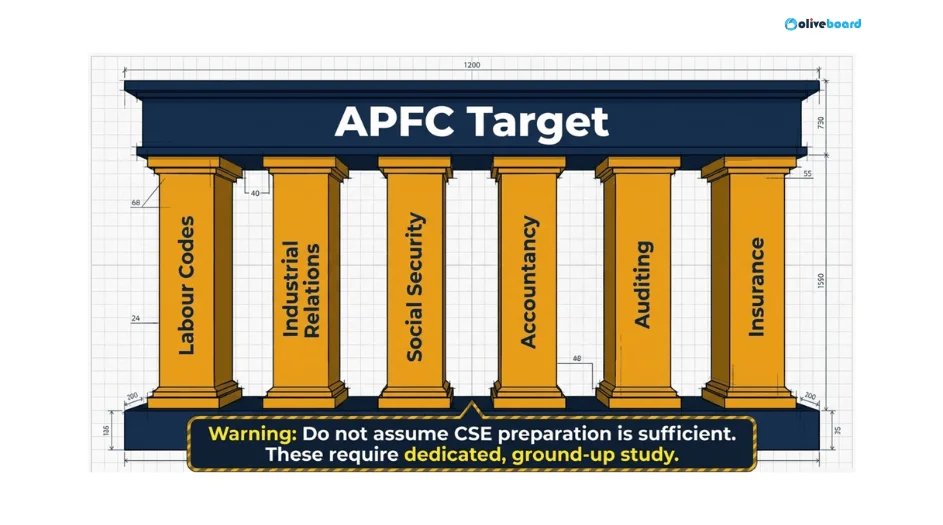
The biggest additional preparation is required for Industrial Relations, Labour Codes, Social Security, Accountancy, Auditing and Insurance. These subjects are either not covered in the same depth in CSE preparation or are not dedicated parts of the General Studies syllabus. Candidates should therefore avoid assuming that their CSE preparation alone will be sufficient.
What should you study under Industrial Relations for UPSC EPFO APFC?
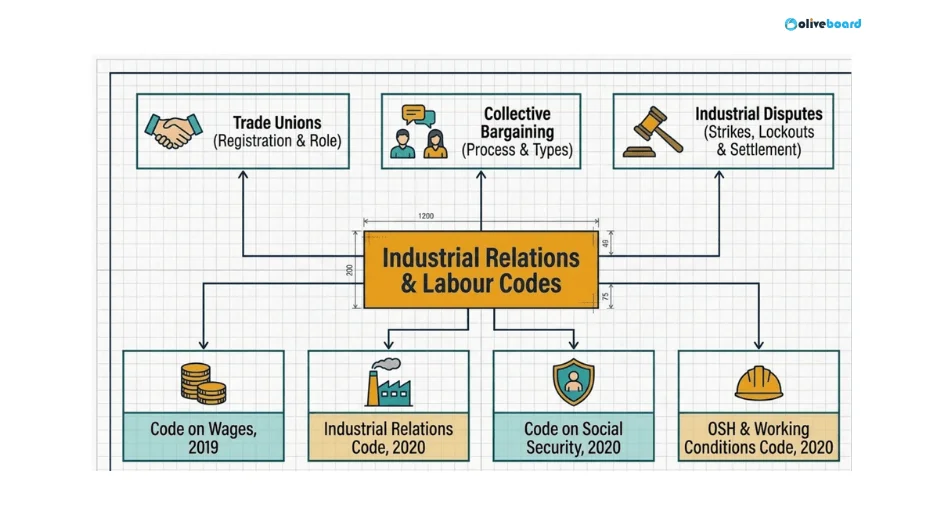
Industrial Relations is an important part of the UPSC EPFO APFC syllabus and focuses on the relationship between employers, employees, trade unions and the government. Candidates should understand the key concepts, labour institutions and mechanisms used to manage workplace relations.
| Topic | What to Study |
| Meaning and Importance | Meaning, objectives, scope and importance of industrial relations |
| Employer-Employee Relations | Rights, responsibilities and relationship between employers and employees |
| Trade Unions | Meaning, objectives, functions, registration and role of trade unions |
| Collective Bargaining | Meaning, process, types, importance and role in resolving workplace issues |
| Industrial Disputes | Meaning, causes, types, settlement methods and dispute-resolution mechanisms |
| Strikes and Lockouts | Meaning, types, conditions and legal provisions related to strikes and lockouts |
| Labour Welfare | Major welfare measures, employee benefits and measures for improving working conditions |
| Worker Participation | Meaning, importance and forms of worker participation in management |
| Labour Administration | Role and functions of government authorities involved in labour administration |
| Labour Institutions | Functions and roles of important organisations and institutions related to labour and employment |
What should you study under Labour Codes for UPSC EPFO APFC?
The four Labour Codes are a key part of the APFC syllabus under Industrial Relations and Labour Codes. Candidates should focus on their objectives, important provisions, definitions, applicability and worker-related benefits.
| Labour Code | What to Study |
| Code on Wages, 2019 | Minimum wages, payment of wages, bonus, equal remuneration and important definitions |
| Industrial Relations Code, 2020 | Trade unions, standing orders, industrial disputes, strikes, lockouts and dispute-resolution mechanisms |
| Code on Social Security, 2020 | Provident fund, pension, insurance, gratuity, social security benefits and coverage of workers |
| Occupational Safety, Health and Working Conditions Code, 2020 | Workplace safety, health standards, working conditions and welfare measures |
| Important Definitions | Key terms and definitions used under the four Labour Codes |
| Applicability | Establishments, employers and categories of workers covered under different provisions |
| Major Provisions | Important rights, duties, benefits and provisions under each Labour Code |
| Key Authorities | Roles and functions of authorities responsible for implementing labour laws |
| Worker Benefits | Wage protection, social security, workplace safety and other statutory protections |
| Recent Developments | Latest notifications, rules and important developments related to the Labour Codes |
What should you study under Social Security in India for UPSC EPFO APFC?
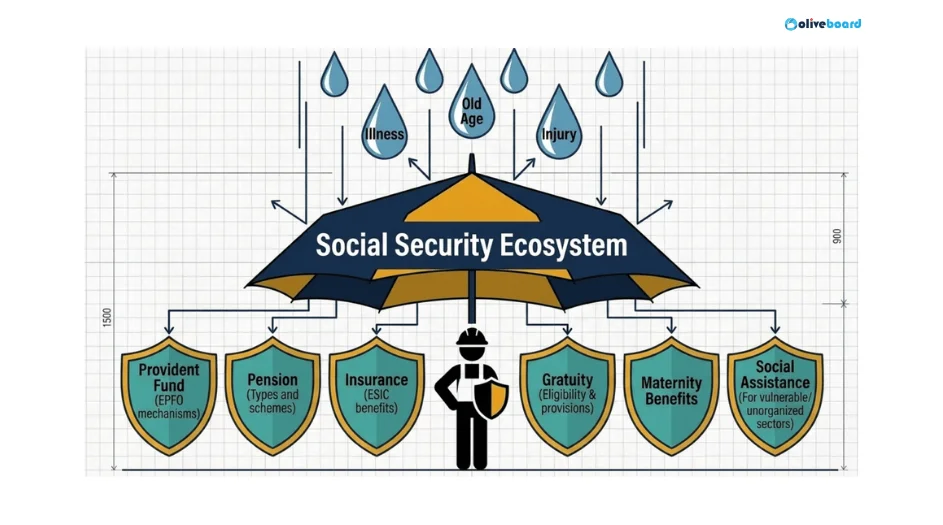
Social Security is one of the most relevant areas for the UPSC EPFO APFC exam because EPFO plays an important role in India’s social security system. Candidates should cover the basic concepts along with major schemes, institutions and benefits available to workers.
| Topic | What to Study |
| Meaning and Importance | Meaning, objectives, need and importance of social security for workers and their families |
| Social Insurance | Meaning, features and role of social insurance in providing financial protection |
| Social Assistance | Government-supported assistance for vulnerable and economically weaker sections |
| Provident Fund | Concept, purpose, contributions, benefits and major provident fund provisions |
| Pension | Types of pension, pension benefits and important pension-related schemes |
| Insurance | Employee-related insurance benefits and the role of insurance in social protection |
| Gratuity | Eligibility, benefits and basic provisions related to gratuity |
| Maternity Benefits | Major maternity-related benefits and provisions available to eligible employees |
| Employee Welfare | Measures and benefits aimed at improving the social and economic well-being of employees |
| EPFO | Structure, functions, role and major schemes administered by EPFO |
| ESIC | Role, functions and major benefits provided by the Employees’ State Insurance Corporation |
| Social Security Schemes | Important Central Government schemes related to social security and worker welfare |
| Organised and Unorganised Workers | Social security measures, schemes and challenges faced by workers in both sectors |
Why should UPSC aspirants give special attention to Accountancy, Auditing and Insurance?
Principles of Accountancy, Auditing and Insurance is one of the biggest gaps between CSE and APFC preparation. Candidates from a commerce background may already know some of these concepts, but other UPSC aspirants may need to study them from the basics.
| Subject | Topics to Cover |
| Accountancy | Basic accounting principles and concepts Journal and ledger Trial balance Cash book Final accounts Profit and loss account Balance sheet Depreciation Capital and revenue expenditure |
| Auditing | Meaning and objectives of auditing Types of audits Internal control and internal audit Audit evidence Errors and fraud Duties and responsibilities of an auditor |
| Insurance | Basic insurance concepts Types of insurance Life insurance General insurance Meaning and types of risk Principles of insurance Basic insurance regulation and regulatory framework |
What should UPSC CSE aspirants do with their existing preparation?
A CSE aspirant should not prepare APFC from zero. The better strategy is to retain the existing UPSC preparation for common subjects and use the remaining preparation time for APFC-specific areas.
| What You Already Know from UPSC CSE | What You Need to Do for UPSC EPFO APFC |
| History | Revise |
| Culture | Revise |
| Economy | Revise + update current issues |
| Polity | Revise |
| Science | Revise |
| Current Affairs | Continue + add labour focus |
| CSAT | Use as base for Maths/Reasoning |
| Essay/Mains preparation | Not directly required for RT |
| Labour | Study separately |
| Social Security | Study separately |
| Accountancy | Study from basics |
| Auditing | Study separately |
| Insurance | Study separately |
| Computer | Add basic preparation |
What should a UPSC CSE aspirant study first for APFC?
The order of preparation matters because the candidate already has a strong base in several subjects. Start with the areas that require the most new learning and gradually move towards revision of common subjects.
- Labour Codes
- Industrial Relations
- Social Security
- Accountancy
- Auditing
- Insurance
- Elementary Mathematics & Statistics
- Computer Applications
- Current Affairs
- Revision of common CSE subjects
How should UPSC aspirants prepare for the APFC exam?
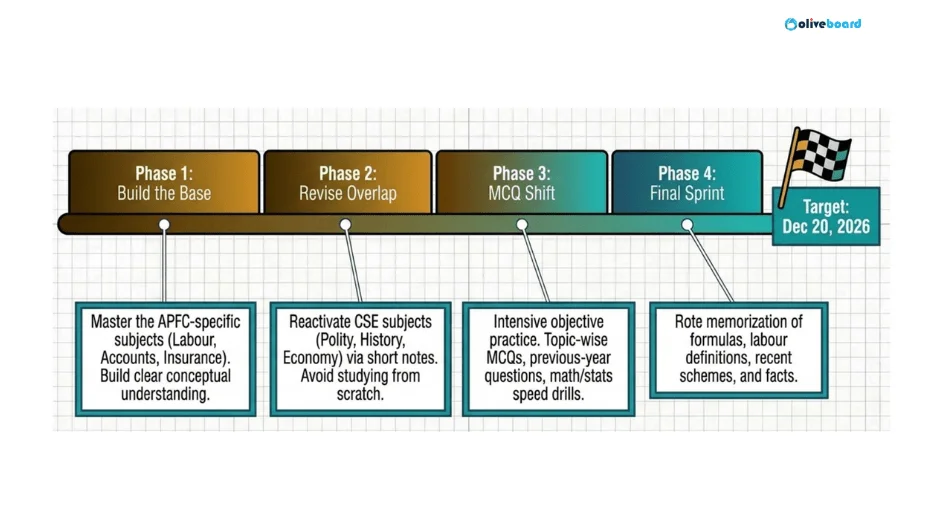
With the UPSC EPFO APFC Recruitment Test scheduled for 20 December 2026, candidates should divide their preparation into phases rather than trying to complete the entire syllabus together. The initial phase should focus on new APFC-specific subjects, followed by revision and intensive MCQ practice.
| Phase | What to Cover and How to Prepare |
| Phase 1: Build the APFC-specific base | Focus on topics that require separate preparation, such as Labour Codes, Industrial Relations, Social Security, Accountancy, Auditing, Insurance, Basic Computer Applications, Elementary Mathematics and Statistics. Build a clear understanding of concepts before moving to intensive practice. |
| Phase 2: Revise the overlapping syllabus | Revise Indian Culture, Freedom Movement, Indian Economy, Constitution, Governance, General Science and Current Affairs using your existing UPSC preparation. Avoid studying everything from scratch and prepare short notes for quick revision. |
| Phase 3: Shift to MCQ practice | Practise topic-wise MCQs, previous-year questions, mixed quizzes and full-length mock tests. Give additional practice to Labour and Social Security, Accountancy, Mathematics and Statistics, and Current Affairs to improve speed and accuracy. |
| Phase 4: Final revision before the exam | Focus on Labour Codes, Social Security schemes, important facts and definitions, Accountancy concepts and formulas, Insurance principles, Polity, Current Affairs, Government schemes and Computer basics. Avoid taking up major new topics in the final weeks and revise frequently asked concepts. |
What should UPSC EPFO APFC aspirants do differently from UPSC CSE aspirants?
The biggest difference is the depth versus speed approach. UPSC CSE preparation requires extensive conceptual understanding, analysis and answer writing, whereas the APFC Recruitment Test requires candidates to identify the correct answer quickly from objective questions.
| UPSC CSE Approach | APFC Approach |
| Detailed conceptual study | Quick conceptual revision |
| Analytical understanding | Factual + conceptual MCQs |
| Answer writing | MCQ practice |
| Extensive current affairs analysis | Relevant facts and developments |
| GS-heavy preparation | GS + specialised subjects |
| Long-form revision | Short notes and quick revision |
Also Check: UPSC EPFO APFC Admit Card 2026
Can UPSC CSE preparation be enough to clear UPSC EPFO APFC?
UPSC CSE preparation provides a strong foundation, but it should not be considered sufficient by itself. Candidates who have prepared seriously for CSE will already have an advantage in History, Economy, Polity, Science and Current Affairs. However, they must separately prepare Labour Codes, Industrial Relations, Social Security, Accountancy, Auditing, Insurance, Computer Applications and the required Mathematics/Statistics topics.
The most efficient approach is therefore not to repeat the entire CSE syllabus but to identify the overlap, revise it quickly and spend the maximum additional time on APFC-specific subjects.
FAQs
Yes, both exams overlap in subjects such as Indian Culture, Freedom Movements, Economy, Constitution, Governance, General Science and Current Affairs.
History, Indian Culture, Economy, Polity, Governance, General Science and Current Affairs have significant overlap.
UPSC aspirants need additional preparation for Labour Codes, Industrial Relations, Social Security, Accountancy, Auditing, Insurance and basic Computer Applications.
CSE preparation provides a strong base, but candidates must separately cover the APFC-specific subjects and practise objective questions.
Yes, Industrial Relations, Labour Codes and Social Security are important APFC syllabus areas and require focused preparation.
- UPSC EPFO Principles of Accountancy, Auditing and Insurance Syllabus 2026
- UPSC EPFO Labour Laws Syllabus 2026 for APFC: Topic-Wise Details
- UPSC EPFO APFC Exam Centre List, City Allocation & Exam-Day Rules
- UPSC EPFO APFC OMR Sheet Filling Rules and Common Mistakes
- UPSC EPFO PYPs, Download EPFO Previous Year Question Papers
- UPSC EPFO APFC Study Material 2026, Download Free Notes

Hi, I’m Aditi. I work as a Content Writer at Oliveboard, where I have been simplifying exam-related content for the past 4 years. I create clear and easy-to-understand guides for JAIIB, CAIIB, and UGC exams. My work includes breaking down notifications, admit cards, and exam updates, as well as preparing study plans and subject-wise strategies.
My goal is to support working professionals in managing their exam preparation alongside a full-time job and to help them achieve career growth.