

Key Takeaways
- This article provides free SSC CGL Polity Notes focused on the Types of Emergency in the Indian Constitution.
- The Indian Constitution outlines three types of emergencies: National Emergency (Article 352), State Emergency (Article 356), and Financial Emergency (Article 360).
- National Emergency allows the Central Government to act during threats like war or rebellion, whereas State Emergency occurs due to state constitutional failures.
- Financial Emergency is declared when financial stability in India is threatened, enabling the Centre to exert economic control.
- Understanding these emergency provisions is crucial for SSC CGL exam preparation and broader polity concepts.
To help you strengthen your preparation, we are providing you with free SSC CGL Polity Notes in this blog. In this edition, we will cover the important topic of Types of Emergency in the Indian Constitution, which is frequently asked in the SSC CGL exam and other competitive exams. This topic is essential for understanding how the Constitution handles crisis situations and ensures stability in the country. The notes are designed in a simple and exam-oriented manner to help you revise quickly and effectively.
What is Emergency?
The Indian Constitution has defined Emergency as “the circumstances which may arise suddenly such that it calls for immediate action by the public authorities under the powers which are specially granted to them”. This means the Government Authorities (Central Government) and institutions get special powers to handle a particular situation.
Dr Babasaheb Ambedkar had noted that In case of an Emergency India could acquire the characteristics of a completely unitary system of Government. The Federal principles of Indian Consitution would be overshadowed by the Unitary Features to handle the Emergency Situations.
Types of Emergency
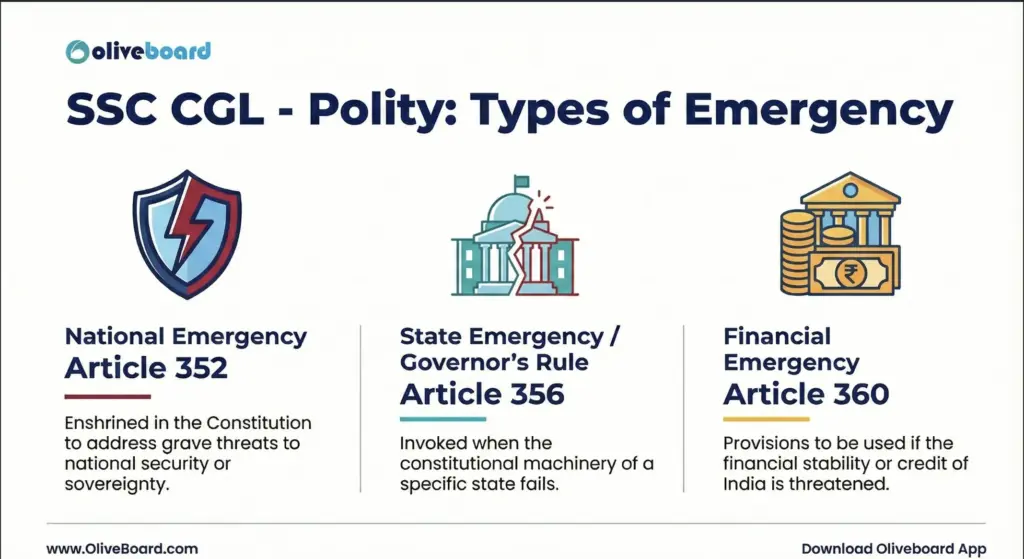
For aspirants preparing for the SSC CGL Exam, understanding the emergency provisions in the Indian Constitution is very important as it is a frequently asked topic in Polity. In India, we have 3 types of Emergency enshrined in our Constitution. They are as follows -:
- National Emergency (Article 352)
- State Emergency / Governor’s Rule (Article 356)
- Financial Emergency (Article 360)
National Emergency (Art 352)
National Emergency (Article 352) is one of the most important provisions in the Indian Constitution that allows the Central Government to take extraordinary powers during serious threats to the nation.
| Aspect | Details |
| Article | Article 352 |
| Declared By | President of India (on advice of Council of Ministers) |
| Grounds | War, External Aggression, Armed Rebellion |
| Parliamentary Approval | Must be approved by both Houses within 1 month |
| Duration | 6 months (can be extended repeatedly) |
| Extension Requirement | Special majority (2/3rd) in both Houses |
| Revocation | Can be revoked anytime by the President |
| Effect on Federal Structure | Becomes unitary; Centre gets power over State List |
| Fundamental Rights | Suspended except Article 20 and Article 21 |
| Times Imposed in India | 3 times |
| Instances | 1962 (China War), 1971 (Indo-Pak War), 1975 (Internal Emergency) |
State Emergency (Art 356)
State Emergency (Article 356) is imposed when the constitutional machinery of a state fails, allowing the Centre to take control of the state administration.
| Aspect | Details |
| Article | Article 356 |
| Also Known As | President’s Rule / Governor’s Rule |
| Declared By | President of India |
| Grounds | Failure of constitutional machinery in a state |
| Basis of Declaration | Governor’s report or President’s satisfaction |
| Parliamentary Approval | Must be approved by both Houses within 2 months |
| Duration | 6 months (can be extended) |
| Maximum Period | Up to 3 years (with conditions) |
| Executive Power | President takes over state executive functions |
| Role of Governor | Acts on behalf of the President to run the state |
| Effect on State Assembly | Can be suspended or dissolved |
| Judicial Review | Subject to judicial review; courts can restore assembly |
| Special Case | 1991 Tamil Nadu (declared without Governor’s report) |
Financial Emergency (Art 360)
Financial Emergency (Article 360) is declared when the financial stability or credit of India or any part of it is under threat, allowing the Centre to take strict economic control.
| Aspect | Details |
| Article | Article 360 |
| Declared By | President of India |
| Grounds | Threat to financial stability or credit of India or any part |
| Parliamentary Approval | Must be approved by both Houses within 2 months |
| Duration | Continues until revoked (no maximum limit specified) |
| Executive Power | Centre can issue financial directions to states |
| Impact on States | States must follow economic and financial instructions from Centre |
| Impact on Salaries | President can reduce salaries of government employees, including judges |
| Judicial Review | Subject to judicial review |
| Status in India | Never imposed so far |
Comparison of National, State, and Financial Emergency
The Indian Constitution provides for three types of emergencies to handle extraordinary situations-National Emergency (Article 352), State Emergency (Article 356), and Financial Emergency (Article 360). Each type differs in terms of grounds, powers, duration, and impact on governance. Understanding their differences is important for clarity in polity concepts.
| Aspect | National Emergency (Art 352) | State Emergency (Art 356) | Financial Emergency (Art 360) |
| Declared By | President (on advice of Council of Ministers) | President | President |
| Grounds | War, External Aggression, Armed Rebellion | Failure of constitutional machinery in state | Threat to financial stability or credit |
| Approval Time | Within 1 month | Within 2 months | Within 2 months |
| Duration | 6 months (extendable) | 6 months (extendable up to 3 years) | No maximum limit |
| Effect on States | Centre gets power over State List | State comes under Centre’s control | Centre directs financial matters of states |
| Fundamental Rights | Suspended (except Art 20 & 21) | No major impact | No direct suspension |
| Role of Parliament | Approves and extends with special majority | Approves extension | Approves continuation |
| Judicial Review | Allowed | Allowed | Allowed |
| Frequency in India | 3 times | Multiple times | Never imposed |
FAQs
There are three types of emergencies: National Emergency (Article 352), State Emergency (Article 356), and Financial Emergency (Article 360).
National Emergency under Article 352 is declared in situations like war, external aggression, or armed rebellion.
President’s Rule refers to State Emergency under Article 356, where the Centre takes control of a state due to failure of constitutional machinery.
No, Financial Emergency under Article 360 has never been imposed in India so far.
Article 20 and Article 21 (Right to life and personal liberty) are not suspended during a National Emergency.
- Life after Clearing SSC CGL, Perks, Lifestyle and Downsides
- SSC CGL 2026 Tier 1 Question Papers, Shift-Wise PYPs, Download PDFs
- How to Prepare General Awareness for SSC CGL Exam 2026? Check Here
- Ratio and Proportion Questions for SSC CGL, Practice now
- General Awareness Study Notes for SSC & Railway Exams 2026
- SSC General Awareness PDF, Download Current Affairs & GK Notes

I’m Mahima Khurana, a writer with a strong passion for creating meaningful, learner-focused content especially in the field of competitive exam preparation. From authoring books and developing thousands of practice questions to crafting articles and study material, I specialize in transforming complex exam-related topics into clear, engaging, and accessible content. I have first hand experience of 5+ months in SSC Exams. Writing, for me, is not just a skill but a way to support and guide aspirants through their preparation journey one well-written explanation at a time.