
Labour laws are one of the most important areas for UPSC EPFO APFC 2026 because the work of an Assistant Provident Fund Commissioner is closely connected with labour welfare, social security, employee rights and enforcement of labour legislation. For a long time, India had a large number of Central labour laws dealing separately with wages, industrial relations, social security and workplace safety. This framework has now undergone a major change: the 29 Central labour laws have been consolidated into four Labour Codes, which came into force from 21 November 2025.
Why are Labour Codes important for UPSC EPFO APFC 2026?
The APFC exam requires candidates to understand labour laws, social security and employment-related issues from both a static and current-affairs perspective. The Labour Codes are especially important because they have changed the legal structure governing wages, industrial relations, social security and occupational safety.
For an APFC aspirant, the Code on Social Security, 2020 deserves special attention because it covers areas directly connected with EPFO, provident fund, pension, insurance and other social security measures. For preparation, connect the Labour Codes with these APFC themes:
- Labour welfare
- Social security
- EPFO and provident fund
- ESIC
- Industrial relations
- Trade unions
- Minimum wages
- Gratuity
- Maternity benefits
- Gig and platform workers
- Occupational safety
- Migrant workers
- Labour administration
- Worker and employer rights
What changed from the old labour-law system to the new Labour Codes?
Earlier, labour regulation was spread across many separate Central Acts, each dealing with a specific subject. The new framework brings these laws into four broad Codes, reducing the number of separate laws and creating more common definitions and procedures. The Government’s compliance handbook notes that 29 Central Labour Acts were rationalised into four Codes, while the overall number of sections was streamlined from 1,228 to 480.
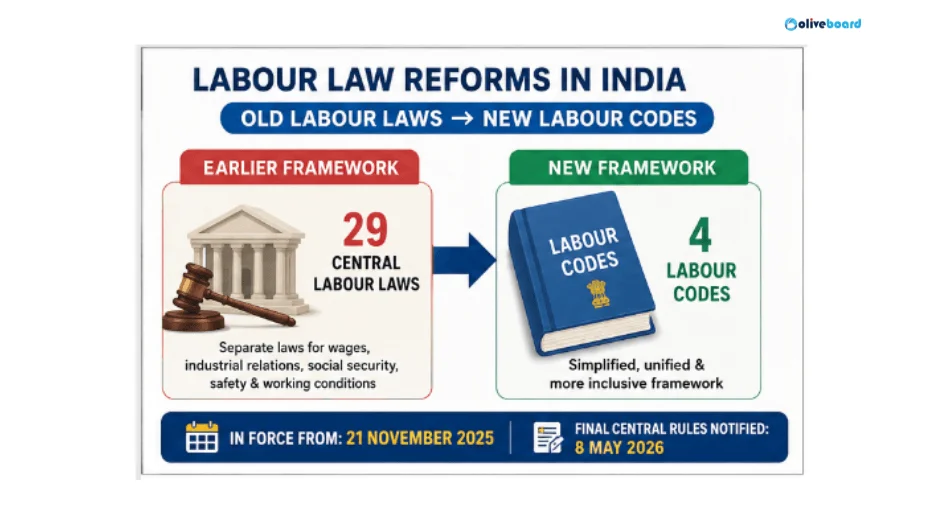
| Earlier framework | New framework |
| 29 major Central labour Acts | 4 Labour Codes |
| Different definitions in different laws | Greater uniformity in definitions |
| Separate registrations, licences and returns | Simplified compliance framework |
| Separate laws for wages and minimum wages | Code on Wages |
| Separate laws for industrial disputes and trade unions | Industrial Relations Code |
| Several laws for social security | Code on Social Security |
| Separate laws for factories, contract labour, migrant workers etc. | OSH & Working Conditions Code |
| Limited coverage under some older laws | Wider coverage under several new provisions |
What are the four new Labour Codes?
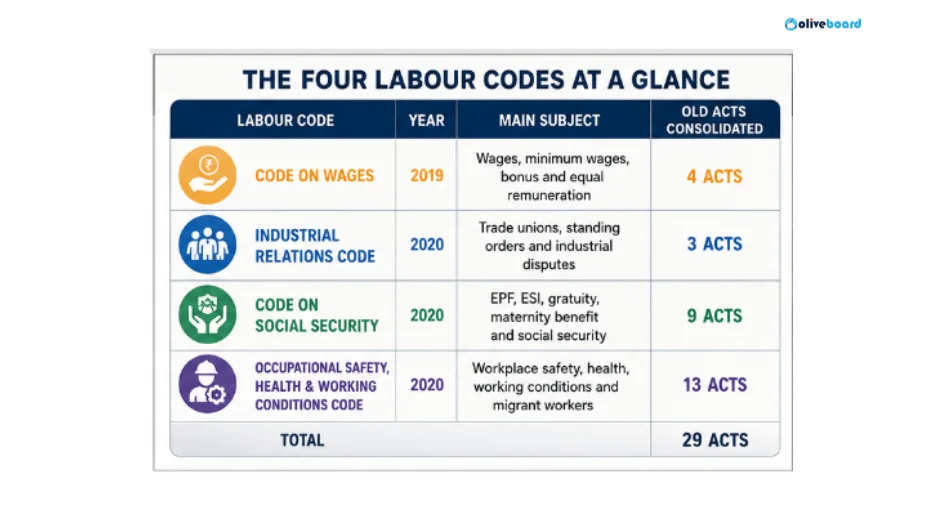
The four Codes cover four major areas: wages, industrial relations, social security, and occupational safety and working conditions. Together, they replace and consolidate 29 Central labour laws. The four Codes came into force from 21 November 2025.
Which old labour laws were merged into the Code on Wages?
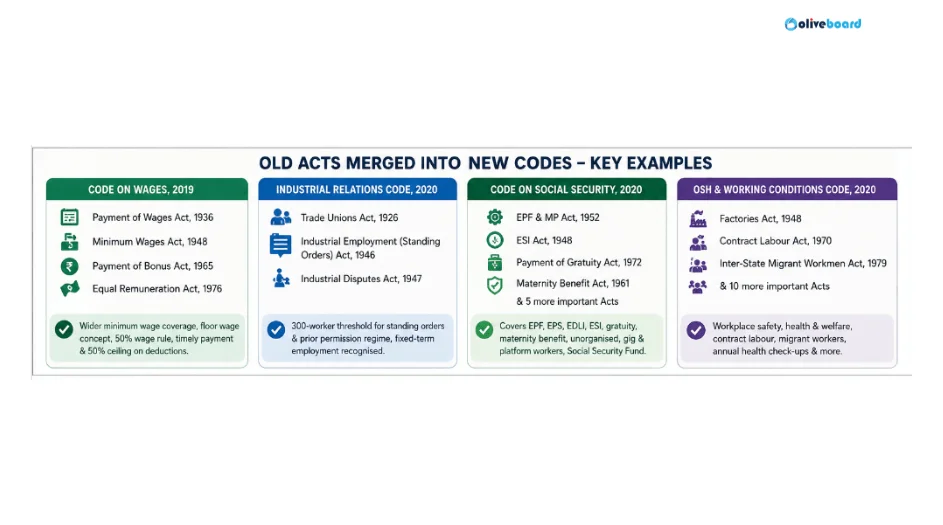
The Code on Wages, 2019 brings together four important wage-related laws. For APFC, candidates should understand both the names of these Acts and the major concepts associated with them. The Code also makes minimum-wage protection broader by moving away from the earlier concept of only “scheduled employments.”
| Old Labour Law | What it dealt with | Now covered under |
| Payment of Wages Act, 1936 | Timely payment and deductions | Code on Wages |
| Minimum Wages Act, 1948 | Minimum wages | Code on Wages |
| Payment of Bonus Act, 1965 | Statutory bonus | Code on Wages |
| Equal Remuneration Act, 1976 | Equal pay and non-discrimination | Code on Wages |
What is the 50% wage rule?
This is a high-priority APFC topic. Under the new wage definition, certain allowances and components are considered while calculating wages. If the specified excluded components exceed 50% of total remuneration, the excess is added back to wages for statutory calculations. The Ministry’s FAQ gives an example in which total remuneration is ₹76,000 and the excess allowance amount of ₹2,000 is added back to wages.
Remember: Do not write in your notes simply as “Basic Pay must always be 50% of CTC.” The legally relevant concept is the definition of wages and the 50% rule for specified components, including the treatment of excess amounts.
Also Check: UPSC EPFO Labour Laws Syllabus 2026 for APFC
Which old labour laws were merged into the Industrial Relations Code?
The Industrial Relations Code, 2020 combines three important laws dealing with trade unions, standing orders and industrial disputes. These subjects are extremely relevant for APFC because questions can test both the old Acts and the changes introduced by the Code.
| Old Labour Law | Major area | New framework |
| Trade Unions Act, 1926 | Registration and functioning of trade unions | Industrial Relations Code |
| Industrial Employment (Standing Orders) Act, 1946 | Service conditions and standing orders | Industrial Relations Code |
| Industrial Disputes Act, 1947 | Disputes, strikes, lockouts, retrenchment etc. | Industrial Relations Code |
What are the major changes to study?
The change from the earlier 100-worker threshold to 300 workers for the special prior-permission regime is a fact worth remembering. The other major changes are as follows:
- Fixed-term employment is specifically recognised.
- Fixed-term employees are entitled to benefits comparable to permanent workers for similar work, subject to the Code.
- Standing-order provisions apply to industrial establishments with 300 or more workers.
- The special regime for prior government permission for lay-off, retrenchment and closure applies to establishments covered by Chapter X, generally at the 300-worker threshold.
- The Code contains provisions relating to negotiating unions and negotiating councils.
- Rules relating to strikes and lockouts have been brought into the common industrial-relations framework.
Which old labour laws were merged into the Code on Social Security?
This is arguably the most important Labour Code for UPSC EPFO APFC preparation. The Code on Social Security, 2020 brings together nine Central laws dealing with provident fund, insurance, gratuity, maternity benefits, employee compensation and other social security matters.
| Important old law | Main area | New framework |
| Employees’ Provident Funds and Miscellaneous Provisions Act, 1952 | EPF, EPS and EDLI | Code on Social Security |
| Employees’ State Insurance Act, 1948 | Health and social insurance | Code on Social Security |
| Employees’ Compensation Act, 1923 | Compensation for employment injury | Code on Social Security |
| Payment of Gratuity Act, 1972 | Gratuity | Code on Social Security |
| Maternity Benefit Act, 1961 | Maternity benefits | Code on Social Security |
| Unorganised Workers’ Social Security Act, 2008 | Social security for unorganised workers | Code on Social Security |
| Employment Exchanges (Compulsory Notification of Vacancies) Act, 1959 | Employment information | Code on Social Security |
| Cine-Workers Welfare Fund Act, 1981 | Welfare of cine workers | Code on Social Security |
| Building and Other Construction Workers’ Welfare Cess Act, 1996 | Construction-worker welfare cess | Code on Social Security |
What makes the Social Security Code important for APFC?
The Code expands the social-security framework to categories such as unorganised workers, gig workers and platform workers. It also provides for schemes and institutional mechanisms relating to social security. The Government specifically highlights the introduction of definitions such as gig worker, platform worker and aggregator.
What is the biggest EPFO-related change under the new Labour framework?
The Code on Social Security retains the central importance of EPFO while placing provident fund and related social-security provisions within a broader unified framework. The Government states that EPFO coverage applies to establishments employing 20 or more employees, while the Code also expands the overall social-security framework to new categories of workers.
Download Notes and Quizzes Based on Labour Codes
Strengthen your UPSC EPFO preparation with Labour Codes notes and practice quizzes covering important concepts, provisions, definitions, and exam-focused topics.
| Particulars | Link |
| UPSC EPFO Labour Laws Notes | Download Free PDF |
| UPSC EPFO Labour Laws Practice Quiz PDF | Download Now |
| UPSC EPFO APFC Previous Year Papers | Download Now |
How has gratuity changed under the new Labour Codes?
Gratuity remains an important social-security benefit, but the new framework has introduced an important provision for fixed-term employees. The Central Government’s model standing orders provide that a fixed-term worker becomes eligible for gratuity after one year of service under the contract, subject to the applicable provisions.
| Point | What to remember |
| Traditional general rule | Gratuity generally linked to five years of continuous service, subject to statutory exceptions |
| Fixed-term employee | Special provision under the new framework |
| Fixed-term gratuity | Eligibility after one year under the Code’s fixed-term employment provision |
| Calculation | Linked to the applicable definition of wages |
| Current effective framework | From 21 November 2025 |
The Ministry has also clarified that the revised definition of wages applies to gratuity calculations from 21 November 2025.
What changed for gig workers and platform workers?
This is a new-age labour issue that old labour-law preparation may not cover adequately. The Code on Social Security expressly recognises gig workers, platform workers and aggregators, creating a statutory framework for extending social-security protection to these categories.
| Term | Simple meaning |
| Gig worker | A person working outside the traditional employer-employee relationship |
| Platform worker | A person earning through a platform-based work arrangement |
| Aggregator | A digital intermediary connecting users with service providers |
| Unorganised worker | A worker falling within the statutory definition of the unorganised sector/worker |
| Social Security Fund | Mechanism for supporting specified social-security schemes |
Which old labour laws were merged into the OSH & Working Conditions Code?
The Occupational Safety, Health and Working Conditions Code, 2020 consolidates 13 Central labour laws. It deals with workplace safety, health, welfare, working conditions, contract labour and migrant workers.
| Important old law | Major subject | New framework |
| Factories Act, 1948 | Factory safety and working conditions | OSH Code |
| Mines Act, 1952 | Mine safety | OSH Code |
| Plantations Labour Act, 1951 | Plantation workers | OSH Code |
| Contract Labour Act, 1970 | Contract labour | OSH Code |
| Inter-State Migrant Workmen Act, 1979 | Migrant workers | OSH Code |
| Building and Other Construction Workers Act, 1996 | Construction workers | OSH Code |
| Motor Transport Workers Act, 1961 | Transport workers | OSH Code |
| Beedi and Cigar Workers Act, 1966 | Beedi/cigar workers | OSH Code |
| Working Journalists laws | Working journalists | OSH Code |
| Sales Promotion Employees Act, 1976 | Sales promotion employees | OSH Code |
| Cine-Workers and Cinema Theatre Workers Act, 1981 | Cine workers | OSH Code |
| Dock Workers Act, 1986 | Dock workers | OSH Code |
What are the most important differences between old labour laws and new Labour Codes?
Instead of memorising hundreds of provisions separately, APFC candidates should prepare a one-page comparison sheet.
| Area | Old Labour-law approach | New Labour Code approach |
| Number of Central laws | Multiple separate Acts | 29 Acts consolidated into 4 Codes |
| Wages | Separate laws | Code on Wages |
| Minimum wages | Scheduled employments | Wider coverage |
| Floor wage | No common statutory floor-wage framework of this kind | Statutory floor wage |
| Wage definition | Different laws could use different concepts | Common definition across four Codes |
| Industrial relations | Separate Acts | Single Industrial Relations Code |
| Standing orders | Earlier threshold generally 100 workers | 300 workers under the Code |
| Retrenchment/closure permission | Earlier 100-worker threshold under the central framework | 300-worker threshold under Chapter X |
| Fixed-term employment | Less unified framework | Specifically recognised |
| Social security | Several separate Acts | Code on Social Security |
| Gig/platform workers | No comparable unified statutory framework | Specifically recognised |
| Migrant workers | Separate law | Integrated under OSH Code |
| Compliance | Multiple registrations/returns | Greater simplification and digital processes |
Should you completely stop studying the old Labour Laws?
No. This is one of the biggest mistakes an APFC aspirant can make. The new Codes are now the primary framework, but the old Acts remain important for understanding the evolution of labour legislation, identifying which provisions were consolidated, and answering questions that test the relationship between an old Act and its corresponding Code. The Government itself describes the reform as consolidation and rationalisation of the earlier 29 Central Acts.
Which old Labour Laws should APFC aspirants study first?
Not every old Act deserves equal preparation time. A smart priority list can save considerable revision time.
| Priority | Old Act | What to study |
| Very High | EPF & MP Act, 1952 | EPF, EPS, EDLI, EPFO, coverage and basic provisions |
| Very High | ESI Act, 1948 | ESIC, insured persons, benefits and coverage |
| Very High | Industrial Disputes Act, 1947 | Industrial disputes, strikes, lockouts, retrenchment |
| Very High | Minimum Wages Act, 1948 | Minimum wages and scheduled employment |
| High | Trade Unions Act, 1926 | Registration and trade-union framework |
| High | Factories Act, 1948 | Health, safety and welfare |
| High | Payment of Gratuity Act, 1972 | Eligibility and gratuity |
| High | Maternity Benefit Act, 1961 | Maternity-related benefits |
| High | Payment of Wages Act, 1936 | Payment and deductions |
| High | Contract Labour Act, 1970 | Contract labour regulation |
| Moderate | Inter-State Migrant Workmen Act, 1979 | Migrant-worker protection |
| Moderate | Equal Remuneration Act, 1976 | Equal pay and non-discrimination |
| Moderate | Standing Orders Act, 1946 | Conditions of service |
What is the best way to study Old Labour Laws and New Labour Codes together?
The easiest method is to use a three-column approach rather than making two separate sets of notes.
| Old Act | New Code | What changed? |
| EPF & MP Act, 1952 | Code on Social Security, 2020 | EPF provisions brought into a broader social-security framework |
| ESI Act, 1948 | Code on Social Security, 2020 | ESI incorporated into unified social-security legislation |
| Minimum Wages Act, 1948 | Code on Wages, 2019 | Wider coverage and floor-wage framework |
| Payment of Wages Act, 1936 | Code on Wages, 2019 | Wage-payment rules consolidated |
| Industrial Disputes Act, 1947 | Industrial Relations Code, 2020 | Dispute-resolution framework consolidated |
| Trade Unions Act, 1926 | Industrial Relations Code, 2020 | Trade-union provisions consolidated |
| Standing Orders Act, 1946 | Industrial Relations Code, 2020 | Standing-order provisions consolidated |
| Factories Act, 1948 | OSH Code, 2020 | Factory safety integrated into wider OSH framework |
| Contract Labour Act, 1970 | OSH Code, 2020 | Contract labour provisions consolidated |
| Inter-State Migrant Workmen Act, 1979 | OSH Code, 2020 | Migrant-worker provisions integrated |
What current Labour Code facts should you memorise for APFC 2026?
These are the high-value facts that should be on your revision sheet:
| Fact | Remember |
| Number of old Central labour laws consolidated | 29 |
| Number of new Labour Codes | 4 |
| Code on Wages | 2019 |
| Industrial Relations Code | 2020 |
| Code on Social Security | 2020 |
| OSH & Working Conditions Code | 2020 |
| Four Codes came into force | 21 November 2025 |
| Final Central Rules notified | 8 May 2026 |
| EPFO establishment threshold under the Code | 20 or more employees |
| Standing orders threshold | 300 or more workers |
| Special lay-off/retrenchment/closure regime | 300 or more workers, subject to the Code |
| Wage allowance rule | 50% |
| Gig/platform workers | Specifically recognised |
| Floor wage | Statutory concept under Code on Wages |
| Main APFC-related Code | Code on Social Security |
What should you study from the old Acts and what can you skip?
A practical strategy is to divide your preparation into Must Study, Understand and Don’t Overdo.
| Category | What to study |
| Must Study | EPF & MP Act, ESI Act, Industrial Disputes Act, Minimum Wages Act |
| Must Study | Four Labour Codes and their major provisions |
| Must Study | Old Act → New Code mapping |
| Must Study | Major changes introduced by the Codes |
| Understand clearly | Trade unions, strikes, retrenchment, gratuity, maternity benefit |
| Understand clearly | Gig workers, platform workers, migrant workers |
| Understand clearly | Floor wage and 50% wage rule |
| Do not overdo | Every section number of every old Act |
| Do not overdo | Obsolete procedural details with no relevance to the current framework |
| Do not ignore | Current rules and government clarifications |
FAQs
The four Labour Codes consolidate and rationalise 29 Central labour laws into four comprehensive Codes.
The four Codes are the Code on Wages, Industrial Relations Code, Code on Social Security, and OSH & Working Conditions Code.
The four Labour Codes came into force across India on 21 November 2025.
The Code on Social Security is particularly important because of its relevance to EPFO, social security, EPF, ESI, gratuity and emerging worker categories.
The Code on Wages provides a common framework for minimum wages, floor wages, timely payment of wages and wage-related deductions.
- Attempt UPSC EPFO APFC Indian Economy Conceptual & Numerical Quiz
- Attempt UPSC EPFO APFC Computer Applications Quiz & Download PDF
- UPSC EPFO APFC Code on Social Security 2020 Quiz & Free PDF
- Attempt UPSC EPFO APFC Insurance Practice Quiz & Download PDF
- Attempt UPSC EPFO APFC Auditing Practice Quiz & Download PDF
- UPSC EPFO APFC Marks vs Cut-Off, How to Calculate Your Score?

Hi, I’m Aditi. I work as a Content Writer at Oliveboard, where I have been simplifying exam-related content for the past 4 years. I create clear and easy-to-understand guides for JAIIB, CAIIB, and UGC exams. My work includes breaking down notifications, admit cards, and exam updates, as well as preparing study plans and subject-wise strategies.
My goal is to support working professionals in managing their exam preparation alongside a full-time job and to help them achieve career growth.