

Key Takeaways
- Blood is vital for transporting oxygen, nutrients, and waste; it consists of four main components: Plasma, RBC, WBC, and Platelets.
- Plasma, making up 55% of blood volume, helps with pressure, clotting, and homeostasis.
- RBCs carry oxygen and carbon dioxide; they have a lifespan of 120 days and lack a nucleus.
- WBCs fight infections and provide immunity; these cells have a lifespan of 13–20 days and include granulocytes and agranulocytes.
- Platelets are crucial for clotting, prevent excessive bleeding, and have a lifespan of 8–12 days.
Blood is one of the most important fluids in the human body. It performs the functions of transporting oxygen and essential nutrients into the cells and also transporting metabolic wastes from the same cells. It is very essential for the survival of the human body. In this blog, we will be learning about the components of blood.
Components of Blood – Biology Notes for SSC CGL
lood is one of the most vital fluids in the human body, responsible for transporting oxygen, nutrients, hormones, and waste materials. For aspirants preparing for SSC CGL, SSC CHSL, Railways, and other government exams, understanding the components of blood is an important part of the General Awareness syllabus.
What are the Components of Blood?
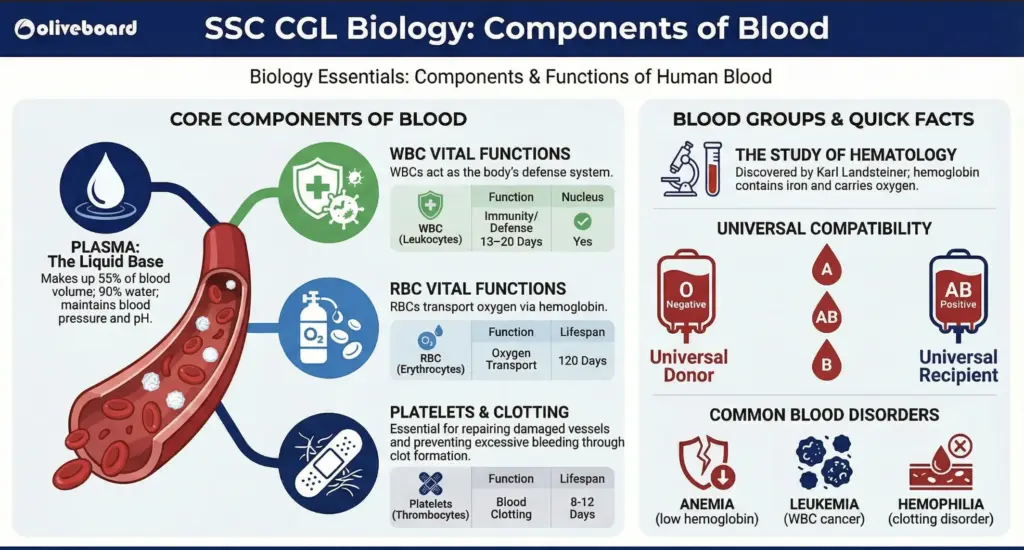
Blood consists of four main components: Plasma, Red Blood Cells (RBC), White Blood Cells (WBC), and Platelets, each playing a vital role in maintaining the proper functioning and survival of the human body.
| Component | Also called as | Function | Lifespan | Nucleus |
| Plasma | – | Transport medium | – | – |
| RBC | Erythrocytes | Oxygen transport | 120 days | No |
| WBC | Leukocytes | Immunity | 13–20 days | Yes |
| Platelets | Thrombocytes | Clotting | 8–12 days | No |
What is Plasma and what are its functions?
Plasma is the liquid component of blood and forms about 55% of total blood volume. It is pale yellow in color and mainly composed of water. Key facts about plasma are:
- 90% water and 10% solutes
- Contains proteins, hormones, nutrients, and waste
- Helps in maintaining blood volume
Functions of Plasma
- Maintains blood pressure
- Helps in clotting and immunity
- Maintains pH balance
- Supports homeostasis in the bod
What are Red Blood Cells (RBC) and their functions?
Red Blood Cells, also called erythrocytes, are responsible for transporting oxygen throughout the body. Key facts about RBC are:
- Disc-shaped cells
- Contain hemoglobin (iron-rich protein)
- No nucleus (except in camel and llama)
- Formed in bone marrow
- Lifespan: 120 days
- Destroyed in liver and spleen
Functions of RBC
- Transport oxygen from lungs to body cells
- Carry carbon dioxide back to lungs
What are White Blood Cells (WBC) and their role?
White Blood Cells, also known as leukocytes, are the defense system of the body. Key facts about WBC are:
- Have a nucleus
- Lifespan: 13–20 days
- Types:
- Granulocytes
- Agranulocytes
Functions of WBC
- Fight infections
- Protect the body from pathogens
- Provide immunity
What are Platelets and why are they important?
Platelets, also known as thrombocytes, play a crucial role in blood clotting. Key facts about platelets are:
- No nucleus
- Lifespan: 8–12 days
- Formed in bone marrow
- Destroyed in spleen
Functions of Platelets
- Help in blood clotting
- Prevent excessive bleeding
- Repair damaged blood vessels
What are Blood Groups and why are they important?
Blood groups are classified based on the presence of antigens on RBCs.
| Blood Group | Can Donate To | Can Receive From |
| A | A, AB | A, O |
| B | B, AB | B, O |
| AB | AB | A, B, AB, O |
| O | All | O |
Important Points
- Universal Donor → O Negative
- Universal Recipient → AB Positive
- Blood group system discovered by Karl Landsteiner
What are some important facts about Blood?
- Study of blood is called Hematology
- Hemoglobin contains iron
- Females generally have lower hemoglobin than males
- Anemia is caused due to low hemoglobin
- Vitamin K helps in blood clotting
- Heparin is a natural anticoagulant
What are Common Blood Disorders?
Some important blood-related disorders asked in exams include:
- Anemia – Low hemoglobin
- Leukemia – Cancer of white blood cells
- Hemophilia – Blood clotting disorder
FAQs
Blood consists of 4 components plasma, RBC, WBC and platelets.
The full form of RBC is Red Blood Cells or Red Blood Corpuscles
The full form of WBC is White Blood Cells or White Blood Corpuscles.
Platelets help in the clotting of blood.
Hematology is the study of blood and blood disorders.
- Fundamental Rights Questions for SSC & Railway Exams, Download PDF
- Top 100 SSC CGL General Awareness Questions, Download PDF
- SSC CGL Polity Study Material, Making of Indian Constitution
- Schedules in Indian Constitution, Polity Study Notes for SSC Exams
- SSC CGL Polity Study Notes, Know Writ Jurisdiction in Indian Constitution
- Most Repeated Quantitative Aptitude Questions for SSC CHSL 2026

Hello there! I’m a dedicated Government Job aspirant turned passionate writer & content marketer. My blogs are a one-stop destination for accurate and comprehensive information on exam categories like Regulatory Bodies, Banking, SSC, State PSCs, and more. I am on a mission to provide you with all the details you need, conveniently in one place. When I am not writing and marketing, you will find me happily experimenting in the kitchen, cooking up delightful treats. Join me on this journey of knowledge and flavors!