
The Indian Constitution is one of the lengthiest written constitutions in the world, and an important part of it is the Schedules. These schedules contain additional details and provisions that support various articles of the Constitution. Questions from this topic are frequently asked in SSC exams, so having a clear understanding can help you score easy marks. In this edition, we are focusing on the topic Schedules in the Indian Constitution, which is often asked in the SSC CGL exam and other competitive exams.
What are Schedules in the Indian Constitution?
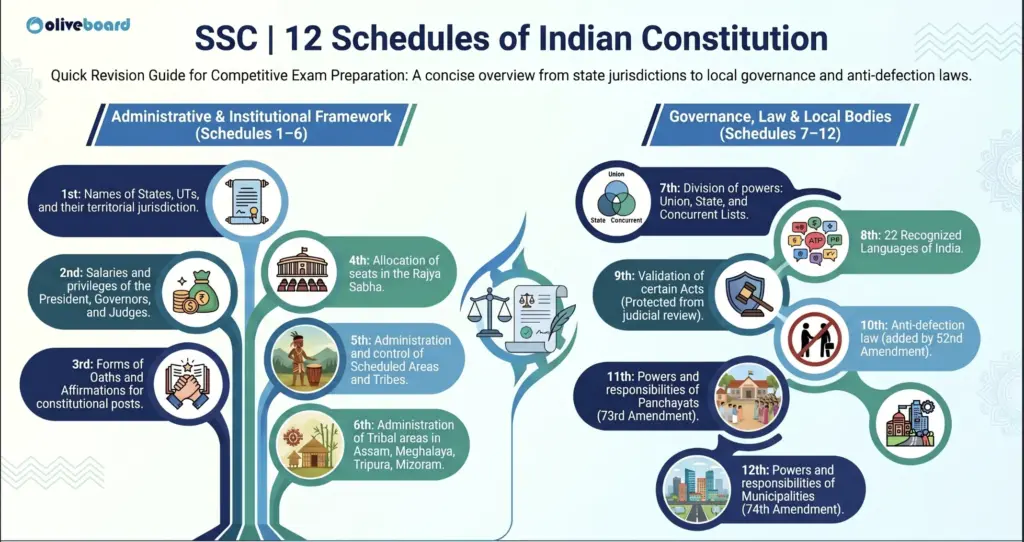
Schedules are lists in the Constitution that provide detailed information related to administration, governance, and other key aspects. Originally, there were 8 Schedules, but now there are 12 Schedules after amendments. This is an important topic from Polity Syllabus.
List of 12 Schedules of Indian Constitution
The Indian Constitution currently has 12 Schedules, each covering specific administrative and constitutional details. For SSC Exams, questions are usually direct, so a quick table-based revision makes it easier to remember all schedules at once.
| Schedule | Details |
| 1st Schedule | Deals with the names of states and union territories and their territorial jurisdiction. |
| 2nd Schedule | Contains provisions related to salaries, allowances, and privileges of key officials like the President, Governors, Judges, etc. |
| 3rd Schedule | Includes forms of oaths and affirmations for constitutional posts. |
| 4th Schedule | Deals with the allocation of seats in the Rajya Sabha. |
| 5th Schedule | Relates to the administration and control of Scheduled Areas and Scheduled Tribes. |
| 6th Schedule | Provides provisions for the administration of tribal areas in states like Assam, Meghalaya, Tripura, and Mizoram. |
| 7th Schedule | Divides powers between Centre and States through Union List, State List, and Concurrent List. |
| 8th Schedule | Lists the recognized languages of India (currently 22 languages). |
| 9th Schedule | Contains laws protected from judicial review (added by the 1st Amendment). |
| 10th Schedule | Deals with anti-defection law (added by the 52nd Amendment). |
| 11th Schedule | Related to Panchayati Raj institutions and their powers (added by the 73rd Amendment). |
| 12th Schedule | Deals with Municipalities and their functions (added by the 74th Amendment). |
Which Schedules were added later to the Indian Constitution?
The Indian Constitution originally contained 8 Schedules. The 9th, 10th, 11th, and 12th Schedules were added later through Constitutional Amendments to deal with specific constitutional and administrative requirements.
| Schedule Added | Constitutional Amendment | Year | Main Purpose |
| 9th Schedule | 1st Constitutional Amendment | 1951 | Contains specified laws covered by Article 31B |
| 10th Schedule | 52nd Constitutional Amendment | 1985 | Anti-Defection Law |
| 11th Schedule | 73rd Constitutional Amendment | 1992 | Powers and functions of Panchayats |
| 12th Schedule | 74th Constitutional Amendment | 1992 | Powers and functions of Municipalities |
For SSC exams, the Schedule–Amendment combination is especially important because questions are often asked by interchanging the 52nd, 73rd, and 74th Amendments.
Which Articles are related to the Schedules of the Indian Constitution?
Several Schedules are directly connected with important Constitutional Articles. Remembering these combinations can help candidates solve both direct and statement-based questions in SSC CGL and other government exams.
| Schedule | Important Related Article(s) | Area Covered |
| 1st Schedule | Articles 1 and 4 | States and Union Territories |
| 4th Schedule | Articles 4 and 80 | Allocation of Rajya Sabha seats |
| 5th Schedule | Article 244(1) | Scheduled Areas and Scheduled Tribes |
| 6th Schedule | Articles 244(2) and 275(1) | Tribal areas in certain northeastern states |
| 7th Schedule | Article 246 | Union, State and Concurrent Lists |
| 8th Schedule | Articles 344 and 351 | Languages |
| 9th Schedule | Article 31B | Specified laws placed in the Ninth Schedule |
| 10th Schedule | Articles 102(2) and 191(2) | Disqualification on grounds of defection |
| 11th Schedule | Article 243G | Panchayats |
| 12th Schedule | Article 243W | Municipalities |
What is the difference between Parts and Schedules of the Indian Constitution?
Parts and Schedules are both structural components of the Constitution, but they serve different purposes. Parts contain the main constitutional provisions and Articles, while Schedules generally provide supplementary details, lists, forms, classifications, or administrative arrangements connected with those provisions.
| Basis | Parts | Schedules |
| Purpose | Organize major constitutional subjects | Provide supplementary details |
| Content | Articles and constitutional provisions | Lists, forms, allocations and administrative details |
| Example | Part III – Fundamental Rights | 8th Schedule – Languages |
| Example | Part IX – Panchayats | 11th Schedule – Panchayat subjects |
Other Blogs relating to Indian Polity
Explore these related Indian Polity blogs to strengthen your preparation with topic-wise notes, important questions, Constitution MCQs, and exam-focused practice. These resources are useful for SSC and other competitive exams and also include dedicated Hindi preparation material.
| S.NO. | Blog |
| 1 | Indian Polity Important Questions in Hindi |
| 2 | Important Polity Questions for SSC Exams |
| 3 | Indian Polity |
| 4 | Indian Polity Notes |
| 5 | MCQs on Indian Constitution |
FAQs
There are a total of 12 schedules in the Indian Constitution at present.
Originally, the Constitution had 8 schedules, and later 4 more were added through amendments.
The 7th Schedule is very important as it deals with the Union, State, and Concurrent Lists.
The 8th Schedule lists the 22 recognized languages of India.
The 10th Schedule deals with the Anti-Defection Law, added by the 52nd Amendment.
The 5th Schedule deals with Scheduled Areas and Scheduled Tribes, while the 6th Schedule provides autonomous administration for tribal areas in specified northeastern states.
- Fill in the Blanks Quiz for SSC CGL, Practice Questions Live
- Geography Questions for SSC CGL, Download PDF Now
- Physics Questions asked in SSC CGL Exams with Solutions, Check Now
- SSC CGL Trigonometry Questions 2026, Practice Quiz Live
- SSC CGL Number System Questions, Get Live Quiz with Solutions & PDF
- SSC CPO Reasoning Questions 2026, Attempt Live Quiz & Download PDF

The most comprehensive online preparation portal for MBA, Banking and Government exams. Explore a range of mock tests and study material at www.oliveboard.in