
Preparing current affairs for the RBI Grade B exam is one of the biggest challenges for aspirants. Many students are confused about which newspaper to read, whether they should follow a finance newspaper along with a general newspaper, and if newspaper reading is even necessary when coaching institutes already provide monthly current affairs PDFs and compiled notes. The right approach is not to study from multiple sources but to choose reliable resources and follow them consistently. Along with selecting the right newspaper, knowing how to prepare, organize, and revise monthly current affairs is equally important for scoring well in the General Awareness section of Phase 1 and the Economic & Social Issues (ESI) paper in Phase 2.
In this blog, we have provided which current affairs sources to follow, whether newspapers are necessary, and how to prepare for RBI Grade B monthly current affairs using a simple, structured, and exam-focused strategy.
Why is monthly current affairs preparation important for RBI Grade B exam?
Monthly current affairs act as the backbone of the General Awareness section because most questions in RBI Grade B Phase 1 are directly or indirectly linked to recent events. The GA section is not theoretical it is memory-based and fact-driven. That is why monthly preparation becomes essential instead of random reading. Monthly preparation helps you:
- Stay updated in a structured manner – Monthly division of current affairs: Follow a fixed monthly system and organise news into clear sections like government schemes, updates from the Reserve Bank of India, important reports, and economy-related news so that revision stays simple and well-planned.
- Avoid last-minute exam pressure – Consistent monthly preparation: Study current affairs regularly every month so that topics do not pile up before the exam and you can revise everything calmly in multiple revision cycles.
Attempt RBI Circular Practice Quiz
- Revise content multiple times before the exam – 2–3 revision cycles with notes and MCQs: Go through the same monthly material at least two to three times using short notes, highlights, and MCQ practice for better retention and quick recall.
- Connect news with banking and economy concepts – Link with RBI policies and schemes: Try to relate each news update with banking concepts, government schemes, and economic developments so that understanding becomes clearer and more exam-focused.
- Improve accuracy in factual questions – Practice for quick recall and precision: Strengthen memory through repeated revision and regular MCQ practice so you can recall facts quickly and improve accuracy in direct General Awareness questions.
Which newspaper should you read for RBI Grade B current affairs?
Many RBI Grade B aspirants are confused about newspaper selection because there are several options available. The purpose of reading a newspaper is not to cover every news article but to understand important economic developments, government policies, banking updates, and editorials that are useful for the exam. Choosing one reliable newspaper and reading it consistently is enough for most aspirants.
| Newspaper | Best For |
| The Hindu | Editorials, economy, government policies |
| The Indian Express | Policy analysis and national issues |
| Business Standard | Banking, RBI updates, economy |
| Mint | Financial markets and business news |
| The Economic Times | Corporate and market news |
What is the correct strategy to prepare RBI Grade B monthly current affairs?
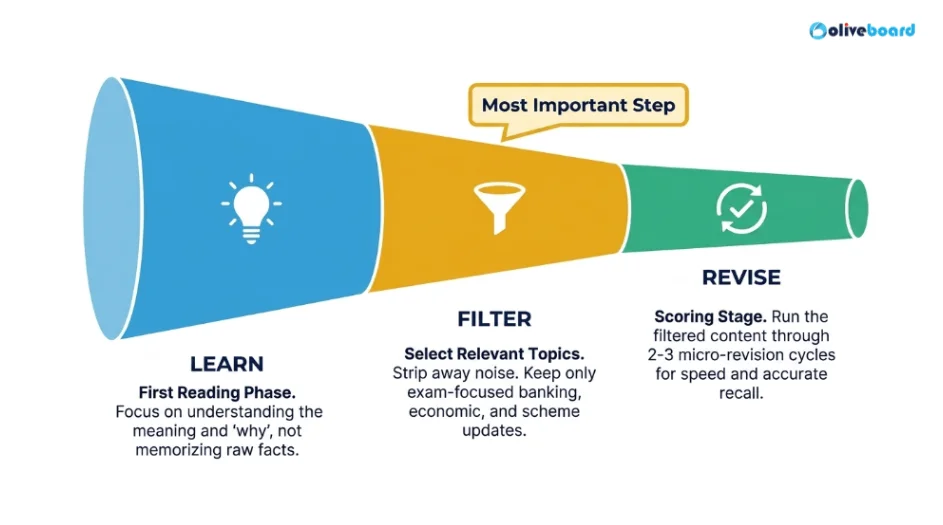
The correct strategy for RBI Grade B monthly current affairs follows a simple 3-stage system that helps in structured learning, smart filtering, and strong revision. Instead of reading randomly, this method ensures you focus only on exam-relevant content and revise it effectively.
| Stage | Action | Details |
| Step 1: Learn (First Reading Phase) | Understand the content | • Read monthly current affairs once carefully • Focus on understanding meaning, not memorizing facts • Try to know what happened and why it is important • Example: If a scheme is launched, focus on its objective, ministry, and beneficiaries instead of only the name |
| Step 2: Filter (Most Important Step) | Select relevant topics | • Keep only exam-focused areas like government schemes, RBI reports, banking news, global reports, economic updates, awards, and indices • Remove unnecessary or low-priority news • Focus on RBI notifications, monetary policy updates, and important economic developments • This step helps reduce confusion and saves revision time |
| Step 3: Revise (Scoring Stage) | Strengthen memory retention | • Revise the same monthly content at least 2–3 times • Use short notes or highlighted PDFs for quick revision • Follow weekly micro-revision of small portions • Practice MCQs after each revision to improve accuracy and recall speed |
Do you need both a general newspaper and a finance newspaper for RBI Grade B?
The answer depends on your preparation level. General newspapers help you understand national issues, government schemes, international relations, and editorials. Finance newspapers focus on banking, monetary policy, inflation, financial markets, RBI notifications, and economic developments. Together, they provide balanced coverage for both Phase 1 and Phase 2.
| Newspaper Type | Covers | Useful For |
| General Newspaper | Government schemes, editorials, international news, social issues | Phase 1 GA and Phase 2 Descriptive |
| Finance Newspaper | RBI updates, banking, economy, inflation, monetary policy | Phase 1 GA, ESI and Finance & Management |
How should you structure RBI Grade B monthly current affairs?
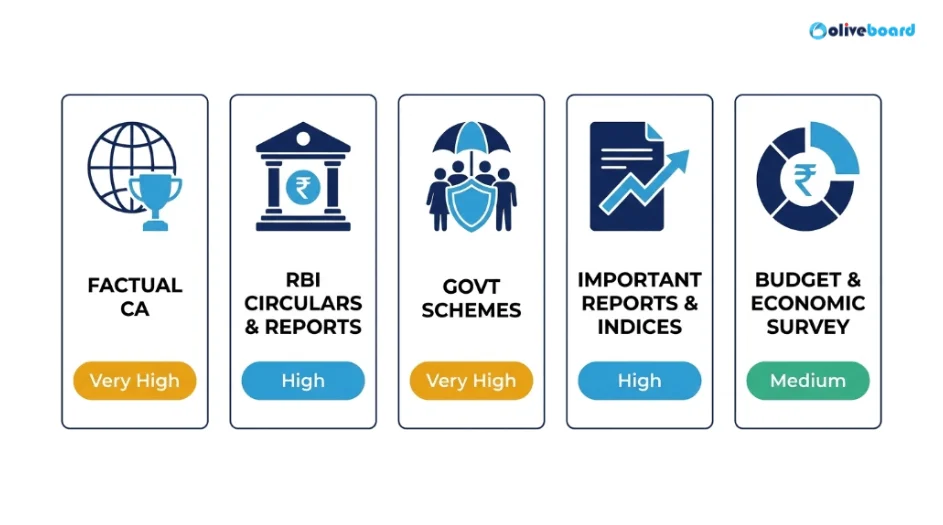
Monthly current affairs should always be divided into the 5-pillar GA framework for better clarity and exam alignment.
| Pillar | Topics Included | Importance Level |
| Pillar 1 | National, International, Economy, Sports, Awards | Very High |
| Pillar 2 | RBI Circulars, Monetary Policy, Banking updates | High |
| Pillar 3 | Government Schemes (new + updates) | Very High |
| Pillar 4 | Reports (World Bank, IMF, UN, NITI Aayog) | High |
| Pillar 5 | Budget & Economic Survey highlights | Medium |
What should you study in all 5 pillars of RBI Grade B monthly CA?
Monthly current affairs for RBI Grade B should always be divided into a 5-pillar structure. This helps in covering the entire GA section in a focused and exam-oriented way instead of random reading.
| Pillar | Area of Study | What to Focus On |
| Pillar 1: Factual Current Affairs | National, International, Economy, Sports, Awards, etc. | • Government decisions and major national news • International events, summits, and organizations • Sports achievements and awards • Important days, books, and personalities • Obituaries and key headlines Note: Focus is on direct factual memory-based questions |
| Pillar 2: RBI Circulars & Reports | RBI updates and banking policies | • Monetary policy updates (Repo, CRR, SLR) • RBI circulars and regulatory changes • Banking sector reports and notifications • Key financial terms and committees Note: Focus on recent RBI actions and their purpose |
| Pillar 3: Government Schemes | New and updated schemes | • Recently launched government schemes • Flagship schemes like PMAY, PMFBY, NPS • Budget-related scheme announcements • Objective, beneficiaries, and features of schemes Note: Use 5W method: What, Why, Who, Where, When |
| Pillar 4: Important Reports & Indices | Global and Indian reports | • Reports by World Bank, IMF, UN, NITI Aayog • Global indices like Happiness Index, HDI, etc. • India’s ranking and key findings • RBI and economic sector reports Note: Focus on report name + organization + India position |
| Pillar 5: Budget & Economic Survey | Economic policy updates | • Union Budget highlights • Key government announcements • Economic Survey summary points • GDP, inflation, fiscal deficit data Note: Focus only on summaries, not full documents |
How to revise monthly current affairs effectively?
Revision is the most important part of GA preparation and determines final selection.
- First Revision – Within 7 days of reading monthly content
- Second Revision – End of month with short notes
- Final Revision – Before mock tests and exam
- Revision Tools – Short notes, MCQs, highlighted PDFs, flashcards
What are the common mistakes in monthly current affairs preparation?
Most aspirants lose marks due to avoidable mistakes rather than lack of effort.
- Reading too many sources instead of sticking to one
- Ignoring revision completely after first reading
- Making long and unstructured notes
- Studying irrelevant or outdated news
- Not practicing MCQs regularly
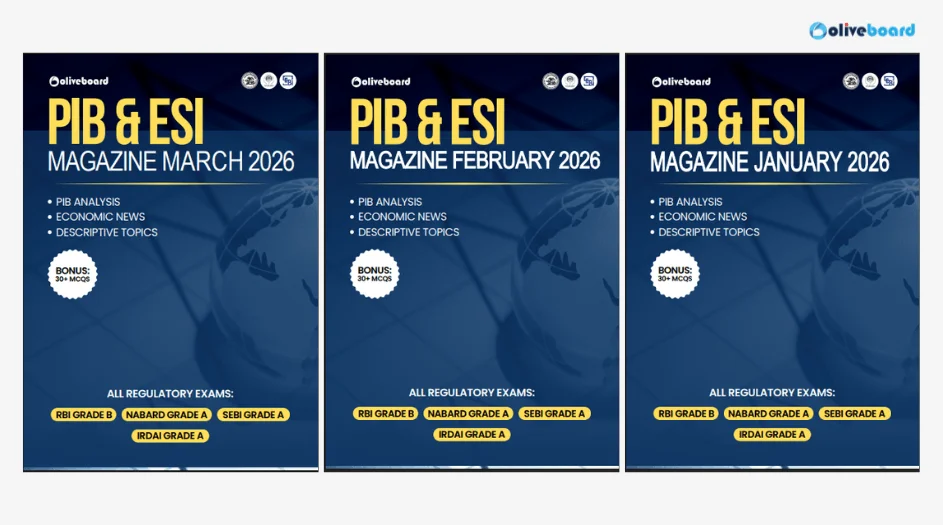
Also Attempt PIB Monthly Current Affair Practice Quiz
| Particulars | Link |
| PIB January Practice Quiz | Attempt and Download PDF |
| PIB February Practice Quiz | Attempt and Download PDF |
| PIB March Practice Quiz | Attempt and Download PDF |
FAQs
Because most GA questions are based on recent factual events and updates.
At least 2–3 times for strong retention and recall.
Follow a 3-step method: Learn, Filter, and Revise.
Schemes, RBI updates, reports, economy news, and international events.
A structured way to divide current affairs into 5 key exam-focused categories.
- RBI Grade A vs. Grade B: Check All Differences Between Grade A & B
- RBI Grade A Notification 2027, Exam Date & Eligibility
- RBI Calendar 2027 Out, Check Notification & Exam Date
- RBI Grade B Phase 1 Subject-Wise Preparation Tips 2027, Check Details
- Shekhar Kumar’s RBI Grade B Journey with AIR-1’s Strategy
- RBI Grade B Toppers’ Scores & Strategies for 2027 Exam

Hi, I’m Aditi. I work as a Content Writer at Oliveboard, where I have been simplifying exam-related content for the past 4 years. I create clear and easy-to-understand guides for JAIIB, CAIIB, and UGC exams. My work includes breaking down notifications, admit cards, and exam updates, as well as preparing study plans and subject-wise strategies.
My goal is to support working professionals in managing their exam preparation alongside a full-time job and to help them achieve career growth.