
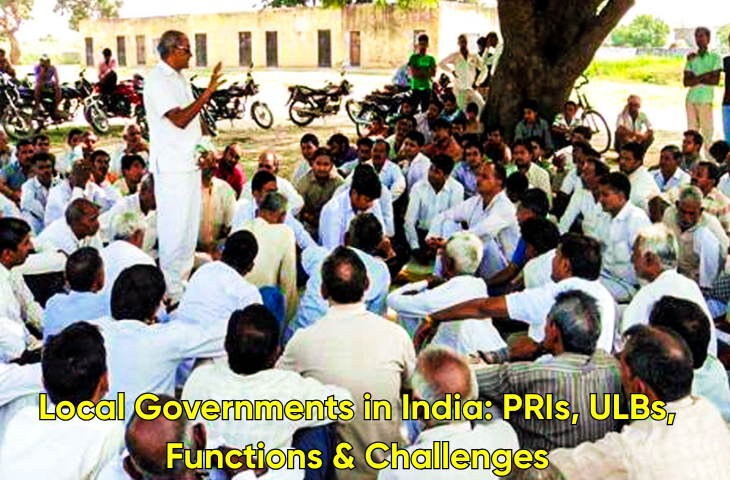
Local governments play an important role in strengthening democracy and ensuring effective administration at the grassroots level. They form the third tier of governance in India, after the Union and State governments, and focus on addressing the everyday needs of people. The 73rd and 74th Constitutional Amendment Acts of 1992 gave constitutional recognition to rural and urban local bodies, promoting decentralisation and public participation.
For UPSC EPFO aspirants, understanding the structure, functions, financial powers, and challenges of local governments is important for topics related to Indian Polity and Governance.
What are local governments in India?
Local governments are institutions that manage public services and development activities at the village, town, and city levels. They allow people to participate directly in decision-making and help implement government policies according to local needs. They are known as the third tier of the Indian governance system and work under the constitutional framework. The three levels of governance in India are:
- Union Government: Manages administration and policies at the national level.
- State Government: Handles administration and development within individual states.
- Local Government: Looks after local development, public services, and community welfare.
The 73rd and 74th Constitutional Amendment Acts, passed in 1992, strengthened local governance by giving constitutional status to Panchayati Raj Institutions (PRIs) and Urban Local Bodies (ULBs).
Download Local Governments in India Quiz PDF
The Local Governments in India Quiz PDF is useful for revising important concepts related to Panchayati Raj Institutions (PRIs), Urban Local Bodies (ULBs), constitutional amendments, financial powers, functions, and challenges of local governance.
| Particulars | Link |
|---|---|
| Local Governments in India Quiz | Download Now |
| UPSC EPFO APFC Previous Year Papers | Download Now |
Attempt Local Governments in India Quiz
Test your preparation with the Local Governments in India Quiz and revise important concepts such as the 73rd and 74th Constitutional Amendment Acts, Gram Sabha, Panchayati Raj structure, types of Urban Local Bodies, Eleventh and Twelfth Schedules, State Finance Commissions, PESA Act, financial devolution, and the major challenges of local governance.
1. Which Constitutional Amendment gave constitutional status to Panchayati Raj Institutions (PRIs)?
2. Part IX of the Constitution of India primarily deals with which institutions?
3. How many subjects are listed in the Eleventh Schedule of the Constitution for possible devolution to Panchayats?
4. How many subjects are listed in the Twelfth Schedule of the Constitution for possible devolution to Municipalities?
5. Under Article 243, a Gram Sabha consists of which persons?
6. Which Article empowers a Gram Sabha to exercise powers and perform functions at the village level as provided by State law?
7. What is the normal constitutional structure of Panchayats under Article 243B?
8. A State may dispense with the intermediate level of Panchayats if its population does not exceed:
9. Which Article primarily deals with reservation of seats in Panchayats?
10. What is the minimum constitutional reservation for women in the total number of seats to be filled by direct election in every Panchayat?
11. What is the minimum constitutional reservation for women in offices of Chairpersons in Panchayats at each level?
12. What is the normal duration of a Panchayat under Article 243E?
13. If a Panchayat is dissolved before the end of its term, a fresh election should ordinarily be completed within:
14. Which constitutional authority supervises, directs and controls the preparation of electoral rolls and elections to Panchayats?
15. Which Article provides for a State Finance Commission to review the financial position of Panchayats?
16. How often must the Governor constitute a State Finance Commission after the initial constitutional requirement?
17. Which Article enables a State Legislature to endow Panchayats with powers for economic development and social justice?
18. Which Article deals with the power to impose taxes by, and the funds of, Panchayats?
19. Which Article permits State legislation regarding maintenance and audit of Panchayat accounts?
20. Article 243O primarily seeks to prevent which of the following?
Quiz Summary

Sign Up
Or, register with email
 Email Id
 Mobile Number
 Password

Login
Email Id
Password
Forgot Password
Please enter the Email ID we will send you a Email with the link to reset the password.
Email Id
Or, login with

What is the historical background of local governments in India?
The concept of local self-government existed in India even before independence. Ancient village assemblies such as the Sabha and Samiti played an important role in administration and justice. During British rule, several reforms were introduced to develop local institutions and encourage public participation. Important developments in the history of local governance include:
| Year | Committee or reform | Key contribution |
|---|---|---|
| 1870 | Mayo’s Resolution | Encouraged the development of local institutions. |
| 1882 | Lord Ripon’s Resolution | Promoted democratic local self-government and is known as the Magna Carta of local self-government in India. |
| 1907 | Royal Commission on Decentralization | Recommended strengthening local bodies. |
| 1919 | Montagu-Chelmsford Reforms | Made local government a provincial subject. |
| 1957 | Balwant Rai Mehta Committee | Recommended the three-tier Panchayati Raj system. |
| 1977 | Ashok Mehta Committee | Recommended a two-tier Panchayati Raj structure. |
| 1986 | L.M. Singhvi Committee | Recommended constitutional recognition for Panchayati Raj Institutions. |
What are Panchayati Raj Institutions (PRIs) in India?
Panchayati Raj Institutions are rural local government bodies responsible for administration and development at the village, block, and district levels. The 73rd Constitutional Amendment Act, 1992, added Part IX (Articles 243 to 243O) to the Constitution and gave constitutional status to PRIs. It introduced a three-tier structure of rural governance and strengthened people’s participation through Gram Sabhas. The three levels of Panchayati Raj Institutions are:
| Level | Institution | Main role |
|---|---|---|
| Village | Gram Panchayat | Looks after village development, sanitation, drinking water, and local facilities. |
| Intermediate | Panchayat Samiti / Block Panchayat | Coordinates development activities across villages within a block. |
| District | Zila Parishad | Supervises and coordinates rural development programmes at the district level. |
Important features of the 73rd Constitutional Amendment Act:
- Gram Sabha: Provides a platform for registered voters in a village to participate in local decision-making.
- Reservation: Provides reservation of seats for Scheduled Castes (SCs), Scheduled Tribes (STs), and at least one-third of seats for women.
- Elections: Requires regular elections every five years, conducted by State Election Commissions.
- State Finance Commission: Recommends financial arrangements between the State government and Panchayats every five years.
- Eleventh Schedule: Assigns 29 subjects to Panchayats, including agriculture, irrigation, education, health, and sanitation.
The Panchayats (Extension to Scheduled Areas) Act, 1996, also known as the PESA Act, extended Panchayati Raj provisions to Fifth Schedule Areas and strengthened the role of Gram Sabhas in tribal communities.
What are Urban Local Bodies (ULBs) in India?
Urban Local Bodies are institutions responsible for managing towns and cities. The 74th Constitutional Amendment Act, 1992, added Part IX-A (Articles 243P to 243ZG) to the Constitution and provided constitutional recognition to urban local governments. It aims to improve urban administration, public services, and citizen participation in city planning. The three main types of Urban Local Bodies are:
| Urban Local Body | Area covered | Main responsibility |
|---|---|---|
| Nagar Panchayat | Areas transitioning from rural to urban | Manages basic civic services during urbanisation. |
| Municipal Council (Nagar Palika) | Smaller urban areas | Handles local services such as sanitation, roads, and water supply. |
| Municipal Corporation (Nagar Nigam) | Larger urban areas | Manages major urban services and city development. |
Important features of the 74th Constitutional Amendment Act:
- Twelfth Schedule: Assigns 18 functions to municipalities, including urban planning, water supply, sanitation, and public health.
- Reservation: Provides reservation for SCs, STs, and at least one-third of seats for women.
- Ward Committees: Encourage public participation in municipal administration.
- Elections: Provides for regular elections every five years through State Election Commissions.
- District Planning Committee (Article 243ZD): Consolidates development plans prepared by Panchayats and Municipalities at the district level.
- Metropolitan Planning Committee (Article 243ZE): Prepares development plans for metropolitan areas.
Apart from these three main bodies, urban administration also includes Cantonment Boards, Notified Area Committees, Town Area Committees, Townships, and Special Purpose Agencies.
Also Check: UPSC EPFO APFC Syllabus
What are the financial powers of local governments in India?
Financial resources are necessary for local governments to perform their responsibilities and provide basic public services. The Constitution provides provisions for raising revenue, receiving grants, and sharing funds with higher levels of government. However, many local bodies still depend heavily on State and Central government support. The main sources of finance for local governments are:
| Financial source | Details |
|---|---|
| Local taxes | Property tax, professional tax, and other authorised local taxes. |
| Fees and charges | Revenue collected through licences, tolls, and user charges. |
| Assigned revenues | A share of certain taxes collected by the State government. |
| Grants-in-aid | Financial assistance from Central and State governments. |
| State Finance Commission | Recommends the distribution of financial resources between the State and local bodies. |
Important constitutional provisions:
- Article 243G: Empowers Panchayats to prepare plans for economic development and social justice.
- Article 243H: Allows State Legislatures to authorise Panchayats to levy, collect, and appropriate taxes, duties, tolls, and fees.
- Article 243I: Provides for the constitution of State Finance Commissions every five years.
- Article 243W: Empowers Municipalities to function as institutions of self-government.
- Article 243X: Allows State Legislatures to authorise Municipalities to levy, collect, and appropriate taxes, duties, tolls, and fees.
- Article 243Y: Provides for the State Finance Commission to review the financial position of Municipalities.
The introduction of the Goods and Services Tax (GST) also reduced the scope of certain local taxes, increasing the dependence of local bodies on government transfers and grants.
What are the major functions of local governments in India?
Local governments are responsible for providing basic services and supporting development in rural and urban areas. Their functions are mainly divided between Panchayati Raj Institutions and Urban Local Bodies. The Eleventh and Twelfth Schedules of the Constitution specify important subjects that may be assigned to these institutions by State Legislatures. The major functions include:
| Panchayati Raj Institutions (Rural) | Urban Local Bodies (Urban) |
|---|---|
| Agriculture and rural development | Urban planning and town development |
| Minor irrigation and water management | Water supply and drainage |
| Rural roads and connectivity | Roads, bridges, and street lighting |
| Primary education | Urban education facilities |
| Health and sanitation | Public health and sanitation |
| Poverty alleviation programmes | Slum improvement and urban poverty reduction |
| Rural housing | Urban housing and land-use regulation |
| Social welfare and community development | Solid waste management and urban forestry |
What are the major challenges faced by local governments in India?
Despite constitutional recognition, local governments face several administrative, financial, and political challenges. Their ability to function independently is often limited by their dependence on State governments and the lack of adequate resources. Weak implementation of decentralisation provisions also affects their performance. The major challenges include:
- Limited financial resources: Many local bodies have a narrow tax base and depend on grants from higher governments.
- Incomplete devolution of powers: States often do not transfer the three important responsibilities known as the 3Fs – Funds, Functions, and Functionaries.
- Lack of trained staff: Many Panchayats and Municipalities do not have enough skilled employees to manage their responsibilities.
- Weak public participation: Gram Sabhas and Ward Committees are not always actively involved in local decision-making.
- Political interference: Excessive control by higher authorities reduces the independence of local institutions.
- Poor implementation: State Finance Commission recommendations and decentralisation policies are not always implemented effectively.
- Urban infrastructure issues: Rapid urbanisation increases pressure on roads, housing, sanitation, water supply, and waste management.
Why are local governments important for Indian democracy?
Local governments strengthen democracy by bringing administration closer to citizens and encouraging people to participate in public decisions. They help identify local problems and develop solutions according to the needs of different communities. Their role is also important in promoting social justice, inclusive growth, and better delivery of public services. Their importance can be understood through the following points:
- Grassroots democracy: Encourages direct participation through Gram Sabhas and Ward Committees.
- Women empowerment: Reservation provides women with opportunities to participate in local administration.
- Social justice: Reservation for SCs and STs promotes their representation in decision-making.
- Better service delivery: Improves access to education, healthcare, sanitation, drinking water, and other essential services.
- Decentralised planning: Allows local bodies to prepare development plans according to local requirements.
- Inclusive development: Strengthens the participation of marginalised communities, particularly in Scheduled Areas through the PESA Act.
Also Check:
FAQs
Local governments are the third tier of governance responsible for administration and development at the village, town, and city levels.
The 73rd and 74th Constitutional Amendment Acts of 1992 gave constitutional status to rural and urban local bodies, respectively.
The three levels are Gram Panchayat, Panchayat Samiti (Block Panchayat), and Zila Parishad.
Gram Sabha allows registered voters in a village to participate in local development planning and decision-making.
The three main types are Nagar Panchayats, Municipal Councils, and Municipal Corporations.
- Industrial Relations & Labour Laws Notes for UPSC EPFO 2026, Free PDF
- UPSC EPFO PYPs, Download EPFO Previous Year Question Papers
- Local Governments in India PRIs, ULBs, Functions & Challenges for UPSC EPFO
- National Payments Corporation of India: Role, Objectives & Systems
- International Economic Institutions MCQs for UPSC EPFO APFC
- UPSC EPFO Selection Process 2026 for APFC Post, Check Details

Hi, I’m Aditi. I work as a Content Writer at Oliveboard, where I have been simplifying exam-related content for the past 4 years. I create clear and easy-to-understand guides for JAIIB, CAIIB, and UGC exams. My work includes breaking down notifications, admit cards, and exam updates, as well as preparing study plans and subject-wise strategies.
My goal is to support working professionals in managing their exam preparation alongside a full-time job and to help them achieve career growth.