
SBI PO vs. SSC CGL: Confused between banking and SSC? You are not alone. Many aspirants struggle to choose between SBI PO and SSC CGL, as both are top government exams with great career opportunities. While SBI PO offers a dynamic role in the banking sector, SSC CGL opens doors to various central government departments. This simple comparison will help you decide which path suits you better based on salary, job profile, work-life balance, and growth.
What kind of career does SBI PO offer?
The SBI PO role is ideal for those who enjoy dynamic work environments and direct public interaction. The job involves customer handling, loan processing, and overall branch operations. Promotions are frequent, and the banking sector offers attractive perks like bonuses and allowances. However, the work pressure is relatively high due to targets and transfers.
What kind of career does SSC CGL offer?
SSC CGL offers a stable government job with fixed hours and less pressure. The roles vary across departments, including administration, audit, and enforcement. It provides better work-life balance, and most positions are not customer-facing. Transfers are less frequent, and promotions may take longer, but the prestige and job security are notable.
Eligibility Requirement: SBI PO vs SSC CGL
Before applying for any competitive exam, it is important to understand the eligibility criteria. Below is a quick comparison of the basic SBI PO Eligibility and SSC CGL Eligibility.
| Criteria | SBI PO Eligibility | SSC CGL Eligibility |
| Educational Qualification | Graduation in any discipline from a recognized university | Graduation in any discipline from a recognized university (some posts may need specific subjects) |
| Age Limit | 21 to 30 years (as of notification date) | 18 to 32 years (varies by post) |
| Age Relaxation | SC/ST – 5 years OBC – 3 years Others as per rules | SC/ST – 5 years OBC – 3 years Others as per rules |
| Attempts | No fixed number of attempts, subject to age limit | No fixed number of attempts, subject to age limit |
| Nationality | Indian citizen or as per SBI rules | Indian citizen or as per SSC rules |
What are the selection processes of SBI PO & SSC CGL?
Both SBI PO Selection Process and SSC CGL Selection Process have multi-stage selection processes, but they differ in structure and focus. Below is a comparison to help you understand the steps involved in each.
| Stage | SBI PO Selection Process | SSC CGL Selection Process |
| Preliminary Exam | Yes – Online Objective Test (Qualifying) | Yes – Tier I (Computer-Based Exam) |
| Mains Exam | Yes – Online Objective + Descriptive Test | Yes – Tier II (Objective Papers based on post applied for) |
| Additional Papers | No | Tier II includes Paper I (compulsory), Paper II & III (post-specific) |
| Interview/Personality Test | Yes – Group Discussion and Personal Interview (50 marks) | No Interview; only document verification for most posts |
| Final Selection | Based on Mains and interview performance | Based on Tier I + Tier II (normalized score) |
| Probation/Training | Probation period after selection | No formal probation; joins directly in department |
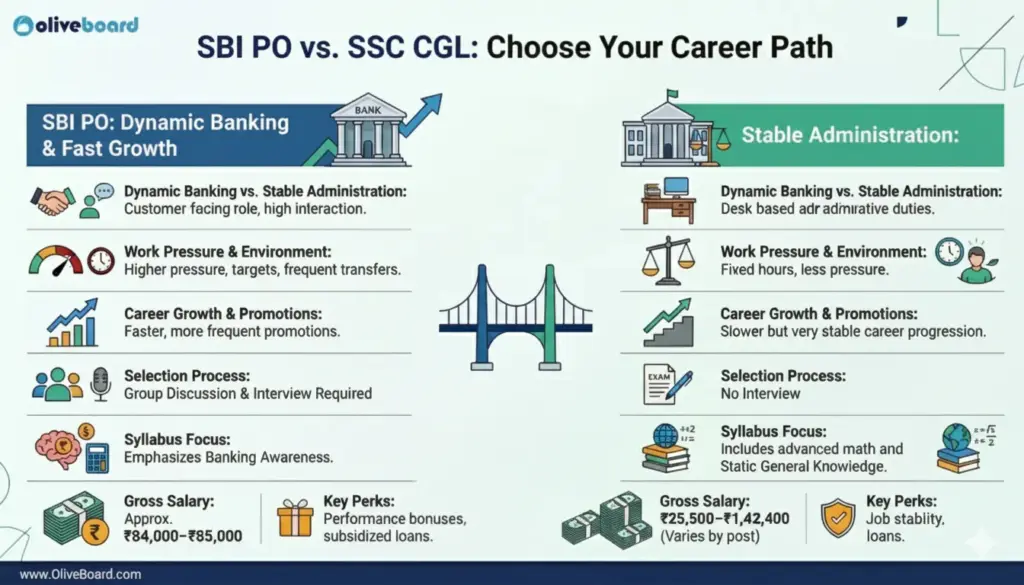
Comparison of SBI PO vs SSC CGL salary, work pressure, growth, and job stability
What are the Exam Patterns of SBI PO & SSC CGL?
Both the SBI PO Exam Pattern and SSC CGL Exam Pattern are conducted in multiple phases and test a candidate’s aptitude, reasoning, and English skills. However, their structure, weightage, and paper style are quite different. Here’s a quick comparison:
| Phase | SBI PO Exam Pattern | SSC CGL Exam Pattern |
| Prelims | Objective Test: English, Quant, Reasoning (100 marks, 1 hr) | Tier I: General Intelligence, English, Quant, GK (200 marks, 1 hr) |
| Mains | Objective Test (Reasoning, Data Analysis, English, GK) + Descriptive (250 marks total) | Tier II: Paper I (Quant & English for all), Paper II (Statistics for JSO), Paper III (General Studies for AAO) |
| Descriptive | Letter & Essay writing (included in Mains) | No separate descriptive paper |
| Interview | Group Discussion & Personal Interview (50 marks) | No interview; only document verification |
| Mode of Exam | Online (All stages) | Online (All stages) |
| Negative Marking | Yes – 0.25 marks in Prelims and Mains | Yes – 0.50 marks in Tier I & Tier II (per incorrect answer) |
SBI PO vs SSC CGL: Which offers a better salary package?
Salary is one of the most important factors candidates compare when deciding between SSC CGL Salary and SBI PO Salary, as both offer attractive starting pay but differ significantly in pay structure, allowances, and long-term perks.
| Criteria | SBI PO | SSC CGL |
| Basic Pay | ₹56,480.00 (after latest revision) | ₹ 35,400 (Level 7 as per 7th CPC) varies as per post |
| Gross Salary | ₹84,000-₹85,000 (varies with city and allowances) | ₹25,500 to ₹1,42,400 (depends on post & location) |
| DA, HRA, TA | Provided as per bank policies & city category | Provided as per central govt rules & city classification |
| Other Allowances | Petrol, newspaper, furniture, medical, etc. | LTC, medical, departmental allowances, etc. |
| Job Benefits | Performance bonuses, subsidized loans, insurance, etc. | Pension under NPS, job stability, low-pressure work culture |
| In-hand Salary | Around ₹80,350.00 | Around ₹64,362- ₹1,04,515 (Varies per post) |
Note: SBI PO pays more initially and grows faster, but SSC CGL offers stability with lower stress.
SBI PO vs SSC CGL – Job Profile
The nature of work in SBI PO and SSC CGL roles is quite different. One involves customer-facing banking operations, while the other focuses on administrative responsibilities in various government departments.
| Criteria | SBI PO | SSC CGL |
| Work Nature | Core banking operations, customer service, handling loans, accounts, etc. | Mostly clerical or administrative duties like data handling, report drafting, supervision |
| Posting Areas | Banks across India, both urban and rural branches | Central government offices across India |
| Training | Mandatory probation/training for 2 years | On-the-job training depending on post and department |
| Interaction | Direct interaction with customers | Minimal public interaction; mostly desk-based roles |
| Work Pressure | Moderate to high; targets and deadlines are common | Low to moderate; structured workflow and fixed responsibilities |
SBI PO vs SSC CGL – Syllabus Comparison
While both exams assess reasoning, math, and English, SSC CGL Syllabus includes advanced math and general awareness, whereas SBI PO Syllabus emphasizes banking and current affairs.
| Section | SBI PO | SSC CGL |
| Reasoning | Puzzles, Seating Arrangement, Input-Output, Coding-Decoding, Blood Relations | Classification, Analogy, Series, Coding-Decoding, Matrix, Directions |
| Quantitative Aptitude | Data Interpretation, Simplification, Profit & Loss, Time & Work, Ratio | Arithmetic (Profit & Loss, SI/CI, Time-Speed-Distance) + advanced math (Geometry, Trigonometry) |
| English Language | Cloze Test, Para Jumbles, Error Spotting, Reading Comprehension | Error Correction, Fill in the Blanks, Vocabulary, Sentence Improvement |
| General Awareness | Banking Awareness, Current Affairs, Economy, Financial News | Static GK, Current Affairs, Indian Polity, History, Geography, Economics |
| Computer Knowledge | Basic Computer Aptitude (only in Mains) | Basic Computer Aptitude (only in Tier 2) |
SBI PO vs SSC CGL: Where will you be after 10 years?
After 10 years, SBI PO officers usually reach senior managerial roles, while SSC CGL officers hold stable mid-to-senior administrative positions.
| Aspect | SBI PO after 10 years | SSC CGL after 10 years |
| Designation | Assistant General Manager or Chief Manager | Section Officer, Superintendent, Assistant Director (post-dependent) |
| Work Nature | Policy execution, business targets, staff supervision | Administrative control, audits, regulatory work |
| Work Pressure | Still high, responsibility-driven | Moderate, rule-based |
| Transfers | Common | Limited |
| Authority | High operational authority | Strong procedural authority |
| Lifestyle | Busy, demanding | Predictable, balanced |
Note: SBI PO rewards ambition and risk-taking, SSC CGL rewards patience and consistency.
SBI PO vs SSC CGL: Choose based on your personality
Choose SBI PO if you thrive under pressure and rapid growth, and choose SSC CGL if you value routine, stability, and long-term peace of mind.
| If you are someone who… | Better choice |
| Likes fast decisions | SBI PO |
| Prefers routine and clarity | SSC CGL |
| Can handle targets and reviews | SBI PO |
| Values fixed working hours | SSC CGL |
| Wants faster financial growth | SBI PO |
| Wants long-term mental peace | SSC CGL |
SBI PO vs SSC CGL – FAQs
Ans. SSC CGL offers better work-life balance, while SBI PO provides faster promotions and dynamic roles.
Ans. SBI PO has higher work pressure due to sales targets and customer interaction.
Ans. No, SSC CGL does not have an interview; selection is based on Tier I and II scores.
Ans. SBI PO generally has a faster joining process due to fewer post-exam formalities.
Ans. Yes, with overlapping syllabi in Quant, Reasoning, and English, dual prep is possible.
- SBI PO GE vs Interview 2026: What to Expect?
- SBI PO GE Sample Topics & Practice Exercises 2026
- SBI PO GE Do’s & Don’ts 2026: Tips to Perform Well
- SBI PO Group Exercise 2026, Complete Guide
- SBI PO Group Exercise Topics 2026, Check Expected Topics
- Top SBI PO GE Topics 2026 to Prepare for Group Exercise

I’m Mahima Khurana, a writer with a strong passion for creating meaningful, learner-focused content especially in the field of competitive exam preparation. From authoring books and developing thousands of practice questions to crafting articles and study material, I specialize in transforming complex exam-related topics into clear, engaging, and accessible content. I have first hand experience of 5+ months in SSC Exams. Writing, for me, is not just a skill but a way to support and guide aspirants through their preparation journey one well-written explanation at a time.