
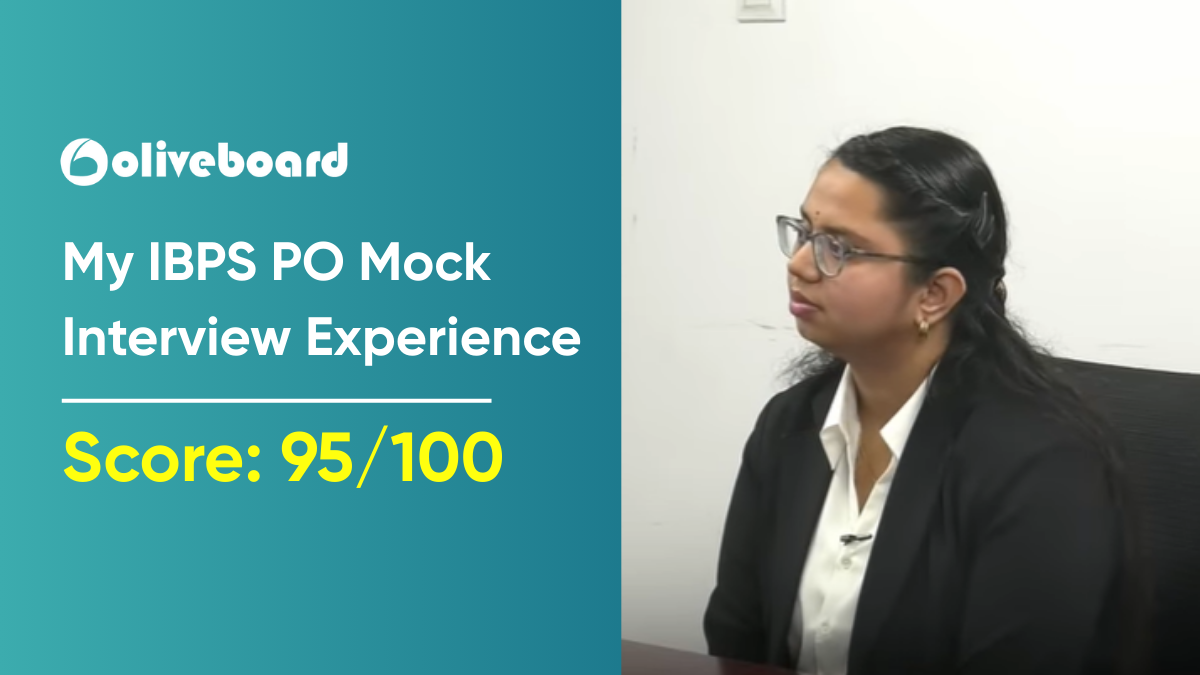
Hi, my name is Komal Kumari currently pursuing B. Com (Final Year), Originally from Bihar, brought up in Tamil Nadu. Worked for 6 months as a Tax Analyst.
Recently, I participated in a mock interview panel for the IBPS PO position conducted by Oliveboard. The experience was a mix of strong technical answers, nervous fumbles, and valuable situational learning.
Below is a detailed breakdown of the questions asked, how I answered them, and my retrospective analysis of my performance.
Part 1: Introduction and Ice Breakers
Question: Have you heard of the Sale of Goods Act? What does it say?
My Answer: I admitted that I could not recall it at that moment.
My Analysis: This was a nervous start. Blanking on a commerce-related act was not ideal. However, admitting I did not know rather than bluffing was the safe choice, though it highlighted a gap in my academic revision.
Question: Please introduce yourself.
My Answer: I introduced myself as Komal Kumari. I mentioned my dual background—originally from Bihar but raised in Tamil Nadu. I highlighted my current education (B.Com Final Year) with my scores (82% in 12th, 92% in 10th) and my 6-month experience as a Tax Analyst. I also mentioned my parents’ professions and my goal to enter the banking sector.
My Analysis: This was a standard, prepared answer. Mentioning my work experience as a “Tax Analyst” immediately gave the panel a hook for the next set of questions.
If you want watch my Video Interview directly, here’s the video!
Part 2: Technical Banking and Tax Knowledge
Question: You mentioned Capital Gains Tax. What is Short-Term Capital Gain?
My Answer: I explained that there are short-term and long-term gains. For shares, I initially struggled with the exact months but corrected myself to “up to 12 months” after the panel pressed me. For house property, I noted the holding period must be more than 3 years.
My Analysis: I fumbled the specific numbers initially. The panel appreciates exactness in tax laws. I need to be sharper with specific tenures (12 months vs 3 years).
Question: What is the difference between a Savings Bank Account and a Current Account?
My Answer: I stated that a savings account earns interest and is for saving money. A current account is for business transactions, has many daily transactions, earns little to no interest, and offers an overdraft facility.
My Analysis: This was a solid answer. Mentioning the “Overdraft facility” showed I understood the commercial utility of current accounts.
Question: What are the functions of the RBI?
My Answer: I listed their key roles: framing guidelines, credit control, acting as the banker’s bank and banker to the government, managing monetary policy, and issuing currency7.
My Analysis: I hit all the necessary keywords. This established a strong baseline of banking knowledge.
Question: Explain money control activities (Repo, Reverse Repo, CRR, SLR).
My Answer: I explained Reverse Repo (banks lending to RBI) and Repo (RBI lending to banks). I also defined CRR (cash reserves with RBI) and SLR (liquid assets). I successfully quoted the current rates: Reverse Repo at 3.35%, Repo at 6.5% (corrected during flow), CRR at 4.5%, and SLR.
My Analysis: This was one of my best moments. Knowing the exact current percentage rates impressed the panel and showed I was up-to-date with monetary policy.
Question: What is CASA? Why do banks prefer it?
My Answer: I defined it as the Current Account Savings Account ratio. I explained that banks prefer a higher CASA (ideally around 40%) because these accounts carry low interest rates, meaning the bank pays less to the customer compared to fixed deposits.
My Analysis: Good conceptual clarity. I explained the “why” (cost of funds) rather than just the definition.
Part 3: Situational and Behavioral Questions
Question: Imagine you are posted in a village facing many cyber frauds. How would you educate the customers?
My Answer: I said I would first analyze the problem. Then, instead of telling people individually, I would organize a “Panchayat” or Gram Sabha involving the Sarpanch (village head). I would use that platform to educate everyone at once about not sharing OTPs or clicking unknown links10.
My Analysis: The panel loved this answer. They specifically complimented the “Gram Sabha” approach because it is a scalable, culturally relevant solution for rural areas.
Question: How would you deal with Non-Performing Assets (NPA) as a Credit Officer?
My Answer: I outlined a process of identification, communication, and understanding the customer’s problem. I also categorized assets into Substandard, Doubtful, and Loss Assets. I mentioned that Loss Assets cannot be recovered at any cost.
My Analysis: My empathy-led approach was good, but I made a technical error regarding “Loss Assets.” I stated they cannot be recovered, which the panel later corrected.
Question: If posted to the North East, how will you manage the culture and language differences?
My Answer: I emphasized that I am a quick learner, citing my internship experience where I didn’t need handholding. I mentioned using technology like Google and YouTube to learn the local language and culture rapidly.
My Analysis: A confident answer showing adaptability.
Part 4: General Awareness and Personal Background
Question: Tell us about Chhath Puja (since you are from Bihar).
My Answer: I explained it is a mega festival celebrating nature and the Sun God. I shared a mythological story about a King and a Rishi to explain the cultural significance.
My Analysis: This showed personality and connection to my roots. It broke the monotony of technical questions.
Question: Where is the RBI Headquarters?
My Answer: I nervously said Delhi, then corrected myself to Mumbai. I also knew it moved from Kolkata to Mumbai in 1937.
My Analysis: This was a panic error. Everyone knows RBI is in Mumbai. It was a reminder to stay calm even when the questions seem simple.
Question: Why are tariffs increasing between the USA, India, and Russia?
My Answer: I discussed the geopolitics of crude oil. I explained that the West wants to break the trade bond India shares with Russia regarding oil imports, leading to tariff pressures15.
My Analysis: This demonstrated that I read the news and understand global economics, not just banking definitions.
FEEDBACK AND CONCLUSION
At the end of the interview, the panel provided specific feedback:
- Communication: They appreciated my communication skills and noted that my answers were relevant to the questions asked.
- Technical Correction: They corrected my statement on Loss Assets. Even if an asset is written off as a “loss,” the bank does not stop its recovery efforts.
- Current Affairs: They advised me to keep reading financial newspapers to stay updated on tax reforms and specific Acts.
Overall Summary
The mock interview was a confidence booster. I realized that while my core banking concepts (like Repo rates and Account types) are strong, I need to be more precise with data (Act names, Headquarters locations). The biggest takeaway was the success of my situational answers—thinking practically (like the Gram Sabha idea) scores high points with the panel.
Hi, I’m Aditi. I work as a Content Writer at Oliveboard, where I have been simplifying exam-related content for the past 4 years. I create clear and easy-to-understand guides for JAIIB, CAIIB, and UGC exams. My work includes breaking down notifications, admit cards, and exam updates, as well as preparing study plans and subject-wise strategies.
My goal is to support working professionals in managing their exam preparation alongside a full-time job and to help them achieve career growth.