

The NABARD Grade A Phase 2 exam date 2026 is expected to be released soon along with the official notification PDF. Aspirants who clear the Phase 1 exam will be shortlisted to appear for the Phase 2 exam. Clearing the NABARD Grade A Phase 2 exam is not just about knowing facts; it is about how effectively you can present and explain them.
The descriptive writing paper often becomes the deciding factor for selection. With high sectional cut-offs and limited preparation time after Phase 1, a focused strategy for descriptive writing is essential. In this blog, we provide details on what to prepare, how to prepare, and how to practice for the NABARD Grade A Phase 2 descriptive writing paper.
Why is the descriptive paper crucial for final selection?
Many aspirants underestimate the descriptive paper and lose marks despite doing well in objective sections. It tests not only your knowledge but also your ability to present ideas clearly and professionally. High sectional cut-offs prove that descriptive writing can make or break your final selection.
What is the NABARD Grade A phase 2 descriptive writing exam pattern?
The NABARD Grade A Phase 2 descriptive exam tests a candidate’s writing ability and subject knowledge in General English, Economic & Social Issues (ESI), and Agriculture & Rural Development (ARD). In the English paper, candidates must answer 3 questions for 100 marks within 90 minutes by typing their responses on a computer.
In the ESI & ARD paper, they need to attempt 4 out of 6 questions, including 2 questions of 15 marks and 2 questions of 10 marks, totaling 50 marks in 90 minutes. Answers can be written in English or Hindi, and the exam mainly assesses clarity of expression, conceptual understanding, and presentation skills.
| Paper | Type | Questions and Marks | Time | Remarks |
| General English | Descriptive | 3 for 100 marks | 90 Min | Answers to be typed on keyboard |
| Economic & Social Issues + Agriculture & Rural Development | Objective | 30 for 50 marks | 30 Min | Some questions carry 2 marks, some 1 mark |
| Economic & Social Issues + Agriculture & Rural Development | Descriptive | 6 (Attempt any 4) for 50 marks | 90 Min | 2 × 15 marks (hard), 2 × 10 marks; type in English or Hindi |
Check Out: NABARD Grade A Phase 2 Exam Pattern
What type of questions were asked in the NABARD Grade A phase 2 descriptive paper?
The NABARD Grade A Phase 2 descriptive paper mainly consist of questions based on static, and current-based questions from ARD and ESI. These questions tests conceptual clarity, application of concepts, awareness of government schemes, and the ability to link theory with current developments. A clear pattern was seen where static ARD topics were repeatedly asked, sometimes with a slight change in statement, while ESI questions focused on policies, schemes, and economic concepts linked to current affairs.
| Question type | Nature of questions | Examples |
| Static ARD-based | Direct conceptual and theoretical questions from core ARD topics | Cross-breeding in animal husbandry, social forestry (definition, objectives, components), drip irrigation (definition, advantages, limitations), agroforestry |
| Static + current ARD | Core static concept linked with recent developments or policies | Minimum Support Price (concept, need, recommending body, approval process, crops covered, recent values) |
| Current affairs-based ARD | Government schemes and sectoral initiatives related to agriculture and allied sectors | Pradhan Mantri Matsya Sampada Yojana – objectives, implementation period, strategy |
| Static ESI-based | Conceptual economic and social development questions | Public Distribution System and its role in food economy, social infrastructure and inclusive growth |
| Current + static ESI | Policy-oriented questions linking theory with recent trends | WTO policies and their impact on Indian economy, benefits of globalization, declining dependence on non-institutional credit by farmers |
| Short descriptive questions | Direct definition-based or list-type questions | Objectives of extension education, methods of extension education |
| Analytical/comment-type | Opinion-based questions requiring balanced arguments | Role of PDS with challenges, dual impact of WTO policies, benefits and limitations of irrigation practices |
How should you frame your answers for ESI and ARD questions?
When writing answers for ESI and ARD questions, it is important to be structured, concise, and focused. Your answer should have a clear introduction, a well-organized body, and a conclusion, but the introduction and conclusion are only necessary for conceptual or technical questions. Focus on writing key points that match the marking scheme, keeping in mind time management and clarity.
| Section | Key Instructions | Tips |
| Introduction | 10% of marks | Include only if question is conceptual, technical, or requires background. Skip for direct questions. |
| Body/Main Content | 80% of marks | Focus on the core points. Use bullets, arrows, or numbering for clarity. Include all important elements expected in marking scheme. |
| Conclusion | 10% of marks | Summarize key points. Optional for direct questions. |
| Time Management | Critical | Start with direct answer for simple questions. Reserve intro/conclusion for complex questions. |
Which common ESI and ARD topics are asked in the Phase 2 descriptive paper?
The NABARD Grade A Phase 2 descriptive paper consistently focuses on a set of core ARD and ESI topics that are largely static, with questions framed either directly or by linking them with current developments. Repeated areas include animal husbandry, irrigation, forestry, extension education, agricultural policies, rural credit, food security, government schemes, social infrastructure, and global economic issues.
| Subject area | Common topics repeatedly asked |
| Animal husbandry (ARD) | Cross-breeding, methods of cross-breeding |
| Irrigation & water management (ARD) | Drip irrigation |
| Forestry & natural resources (ARD) | Social forestry, agroforestry |
| Agricultural extension (ARD) | Extension education |
| Agricultural policies (ARD) | Minimum Support Price (MSP) |
| Agriculture & allied schemes (ARD) | Pradhan Mantri Matsya Sampada Yojana, NRLM |
| Rural credit & financial inclusion (ARD/ESI) | Institutional vs non-institutional credit |
| Food security systems (ESI) | Public Distribution System (PDS) |
| Economic development (ESI) | Social infrastructure, inclusive growth |
| Global economy & trade (ESI) | Globalisation, WTO policies |
What are the important tips for NABARD Grade A descriptive writing preparation?
To score well in the NABARD Grade A descriptive (ARD) paper, it is important to frame answers in a systematic manner. Before starting to write, first note down all key points on the rough sheet. Plan what to write in the introduction, the main points to be covered in the body, and how to conclude the answer. Following this approach will help you write well-structured answers in all three descriptive sections ESI, ARD, and English.
- Plan before writing: First, list all important points on the rough sheet before starting the answer.
- Introduction: Write a short and clear opening that defines or briefly explains the topic.
- Body of the answer: Mention key facts, concepts, examples, data, or government schemes related to the question.
- Structure: Present points in a logical order using short paragraphs or bullets for clarity.
- Conclusion: End with a positive summary, future outlook, or a way forward.
- Time management: Stick to the word limit and avoid unnecessary explanations.
- Applicability: Follow this same structure for ESI, ARD, and English descriptive answers.
How can you manage time while writing descriptive answers in exams?
Time management is crucial for scoring well in descriptive answers. Begin by reading the question carefully and identifying if it needs an introduction and conclusion.
| Step | Instruction | Tips |
| Question Analysis | Identify type: direct vs conceptual | Decide whether intro/conclusion is needed |
| Presentation | Use bullets, arrows, hashtags | Keep answer neat and readable |
| Avoid | Fancy formatting, unnecessary filler | Focus on key points only |
What are the common essay topics repeatedly asked in NABARD Grade A English paper?
In the NABARD Grade A Phase 2 English paper, essay questions are not random. They are consistently drawn from broad, recurring themes connected to agriculture, rural development, economy, social issues, technology, and sustainability. These themes overlap with ESI, ARD, and current affairs, making them high-probability essay areas every year. Understanding these common topics helps you prepare smartly instead of memorising isolated essays.
| Broad Theme | Common Essay Topics Includes |
| Agriculture & Rural Development | Sustainable agriculture, reforms in agriculture sector, future of Indian agriculture |
| Economy & Development | $5 trillion economy, inflation, rural poverty, employment |
| Environment & Sustainability | Climate change, climate-resilient agriculture, green finance |
| Social Issues | Women empowerment, women safety, poverty, inequality |
| Science & Technology | AI in agriculture, digital education, emerging technologies |
| Government Initiatives | Millets, ethanol blending, startups, Atmanirbhar Bharat |
| Health & Education | Post-pandemic healthcare, privatization of education |
| Finance & Inclusion | Microfinance, financial inclusion, rural credit |
| Governance & Policy | NEP 2020, cooperative institutions, disaster management |
Check out the detailed ESI and ARD preparation guide
How to approach common NABARD essay themes effectively?
To effectively approach common NABARD essay topics, focus on understanding the core idea rather than memorising full essays. Start with a simple introduction and relate the topic to key areas like rural development, agriculture, or financial inclusion, which are important for NABARD exams.
Then structure your content into 2–3 clear aspects such as economic impact, social importance, and future prospects. Maintain balance by highlighting both advantages and challenges, and support your points with simple current examples instead of heavy data. Conclude with a positive and practical way forward to leave a strong impression in the exam.
How to handle letter and report writing questions?
Letter and report writing are high-scoring sections in the descriptive paper if written with the correct structure and tone. Common letter types asked include complaint letters, official correspondence, and request or extension letters.
While evaluating answers, examiners mainly check whether the format is correct, the tone is professional, the purpose is clearly stated, and the content is concise and relevant.For report writing, candidates should focus on maintaining a clear structure, logical flow of ideas, and factual, objective language.
Also Check: Important Government Schemes for NABARD Grade A
What is the syllabus for NABARD Grade A descriptive writing?
The NABARD Grade A syllabus for descriptive writing is largely the same as Phase 1 and Phase 2 objective papers, but you are expected to answer in a more analytical and structured manner.
Paper 1 – General English Topics:
- Essay Writing
- Precis Writing
- Reading Comprehension
- Business & Office Correspondence (Letters/Reports)
Paper 2 – ESI & ARD Topics:
ESI Topics:
- Indian Economy
- Inflation & Population Trends
- Agriculture & Industry
- Rural Banking & Financial Institutions
- Globalisation
- Social Justice & Inclusive Growth
- Education & Social Structure
- Current Economic & Social Issues
ARD Topics:
- Agriculture & Agronomy
- Cropping Systems & Seed Technology
- Soil & Water Conservation
- Farm & Agricultural Engineering
- Horticulture & Plantation Crops
- Animal Husbandry & Fisheries
- Forestry & Agroforestry
- Ecology & Climate Change
- Rural Development & Panchayati Raj
- Present Scenario of Indian Agriculture
How should you prepare ESI & ARD for descriptive answers?
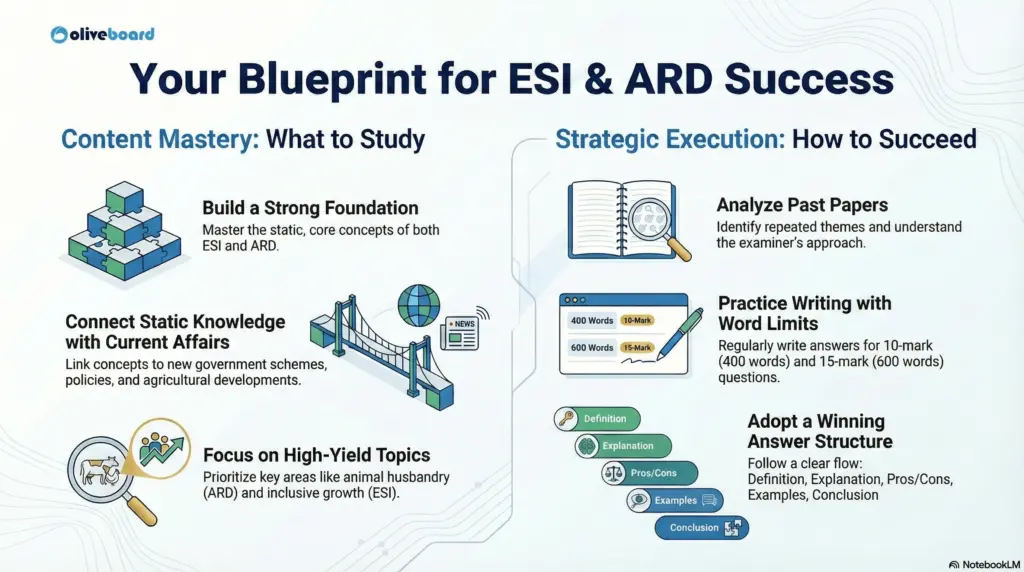
The best strategy is to integrate objective and descriptive preparation. For every topic, structure your answers as follows:
- Build strong clarity of static concepts in both ESI and ARD, as many questions are directly asked from core topics
- Prepare static ARD topics thoroughly such as animal husbandry, irrigation, forestry, agroforestry, and extension education
- Link static concepts with current affairs, especially for schemes, policies, and agriculture-related developments
- Focus on ESI fundamentals like economic concepts, social infrastructure, inclusive growth, globalization, and food security
- Study government schemes and policies with objectives, features, implementation, and relevance
- Analyse previous year questions to understand repeated themes and examiner’s approach
- Practise answer writing regularly within the prescribed word limits (400 words for 10 marks, 600 words for 15 marks)
- Follow a clear structure: definition – explanation – advantages/challenges – examples – conclusion
- Use simple language, relevant examples, and balanced arguments instead of rote learning
How much practice is required for NABARD Grade A descriptive paper?
For the NABARD Grade A descriptive paper, consistent and focused practice is very important. Candidates should regularly write answers, practice typing on a computer, and revise key points, starting with 3–4 days a week and increasing to daily practice in the final weeks before the exam.
For Agriculture & Rural Development (ARD), preparation should cover core static topics like animal husbandry, irrigation, forestry, extension education, and important agriculture-related schemes that are frequently asked. For Economic & Social Issues (ESI), candidates should practice questions on economic concepts, government policies, social sector issues, and current affairs with a clear and balanced approach.
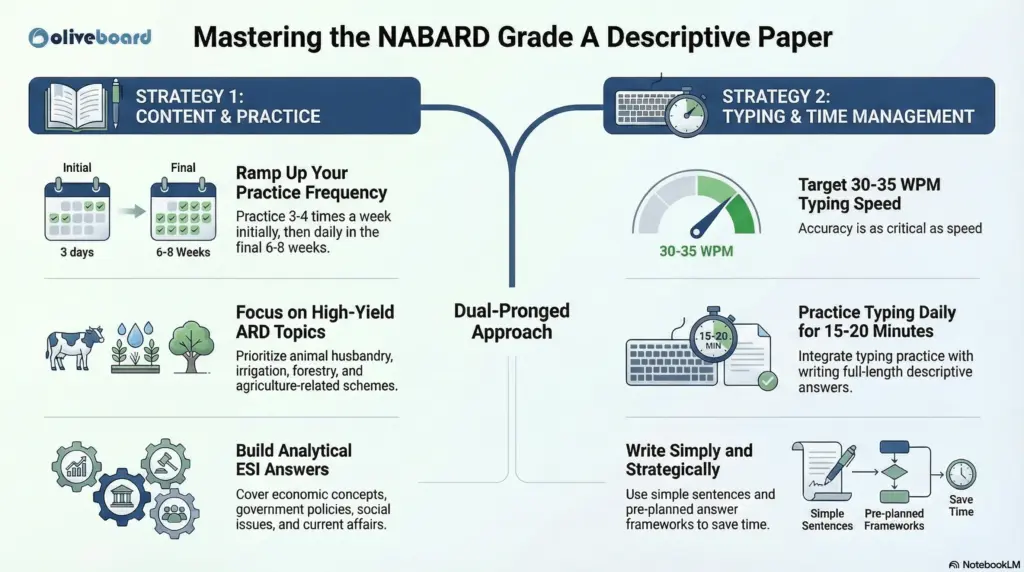
Typing speed is very important in the NABARD Grade A descriptive paper, so candidates should practice regularly to reach 30–35 words per minute with accuracy by typing 15–20 minutes daily on a keyboard. Writing full-length answers in simple language and following a clear structure helps improve speed and clarity. Avoiding unnecessary complexity also saves time, helps manage word limits, and builds confidence for the exam.
FAQs
The NABARD Grade A phase 2 exam scheduled to be held on 25th January 2026.
It tests clarity of thought, presentation, and can significantly impact final selection.
Paper 1 English Descriptive (100 marks, 90 min); Paper 2 ESI & ARD Descriptive (50 marks, 90 min).
Essay, Precis, Letter/Report writing, and Reading Comprehension.
ESI: Economy, Banking, Social Issues; ARD: Agriculture, Horticulture, Animal Husbandry, Rural Development, Ecology.
- Shekhar Kumar’s RBI Grade B Journey with AIR-1’s Strategy
- Success Story Of Tanay Gaurav, AIR 1 In RBI Grade B 2024
- RBI Grade B Toppers’ Scores & Strategies for 2027 Exam
- SEBI Law Officer Recruitment 2026, Check Revised Eligibility Criteria
- SEBI IT Officer Recruitment 2026 Eligibility Criteria Revised
- PFRDA Grade A Phase 1 Exam Analysis for 15th October 2026

Hi, I’m Aditi. I work as a Content Writer at Oliveboard, where I have been simplifying exam-related content for the past 4 years. I create clear and easy-to-understand guides for JAIIB, CAIIB, and UGC exams. My work includes breaking down notifications, admit cards, and exam updates, as well as preparing study plans and subject-wise strategies.
My goal is to support working professionals in managing their exam preparation alongside a full-time job and to help them achieve career growth.