
On the sacred occasion of Magha Purnima and the birth anniversary of Guru Ravidas, the Union Budget for 2026–27 was presented on 1st February 2026. The Finance Minister highlighted that over the last 12 years, India’s economy has shown stability, fiscal discipline, sustained growth, and controlled inflation, even during global uncertainty.
The Budget focuses strongly on investment-led development, boosting manufacturing, logistics, skilling, digital infrastructure, and inclusive growth. Special attention has been given to Yuva Shakti (youth power), infrastructure corridors, innovation, MSMEs, and governance reforms.

Key Highlights of Union Budget 2026–27
Some of the most important announcements from the Union Budget 2026-27 include:
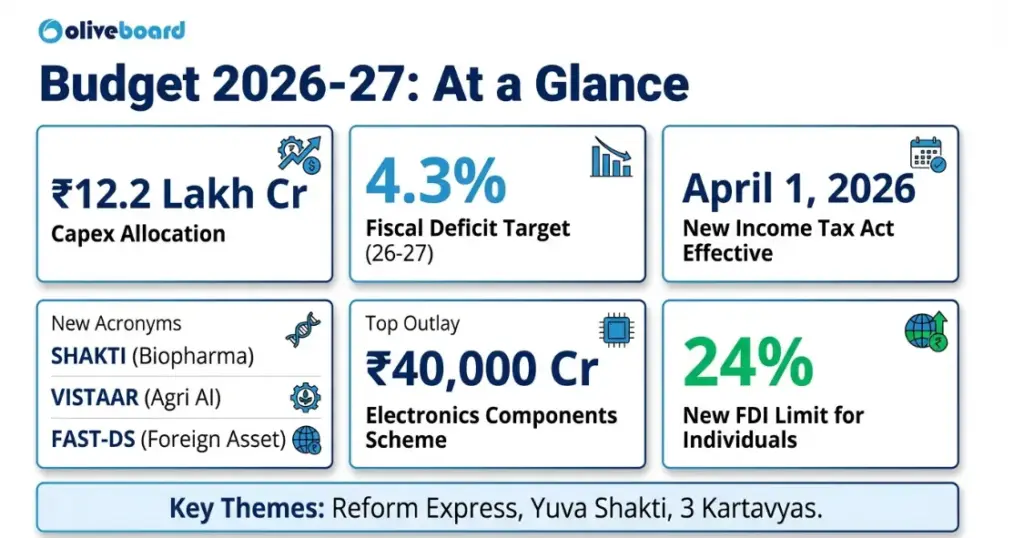
- Fiscal deficit targeted at 4.3% of GDP to ensure macroeconomic stability.
- Capital expenditure increased to ₹12.2 lakh crore to drive infrastructure-led growth.
- Public investment aimed at crowding in private investment and boosting long-term capacity.
- Real GDP growth projected at ~7%, with nominal GDP at 10–10.5%.
- Growth strategy focused on investment, exports, manufacturing, and services.
- Defence allocation raised to ₹7.85 lakh crore, the highest among all sectors.
- Emphasis on indigenous defence manufacturing and strategic self-reliance.
- Railways allocated ₹2.93 lakh crore to strengthen logistics and connectivity.
- Highways received ₹3.10 lakh crore to expand road infrastructure.
- Focus on freight corridors, high-speed rail, and green logistics.
- Health & Family Welfare allocation of ₹1.07 lakh crore for hospitals and research.
- Education allocation of ₹1.39 lakh crore to promote digital learning and AI skills.
- Agriculture & allied sectors allocated ₹1.41 lakh crore to support farmers and productivity.
- Rural Development received ₹1.97 lakh crore for employment and infrastructure.
- Department of Space allocated ₹13,706 crore to support ISRO and private participation.
- MSME Ministry allocation of ₹0.25 lakh crore to improve credit and competitiveness.
- Startups supported through regulatory ease, R&D funding, and deep-tech missions.
- Renewable energy allocated ₹0.33 lakh crore to accelerate clean energy transition.
- Power Ministry allocation of ₹0.30 lakh crore to ensure energy security.
- Fertiliser subsidy pegged at ₹1.71 lakh crore to support farmers.
- Food subsidy/PDS allocation of ₹2.35 lakh crore to ensure food security.
- Large-scale AI skilling for 25 crore people to prepare future workforce.
- Continued support for quantum computing and national R&D missions.
- Stable and simplified personal and corporate tax regime maintained.
- Measures introduced to attract foreign investment and deepen capital markets.
- Housing & Urban Affairs allocated ₹0.86 lakh crore for metro and urban services.
- Expansion of Khelo India Mission to promote sports talent and employment.
- Support extended to AVGC and creative industries for skill and job creation.
What is the sector-wise budget allocation in Union Budget 2026–27?
Union Budget 2026–27 prioritises defence, infrastructure, agriculture, social services, and strategic technologies. Alongside traditional ministries, emerging areas such as space, renewable energy, and digital ecosystems receive focused support to strengthen India’s long-term growth and strategic capacity.
| Sector | Budget Allocation |
| Defence | ₹7.85 lakh crore |
| Railways | ₹2.93 lakh crore |
| Road Transport & Highways | ₹3.10 lakh crore |
| Agriculture & Allied Activities | ₹1.41 lakh crore |
| Rural Development | ₹1.97 lakh crore |
| Education | ₹1.39 lakh crore |
| Health & Family Welfare | ₹1.07 lakh crore |
| Housing & Urban Affairs | ₹0.86 lakh crore |
| Fertiliser Subsidy | ₹1.71 lakh crore |
| Food Subsidy / PDS | ₹2.35 lakh crore |
| MSME Ministry | ₹0.25 lakh crore |
| Renewable Energy (MNRE) | ₹0.33 lakh crore |
| Power Ministry | ₹0.30 lakh crore |
| Space / ISRO (Department of Space) | ₹13,706 crore |
Note on Sector-wise Allocation
- Figures are Budget Estimates (BE) 2026–27 from official SBE and Demand-for-Grants documents- Download Expenditure Budget 2026-27 PDF.
- Amounts are rounded and shown in ₹ lakh crore / ₹ crore.
- Sector refers to the ministry or department total outlay.
- Food and fertiliser subsidies are shown separately.
- These are estimates, not final expenditure.
The “3 Kartavyas”: Strategic Pillars of Budget 2026–27
The Finance Minister repeatedly emphasised that this Budget rests on three driving forces. Let us look at each one in detail.
- Accelerating and sustaining economic growth
- Fulfilling aspirations and building capacity
- Ensuring inclusion with fiscal prudence
How does the first Kartavya focus on growth?
The first Kartavya of the Union Budget 2026-27 is centred on productivity-enhancing investment, particularly in manufacturing, infrastructure, logistics, and energy security. A major thrust is on scaling up advanced manufacturing sectors such as:
- Semiconductors
- Biopharmaceuticals
- Electronics components
- Rare earth minerals
- Capital goods and heavy engineering
- Chemicals and industrial clusters
How does the second Kartavya build people’s capacity?
The second Kartavya of the Union Budget 2026-27 places people at the centre of economic strategy. It recognises that India’s demographic advantage can only translate into growth if workers are healthy, skilled, and productive. Accordingly, the Budget expands:
- Medical education and allied health training
- Skilling programmes linked to new technologies
- Services-sector development
- Women-led enterprises and self-help groups
- Support for persons with disabilities
- Mental health and trauma-care infrastructure
How does the third kartavya ensure stability?
The third Kartavya of the Union Budget 2026-27 focuses on fiscal discipline, reform, and inclusion. It includes:
- Maintaining the deficit-reduction roadmap
- Simplifying direct and indirect taxes
- Improving compliance through digital systems
- Encouraging formalisation of the economy
- Strengthening financial markets
- Promoting balanced regional development
Fiscal Consolidation and Budget Estimates
The Finance Minister highlighted that fiscal consolidation remains a key priority while supporting economic growth. The budget estimates for 2026–27 show improvement in key fiscal indicators, reflecting prudent financial management. The government aims to balance expenditure needs with long-term fiscal stability. The difference between total revenue and total expenditure of the government is termed as the fiscal deficit. It is an indication of the total borrowings required by the government.
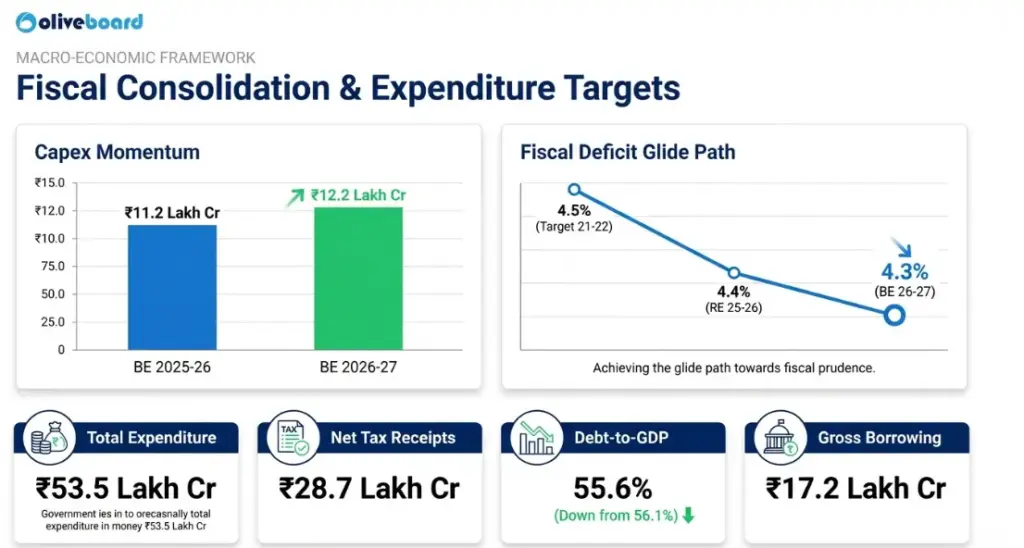
- Debt-to-GDP ratio: 55.6% (BE 2026–27)
- Fiscal deficit: 4.3% of GDP (BE 2026–27)
- Non-debt receipts: ₹36.5 lakh crore
- Net tax receipts: ₹28.7 lakh crore
- Total expenditure: ₹53.5 lakh crore
Capital Expenditure Increased to ₹12.2 Lakh Crore
The government continued its strong push for infrastructure-led growth by sharply raising public capital expenditure for FY 2026–27. High capex is intended to crowd-in private investment, reduce logistics costs, and strengthen India’s productive base over the long run.
- Capex for FY 2026–27: ₹12.2 lakh crore
- Infrastructure Risk Guarantee Fund proposed
- Support for private sector confidence in long-gestation projects
Strong Push to Emerging Technologies and AI
Union Budget 2026 placed major emphasis on artificial intelligence and frontier technologies as drivers of productivity and inclusion. The government aims to prepare a future-ready workforce through nationwide skilling initiatives while sustaining funding for advanced scientific missions.
- Capacity-building AI missions covering 25 crore people
- Continued support for National Quantum Mission
- Strengthening the Anusandhan National Research Fund
- R&D and Innovation Fund expansion
Education to Employment and Enterprise Committee
To better align education systems with future labour-market needs, the Finance Minister announced the creation of a high-level committee focused on employment-oriented reforms. The services sector, exports, and digital-economy opportunities form the core of its mandate.
- High-Powered Standing Committee proposed
- Services sector identified as major growth engine
- Target of 10% global share in services exports by 2047
- Assessment of AI’s impact on employment and skills
AVGC Sector and Creative Economy
Recognising the employment potential of animation, visual effects, gaming, and comics, the Budget proposed dedicated skilling pipelines and institutional support.
- AVGC workforce requirement of 2 million by 2030
- Content-creator labs in schools and colleges
- Support to Indian Institute of Creative Technologies

India Semiconductor Mission 2.0
To deepen strategic manufacturing capabilities, the Budget launched India Semiconductor Mission 2.0. The new phase aims to strengthen domestic chip design, fabrication, packaging, and materials supply chains while building research ecosystems and training talent.
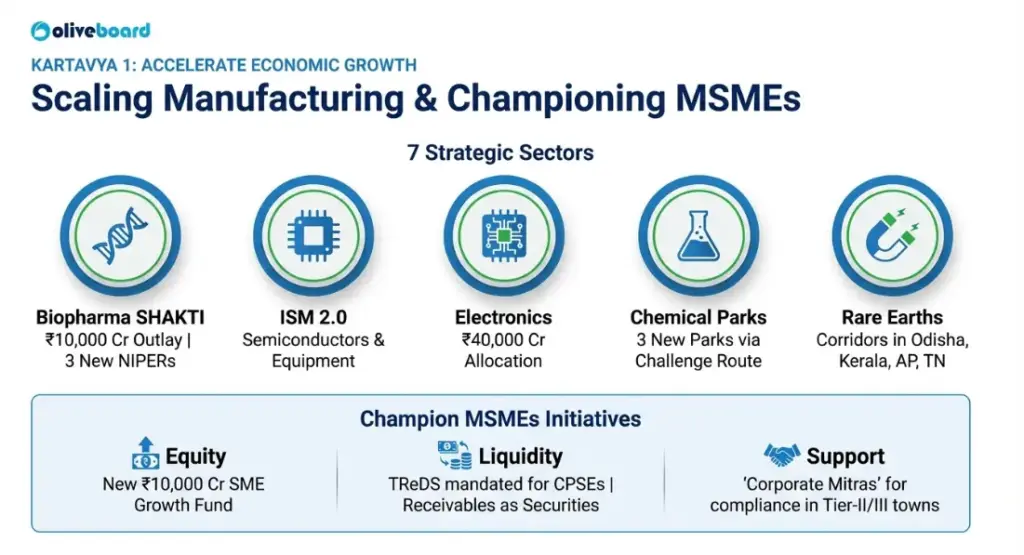
- Outlay: ₹40,000 crore
- Focus on chip design and fabrication
- Domestic intellectual-property creation
- Industry-led research and training centres
Shakti Initiative for Semiconductor Ecosystem
Alongside ISM 2.0, a dedicated Shakti Initiative was announced to nurture the wider semiconductor ecosystem. The programme will focus on specialised skilling, supplier development, and startup participation.
- Outlay: ₹10,000 crore over five years
- Support for ecosystem and vendor development
- Creation of skilled technical workforce
Rare Earth Corridors for Critical Minerals
The Budget announced major steps to strengthen India’s presence in critical minerals, particularly rare earth elements required for EVs, renewable energy, electronics, and defence equipment. Dedicated mineral corridors will integrate mining, processing, and manufacturing activities.
- Corridors in Odisha, Kerala, Andhra Pradesh, Tamil Nadu
- Focus on exploration, processing and downstream manufacturing
- Linked with rare-earth magnet production schemes
Major Support for MSMEs and Micro Enterprises
Recognising MSMEs as India’s principal employment generators, the Budget announced a comprehensive financing and reform package to improve liquidity, reduce compliance burdens, and speed up payments.
- ₹10,000 crore SME Growth Fund
- ₹2,000 crore top-up to Self-Reliant India Fund
- Over ₹7 lakh crore liquidity support already provided
MSME Financing and Market Reforms
Structural reforms were proposed to strengthen the MSME credit ecosystem and ensure timely payments from large buyers. Digital public platforms will play a central role in integrating procurement, financing, and invoice discounting.
- Mandatory TReDS for CPSE purchases from MSMEs
- Credit-guarantee support for invoice discounting
- GeM–TReDS integration
- Training of Corporate Mitras for compliance
GDP Growth Assumptions and Economic Outlook
The Budget is anchored in expectations of sustained economic momentum despite global headwinds. The government projects that domestic demand, public investment, and manufacturing expansion will keep India among the fastest-growing large economies.
- Nominal GDP growth assumption around 10–10.5%
- Real growth targeted near 7%
- Investment-led growth strategy
- Focus on export competitiveness
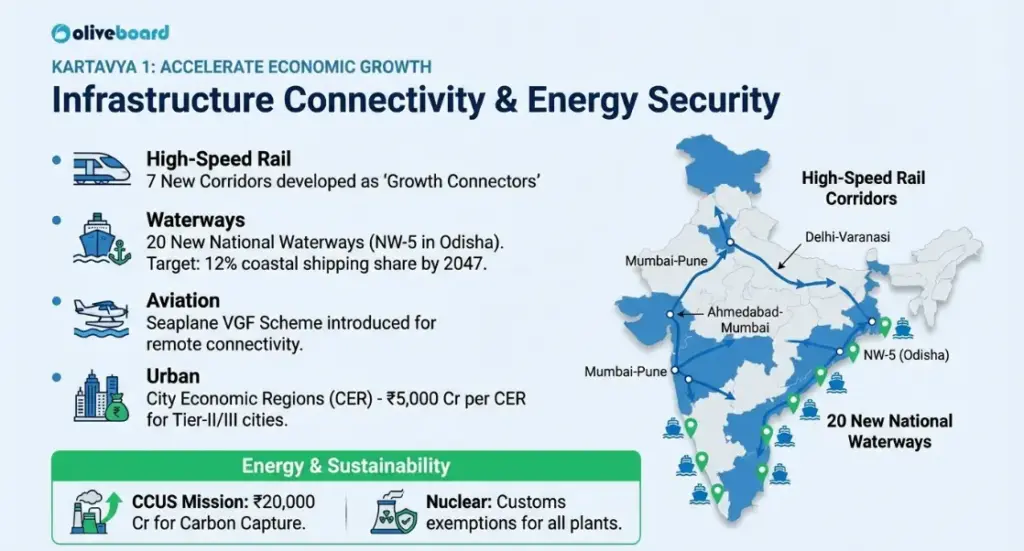
Railways and Transport Infrastructure
The Budget maintained heavy emphasis on improving logistics and multimodal connectivity. New freight and passenger corridors aim to reduce travel time, cut transport costs, and support industrial clusters. Sustainability was highlighted through energy-efficient cargo systems.
- Seven high-speed rail corridors announced
- Dedicated freight corridor from Dankuni to Surat
- Focus on green logistics
Banking and NBFC Sector Reforms
To strengthen financial stability and prepare institutions for the next phase of growth, the government proposed a comprehensive review of the banking sector. Public-sector NBFCs will be restructured to enhance efficiency and lending capacity.
- High-level banking committee for Viksit Bharat
- Focus on stability, inclusion and consumer protection
- Restructuring of PFC and REC

Khelo India Mission for Sports Development
A new Khelo India Mission was announced to transform sports into a source of national talent development, employment, and youth engagement. Infrastructure, coaching, and grassroots participation will be expanded.
- Khelo India Mission to be launched
- Focus on nurturing sporting talent
- Employment and skilling opportunities
Textile Sector Integrated Development Programme
The labour-intensive textile sector received a major integrated support package. The programme aims to modernise clusters, encourage sustainable production, and generate rural employment.
- Mega textile parks through challenge mode
- National Fibre Scheme
- Textile Expansion and Employment Scheme
- SAMARTH 2.0 for skilling
Biopharma Shakti and Healthcare Expansion
Healthcare and pharmaceutical manufacturing featured prominently in the Budget. The Biopharma Shakti initiative seeks to position India as a global innovation hub while strengthening regulatory systems and clinical-trial capacity.
- ₹10,000 crore outlay over five years
- Three new NIPER institutes; seven to be upgraded
- 1,000 new clinical-trial sites
- Strengthening CDSCO
Medical Tourism and AYUSH Infrastructure
To promote India as a global healthcare destination, new medical-tourism hubs and AYUSH institutions were announced. These will combine traditional systems with modern healthcare delivery.
- Five regional medical-tourism hubs
- Three new All India Institutes of Ayurveda
- Upgrade of AYUSH pharmacies and laboratories
- Strengthening WHO Global Traditional Medicine Centre
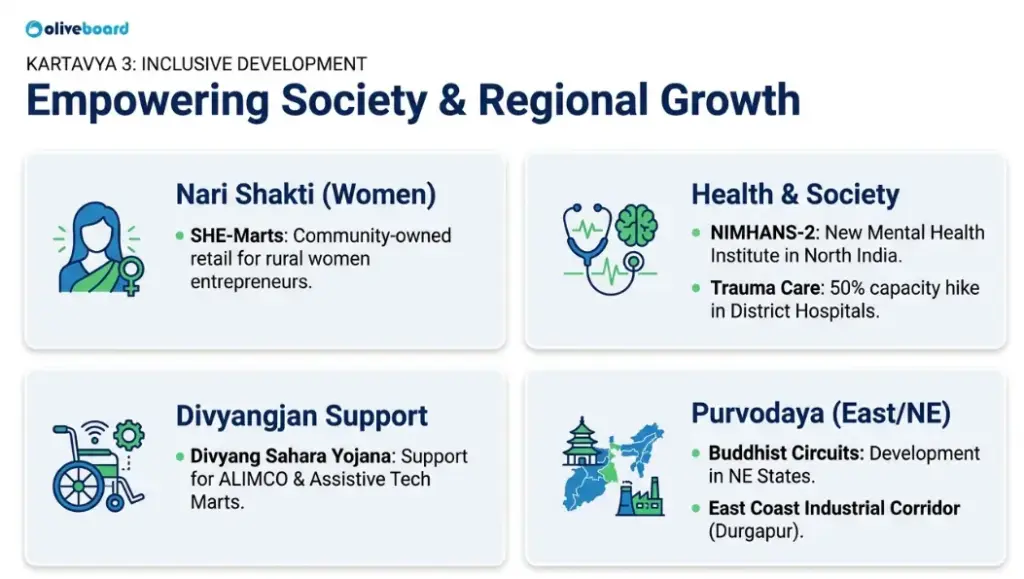
Women-Led Development and SHG Support
Women-centric initiatives remain a major pillar of the Budget’s social agenda. Support is channelled through self-help groups, entrepreneurship platforms, and access-to-credit programmes. The objective is to raise labour-force participation and household incomes.
- Credit support for women-led enterprises
- Expansion of SHG-linked livelihoods
- Skill programmes for women entrepreneurs
- Market-access platforms
Divyangjan Kaushal Yojana
Special measures were introduced to expand skill development and dignified livelihood opportunities for persons with disabilities.
- Divyangjan Kaushal Yojana proposed
- Focus on inclusive employment
Health Infrastructure and Human Resources
Beyond biopharma, the Budget invested heavily in public healthcare systems. District hospitals will be upgraded, mental-health facilities expanded, and allied-health professionals trained at scale.
- District hospitals to become teaching institutions
- Expansion of trauma-care centres
- New national mental-health institutes
- Training of geriatric-care and allied-health workers
Special Focus on Eastern and North-Eastern States
The Budget reiterates commitment to balanced regional development. Industrial corridors, logistics hubs, and power projects are planned in eastern India and the North-East to unlock underutilised potential.
Connectivity improvements remain a core priority.
- Industrial corridors in eastern states
- Power and transport projects in North-East
- Tourism promotion
- Skill centres
Defence Manufacturing and Self-Reliance
Defence allocations emphasised indigenous production, exports, and advanced systems development. Defence corridors and private-sector participation will be further strengthened.
- Higher capital procurement for domestic firms
- Defence-corridor expansion
- Startup participation in R&D
- Export-oriented manufacturing
Urban Development and City Infrastructure
Cities remain central to India’s growth ambitions. The Budget supports metro rail projects, water-supply upgrades, housing redevelopment, and municipal-finance reforms. Urban local bodies are being encouraged to tap bond markets for capital funding.
- Metro and multimodal projects
- Water and sanitation upgrades
- Municipal bond financing
- Urban-renewal programmes
Agriculture and Fisheries
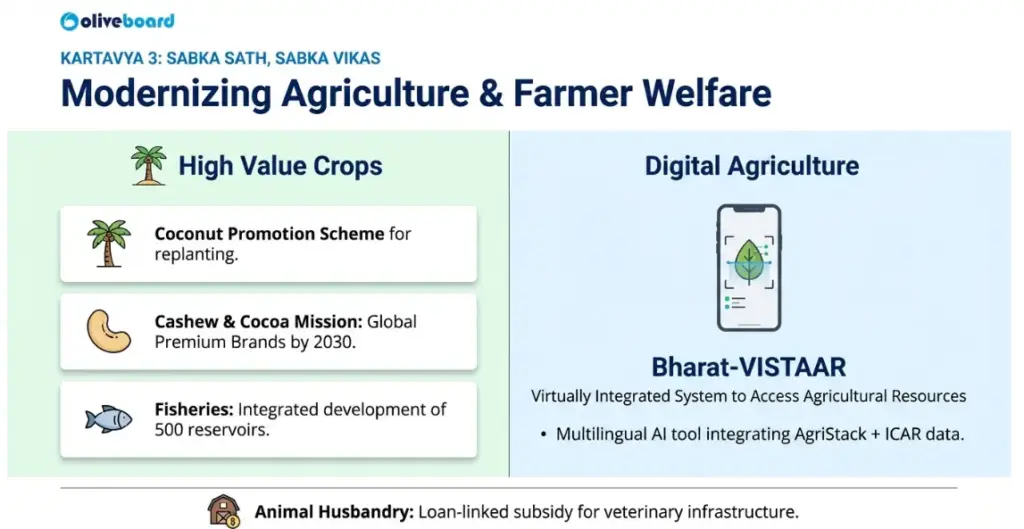
Union Budget 2026–27 gives strong attention to agriculture and fisheries to raise farm incomes, improve productivity, and reduce climate risks. The focus is on better irrigation, diversification into oilseeds and millets, digital farm services, storage facilities, and expansion of aquaculture and fish processing. These measures are aimed at strengthening rural livelihoods and food security.
- Expansion of irrigation projects
- Push for oilseeds, millets, and crop diversification
- Digital agriculture platforms for farmers
- Warehousing and cold-chain infrastructure
- Aquaculture development and fish processing
- Support for fisheries exports
Climate Resilience and Disaster Preparedness
Alongside clean-energy investments, the Budget increases attention to climate adaptation, flood control, drought management, and disaster-response systems.
- Flood-mitigation projects
- Coastal-resilience programmes
- Drought-proofing measures
- Disaster-response funding
Tourism and Cultural Infrastructure
Tourism is positioned as a labour-intensive growth engine, particularly for hill states, coastal regions, and heritage towns. Infrastructure upgrades and destination-management plans are proposed. Spiritual circuits and eco-tourism receive special emphasis.
- Tourism-infrastructure funding
- Heritage-site upgrades
- Eco-tourism promotion
- Regional tourism circuits
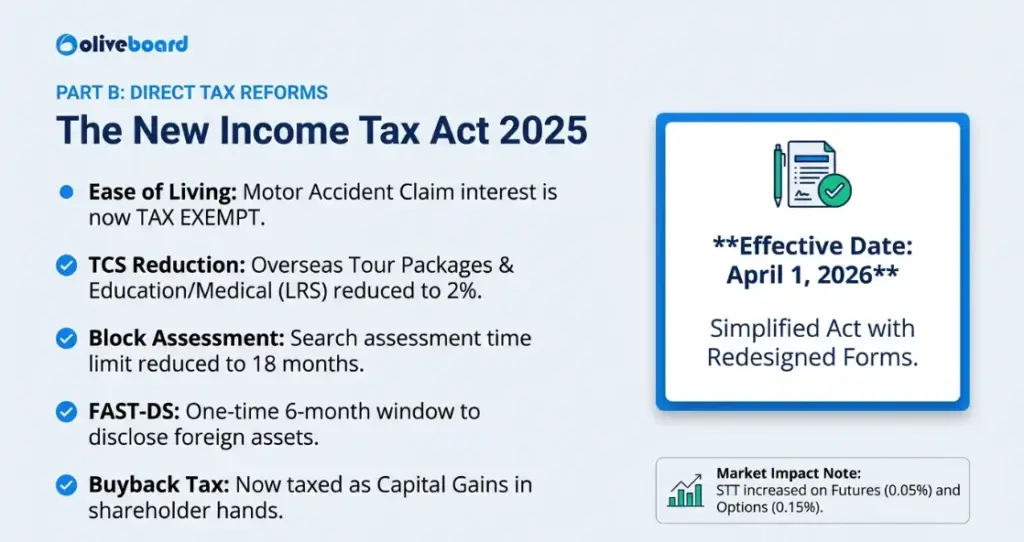
Income Tax and Relief to Middle-Class Taxpayers
Union Budget 2026–27 continues the government’s policy of keeping tax rates broadly stable while simplifying compliance and widening the tax base. Instead of major slab restructuring, the focus is on procedural ease, faster refunds, dispute resolution, and encouraging voluntary compliance.
The Budget also signals a predictable tax regime to support household consumption and long-term financial planning.
- No major changes to headline income-tax slab rates
- Greater automation in processing and refunds
- Dispute-resolution mechanisms strengthened
- Continued push for faceless assessments
- Simplification of compliance for salaried taxpayers
Encouraging Household Savings and Long-Term Investing
The Budget places renewed emphasis on channeling household savings into productive financial assets rather than idle holdings. Policy signals aim to strengthen participation in mutual funds, pensions, and insurance while keeping inflation protection in mind.
The broader objective is to mobilise domestic capital for infrastructure and industrial investment.
- Support for pension and long-term savings products
- Financial-literacy initiatives
- Retail participation in capital markets encouraged
- Stable taxation framework for investments
Foreign Investors and Global Capital Flows
Attracting stable foreign capital remains a priority in Budget 2026–27, particularly in manufacturing, infrastructure, green energy, and technology. Policy continuity, regulatory predictability, and faster approvals are emphasised to reassure international investors.
- Stable FDI policy regime
- Faster clearances for large projects
- Focus on green-field manufacturing
- Support for sovereign-wealth and pension funds
- Tax certainty for cross-border investors
Capital Markets and Financial-Sector Deepening
The Budget supports deeper and more resilient financial markets to fund India’s growth ambitions. Reforms target better corporate-bond markets, infrastructure-investment trusts, and retail investor protection.
These measures aim to diversify funding sources beyond bank credit.
- Development of corporate-bond markets
- Strengthening of InvITs and REITs
- Investor-protection mechanisms
- Market-regulator capacity building

Start-Ups and Innovation Ecosystem
Start-ups continue to receive policy attention as engines of innovation and productivity. Budget 2026–27 extends funding support, regulatory simplification, and R&D incentives, particularly for deep-tech, climate-tech, biotech, and defence applications.
The government also highlights stronger university-industry collaboration.
- Continued support for startup-fund-of-funds
- Regulatory simplification measures
- Tax-administration stability for new ventures
- Deep-tech and green-tech focus
- Innovation hubs in academic institutions
Insurance, Pensions and Social Security Expansion
Long-term household financial security is another theme of the Budget. Insurance penetration and pension coverage are being expanded, especially for informal-sector workers and gig-economy participants.
Digital enrolment platforms will play a major role.
- Insurance-access initiatives
- Pension coverage for informal workers
- Digital onboarding systems
- Financial-inclusion measures

Hi, I’m Tripti, a senior content writer at Oliveboard, where I manage blog content along with community engagement across platforms like Telegram and WhatsApp. With 3+ years of experience in content and SEO optimization related to banking exams, I have led content for popular exams like SSC, banking, railway, and state exams.