
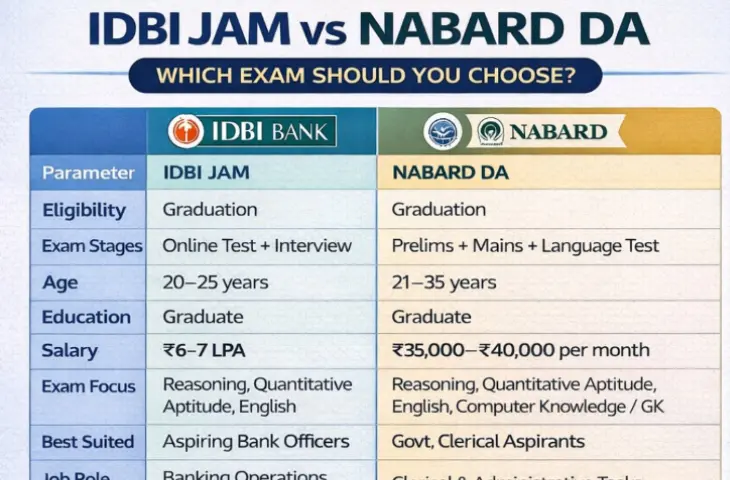
Many banking and finance aspirants often compare NABARD Development Assistant (DA) and IDBI Junior Assistant Manager (JAM) while deciding which exam to prepare for. Both recruitments offer stable government-sector careers but differ in job profile, career growth, and exam structure. NABARD DA is largely a clerical-level role focused on rural development administration, while IDBI JAM is an officer-level position in a commercial bank. Understanding their eligibility, selection process, salary, and growth opportunities can help candidates make a more informed choice.
NABARD DA vs IDBI JAM Eligibility
Before applying, candidates must ensure they meet the educational qualification and age criteria prescribed for each exam. Both exams require a graduate degree, but the minimum marks and age limits differ. NABARD DA also has a specific requirement for Hindi posts and includes computer knowledge, while IDBI JAM requires higher minimum graduation marks for general category candidates.
| Criteria | IDBI JAM | NABARD Development Assistant |
| Educational Qualification | Bachelor’s degree in any discipline from a recognized university | Bachelor’s degree in any discipline from a recognized university |
| Minimum Marks | 60% for General/EWS/OBC, 55% for SC/ST/PwBD | 50% for General (pass class for SC/ST/PwBD/Ex-Servicemen) |
| Additional Requirements | Basic computer knowledge, regional language desirable | Knowledge of word processing on PC |
| Minimum Age | 20 years | 21 years |
| Maximum Age | 25 years | 35 years |
NABARD DA vs IDBI JAM Selection Process
The recruitment stages for the two exams vary in complexity. IDBI JAM has a shorter selection process consisting of an online test followed by a personal interview. NABARD DA involves multiple stages, including preliminary and mains examinations along with a language proficiency test.
| Stage | IDBI JAM | NABARD Development Assistant |
| Stage 1 | Online Test | Preliminary Examination |
| Stage 2 | Personal Interview | Mains Examination |
| Stage 3 | — | Language Proficiency Test (LPT) |
| Final Selection | Based on online test and interview | Based on mains exam and LPT |
NABARD DA vs IDBI JAM Exam Pattern
The exam structure is different for both recruitments in terms of sections, duration, and question distribution. IDBI JAM Exam Pattern evaluates candidates across four major subjects including banking awareness and computer knowledge. NABARD DA Exam Pattern for prelims focus mainly on reasoning, quantitative aptitude, and English language.
| Feature | IDBI JAM Exam | NABARD DA Prelims |
| Mode of Exam | Online (Computer-Based Test) | Online Objective Test |
| Total Questions | 200 | 100 |
| Total Marks | 200 | 100 |
| Sections | Reasoning & DI, English Language, Quantitative Aptitude, Banking/Economy/Computer Awareness | English Language, Quantitative Aptitude, Reasoning Ability |
| Duration | 2 Hours (sectional timing) | 60 Minutes |
| Negative Marking | 0.25 marks for each wrong answer | 0.25 marks for each wrong answer |
NABARD DA vs IDBI JAM Salary
Both posts offer stable pay and benefits, but the salary structure differs because the roles belong to different cadres. IDBI JAM is an officer-level post with a higher annual CTC and faster salary growth. NABARD Development Assistant offers a structured clerical salary with multiple allowances and a stable monthly income.
| Component | IDBI JAM | NABARD Development Assistant |
| Basic Pay | ₹45,000 – ₹50,000 approx | ₹23,100 |
| Gross Salary | ₹50,000+ approx | ₹46,500 approx |
| In-Hand Salary | ₹42,000 – ₹45,000 approx | Around ₹40,000+ approx |
| Annual CTC | ₹6.14 – ₹6.50 lakh approx | Around ₹5.5 lakh approx |
| Allowances | DA, HRA, TA, medical benefits | DA, Grade Allowance, Transport Allowance, Special Allowances |
NABARD DA vs IDBI JAM Job Profile
The job responsibilities for both posts vary because one is an officer-level banking role and the other is a clerical administrative role. IDBI JAM officers handle banking operations, customer service, and branch-level responsibilities. NABARD Development Assistants mainly provide operational and clerical support in rural development and financial administration.
| Aspect | IDBI JAM | NABARD Development Assistant |
| Role Level | Officer-level position | Clerical/administrative role |
| Key Responsibilities | Banking operations, customer service, loan processing, branch operations | Record management, documentation, assisting officers, handling rural development program data |
| Work Environment | Commercial bank branches | NABARD offices and regional institutions |
| Focus Area | Banking and financial services | Rural development and agricultural finance administration |
NABARD DA vs IDBI JAM Career Growth
Career progression opportunities differ significantly between the two posts. IDBI JAM provides a direct entry into the officer cadre with faster promotions. NABARD Development Assistant begins at clerical level but allows promotion to officer positions through departmental exams and experience.
| Career Path | IDBI JAM | NABARD Development Assistant |
| Entry Role | Junior Assistant Manager (Grade O) | Development Assistant |
| First Promotion | Assistant Manager (Grade A) after 3 years | Officer Cadre through departmental exam |
| Mid-Level Roles | Deputy Manager / Manager | Assistant Manager / Deputy Manager |
| Senior Roles | Senior Manager, Chief Manager, Executive positions | Manager, Chief Manager, Regional Director |
Which exam should you choose?
Choosing between NABARD Development Assistant and IDBI Junior Assistant Manager depends largely on the type of role and career path a candidate prefers. Candidates looking for an officer-level role with faster promotions and exposure to banking operations may prefer IDBI JAM. Those who prefer a stable clerical position in a prestigious development-focused institution may find NABARD DA more suitable.
Why choose IDBI JAM?
- Direct entry into the officer cadre
- Higher starting salary and annual CTC
- Faster career progression in banking roles
- Exposure to branch operations and financial services
Why choose NABARD Development Assistant?
- Opportunity to work in a premier rural development institution
- Stable clerical-level workload with structured salary
- Promotion opportunities to officer cadre through internal exams
- Work related to agriculture, rural finance, and development programs
- NABARD DA vs IDBI JAM 2026: Eligibility, Salary & Career
- NABARD Grade A Question Papers, Section-Wise PYPs, Download PDFs
- ESI & ARD Practice Questions for NABARD Grade A 2026
- NABARD Grade A Practice Quiz, Download Free PDF
- Internet & Web for NABARD DA Exam: Free Quiz and PDF
- NABARD Development Assistant Exam Analysis 2026, All Shifts

Hi, I’m Tripti, a senior content writer at Oliveboard, where I manage blog content along with community engagement across platforms like Telegram and WhatsApp. With 3+ years of experience in content and SEO optimization related to banking exams, I have led content for popular exams like SSC, banking, railway, and state exams.