
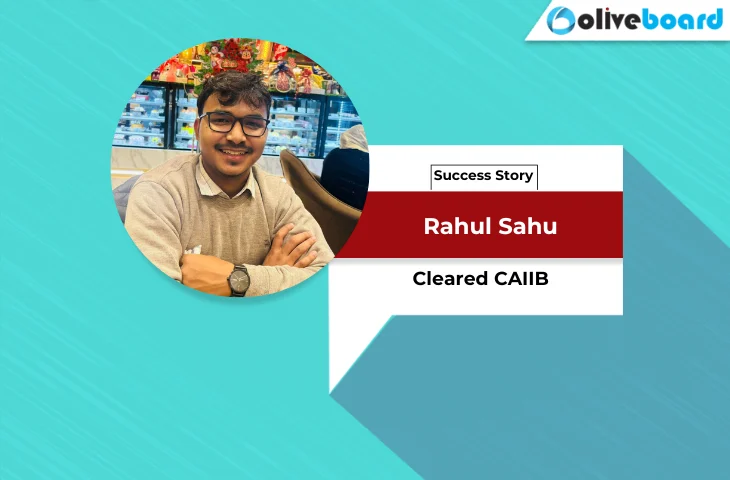
Most bankers believe CAIIB can’t be cleared in the first attempt, especially while managing branch work, targets, and transfers. Rahul Sahu proved that belief wrong by clearing all five CAIIB papers in his very first attempt. This achievement makes Rahul’s journey a real success story for ambitious bankers.
Success Story of Rahul Sahu
Rahul Sahu has successfully cleared the CAIIB (Certified Associate of Indian Institute of Bankers) Exam in his first attempt. He is currently working as a Junior Associate at State Bank of India, posted in Pratapgarh, Uttar Pradesh. Coming from a commerce background with B.Com and MBA (Finance), Rahul followed a structured plan and relied on just one platform. Thus, the journey of CAIIB becomes a true example of the Success Story of Rahul Sahu.
Interview with CAIIB First-Attempt Qualifier Rahul Sahu
Clearing CAIIB is challenging due to the exam’s vast syllabus, conceptual depth, and low pass percentage. Curious about his exact strategy? Here’s what Rahul told us in the interview, which highlights the remarkable Success Story of Rahul Sahu who qualified in his first attempt.
Q1. How did you feel when you first saw the CAIIB exam pattern across all papers?
A: When I first saw the ABM paper, I realised CAIIB is not about mugging up content. The questions are objective but highly conceptual. IIBF tests how well you link concepts across modules. If you’ve studied through structured classes and practiced questions properly, like Oliveboard did in their CAIIB batches, the pattern starts making sense.
Q2. When did you start your preparation and which batch did you follow?
A: I started my preparation about three months before the exam. I enrolled in Oliveboard’s CAIIB Super Elite batch. Initially, I thought of completing the foundation course, but due to time constraints, I shifted to the crash courses. All teachers were running subject-wise crash classes, which made it possible to complete the syllabus on time.
Q3. What was your strategy for ABM?
A: I scored 73 marks in ABM. The classes were very focused and exam-oriented. After completing lectures, I revised using Oliveboard PDFs and made handwritten notes. I condensed every chapter into two or three pages. Before the MCQ and cracker batch started, I revised my notes so I could identify weak areas during practice. This particular method was a significant part of my success story.
Q4. Bankers often fear BFM. How did you approach it?
A: I was scared of BFM initially and only aimed to clear it. But I ended up scoring 59 marks. BFM looks small but the syllabus is huge, especially for non-commerce students. Oliveboard’s classes and PDFs helped me cover the syllabus systematically. I also attended sessions, YouTube marathons, and practiced MCQs, which helped reduce fear.
Q5. ABFM was considered one of the toughest papers. How did you manage it?
A: I thought ABFM would be easy because it had more theory, but later realised it had many numericals. I had only five days left for ABFM due to exam scheduling and travel. I relied completely on my handwritten notes and Oliveboard revision PDFs and managed to score 63 marks.
Q6. How did examples and teaching style help in BRBL?
A: BRBL has many sections, limits, and provisions. The way concepts were explained in Oliveboard classes using stories and examples helped a lot. During the exam, those examples instantly came to mind. That’s why revision through class notes and recorded lectures was very helpful.
Q7. Why did you choose ITDB as your elective, and how did you prepare?
A: I chose ITDB because digital banking is important for long-term growth. Initially, I regretted it because the syllabus was big. I didn’t take any separate foundation or crash course. I just attended Oliveboard’s regular classes, watched YouTube marathons, and revised PDFs once. Even with limited time, I scored 65 marks.
Q8. Why were handwritten notes so important in your preparation?
A: With such a huge syllabus, revising PDFs again and again becomes difficult near the exam. When you make handwritten notes from Oliveboard PDFs and live classes, revision becomes easy. Even reducing a 30-page PDF to five pages of notes helps a lot in the last 15-20 days. No doubt, handwritten notes were pivotal in my story for CAIIB prep.
Q9. What advice would you give to candidates who couldn’t clear CAIIB?
A: Not clearing CAIIB doesn’t mean you can’t clear it. CAIIB needs time and consistency. If someone starts three or four months early and studies two to three hours daily using structured courses, mocks, and revision support like Oliveboard provides, clearing CAIIB is very much possible. Last-minute preparation won’t work.
Watch the full video:
Rahul Sahu’s CAIIB journey proves that early preparation, consistent study, and the right platform can help any banker clear CAIIB in the first attempt. This is an inspiring Success Story for many professionals.
If you are preparing for CAIIB, JAIIB, or future professional banking exams, start early, stay consistent, and choose a structured learning path. Use comprehensive courses, attend live and recorded classes, revise through PDFs and handwritten notes, and test yourself regularly with mocks. Let the Success Story of Rahul Sahu motivate you.

I started my journey with storytelling and journalism, and somewhere along the way, I discovered how much I truly love writing. Words have always been my way of connecting with people.
With 4+ years of experience in content creation, social media, and video storytelling, I focus on building meaningful conversations, not just posts. I enjoy understanding audiences, planning engaging content, and turning followers into active, connected communities.
At Oliveboard, I work on creating value-driven content that informs, engages, and brings people together.