
The 8th Pay Commission has become a major point of discussion among aspirants preparing for RBI Grade B, SSC CGL, and RRB Group D, as well as candidates targeting other government and banking jobs. With the commission expected to revise salaries from January 2026, the biggest questions candidates are asking are how much salaries may increase, which posts will benefit the most, and whether bank employees will also see a pay hike.
Key Takeaways
- The 8th Pay Commission, appointed to revise salaries for government employees, is expected to introduce significant pay increases by January 2026.
- Salaries for positions like RBI Grade B and SSC CGL may increase by 30-34%, with specific revised basic pay details provided for various roles.
- Bank employees’ salaries won’t directly change under the 8th Pay Commission but may align with government salary revisions post-implementation of 13th Bipartite Settlement.
- Experts suggest the fitment factor for the 8th Pay Commission will range from 1.83 to 2.86, affecting pay scale adjustments significantly.
- Employees will receive arrears calculated based on the delayed implementation of salary revisions, effective from January 2026.
In this blog we will provided the expected salary revisions, fitment factor, DA impact, arrears, and post-wise salary estimates to help aspirants clearly understand what their pay structure could look like after the 8th Pay Commission..
What is the 8th Pay Commission, and how will it affect Government employees’ salaries?
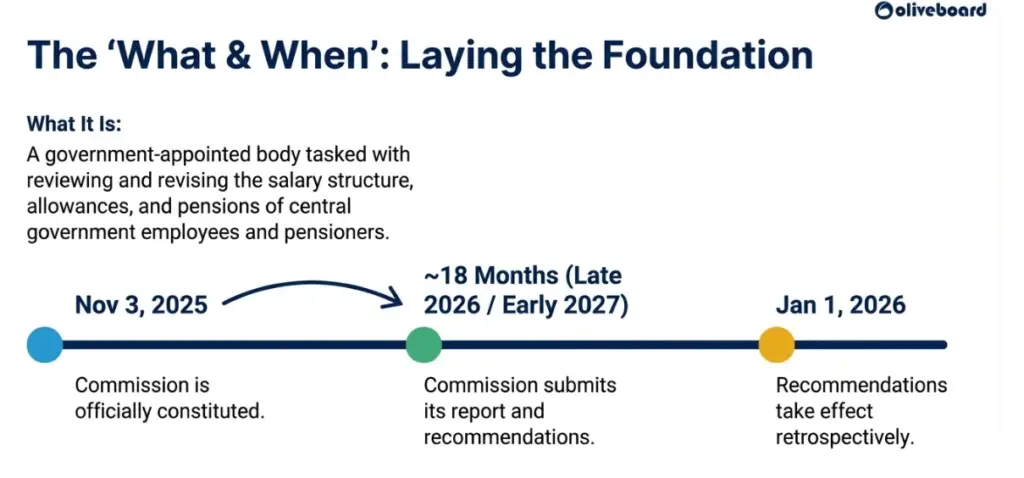
The 8th Pay Commission is a government-appointed body tasked with reviewing and revising the salary structure, allowances, and pensions of central government employees and pensioners. Officially constituted on 3rd November 2025, the commission is expected to submit its report within 18 months. Its recommendations are proposed to take effect from 1st January 2026, though actual implementation may happen later.
Once implemented, the 8th Pay Commission is expected to lead to a significant increase in basic pay, along with revisions in allowances and pensions, thereby improving overall earnings for government employees and retirees.
Reference: Watch the You Tube Video
How much will salaries increase for RBI Grade B, SSC CGL, RRB Group D, after the 8th Pay Commission is implemented?
After the implementation of the 8th Pay Commission, salaries across government exams such as RBI Grade B, SSC CGL, and RRB Group D are expected to see a broad increase of around 30–34%, depending on the final fitment factor, which is projected to range between 1.83 and 2.46.
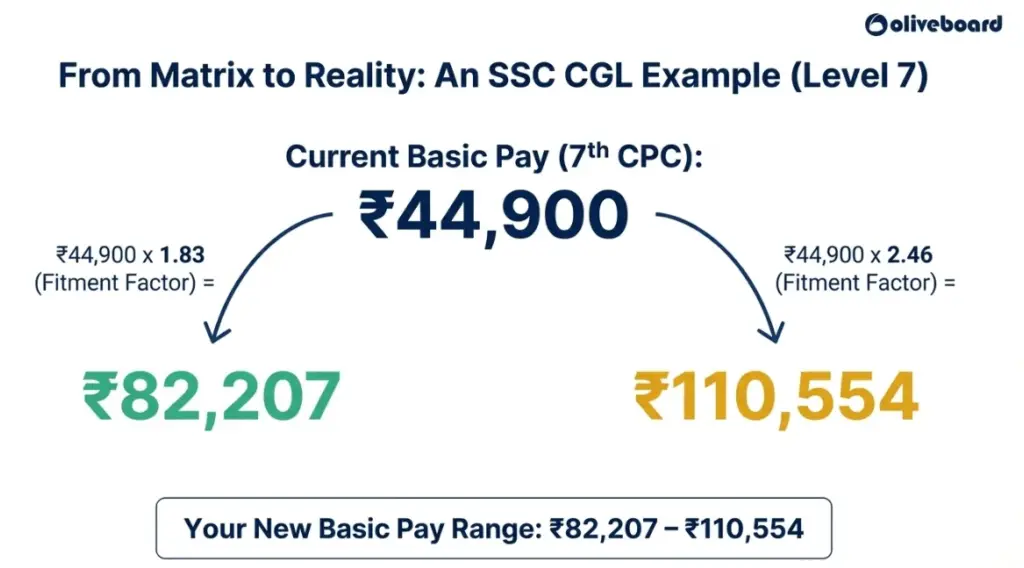
For RRB Group D (Pay Matrix Level 1), the basic pay could rise from ₹18,000 to roughly ₹32,940–₹44,280. SSC CGL posts, which typically fall between Pay Matrix Levels 4 to 7, may see basic salaries increase from the current ₹25,500–₹44,900 range to approximately ₹46,665–₹1.10 lakh, depending on level and fitment factor.

While RBI Grade B officers follow a separate pay structure, any alignment or revision in line with the 8th Pay Commission could also result in a substantial upward revision.
How do the pay levels offered for different posts through different exams vary?
The 8th Pay Commission is expected to bring a substantial revision in basic pay across various government exams and posts, including regulatory bodies, railways, and SSC recruitments. The table below provides a comparative overview of the current basic pay under the 7th Pay Commission and the expected revised basic pay under the 8th Pay Commission for some of the exams.
| Exam Name | Current Basic Range | Expected Rate After 8th Pay Commission |
| RBI Grade B | Basic Range: Rs. 78,450 (as per Notification 2025) Approx Pay Scale Range as per 7 CPC: Level 12 (Rs. 78,800) | Expected Revised Pay Scale: (Rs. 144,144 – Rs. 193,728) |
| NABARD Grade A | Basic Range: Rs. 44,500 (as per Notification 2025-26) Approx Pay Scale Range as per 7 CPC: Level 7 (Rs. 44,900) | Expected Revised Pay Scale: (Rs. 82,207 – Rs. 1,10,554) |
| SEBI Grade A | Basic Range: Rs. 62,500 (as per Notification 2025-26) Approx Pay Scale Range as per 7 CPC: Level 11 (Rs. 67,700) | Expected Revised Pay Scale: (Rs. 1,23,381 – Rs. 1,66,452) |
| SIDBI Grade A | Basic Range: Rs. 44,500 (as per Notification 2025) Approx Pay Scale Range as per 7 CPC: Level 7 (Rs. 44,900) | Expected Revised Pay Scale: (Rs. 82,207 – Rs. 1,10,554) |
| SIDBI Grade B | Basic Range: Rs. 55,200 (as per Notification 2025) Approx Pay Scale Range as per 7 CPC: Level 10 (Rs. 56,100) | Expected Revised Pay Scale: (Rs. 102,423 – Rs. 137,826) |
| IFSCA Grade A | Basic Range: Rs. 62,500 (as per Notification 2025-26) Approx Pay Scale Range as per 7 CPC: Level 11 (Rs. 67,700) | Expected Revised Pay Scale: (Rs. 1,23,381 – Rs. 1,66,452) |
| PFRDA Grade A | Basic Range: Rs. 44,500 (as per Notification 2025) Approx Pay Scale Range as per 7 CPC: Level 7 (Rs. 44,900) | Expected Revised Pay Scale: (Rs. 82,207 – Rs. 1,10,554) |
| RRB JE | Basic Range: Level 6 ₹35,400 | Expected Revised Pay Scale: (Rs. 64,872 – Rs. 87,084) |
| RRB ALP | Basic Range: Level 2 ₹19,900 | Expected Revised Pay Scale: (Rs. 36,417 – Rs. 48,974) |
| RRB Group D | Basic Range: Level 1 ₹18,000 | Expected Revised Pay Scale: (Rs. 32,940 – Rs. 44,280) |
| RRB Constable | Basic Range: Level 3 ₹21,700 | Expected Revised Pay Scale: (Rs. 39,711 – Rs. 53,466) |
| RRB SI | Basic Range: Level 6 ₹35,400 | Expected Revised Pay Scale: (Rs. 64,872 – Rs. 87,084) |
| RRB Technician | Basic Range: Level 5 Rs. 29,200 (Grade 1) Basic Range: Level 2 Rs.19,900 (Grade 3) | Expected Revised Pay Scale: (Rs. 36,417 – Rs. 48,974) Expected Revised Pay Scale: (Rs. 36,417 – Rs. 48,974) |
| RRB NTPC | Basic Range: Level 2 ₹19,900 | Expected Revised Pay Scale: (Rs. 36,417 – Rs. 48,974) |
| RRB Paramedical | Basic Range: Level 2 ₹19,900 | Expected Revised Pay Scale: (Rs. 36,417 – Rs. 48,974) |
| SSC CGL | Basic Range: Level 4 (₹25,500) to Level 8 (₹47600) | Expected Revised Pay Scale: Level 4 (Rs. 46,665 – Rs. 62,850) Level 8 (Rs. 87,168 – Rs. 117,177) |
| SSC CHSL | Basic Range: Level 2 ₹19,900 -Level 4 ₹25,500 | Expected Revised Pay Scale: Level 2 (Rs. 36,417 – Rs. 48,974) Level 4 (Rs. 46,665 – Rs. 62,850) |
| SSC MTS | Basic Range: Level 1₹18,000 | Expected Revised Pay Scale: (Rs. 32,940 – Rs. 44,280) |
| SSC CPO | Basic Range: Level 6 ₹35,400 | Expected Revised Pay Scale: (Rs. 64,872 – Rs. 87,084) |
| SSC GD | Basic Range: Level 3 ₹21,700 | Expected Revised Pay Scale: (Rs. 39,711 – Rs. 53,466) |
| SSC Stenographer | Basic Range: Level 1 ₹18000 – Level 7 ₹44900 | Expected Revised Pay Scale: Level 1 (Rs. 32,940 – Rs. 44,280) Level 7 (Rs. 82,207 – Rs.110,554) |
| SSC JE | Basic Range: Level 6 ₹35,400 | Expected Revised Pay Scale: (Rs. 64,872 – Rs. 87,084) |
| SSC JHT | Basic Range: Level 6 ₹35,400 to Level 7 ₹35,400 | Expected Revised Pay Scale: Level 6 (Rs. 64,872 – Rs. 87,084) Level 7 (Rs. 82,207 – Rs.110,554) |
| SSC Selection Post | Basic Range: Level 1 ₹18000 – Level 7 ₹44900 | Expected Revised Pay Scale: Level 1 (Rs. 32,940 – Rs. 44,280) Level 7 (Rs. 82,207 – Rs.110,554) |
What will be the revised bank employees’ salary after the 8th Pay Commission?
The 8th Pay Commission will not directly revise the salaries of bank employees, as public sector banks follow the Bipartite Settlement system, not Pay Commissions. Currently, bank employees’ salaries are governed by the 12th Bipartite Settlement, which was signed in March 2024 and remains valid until 31 October 2027. After this period, salaries of SBI PO, SBI Clerk, IBPS PO, IBPS Clerk, and other bank employees will be revised under the 13th Bipartite Settlement.
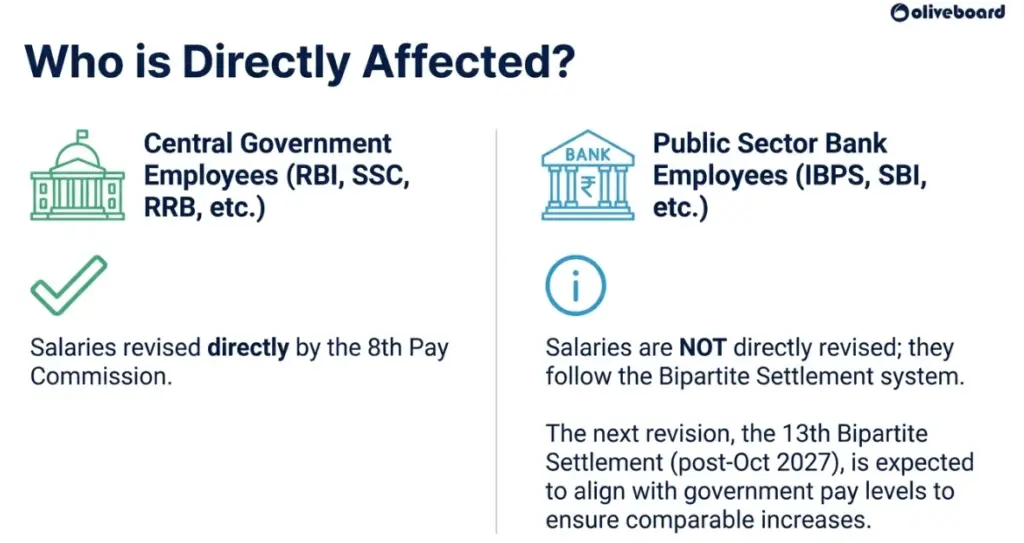
While this revision will be negotiated separately, it is expected to broadly align bank salaries with the revised pay levels of central government employees following the implementation of the 8th Pay Commission, ensuring that bank employees receive a comparable level of salary increase rather than being left behind.
Also Check: Will 8th Pay Commission Affect Bank Employees’ Salary
What is the fitment factor on which salaries will be revised?
The fitment factor is a key tool used by Pay Commissions to revise government employees’ and pensioners’ basic pay. It helps convert old salaries into new ones by considering inflation, cost of living, and real wage growth. The final fitment factor determines how much basic pay will increase under a new pay structure.
- Final factor: Depends on economic conditions, fiscal considerations, and commission recommendations.
- Definition: Multiplier used to revise basic pay and pensions.
- Purpose: Accounts for inflation, cost of living, and real wage growth.
- 7th Pay Commission: Fitment factor was 2.57.
- 8th Pay Commission projection: Experts estimate 1.83-2.86.
- Impact: Higher fitment factor – bigger increase in basic salaries.
As per the news, the 8th Pay Commission will be implemented from January 2026, but the commission will release the rates by late 2026 or early 2027. How does it work?
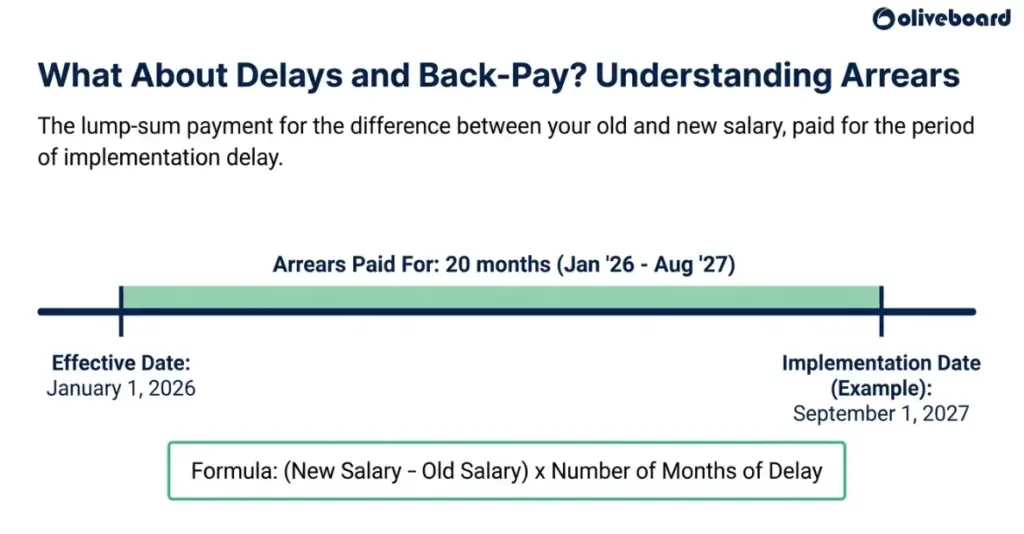
Although the 8th Pay Commission is scheduled to take effect from January 1, 2026, the actual revision of salaries may not happen immediately. This is because the commission, constituted in November 2025, is expected to take around 18 months to study pay structures, consult stakeholders, and submit its recommendations. Once the report is submitted likely by late 2026 or early 2027 the government will review and approve the recommendations before implementing them. When implemented, salary revisions are usually given retrospective effect from January 2026, and employees receive arrears for the delayed period, similar to the implementation pattern followed in earlier Pay Commissions.
What are arrears, and how are they calculated?
Arrears are pending salary or pension payments given to employees when a new Pay Commission’s recommendations are implemented later than their effective date. They ensure employees receive the difference for the period of delay between the old and revised pay.

- Payment mode: Paid as a lump sum along with the revised salary.
- Definition: Pending salary/pension paid for the period between the effective date and implementation of revised pay.
- Example: For the 8th Pay Commission, if pay is effective from 1st Jan 2026 but implemented later in 2026/2027, arrears cover the difference.
- Calculation: Multiply the monthly pay difference (after applying the new fitment factor) by the number of delayed months.
What is the expected salary hike under the 8th Pay Commission pay matrix?
The table below shows the projected revision in basic pay under the 8th Pay Commission across different pay matrix levels. Based on the expected fitment factor range of 1.83 to 2.46, it compares the current basic salaries under the 7th Central Pay Commission with the likely revised basic pay under the 8th Pay Commission. These estimates help aspirants to understand the potential salary increase across various levels once the new pay structure is implemented.
| Pay Matrix Level | 7th CPC Basic Salary | 8th CPC Basic Salary (Low End – 1.83) | 8th CPC Basic Salary (High End – 2.46) |
| Level 1 | Rs. 18,000 | Rs. 32,940 | Rs. 44,280 |
| Level 2 | Rs. 19,900 | Rs. 36,417 | Rs. 48,974 |
| Level 3 | Rs. 21,700 | Rs. 39,711 | Rs. 53,466 |
| Level 4 | Rs. 25,500 | Rs. 46,665 | Rs. 62,850 |
| Level 5 | Rs. 29,200 | Rs. 53,416 | Rs. 71,923 |
| Level 6 | Rs. 35,400 | Rs. 64,872 | Rs. 87,084 |
| Level 7 | Rs. 44,900 | Rs. 82,207 | Rs. 110,554 |
| Level 8 | Rs. 47,600 | Rs. 87,168 | Rs. 117,177 |
| Level 9 | Rs. 53,100 | Rs. 97,059 | Rs. 130,386 |
| Level 10 | Rs. 56,100 | Rs. 102,423 | Rs. 137,826 |
| Level 11 | Rs. 67,700 | Rs. 123,381 | Rs. 166,452 |
| Level 12 | Rs. 78,800 | Rs. 144,144 | Rs. 193,728 |
| Level 13 | Rs. 1,23,100 | Rs. 225,473 | Rs. 302,226 |
| Level 13A | Rs. 1,31,100 | Rs. 240,513 | Rs. 322,311 |
| Level 14 | Rs. 1,44,200 | Rs. 263,886 | Rs. 354,172 |
| Level 15 | Rs. 1,82,200 | Rs. 333,426 | Rs. 448,713 |
| Level 16 | Rs. 2,05,400 | Rs. 375,882 | Rs. 505,584 |
| Level 17 | Rs. 2,25,000 | Rs. 411,750 | Rs. 553,500 |
| Level 18 | Rs. 2,50,000 | Rs. 457,500 | Rs. 615,000 |
Reference: Check Details
FAQs
It is a government-appointed body that revises salaries, allowances, and pensions of central government employees.
It is proposed to be effective from 1st January 2026, though actual implementation may happen later.
No official decision has been announced yet.
It is expected after the 12th Bipartite Settlement expires on 31 October 2027.
Posts under SSC, Railways, central government services, and regulatory bodies are expected to see revisions.
- IBPS Clerk Exam Analysis 2026, Check 11th October, Shift 1 Review
- RRB NTPC Geography Syllabus, Topics and Live Quiz
- RRB NTPC Medical Rejections, Know the Reasons
- Railway Station Master Syllabus 2026, Check New CBT Pattern
- Railway Station Master Application Form 2026, Get Apply Online Link
- Railway Station Master Exam Date 2026, Check CBT Schedule

Hi, I’m Aditi. I work as a Content Writer at Oliveboard, where I have been simplifying exam-related content for the past 4 years. I create clear and easy-to-understand guides for JAIIB, CAIIB, and UGC exams. My work includes breaking down notifications, admit cards, and exam updates, as well as preparing study plans and subject-wise strategies.
My goal is to support working professionals in managing their exam preparation alongside a full-time job and to help them achieve career growth.