
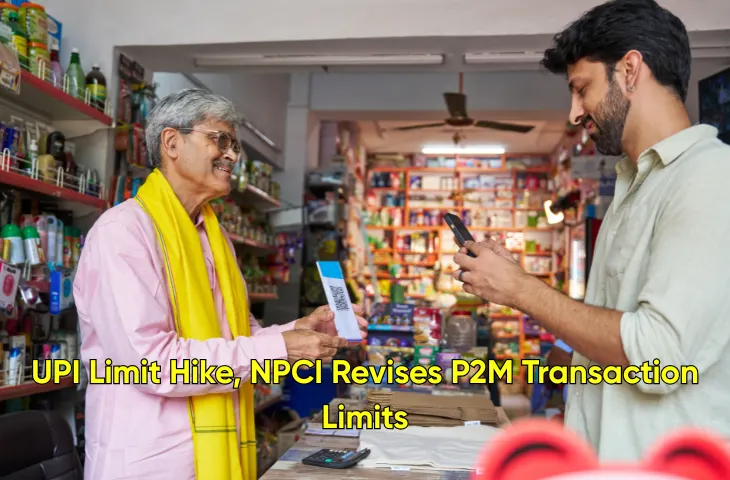
UPI Limit Hike: In a significant move to promote digital transactions, the National Payments Corporation of India (NPCI) has revised the Unified Payments Interface (UPI) limits for Person-to-Merchant (P2M) payments. The update, effective from 15 September 2025, allows higher-value payments in specific sectors like insurance, investments, loan repayments, and government marketplaces. This step strengthens India’s digital payment ecosystem and reduces reliance on traditional banking methods such as NEFT and RTGS for large-value transactions.
What Has Changed in UPI Limits?
NPCI’s circular introduces higher limits for UPI-based P2M transactions while keeping person-to-person (P2P) limits unchanged. This ensures that larger payments in key sectors can be made digitally without delays.
- Per-transaction limit for P2M payments: ₹5 lakh
- Daily cap across all P2M transactions: ₹10 lakh
- Applies only to verified merchants
- No change in P2P daily limit, which remains ₹1 lakh
This change ensures that UPI remains both user-friendly and secure while accommodating the increasing demand for high-value digital transactions.
Sectors Eligible for UPI Limit Hike
The revised UPI limits are applicable only in selected categories that frequently involve large-value transactions. This targeted approach avoids misuse while making digital payments seamless for critical services.
- Insurance Premium Payments: Policyholders can now pay annual or bulk premiums directly via UPI without splitting payments.
- Capital Market Investments: Payments for mutual funds, bonds, or equities can be settled quickly and securely.
- Travel and Tourism Services: High-value bookings such as international flights or holiday packages can be paid in a single UPI transaction.
- Loan Collections and EMI Payments: Banks and NBFCs can collect larger EMIs or loan repayments through UPI.
- Government e-Marketplace (GeM) Transactions: Businesses engaging with government procurement platforms can now settle payments faster through UPI.
Benefits of the UPI Limit Hike
The NPCI’s move is not only about increasing transaction ceilings but also about expanding the scope of digital payments in India’s financial ecosystem.
Boost to Digital Transactions
High-value payments that previously required RTGS or NEFT can now be completed via UPI. This reduces reliance on traditional channels and makes the process faster and more efficient.
Encouragement of the Formal Economy
Routing high-value transactions through UPI ensures greater transparency. It improves financial reporting and helps in regulatory compliance, especially in insurance and capital markets.
Convenience for Users and Merchants
- Customers can make one-time payments without splitting transactions.
- Merchants receive quicker settlements, improving their cash flow.
- Payment processes become smoother across platforms, enhancing customer satisfaction.
Static Facts for Exams
This section provides key details that aspirants must remember for bank and insurance exams.
- Announced by: National Payments Corporation of India (NPCI)
- Effective Date: 15 September 2025
- New P2M Per-Transaction Limit: ₹5 lakh
- New P2M Daily Aggregate Limit: ₹10 lakh
- Applies to: Verified merchants only
- No change in Person-to-Person (P2P) limit (remains ₹1 lakh daily)
UPI and India’s Digital Economy
UPI has already revolutionised India’s payment system by making transactions simple, real-time, and low-cost. This limit hike strengthens UPI’s role as a preferred channel for high-value payments, especially as India moves towards a less-cash economy. By supporting sectors like insurance, investments, and government procurement, the NPCI ensures that digital payments expand into areas where traditional banking once dominated.
Impact on Banking and Insurance Sector
The banking and insurance sectors stand to gain significantly from this move. Insurers can streamline premium collections, banks can facilitate large EMI payments through UPI, and capital markets can handle investor transactions more efficiently. This reduces dependency on older systems and positions UPI as an all-encompassing digital payment solution.
Challenges Ahead
While the revision is progressive, certain challenges must be addressed to ensure smooth adoption.
- Security Risks: High-value transactions make UPI a potential target for fraud, requiring strong authentication and monitoring.
- Merchant Onboarding: Only verified merchants can access the revised limits, so widespread adoption will depend on merchant compliance.
- User Awareness: Customers must be made aware of the new limits and the conditions under which they apply.
| Also Read |
| Digital Banking in India |
| Bharat Bill Payment System |
| Forex Market |
| Aadhaar Enabled Payment System |
| Electronic Clearing System |
FAQs
Q1. What is the new UPI limit for Person-to-Merchant (P2M) payments?
A1. The revised UPI limit allows payments up to ₹5 lakh per transaction and a daily cap of ₹10 lakh across all P2M transactions, applicable from 15 September 2025.
Q2. Does the UPI limit hike apply to all types of transactions?
A2. No, the higher limits apply only to specified sectors such as insurance, capital market investments, travel and tourism, loan repayments, and Government e-Marketplace transactions.
Q3. Has the UPI limit for Person-to-Person (P2P) payments changed?
A3. No, the UPI daily limit for P2P transactions remains unchanged at ₹1 lakh.
Q4. Who announced the revised UPI limits and when do they take effect?
A4. The National Payments Corporation of India (NPCI) announced the changes, which are effective from 15 September 2025.
Q5. Why has NPCI increased UPI limits for P2M transactions?
A5. The increase aims to promote high-value digital payments, enhance convenience for users and merchants, reduce dependence on traditional banking methods, and strengthen transparency in financial transactions.
- Profit & Loss Questions for Bank Exams, FREE PDF & Live Quiz
- Inequalities Questions for Bank Exams, FREE PDF & Quiz
- Reasoning Questions for Bank Exams, FREE PDF & Quiz
- Banking Exams Eligibility 2026: Age Limit, Qualification, Nationality & More
- IOB LBO GA Questions Asked 2026, 29th and 24th September
- IBPS RRB PO 2nd Reserve List 2026 Out, Check Now

Hi, I’m Tripti, a senior content writer at Oliveboard, where I manage blog content along with community engagement across platforms like Telegram and WhatsApp. With 3+ years of experience in content and SEO optimization related to banking exams, I have led content for popular exams like SSC, banking, railway, and state exams.