
The RRB Group D Physical Efficiency Test (PET) is a crucial part of the recruitment process conducted by the Railway Recruitment Board (RRB) for various Group D posts such as Track Maintainer, Helper, Assistant Pointsman, Porter, and related categories. While many applicants focus on written exams (CBT), the RRB Group D physical efficiency test often becomes a decisive stage – especially for candidates from rural backgrounds and physically active lifestyles. This article gives you a comprehensive and insightful understanding of the PET, including its importance, standards, training strategies, rules, evaluation criteria, and preparation tips beyond what typical pages offer.
What is the RRB Group D Physical Efficiency Test?
According to the RRB Group D notification, the physical efficiency test is a qualifying test of physical performance where candidates demonstrate their stamina, strength, and endurance through a simple but rigorous activity – typically running. Unlike academic exams, PET tests your functional fitness, which is essential for the physically demanding roles in the railways.
Why the Physical Efficiency Test matters?
The RRB Group D physical efficiency test matters because the job requires candidates to be physically fit to undertake roles like maintaining tracks, lifting equipment, and assisting passengers. Given below are the details:
- Ensures safety of workforce and passengers
- Filters candidates with adequate fitness
- Encourages healthy and resilient workforce culture
- Reduces workplace injuries
What is the RRB Group D Selection Process
The RRB Group D selection process is divided into stages like – CBT, PET, DV and Medical Test. Given below are the details:
| Stage | Details |
| Computer-Based Test (CBT) | Online test with objective questions on General Science, Mathematics, General Intelligence, and Current Affairs. |
| Physical Efficiency Test (PET) | Tests physical fitness of candidates through running and weight-lifting activities. |
| Document Verification | Verification of educational, category, and identity documents. |
| Medical Examination | Ensures candidates meet vision and medical standards. |
RRB Group D Physical Test details
The RRB Group D PET 2026 is expected to follow the same pattern as in the previous recruitment cycle. It consists mainly of two tasks:
- Weight Lifting (Carrying and Lifting Weight)
- Running / 1000 Metres Race
These tasks assess both muscular strength and cardiovascular endurance – two vital attributes for railway maintenance and field work.
What is the RRB Group D Physical Test for males?
The RRB Group D physical test for males involves tasks like weight lifting and running. The details are tabulated below:
| Task | Requirement | Attempts Allowed |
| Weight Lifting | Should lift and carry 35 kg of weight for 100 metres in 2 minutes without putting it down. | Only one chance |
| Running | Should run a distance of 1000 metres in 4 minutes and 15 seconds in one attempt. | Only one chance |
What is the RRB Group D Physical Test for females?
The RRB Group D physical test for females evaluates their lifting and running capabilities. Check out the requirements:
| Task | Requirement | Attempts Allowed |
| Weight Lifting | Should lift and carry 20 kg of weight for 100 metres in 2 minutes without putting it down. | Only one chance |
| Running | Should run 1000 metres in 5 minutes and 40 seconds in one attempt. | Only one chance |
PET Evaluation by Category
A detailed table for PET evaluation by category is given below. Candidates must check them out:
| Category | Activity | Distance | Time Limit | Qualifying Standard |
| Male | Run | 1.5 km | 05:30 mins | Complete within time |
| Female | Run | 1.0 km | 05:00 mins | Complete within time |
| Ex-Servicemen (Male) | Run | 1.5 km | 05:45–06:00 mins (based on relaxation) | Complete within time |
| Ex-Servicemen (Female) | Run | 1.0 km | 05:15–05:30 mins | Complete within time |
RRB Group D PET Schedule 2026
The Railway Group D physical test schedule will be released soon for the applicants after the CBT exam is over. The zone-wise dates will be updated in this table when released by the official sources.
| Zone | Date |
| RRB Bhubaneshwar | To be released |
| RRB South Central (Secunderabad) | To be released |
| RRB Chennai | To be released |
| RRB Ajmer | To be released |
| RRB Mumbai | To be released |
| RRB Gorakhpur | To be released |
| RRB Prayagraj | To be released |
| RRB Siliguri | To Be Announced |
| RRB Malda | To be released |
| RRB Patna | To be released |
| RRB Muzzaffarnagar | To be released |
| RRB Ranchi | To be released |
| RRB Kolkata | To be released |
| RRB Bengaluru | To be released |
| RRB Chandigarh | To be released |
| RRB Ahmedabad | To be released |
| RRB Bhopal | To be released |
| RRB Bilaspur | To be released |
| RRB Jammu and Kashmir | To be released |
| RRB Guwahati | To be released |
| RRB Thiruvananthapuram | To be released |
How are PET scores calculated for Group D recruitment?
Unlike exams with numerical marks, RRB Group D PET is evaluated on a pass/fail basis. There is no scoring system, such as marks or ranking. Candidates must simply complete the run within the required time. This means:
- Even if you finish earlier than required, you earn no extra benefit.
- If you fail by even a few seconds, you are disqualified.
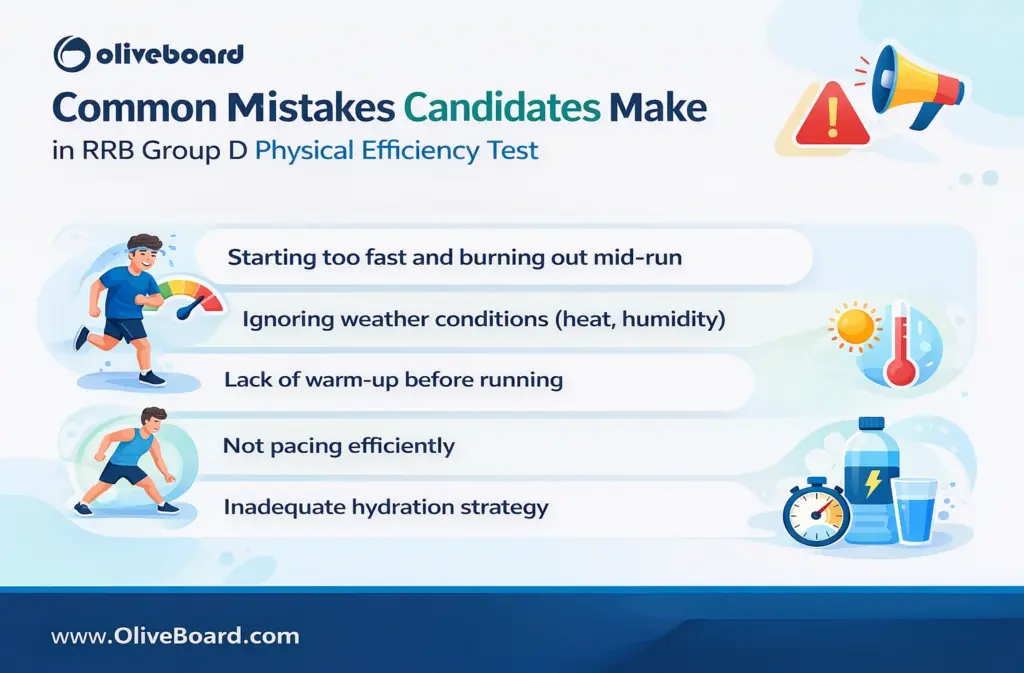
What are the common mistakes that candidates make for PET?
Candidates commit certain mistakes, such as starting too fast and burning out later, not pacing efficiently. Check out some of the common mistakes:
Training Plan for Railway Group D PET Success
To excel in the RRB Group D physical efficiency test, you need strategic training, not random workouts. Check out the plan:
| Week | Run Type | Distance | Goal |
| 1–2 | Easy Run | 1–2 km | Build base endurance |
| 3–4 | Interval Run | 0.5 km x 3 | Improve speed |
| 5–6 | Tempo Run | 1.5 km | Increase stamina |
| 7–8 | Hill/Incline | 1–1.5 km | Improve strength |
| 9–10 | Long Run | 2–3 km | Boost endurance |
| 11–12 | Simulation Run | 1.5/1 km | Time trial practice |
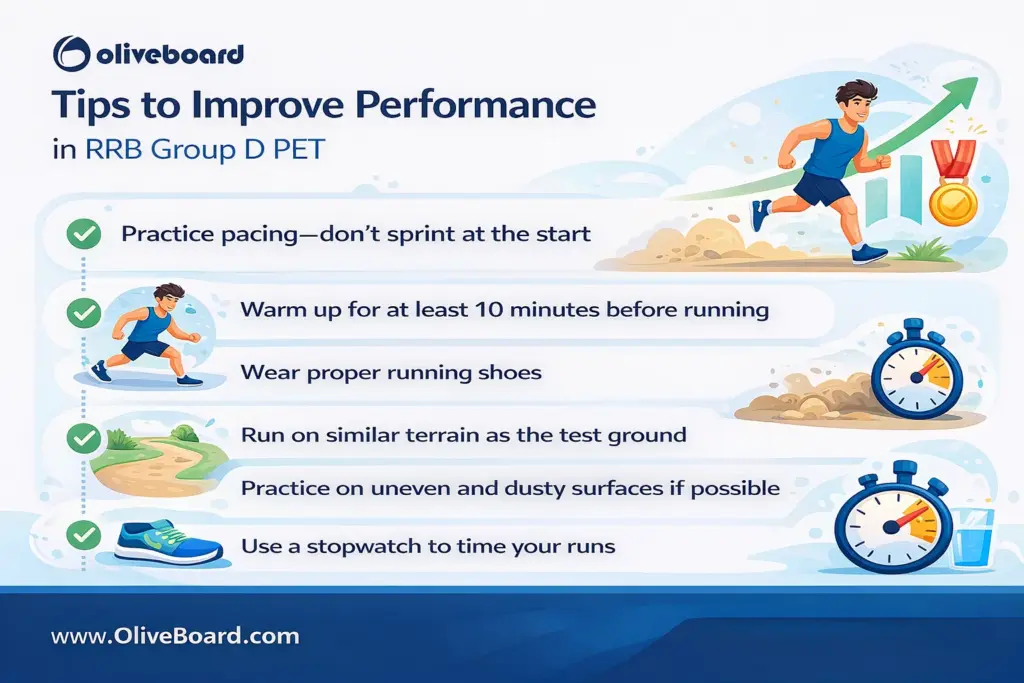
How can I improve my performance in Railway Group D PET 2026?
To improve performance, candidates must practice warm-ups for at least 10 minutes, wear proper running shoes, and more. Given below are the details:
Key Points – RRB Group D PET 2026
The key points of the article are summarised below for the candidates. Check out for a quick overview:
| Aspect | Male Candidates | Female Candidates |
| Weight to Carry | 35 kg for 100 metres | 20 kg for 100 metres |
| Time Limit (Weight Task) | 2 minutes (without setting it down) | 2 minutes (without setting it down) |
| Running Distance | 1000 metres | 1000 metres |
| RRB Group D Running Time Limit | 4 min 15 sec | 5 min 40 sec |
| Number of Attempts | 1 | 1 |
| Nature of Test | Qualifying | Qualifying |
The RRB Group D Physical Efficiency Test 2026 is not merely a formality – it’s a reflection of a candidate’s readiness to take on real-world railway responsibilities. With proper physical preparation, disciplined training, and mental determination, every aspirant can clear the PET with ease.
FAQs
The RRB Group D Physical Efficiency Test is a qualifying physical test conducted after the Computer-Based Test (CBT). It evaluates a candidate’s strength and endurance through activities like weight lifting and running to ensure they are fit for physically demanding railway duties.
Male candidates must:
Lift and carry 35 kg of weight for 100 metres in 2 minutes without putting it down.
Run 1000 metres in 4 minutes and 15 seconds in one go.
Only one attempt is allowed for each event.
Female candidates must:
Lift and carry 20 kg of weight for 100 metres in 2 minutes without putting it down.
Run 1000 metres in 5 minutes and 40 seconds in one attempt.
No relaxation or retest is permitted.
The PET is purely qualifying in nature. No marks are added to the final merit list. However, candidates must pass both tasks (weight lifting and running) to proceed to the next stage – Document Verification and Medical Test.
Begin regular running practice to build stamina.
Do strength training like push-ups, squats, and lifting exercises.
Follow a balanced diet and stay hydrated.
Simulate the test environment to improve timing and confidence.
Avoid overtraining and ensure adequate rest before the test day.
- RRB Technician Answer Key 2026 Out, Grade 1 & 3 Download Link
- Top RRB Technician Science Questions, Download Free PDF
- RRB Technician City Intimation Slip 2026, Check Exam City
- RRB Technician Grade 3 Chemistry Syllabus, Check Topics
- RRB Technician Grade 3 Mathematics Syllabus, Check Exam Pattern
- RRB Technician Maths Questions, Attempt Live Quiz & Download PDF

Hello! This is Arijit Dutta. I am a skilled Content Writer at Oliveboard with nearly 3+ years of experience in crafting engaging, informative, and exam-focused content for the Railways Domain. With a strong command of language and a keen understanding of learner needs, I contribute significantly to Oliveboard’s mission of delivering high-quality educational resources. Passionate about clear communication and continuous learning, I consistently create content that helps government job aspirants achieve their goals. Outside of work, I enjoy playing cricket and listening to music, which helps me stay balanced and creative in my professional journey.