
The negative marking in the RRB Technician exam is one of the most crucial factors that can make or break your Computer-Based Test (CBT) performance. While many candidates understand that guessing wrong answers can reduce their score, few grasp how deeply this rule influences strategy, overall ranking, cutoff chances, and psychological approach during the exam. This article explores these dimensions comprehensively – combining official marking rules with statistical insights, strategies, and real examination math – so you can approach your preparation and exam day with confidence and clarity.
What is Negative Marking in the RRB Technician Exam?
Negative marking refers to the deduction of -1/3 mark for every wrong answer in the CBT examination. The key marking rules as per the RRB Technician exam pattern are given below:
| Element | Details |
| Correct answer | +1 mark |
| Wrong answer / Incorrect | −1/3 mark (i.e., −0.33 marks for each wrong answer) |
| Unattempted | 0 marks (no penalty) |
| Total Questions | 100 |
| Total Marks | 100 |
| Minimum Qualifying Marks | Varies by category (e.g., 40% for UR, 30% for OBC/SC, etc.) |
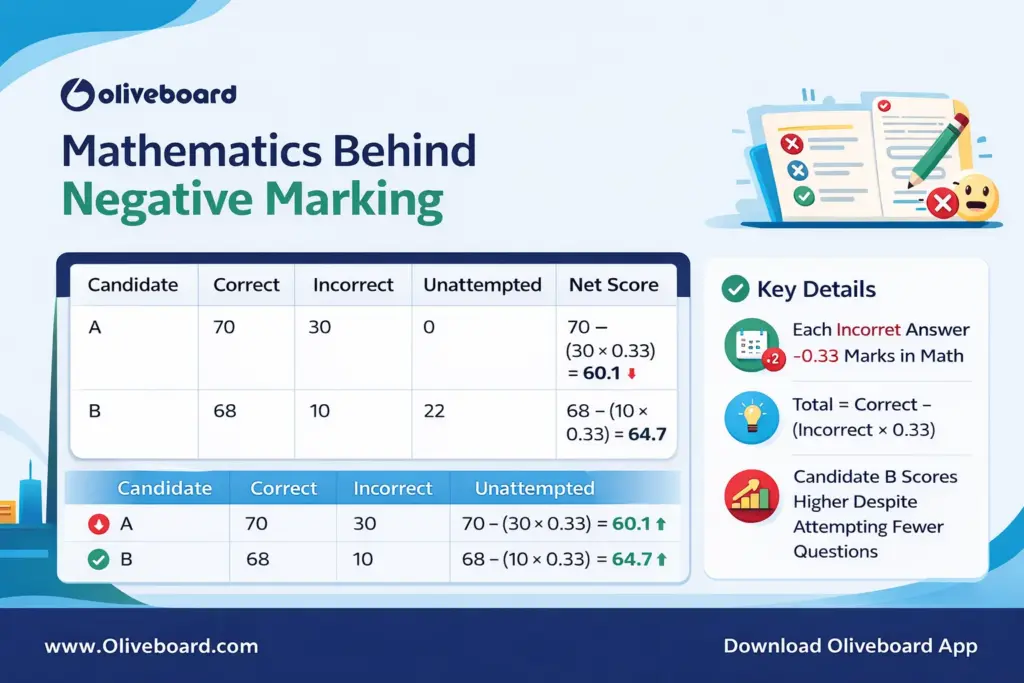
Mathematics behind Negative Marking
Often, candidates focus solely on raw scores, but the net score reveals the real story once wrong answers are taken into account. Let’s compare two candidates:
Strategic Implications of Negative Marking in RRB Technician Exam
Negative marking creates a strategic landscape where answering smartly is far more effective than attempting maximum questions mindlessly. Check out the details given below:
| Aspect | Key Points | Impact on Score | Practical Advice |
| Guessing vs Calculated Attempting | If you can eliminate at least two wrong options, the probability of a correct answer becomes 50% | Expected value becomes positive (+0.335), making educated guessing beneficial | Attempt only when logical elimination is possible; avoid blind guessing |
| Blind Guessing | No elimination of options; answer chosen randomly | Expected value becomes slightly negative, leading to score reduction | Leave the question unattempted if no logical clue is available |
| Time Management in CBT | Expected value becomes slightly negative, leading to a score reduction | More wrong answers lead to negative marking and stress | Maintain a balanced pace instead of rushing |
| Accuracy vs Speed Trade-off | Low accuracy can significantly reduce the final score | Rushing increases the chances of incorrect answers | Focus on accuracy first, then speed |
| Smart Attempt Strategy | Attempt only high-confidence questions | More serious attempts do not guarantee higher scores | Set a confidence threshold before attempting a question |
How does Negative Marking affect Cutoffs and Merit List?
Negative marking highly affects the cut-offs in deciding the final score of a candidate. Applicants who score above the cut-off marks will be selected for the further recruitment process as per the RRB Technician selection process. The minimum qualifying marks as per the category are as follows:
| Category | Minimum Net Score Required |
| UR / EWS | 40% |
| OBC (NCL) | 30% |
| SC | 30% |
| ST | 25% |
Normalisation Consideration:
In multiple shift exams like RRB Technician CBT, raw scores are normalised to ensure fairness across different question sets. The normalisation math takes net scores as input -meaning how negative marks reduce raw scores compounds further when converting to a normalised score.
What is the Psychological Impact during the RRB Technician Exam?
There is a high psychological impact during the RRB Technician exam as it influences a candidate’s confidence. Some of the important factors are given below:
| Factor | Explanation | Negative Impact | Recommended Solution |
| Candidate Confidence | Accumulating negative marks can mentally affect candidates during the exam | Low morale increases stress and leads to additional careless errors | Build emotional resilience through regular mock practice |
| Psychological Pressure | Fear of penalties creates self-doubt after incorrect attempts | Confidence drops even when overall performance is stable | Avoid tracking mistakes mid-exam; stay process-focused |
| Decision Paralysis | Overthinking whether to guess or skip wastes valuable exam time | Breaks rhythm and reduces total attempts | Predefine clear attempt rules before the exam |
| Hesitation During CBT | Lack of confidence leads to repeated re-evaluation of questions | Momentum loss and time mismanagement | Trust the first logical judgment when the confidence threshold is met |
| Mock Test Conditioning | Trust the first logical judgment when confidence threshold is met | Poor confidence transfer to actual CBT | Track negative marks strictly during mocks to build exam-ready confidence |
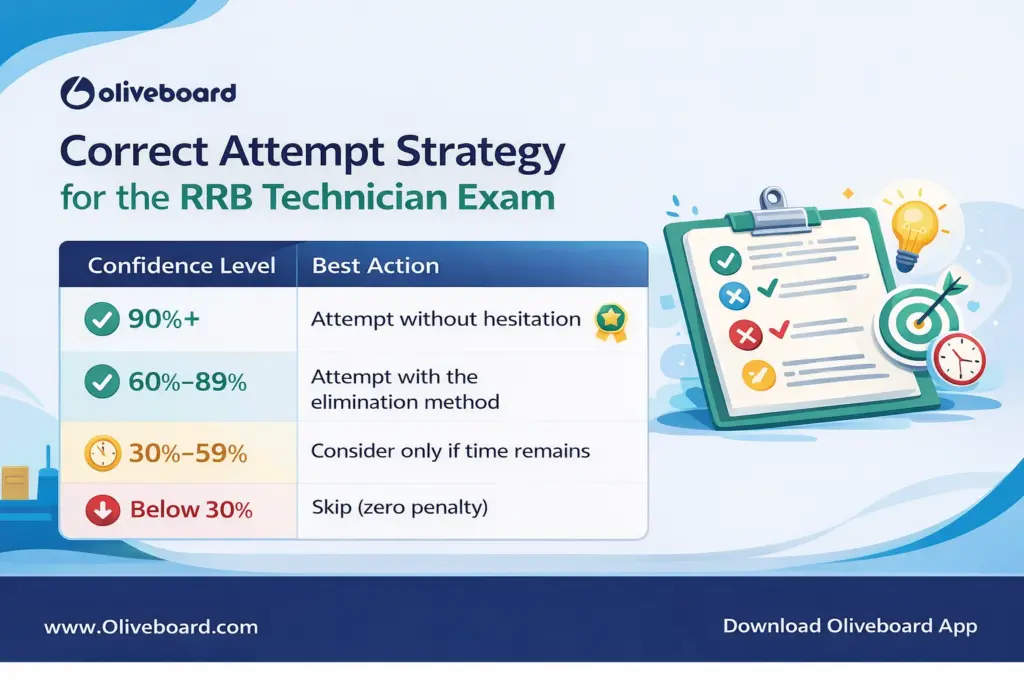
What should be the correct attempt strategy for the RRB Technician exam?
The main strategy that should be adopted is attempting questions without hesitation. Check out more details below:
What are the common mistakes that applicants make in the exam?
Certain mistakes, like attempting all questions, improper time management skills, and more, are made by the candidates. The table below shows a better approach to dealing with these mistakes:
| Common Mistake | What Candidates Do | Why It Hurts the Score | Better Approach |
| Attempting All Questions Blindly | Tries to answer every question regardless of clarity | Negative marking can outweigh correct answers, reducing net score | Attempt only questions with reasonable confidence |
| Poor Time Prioritization | Starts with weaker or low-accuracy sections | Time is wasted on questions with low return | Begin with strong areas where accuracy is high |
| Ignoring Elimination Techniques | Does not rule out incorrect options before attempting | Misses chances for positive expected value | Use elimination to improve accuracy before guessing |
| Quantity Over Quality Approach | Poor Time Prioritisation | Prioritise accuracy-driven attempts | A high attempt count does not guarantee a higher score |
| Lack of Attempt Strategy | Makes on-the-spot decisions during the exam | Leads to confusion and time loss | Define clear attempt rules before CBT |
FAQs
For every incorrect answer, 1/3rd mark (0.33 marks) is deducted under the negative marking in the RRB Technician exam, while unattempted questions carry no penalty.
Yes. Skipping a question results in zero loss, whereas an incorrect attempt leads to negative marking, which can significantly reduce your net CBT score.
Negative marking impacts both. It reduces your raw CBT score, which is then used for normalisation and merit ranking, directly influencing your chances of selection.
Yes, if you can confidently eliminate at least two incorrect options, educated guessing can have a positive expected outcome, even with negative marking in place.
By focusing on accuracy-based practice, using option elimination techniques, analysing mock tests thoroughly, and attempting only high-confidence questions during the CBT.

Hello! This is Arijit Dutta. I am a skilled Content Writer at Oliveboard with nearly 3+ years of experience in crafting engaging, informative, and exam-focused content for the Railways Domain. With a strong command of language and a keen understanding of learner needs, I contribute significantly to Oliveboard’s mission of delivering high-quality educational resources. Passionate about clear communication and continuous learning, I consistently create content that helps government job aspirants achieve their goals. Outside of work, I enjoy playing cricket and listening to music, which helps me stay balanced and creative in my professional journey.