
Key Takeaways
- The RBI Financial Stability Report (FSR) analyzes the resilience and risks of India’s financial system, covering various institutions and markets.
- It plays a crucial role for RBI Grade B exam aspirants, linking current affairs with core finance concepts.
- Key financial ratios like LCR, PCR, and CRAR assess banks’ stability and their ability to manage stress and liquidity.
- The report reveals that while stablecoins pose emerging risks, both NBFCs and mutual funds exhibit strong credit growth and liquidity.
- Recent regulatory initiatives focus on sustainable finance, monitoring digital risks, and expanding deposit insurance coverage.
The RBI Financial Stability Report (FSR) is one of the most important documents released by the Reserve Bank of India to analyse the strength, risks, and performance of India’s financial system. It covers banks, NBFCs, insurance companies, mutual funds, and overall financial markets. The report helps students, aspirants, and professionals understand how stable the economy is and what risks may arise in the future. From liquidity ratios to stress tests and crypto-related risks, the FSR gives a complete health check of India’s financial ecosystem.
In this blog, we have provided details about the December 2025 Financial Stability Report, along with the direct link to download the PDF and more.
What is the RBI financial stability report and why is it important?
The RBI Financial Stability Report is a detailed assessment of the financial system’s resilience, risks, and growth trends. It evaluates banks, NBFCs, insurance firms, mutual funds, and market infrastructure institutions. The main aim is to check whether the system can handle economic stress and maintain stability. It also highlights emerging risks like stablecoins, liquidity stress, and global uncertainties. For exam aspirants, this report becomes important because it combines data, concepts, and policy direction in one place.
- Evaluates financial stability of India
- Measures capital adequacy, liquidity, and asset quality
- Identifies risks in banking and non-banking sectors
- Conducts macro stress tests
- Provides regulatory outlook and future risks
How is the RBI financial stability report important for RBI Grade B exam aspirants?
The RBI Financial Stability Report is highly important for RBI Grade B 2026 exam because it connects current affairs with core finance concepts. Many Phase 1 and Phase 2 questions come from banking stability, financial markets, and regulatory updates discussed in the report.
It helps aspirants understand real examples of CRAR, LCR, stress testing, NBFC risks, and global financial trends. The report also strengthens descriptive answer writing as it provides authentic data, RBI views, and policy direction.
Download RBI Grade B Notes 2026 PDF
How strong is the Indian banking sector according to the report?
The financial stability report shows that the Indian banking system remains strong with high capital buffers and improving asset quality. Scheduled commercial banks maintain good liquidity levels and stable profitability. Ratios like CRAR, LCR, PCR, and ROA indicate that banks are well prepared for stress scenarios. Even under adverse economic conditions, most banks remain above regulatory requirements, which reflects strong resilience.
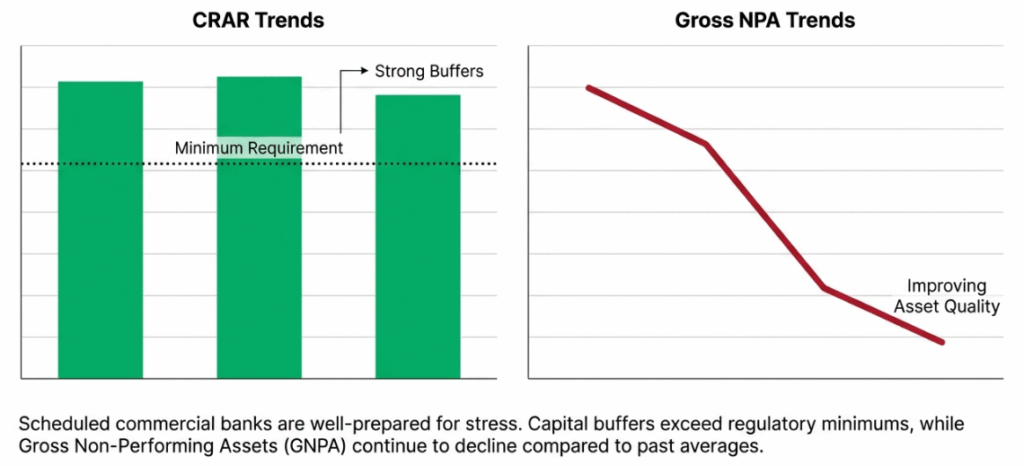
- Capital Adequacy Ratio (CRAR): Around strong levels with buffers above minimum requirement
- Gross NPA declining compared to past averages
- Provisioning Coverage Ratio around 76%
- Liquidity Coverage Ratio above 100% regulatory limit
- Profitability improving with stable credit growth
Also Check:
| Important eBook | Free PDF Download Link |
| Union Budget Highlights 2026-27 | Download PDF |
| Important Highlights about Economic Survey 2025-26 | Download PDF |
| ESI & FM Infographics for One-Stop Revision Source | Download PDF |
What do key financial ratios like LCR, PCR and CRAR mean?
Financial ratios help measure how safe and stable banks are. Liquidity Coverage Ratio (LCR) checks short-term liquidity strength, Provisioning Coverage Ratio (PCR) measures protection against bad loans, and Capital Adequacy Ratio (CRAR) evaluates risk-based capital strength. These indicators help regulators ensure banks can survive financial stress and maintain customer trust.
| Ratio | Meaning | Current Understanding |
| LCR | Ability to survive 30-day liquidity stress | Above regulatory 100% |
| PCR | Provisions made against NPAs | Around 76% showing safety buffer |
| CRAR | Capital vs risk-weighted assets | Strong capital position |
| NSFR | Long-term funding stability | Above minimum requirement |
| Slippage Ratio | Loans turning into NPAs | Lower is better |
What do stress tests reveal about Indian banks?
Stress tests simulate difficult economic situations like slowdown, global uncertainty, or GDP shocks. The RBI report shows that banks can maintain capital adequacy even in adverse scenarios. Although some liquidity pressure appears in severe stress cases, overall resilience remains strong. This indicates that the financial system has enough buffers to handle economic challenges.
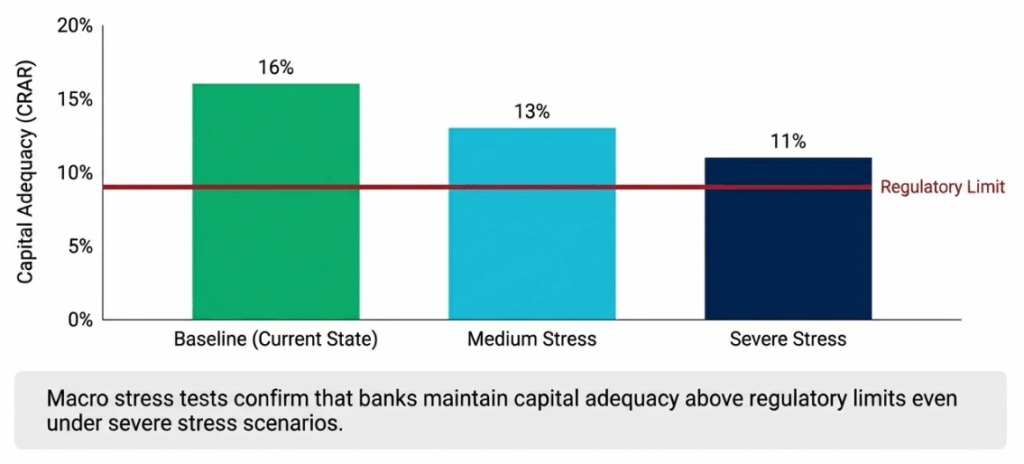
- Baseline CRAR remains strong
- Gradual slowdown reduces capital but stays above limits
- Severe stress scenarios still manageable
- Few banks may face liquidity shortages under extreme conditions
- Macro stress tests confirm sector resilience
Download RBI Grade B 2024 AIR 1 Handwritten Notes
What is the role of stablecoins and crypto risks in the report?
The report highlights stablecoins as an emerging financial stability concern. Stablecoins are cryptocurrencies designed to reduce volatility by being linked to traditional currencies like the US dollar. While they bring efficiency in crypto trading, they are not equal to real money and carry risks. RBI and BIS have raised concerns regarding stability, regulation, and systemic impact.
- Stablecoins reduce volatility compared to Bitcoin or Ethereum
- Often pegged to currencies like USD (e.g., USDT, USDC)
- Major use case is crypto trading transactions
- Represent large share of crypto trading volume
- Regulatory risks and financial stability concerns remain
How are NBFC’s and Mutual Funds performing as per the FSR?
NBFCs show strong credit growth and improving asset quality, but some entities face liquidity mismatches under severe stress scenarios. Mutual funds maintain liquidity levels, but midcap and small-cap schemes show higher liquidity risk due to longer liquidation periods. RBI monitors interconnectedness between banks and NBFCs because funding links can transmit risks across sectors.
- NBFC credit growth around strong double-digit levels
- Asset quality stabilising with adequate provisions
- Liquidity stress visible in extreme conditions
- Mutual funds maintain threshold liquidity ratios
- Midcap and small-cap schemes require stronger risk management
Download the RBI Grade B Previous Year Questions PDF
What does the report say about insurance sector stability?
The insurance sector continues to be a major component of India’s financial system, with large assets under management. Life insurance dominates the sector, contributing most of the investment share. While premium growth continues, the growth rate is slowing. Non-life insurance remains diversified, and solvency ratios indicate improved resilience.
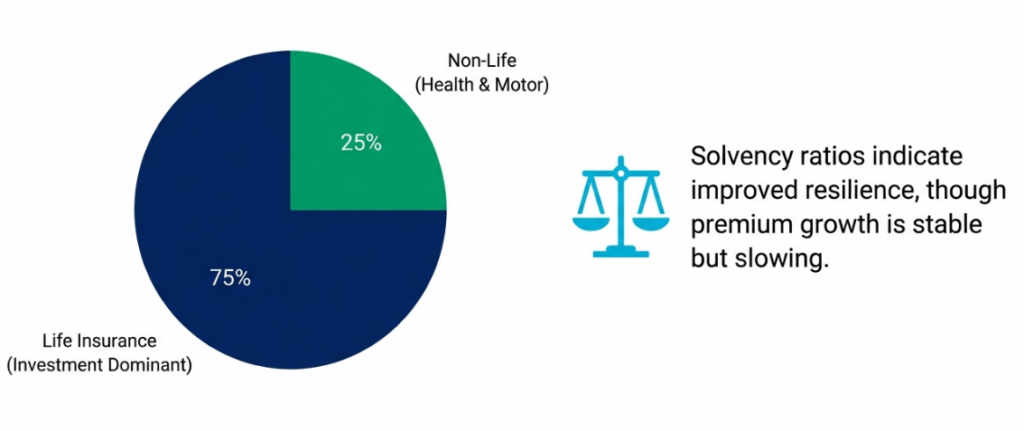
- Total AUM around large multi-lakh crore levels
- Life insurance contributes majority of investments
- Premium growth slowing but stable
- Health and motor segments dominate non-life claims
- Reliance on foreign reinsurance increasing
What regulatory initiatives are highlighted in the financial stability report?
The report also compiles recent regulatory actions by RBI. These include climate finance initiatives, co-lending guidelines, ESG debt framework, and consolidation of master directions. Regulatory focus is shifting towards sustainable finance, digital risks, and stronger governance frameworks to maintain financial stability.
- ESG debt securities framework
- Climate finance initiatives
- Consolidated master directions by RBI
- Deposit insurance coverage expansion
- Monitoring decentralized finance risks
Download RBI FSR December 2025 PDF
The direct link to download the Financial Stability Report released by RBI is provided below. Aspirants can download the PDF using the link.
Download the RBI FSR Official PDF
FAQs
The Reserve Bank of India releases the Financial Stability Report twice a year.
It is generally published two times every year.
Its main aim is to assess risks and ensure stability of India’s financial system.
Banks, NBFCs, insurance companies, mutual funds, and financial markets are covered.
CRAR measures the capital strength of banks against risk-weighted assets.
- Practice Mensuration Questions, Live Quiz, FREE PDF
- RBI Assistant Prelims Shift Timings 2026: Get FREE Study Notes
- Syllogism for RBI Assistant Exam, Live Quiz, FREE PDF
- Practice Blood Relation Questions Live Quiz, Download FREE PDF
- Alphabetical Series Questions For RBI Assistant Exam 2026, LIVE Quiz
- Important Phrasal Verbs for RBI Assistant Exam 2026, LIVE Quiz

Hi, I’m Aditi. I work as a Content Writer at Oliveboard, where I have been simplifying exam-related content for the past 4 years. I create clear and easy-to-understand guides for JAIIB, CAIIB, and UGC exams. My work includes breaking down notifications, admit cards, and exam updates, as well as preparing study plans and subject-wise strategies.
My goal is to support working professionals in managing their exam preparation alongside a full-time job and to help them achieve career growth.